Quick Answer
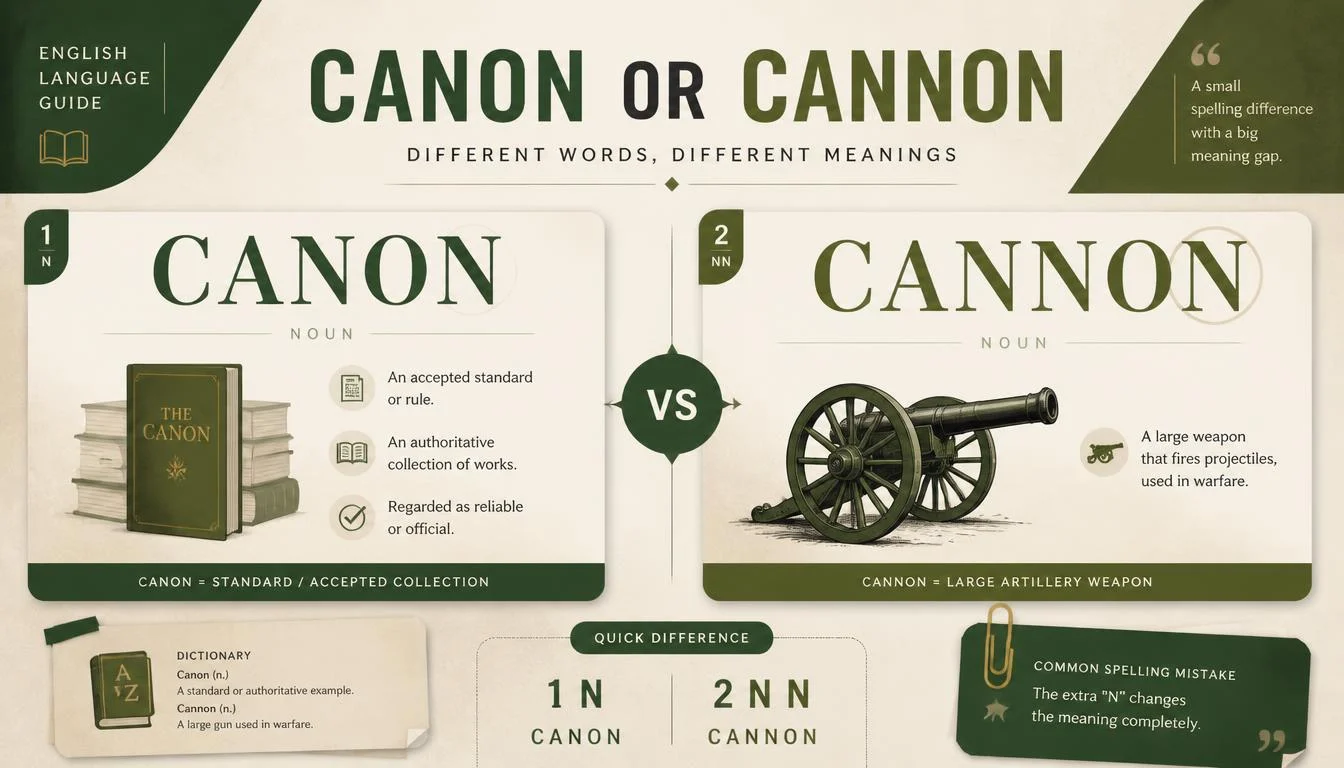
The difference between canon and cannon comes down to meaning and context. Canon refers to accepted principles, rules, or official lists, while cannon is a large gun or artillery piece. These words sound similar but have completely different meanings. Understanding the distinction helps prevent embarrassing writing mistakes.
Picture this: you’re writing an important email to your literature professor about the “literary cannon” or drafting a business proposal referencing “company cannon.” Both uses are incorrect, and they completely change what you’re trying to say.
Canon and cannon are classic examples of commonly confused words that sound nearly identical but mean entirely different things. The confusion makes perfect sense, given that both words are spelled similarly and pronounced almost the same way. Yet using the wrong one can make you look unprofessional, especially in academic or business writing. This guide will explain the differences clearly and give you practical tools to remember which word to use.
What’s the Difference Between Canon and Cannon?
The core difference between canon and cannon is that canon refers to principles, rules, or official lists, while cannon is a military weapon used for firing projectiles.
Meaning of Each Word
Canon (pronounced KAN-uhn) has several related meanings, all centered around the idea of an authoritative standard or accepted collection. It can refer to religious laws, literary works considered authentic, or established rules in art, music, and other fields.
Cannon (pronounced KAN-uhn as well) refers specifically to a large-caliber gun, typically mounted, that fires heavy projectiles. It can also describe a similar device used in modern military vehicles or a type of automatic weapon on aircraft.
Part of Speech and Primary Purpose
Both words function as nouns. Canon serves as a conceptual noun, representing ideas, standards, and collections. Cannon serves as a concrete noun representing a physical object.
Side-by-Side Comparison
| Feature | Canon | Cannon |
|---|---|---|
| Meaning | Rules, principles, or official collection | Large military gun or artillery piece |
| Part of Speech | Noun | Noun |
| Refers To | Ideas, standards, literature, religious laws | Physical weapon, artillery equipment |
| Typical Usage | Literary canon, religious canon, canon law | Cannon fire, mounted cannon, cannonball |
| Example | Shakespeare is part of the literary canon. | The soldiers loaded the cannon. |
| Common Confusion | Often misspelled as “cannon” | Often misspelled as “canon” |
In short, choose canon when discussing standards, rules, or accepted collections. Choose cannon when discussing large guns or artillery equipment. The two words are never interchangeable.
Is This a Grammar, Vocabulary, or Usage Issue?
This is primarily a vocabulary and usage issue rather than a strict grammar rule. Grammar involves the structural rules of language, like sentence construction and punctuation. Here, both canon and cannon function as nouns, so grammar isn’t the problem.
The confusion comes from vocabulary and proper word choice. These are homophones words that sound identical but have different meanings. English has hundreds of these pairs, and canon/cannon is among the trickiest because both words are common in different contexts.
Formal and Academic Use
In formal English, using the correct term shows attention to detail. Canon appears frequently in academic writing, particularly in literature, art history, music theory, and religious studies. Cannon appears in historical writing, military contexts, and technical documentation.
Business Writing
In business settings, canon might appear when discussing company standards, accepted procedures, or official guidelines. Cannon would only appear in industries related to defense, manufacturing, or heavy equipment.
Everyday Conversation
Both words appear in daily life, though canon shows up more often in cultural discussions. When people talk about “cannon,” they’re usually referencing historical events, movies, or military topics. Understanding which word fits your context demonstrates language proficiency.
The practical takeaway: Since both words are correct in different situations, focus on remembering what each word means, not on which one is “right.” When you need a standard or rule, use canon. When you need a weapon, use cannon.
A Complete Guide to Using Canon
Definition and Meaning
Canon comes from the Greek word kanōn, meaning “measuring rod” or “rule.” Today, it refers to an established principle, a set of rules, or an authoritative list of works considered genuine or important.
Pronunciation
Canon is pronounced KAN-uhn, with the stress on the first syllable. It rhymes with “woman.”
Common Collocations and Sentence Patterns
Canon appears in predictable patterns with specific modifiers:
- Literary canon the accepted collection of important literature
- Religious canon sacred texts or religious laws
- Canon law the official rules of a church
- Established canon widely accepted standards
- Western canon classic works from Western civilization
Workplace and Academic Examples
Business scenario: “Our company’s canon of conduct emphasizes transparency and accountability in all client dealings.”
Academic context: “The professor argued that including diverse voices would enrich the literary canon rather than diminish it.”
Technology context: “The programming language’s standard canon includes best practices for security and efficiency.”
Email example: “Dear Team, please review the design canon before finalizing the new brand guidelines.”
Daily conversation: “I’m taking a class on the Western canon, and we’re reading Homer this week.”
Common Learner Mistakes
English learners often write “cannon” when referring to rules or standards. The most common mistake involves using “literary cannon” instead of “literary canon.” While the extra “n” might seem minor, it completely changes the meaning from “accepted works” to “military equipment.
Mini Recap
Remember: canon is conceptual. It’s about ideas, accepted rules, and important works. If you’re discussing standards or collections, canon is your word.
A Complete Guide to Using Cannon
Definition and Meaning
Cannon comes from the Old Italian word cannone, meaning “large tube.” It describes a heavy artillery weapon that fires projectiles through a barrel.
Pronunciation
Cannon is also pronounced KAN-uhn. It sounds identical to canon, which explains why so many people get them confused.
Common Collocations and Sentence Patterns
Cannon pairs naturally with military and historical vocabulary:
- Cannon fire the sound or act of firing a cannon
- Mounted cannon a cannon fixed to a base or vehicle
- Cannonball the projectile fired from a cannon
- Naval cannon a cannon on a ship
- Cannon blast the explosion from firing
Workplace and Academic Examples
Business scenario: “The defense contractor demonstrated the new automated cannon system to military officials.”
Academic context: “Archaeologists discovered a sixteenth-century cannon buried near the fortress wall.”
Technology context: “The aircraft’s rotary cannon can fire thousands of rounds per minute.”
Email example: “The historical reenactment group needs volunteers to maintain the museum’s antique cannon.”
Daily conversation: “We visited the old fort and saw a huge cannon on display.”
Common Learner Mistakes
Many writers accidentally use “canon” when discussing weapons. The mistake often happens because “canon” is a more familiar word in educational contexts, so it gets applied incorrectly.
Mini Recap
Cannon is concrete. It’s an actual weapon you can touch. If you’re discussing artillery or any kind of heavy gun, cannon is always the correct choice.
When Not to Use These Words
Common Situations Where Writers Choose the Wrong Word
When writing about literature: Using “cannon” instead of “canon” is one of the most common errors in academic writing. Writers sometimes remember the word sounds familiar but choose the wrong spelling.
In religious texts: People occasionally write “cannon law” when referring to church rules. The correct phrase is “canon law,” referring to an established set of religious principles.
During discussions about standards: Writers might use “cannon” as a metaphor for established practices. While a cannons represents power, the word you want for standards or principles is always canon.
In historical writing about weapons: Some writers accidentally choose “canon” when describing artillery. This mistake often happens because both words deal with “historical” topics.
When using the phrase “loose canon”: The correct expression is “loose cannon,” meaning an unpredictable or uncontrollable person. Many people mistakenly write “loose canon.”
In technical documentation: Authors sometimes confuse these words when describing “canonical” information, using “cannonical” instead. The correct technical term is “canonical.”
Common Mistakes Table
| Correct Sentence | Incorrect Sentence | Explanation |
|---|---|---|
| The literary canon includes Shakespeare’s plays. | The literary cannon includes Shakespeare’s plays. | Literature belongs to accepted standards (canon), not military equipment (cannon). |
| The soldiers fired the cannon at the fortress. | The soldiers fired the canon at the fortress. | Weapons use cannon; rules use canon. |
| Church officials debated canon law. | Church officials debated cannon law. | Religious rules are canon, not artillery. |
| She’s considered a loose cannon in the office. | She’s considered a loose canon in the office. | The idiom refers to an unpredictable person, not an accepted standard. |
| The museum displayed a Civil War cannon. | The museum displayed a Civil War canon. | Historical weapons require cannon, not literary standards. |
Quick Decision Box
- If you mean an accepted standard, rule, or collection of important works → Use CANON
- If you mean a large gun, artillery piece, or military weapon → Use CANNON
- If you’re describing an unpredictable person → Use CANNON (loose cannon)
Remember the rule: Cannon has two Ns because it needs twice the firepower. Canon has one N because one rule is enough.
Real-World Examples
Office scenario: When drafting company policy, your senior manager might say, “We need to establish a canon of best practices for client communication.” They’re setting standards, not ordering weapons.
Business email: “Please ensure all proposals follow the marketing department’s canon regarding brand voice and visual identity.”
University context: “The English Department’s reading list represents the established canon of American literature from 1800 to 1950.
Customer support: “Our customer service canon requires responding to all inquiries within four business hours.”
Technology context: “The development team follows the company’s code canon, which emphasizes readability and documentation.”
Artificial Intelligence: “Training data for language models often includes the literary canon to expose AI to historically important works.”
Daily conversation: “My friend is such a loose cannon, you never know what she’s going to say next.”
Modern Technology and Usage
Canon in AI and Software
In technology, “canonical” describes the standard or accepted version of something. For example, a “canonical URL” represents the preferred version of a web page for search engines. The term “canon” rarely appears directly in tech contexts, but its derivative “canonical” is common.
Cannon in Tech
Cannon appears in tech primarily when describing automated weapons, defense systems, or military technology. You might encounter it in news about defense contracting, video game weapons, or historical technology articles.
Voice Assistants and AI
Voice assistants must distinguish between these homophones based on context. When you say “KAN-uhn,” the assistant analyzes surrounding words to determine whether you meant the standard or the weapon. This challenges natural language processing systems.
Word Origins
Canon traces back to the Greek kanōn, which meant “measuring rod” or “rule.” The word passed through Latin (canon) and Old French before entering English. Its meaning has remained remarkably consistent for thousands of years, always relating to standards and rules.
Cannon comes from the Old Italian cannone, meaning “large tube,” which itself derives from canna, meaning “tube” or “reed.” The word entered English in the fourteenth century, referring to the large guns that had become common in warfare.
Understanding these origins helps clarify the difference: canon is about measuring and standards; cannon is about physical tubes.
Expert Insight
Here’s what professional editors and language instructors want you to know: the canon/cannon confusion is entirely natural, and even professional writers make this mistake under deadline pressure. The key isn’t memorizing dry definitions it’s creating a mental image that sticks. Imagine a cannon as a physical object with two Ns, like the two wheels on a cannon carriage. Imagine canon as having one N, like the singular standard it represents. This simple visual trick works for students at every level.
Error Prevention Checklist
Always use CANON when:
- Discussing accepted literature, art, or music
- Writing about religious laws or principles
- Establishing organizational standards
- Referring to official rules
- Using the word “canonical” in technical contexts
Always use CANNON when:
- Describing artillery or military weapons
- Writing about historical battles
- Discussing large-caliber guns
- Using the idiom “loose cannon”
- Describing firing mechanisms
Never confuse these words if:
- You remember that cannon has two wheels (and two Ns)
- You remember that canon has one rule (and one N)
- You visualize a physical object (cannon) versus an abstract concept (canon)
Quick memory tip: Two Ns for a weapon that needs two wheels. One N for a rule that’s singular.
Related Grammar Confusions
Here are other commonly confused word pairs worth learning to avoid similar mistakes:
- Affect vs. Effect Understanding when to use each can significantly improve your professional writing.
- Compliment vs. Complement These sound similar but mean very different things in conversation.
- Principal vs. Principle Confusing these can undermine your credibility in academic settings.
- Stationary vs. Stationery One describes movement; the other describes paper products.
- Cite vs. Sight vs. Site These homophones cause endless confusion in written English.
- Peace vs. Piece One relates to calm, the other to portions of something.
- Weather vs. Whether Understanding the difference prevents awkward writing mistakes.
- Accept vs. Except These opposite words often confuse writers of all levels.
- Lead vs. Led The past tense of “lead” trips up many professional writers.
- Breath vs. Breathe One is a noun; the other is a verb.
FAQs
What’s the easiest way to remember canon vs. cannon?
The simplest memory trick is to count the Ns. Cannon has two Ns because you can picture a cannon with two wheels rolling into battle. Canon has one N because one standard, rule, or accepted collection is enough to remember.
Can canon ever refer to a weapon?
No. Canon does not refer to a weapon. If you mean a large gun or piece of artillery, the correct word is cannon, with two Ns. The two words have different meanings and cannot be used interchangeably.
Why do people confuse canon and cannon so often?
They are homophones, meaning they sound exactly the same when spoken. Because the pronunciation gives no clue about the spelling, people often confuse them when writing. Their similar appearance makes the mistake even easier to make.
Is “loose canon” ever correct?
No. The correct expression is “loose cannon,” referring to someone who is unpredictable or difficult to control. The phrase compares such a person to an unsecured cannon that could move or cause trouble unexpectedly.
How is canon used in modern business writing?
In business writing, canon can refer to established standards, principles, guidelines, or accepted practices. For example, “Our corporate canon emphasizes sustainability reporting” uses canon to describe an established body of principles or practices.
Does technology use canon differently?
In technology, canon commonly appears in the related word canonical, which describes something recognized as standard or authoritative. For example, a canonical URL identifies the preferred version of a webpage. Cannon is generally used only when referring to weapons, defense systems, or related historical subjects.
Conclusion
The canon vs. cannon distinction is simple once you understand the core difference. Canon represents standards, principles, and accepted collections. Cannon represents artillery and military weapons. One is abstract; the other is concrete.
Remember the two Ns rule: cannon has two Ns for its two wheels, and canon has one N for its single standard. This practical memory trick will save you from embarrassing mistakes in emails, academic writing, and professional communication. The next time you’re writing about literature, rules, or anything involving standards, reach for canon. When you’re writing about weapons or artillery, cannon is your word.
With this guide, you’ll never have to wonder which one to use again.
Read More Related Articles:
- Usage vs Useage | Stop Making This Spelling Mistake in Your Writing In 2026
- Losing vs Loosing | How One Extra “O” Changes the Entire Meaning In 2026
- Successfully or Succesfully | Easy Trick to Remember the Correct Spelling Forever In 2026

Zoe Chambers works as a content writer at synoseek.com, contributing thoughtful pieces on everyday subjects and ideas. She writes in a simple, grounded way, often drawing from real-world experiences. Her focus is on keeping content natural, clear and easy for readers to connect with.
11 thoughts on “Canon or Cannon | Quick Guide to These Commonly Confused Words In 2026”