Quick Answer
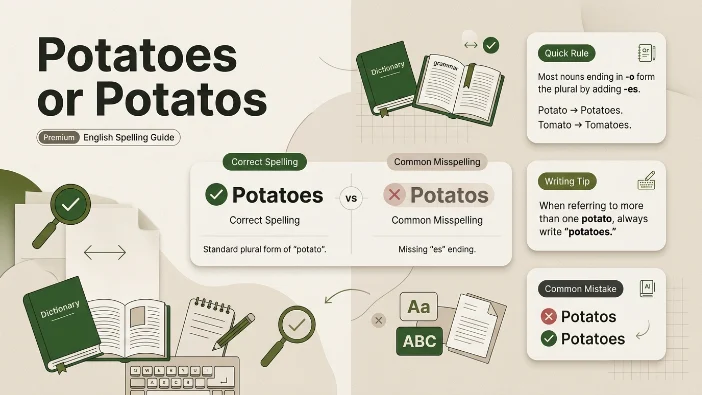
The correct plural spelling of the singular noun potato is potatoes. Potatos is an incorrect misspelling that is never accepted in standard English. This common error occurs because many words ending in “o” simply add an “s,” but potato follows the rule requiring “es.” Remember: you eat potatoes, not potatos.
The humble potato has a way of tripping people up. Not just in the kitchen, but in writing. You can peel it, mash it, and roast it to perfection, but when it comes to spelling the plural form, many otherwise confident writers suddenly draw a blank. Is it “potatoes” or “potatos”? This one little vowel has caused countless grocery lists, recipes, and even professional documents to contain an embarrassing error.
What makes this confusion so understandable is the inconsistency of English pluralization rules. If you can have a single “photo” that becomes “photos,” why wouldn’t “potato” become “potatos”? The answer lies in a specific spelling rule that catches many people off guard. The reality is that “potatos” is simply not an accepted word in English . By the time you finish reading this guide, you’ll not only know which spelling is correct, but you’ll understand exactly why and you’ll never make this mistake again.
Potatoes vs. Potatos: What’s the Real Difference?
The core difference between “potatoes” and “potatos” couldn’t be simpler: one is correct, and one is not. “Potatoes” is the standard plural form of the noun “potato,” while “potatos” is a common misspelling that should never be used in any formal or professional context .
When you’re writing about more than one of these starchy tubers, you must use “potatoes.” This spelling is required in all varieties of English, whether you’re using American or British conventions. There are no exceptions, no regional variations, and no informal acceptances .
Comparison Table: Potatoes vs. Potatos
| Feature | Potatoes | Potatos |
|---|---|---|
| Meaning | The edible tuber of the potato plant; more than one potato | No standard meaning (misspelling) |
| Part of Speech | Plural noun | Invalid spelling |
| Refers To | Multiple potatoes (the vegetable) | Nothing (incorrect form) |
| Typical Usage | “We need to buy potatoes for dinner.” | Never used in standard English |
| Example | “She mashed the potatoes with butter.” | “She mashed the potatos…” ❌ |
| Common Confusion | Correct plural form | Common misspelling |
To put it plainly: “potatos” is not simply an alternative spelling. It’s an error. When you use it, your writing instantly appears less professional and less polished. The distinction is not a matter of style or preference; it’s a matter of correctness.
Is This a Grammar, Vocabulary, or Usage Issue?
This is primarily a spelling and grammar issue, though it touches on vocabulary usage as well. From a grammatical standpoint, “potatoes” involves the correct formation of plural nouns. English nouns that end in “o” fall into two categories when forming plurals: those that add just “s” and those that add “es” .
“Potato” belongs to the latter group because it ends with a consonant before the final “o” . Other common examples following this same pattern include “tomato” (tomatoes) and “hero” (heroes). Meanwhile, words like “photo” (photos) or “piano” (pianos) take a simple “s” because they end with a vowel before the “o” or are shortened forms of longer words.
From a vocabulary perspective, “potatos” is a word that simply does not exist in the English language. You won’t find it in any reputable dictionary from Merriam-Webster to Oxford. The word “potato” itself (singular) is always spelled without an “e” at the end . It’s only when you make it plural that the “e” appears before the “s” a detail that confuses many writers.
Practical takeaway: When you’re writing about a single potato, use “potato.” When you’re writing about two or more, use “potatoes.” Never use “potatos.”
Understanding the Word “Potato”
Meaning and Pronunciation
The word “potato” refers to the edible tuber of the plant Solanum tuberosum, a member of the nightshade family . This vegetable originated in South America and has been cultivated for thousands of years, becoming a staple food in cuisines worldwide . The pronunciation is /pəˈteɪtoʊ/ in American English and /pəˈteɪtəʊ/ in British English .
Part of Speech
“Potato” is primarily a countable noun. This means it has both singular and plural forms. You can have one potato or several potatoes . The word can also function as an adjective in compound nouns like “potato salad” or “potato peeler.”
Common Collocations and Sentence Patterns
Adjective + potato: baked potato, mashed potato, roasted potato, sweet potato, fried potato, raw potato, large/small potato, Idaho potato
Verb + potato: peel potatoes, chop potatoes, boil potatoes, roast potatoes, mash potatoes, grow potatoes, plant potatoes, buy potatoes
Typical sentence patterns:
- “I need to buy some potatoes for the stew.”
- “The farmer planted potatoes in the field.”
- “Would you like a baked potato with your meal?”
Examples in Different Contexts
Workplace example: “For the company potluck, I’ll bring roasted potatoes with rosemary.”
Academic example: “The study examined the nutritional content of potatoes grown in different soil conditions.”
Technology context: “The AI system uses machine learning to identify diseased potatoes in crop images.”
Email example: “Please confirm how many pounds of potatoes we need to order for the event.”
Daily conversation: “Could you grab some potatoes from the grocery store? We’re out.”
One Learner Mistake to Avoid
Many learners assume that all words ending in “o” behave the same way. This leads them to write “potatos” by analogy with “photos” or “pianos.” However, the key is to remember that nouns ending in a consonant followed by “o” usually take “es.” Since “potato” ends with “t” before the “o,” it gets the “es” treatment .
Mini recap: “Potato” is a countable noun that describes an edible tuber. It’s pronounced puh-TAY-toe and follows the “consonant-o” rule for pluralization.
Understanding “Potatos”
The Simple Truth
“Potatos” is simply a misspelling of “potatoes” . It has no legitimate meaning, no accepted usage, and no place in standard English. When you see this spelling in a text, it represents an error nothing more, nothing less .
Why Does This Mistake Happen?
The error occurs because of the natural tendency to apply a simple rule just add “s” to make a plural to all words. This works for countless English nouns: book becomes books, dog becomes dogs, and photo becomes photos. When writers are working quickly, they may automatically default to this pattern and accidentally add only an “s” to “potato” .
Another contributing factor is the existence of words like “tomato” and “potato” themselves. Since both end in “o” and both take “es” in the plural, the two words are often learned together, and there’s some cross-contamination. Additionally, because the singular form “potato” has no “e,” it may seem counterintuitive that the plural suddenly includes one .
Historical Context: The “Potatoe” Error
The confusion doesn’t stop with the plural form. The singular form is sometimes misspelled as “potatoe” with a final “e.” This error became famously associated with former U.S. Vice President Dan Quayle, who, during a 1992 school spelling bee, corrected a student’s correct spelling of “potato” to “potatoe” . The incident became a cultural touchstone for the dangers of overconfidence in spelling.
The “potatoe” error is distinct from the “potatos” error, but both stem from the same misunderstanding: uncertainty about the role of the letter “e” in the singular and plural forms of this word.
When NOT to Use Each Word
Common Situations Where Writers Choose the Wrong Form
1. Writing a grocery list quickly
- The mistake: Writing “Buy potatos” because you’re moving fast.
- Why it happens: Automatic default to the simple “add s” rule.
- How to remember: Slow down when writing grocery lists. “I need potatoes with an E.”
2. Sending a professional email about a team event
- The mistake: “Please bring potatos for the barbecue.”
- Why it happens: Casual writing habits from informal communication.
- How to remember: Professional writing requires professional spelling. Use “potatoes.”
3. Writing a recipe for a blog or cookbook
- The mistake: “Add three potatos to the pot.”
- Why it happens: Over-focusing on the cooking instructions and neglecting spelling.
- How to remember: Recipes are published content. Check your vegetable spellings twice.
4. Taking notes in a meeting
- The mistake: “Need potatos for the catering order.”
- Why it happens: Writing quickly and prioritizing speed over accuracy.
- How to remember: Even quick notes should be accurate. Use “potatoes.”
5. Texting friends or family
- The mistake: “We’re out of potatos!”
- Why it happens: Texting encourages shortcuts and informal spelling.
- How to remember: Texting is still writing. Get it right.
6. Drafting an academic paper
- The mistake: “The potatos were harvested in October.”
- Why it happens: Focusing on complex arguments and neglecting basic spelling.
- How to remember: Academic writing demands precision. Always use “potatoes.”
7. Creating marketing content for a food brand
- The mistake: “Our potatos are farm-fresh.”
- Why it happens: Rushing to publish without proper proofreading.
- How to remember: Brand credibility matters. Spell your products correctly.
8. Writing in a second language
- The mistake: Applying the “simple s” plural rule universally.
- Why it happens: Not knowing the specific rule for words ending in “consonant-o.
- How to remember: English has exceptions. This is one of them.
Common Mistakes Table
| Correct Sentence | Incorrect Sentence | Explanation |
|---|---|---|
| “We need to buy potatoes for dinner.” | “We need to buy potatos for dinner.” | The plural of “potato” requires “-es,” not just “-s.” |
| “She peeled the potatoes before boiling them.” | “She peeled the potatos before boiling them.” | The “e” is essential for the correct plural spelling. |
| “Could you pass the mashed potatoes?” | “Could you pass the mashed potatos?” | Even in a prepared dish, the plural form is “potatoes.” |
| “Idaho is famous for its potatoes.” | “Idaho is famous for its potatos.” | Regional correctness doesn’t allow for “potatos.” |
| “I used fresh potatoes in the soup.” | “I used fresh potatos in the soup.” | “Fresh potatoes” is standard; “potatos” is not a word. |
| “The potatoes are sprouting in the pantry.” | “The potatos are sprouting in the pantry.” | The meaning is clear, but the spelling is wrong. |
Quick Decision Guide
When you’re uncertain whether to use “potato” or “potatoes,” ask yourself:
- Are you referring to one item or multiple items?
- ONE → Use “potato”
- TWO OR MORE → Use “potatoes”
- Are you trying to use a plural form?
- YES → Add “-es” → “potatoes”
- NO → Use “potato”
- Is there an “e” in the singular form?
- NO → The singular is “potato” (no final “e”)
- YES → You might be misspelling it as “potatoe”
The 10-Second Rule: If you mean more than one potato, you need the letter “e” before the “s.” If you mean just one, the “e” disappears. Never use “potatos.”
Real-World Examples of Proper Usage
Office Communication
From a team manager: “I’ve arranged for catering from the local deli. They’ll provide sandwiches, salads, and roasted potatoes with herbs. Please let me know if you have any dietary restrictions.”
Business Email
Subject: Vendor Order Confirmation
“Dear Sarah,
We’ve confirmed the order with Green Valley Farms. They will deliver 200 pounds of potatoes on Tuesday morning. Please ensure the loading dock is clear by 8:00 AM so the driver can unload the potatoes promptly.
Best regards,
Marcus”
School or University Context
From an economics professor: “The Irish Potato Famine of the 1840s demonstrates how over-reliance on a single crop can have devastating economic consequences. When the potatoes failed, the population faced widespread starvation and forced migration.”
Customer Support
From a help desk representative: “Thank you for contacting us about your grocery delivery. We’ve checked our system and confirm that the potatoes were included in your order. They should have been packed in a separate brown bag alongside your other vegetables.”
Technology Context
From a software documentation: “The image recognition algorithm processes thousands of training images, including agricultural photographs of potatoes in various stages of growth. This helps the system distinguish between healthy potatoes and those affected by disease.”
Artificial Intelligence Application
From an AI development update: “Our new agricultural monitoring tool can analyze satellite imagery to predict potato yields across vast farming regions. The system provides farmers with real-time data about their potato crops, enabling more efficient harvest planning.”
Daily Conversation
In a kitchen: “Check the pantry and see if we have enough potatoes for tonight’s dinner. I’m planning to make a potato gratin, and we’ll need about six large potatoes for the recipe.”
At a farmers’ market: “Your potatoes look wonderful today. Are these the Yukon Gold variety? I find they make the best mashed potatoes.”
The History and Origin of the Word “Potato”
Understanding where the word “potato” comes from can help you appreciate why it’s spelled the way it is and why the “e” appears in the plural.
The English word “potato” derives from the Spanish word patata, which itself comes from the Taíno word batata, referring to what we now know as the sweet potato . When Spanish explorers encountered the vegetable in South America, the name evolved. The Quechua word for white potato is papa, which also influenced the terminology .
The spelling settled into “potato” in English around the 16th century. The plural “potatoes” follows the natural English rule for forming plurals of words ending in “consonant-o” . Interestingly, the Spanish word patata doesn’t have the same pluralization issue, as its plural is patatas a simple addition of “s.” English, being the language of exceptions that it is, handles things differently.
Expert Insight: Understanding Why This Rule Works
Imagine you’re teaching a classroom full of English learners. They’ve just learned that most nouns form their plurals by adding “s.” Then they encounter “potato” and need to learn a new rule. Here’s how an experienced instructor would explain it:
The key to mastering English plurals isn’t just memorizing rules it’s understanding the patterns behind them. When we say “potatoes,” we’re following a pattern that exists for a reason: words ending in a consonant followed by “o” often take “es” to make the plural sound more natural. Try saying “potatos” out loud. It feels incomplete, doesn’t it? That “es” ending adds the extra syllable our ears expect. By contrast, “photos” flows smoothly because the “o” sound naturally extends into the “s.” Once you start listening for the rhythm of these words, you’ll rarely confuse “potatoes” with “potatos” again.
This insight helps readers understand why the rule exists, not just what the rule is.
Error Prevention Checklist
- □ Always use “potato” when referring to one: “I baked a potato for lunch.”
- □ Always use “potatoes” when referring to more than one: “We harvested potatoes from the garden.”
- □ Never use “potatos” in any context it is always wrong.
- □ Double-check your work if you’re unsure: Does the plural have an “e” before the “s”?
- □ Remember the memory trick: Potatoes are edible, and both “potatoes” and “edible” contain the letter “e” .
- □ If you’re writing about one but find yourself adding an “e” at the end, you’ve made the “potatoe” error. Don’t do that either.
Related Grammar Confusions
If you find “potatoes or potatos” confusing, you might also benefit from understanding these similar comparisons:
- Tomatoes or Tomatos: The same rule applies “tomatoes” is correct, “tomatos” is not.
- Heroes or Heros: Another “consonant-o” word that takes “es” in the plural.
- Echoes or Echos: The plural is “echoes,” following the same pattern.
- Zeroes or Zeros: Unlike most “consonant-o” words, “zeros” is acceptable (though “zeroes” is also used).
- Potato or Potatoe: The singular form is never spelled with a final “e.”
- Countable vs. Uncountable Nouns: Understanding when a word like “potato” is countable and when it might be treated as uncountable (like “mashed potato” as a dish) .
- Words Ending in “O”: A general overview of the different pluralization rules for words ending in “o.
- Common Spelling Mistakes in English: A broader look at words that regularly trip people up.
Each of these topics is worth exploring because they reveal the fascinating complexity of English spelling and grammar.
FAQs
Is it “potatos” or “potatoes” in American English?
The correct spelling is “potatoes” in all varieties of English, including American English. “Potatos” is considered a misspelling and is not accepted in any standard dictionary . Whether you’re in the U.S., the U.K., Canada, Australia, or any other English-speaking country, “potatoes” is the only correct plural form.
What is the plural form of potato?
The plural form of the noun “potato” is “potatoes” . This follows the English rule for nouns ending in a consonant followed by “o,” which requires adding “es” rather than just “s.” Other examples include “tomatoes,” “heroes,” and “echoes” .
Why do we spell it “potatoes” and not “potatos”?
We spell the plural as “potatoes” because the noun ends with a consonant (the letter “t”) before the final “o.” English spelling rules dictate that such nouns typically take “-es” in the plural. This makes the plural form more pronounceable and follows established patterns .
Is “potatos” a real word?
No, “potatos” is not considered a real word in standard English. It is simply a common misspelling of “potatoes.” You will not find “potatos” listed as an accepted form in any major dictionary .
How do you remember the difference between “potatoes” and “potatos”?
A simple memory trick is to remember that potatoes are edible, and both “potatoes” and “edible” contain the letter “e” . Alternatively, think of it this way: if you’re eating more than one, you need more than one letter “e.” That “e” goes before the “s.”
Conclusion
The “potatoes or potatos” confusion is one of those small but persistent language challenges that can undermine your writing credibility. While it might seem like a minor detail, using the incorrect spelling suggests carelessness and reduces your professional authority. The good news is that mastering this distinction is straightforward once you understand the rule.
Potatoes is the correct plural form of potato. Potatos is never acceptable. If you’re referring to a single tuber, use “potato.” If you’re referring to multiple, use “potatoes.” And if you’re ever uncertain, remember this simple rule: words ending in a consonant followed by “o” typically require “es” in the plural. Potatoes are edible, and both words contain the letter “e.”
By applying this rule consistently, you’ll avoid one of English’s most common spelling pitfalls. And next time you write a grocery list, a recipe, or a professional document, you’ll do so with confidence knowing that your spelling of this humble vegetable is exactly as it should be.