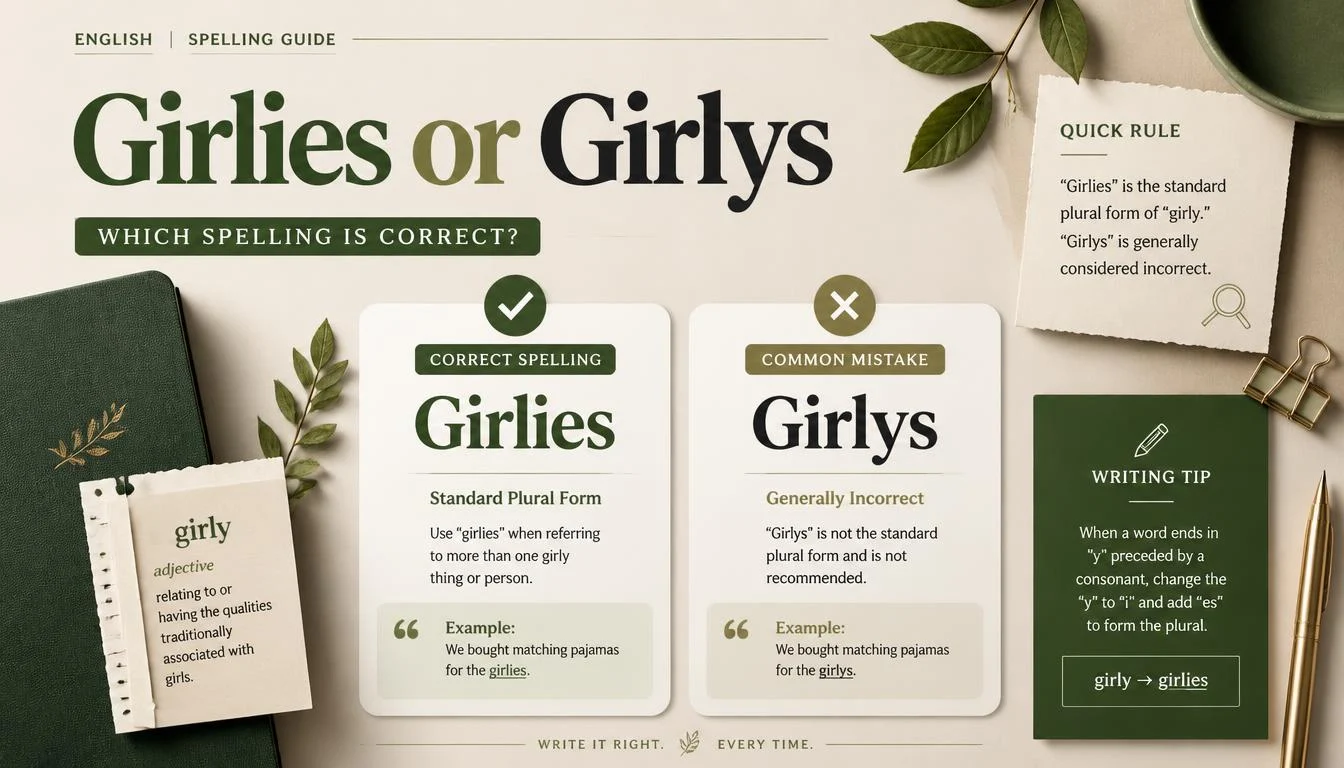
Quick Answer:
The correct spelling is Girlies, not Girlys. When a word ends in a consonant plus “y,” English grammar rules require you to change the “y” to “i” before adding “es.” So “girly” becomes “girlies” in plural form, following the same pattern as “lady” becoming “ladies.”
If you’re wondering whether it should be Girlies or Girlys, the correct spelling is girlies. It is the plural form of the informal word “girly,” often used as a friendly or playful way to refer to girls or female friends.
Although girlys may look logical at first, it is not the standard plural spelling. In this guide, we’ll explain why girlies is correct, what it means, and show you how to use it naturally in texts, social media, and casual conversations.
Why This Small Word Trips Up So Many Writers
Type “girlies” into any group chat and someone will inevitably spell it “girlys” instead. It happens constantly, and honestly, it makes sense why. The word “girly” already looks a little unusual on its own, so when people try to make it plural, their instinct is often to just slap an “s” on the end and move on.
But that instinct leads to a mistake. Girly” is an adjective that has been turned into an informal noun, and like most English words ending in a consonant followed by “y,” it follows a specific spelling rule when pluralized. Get the rule wrong, and you end up with “girlys,” a spelling that looks off to anyone who knows the pattern, even if they can’t immediately explain why.
This matters more than it might seem. Whether you’re texting friends, writing a caption for social media, or drafting content for a brand that wants to sound casual but polished, spelling errors like this one quietly chip away at how credible your writing looks. In this guide, you’ll learn exactly why “girlies” wins over “girlys,” when each form actually shows up in real writing, and how to never second-guess yourself again.
Girlies or Girlys: What’s the Difference?
The short answer is that only one of these spellings follows standard English grammar. “Girlies” is correct. “Girlys” is a common misspelling that breaks a rule most people learned in elementary school without realizing it still applies here.
“Girly” functions as an informal noun when people use it to refer to a girl, a young woman, or increasingly, as a casual term of address for a friend group (“hey girlies!”). Like many nouns ending in a consonant and then “y,” the plural form requires changing that “y” to “i” before adding “es.” This isn’t a random quirk. It’s a consistent pattern that shows up across dozens of common English words.
| Feature | Girlies | Girlys |
|---|---|---|
| Meaning | Correct plural of “girly” | Incorrect spelling of the plural |
| Part of Speech | Informal plural noun | Not a recognized spelling |
| Refers To | Girls, young women, or a friend group | N/A |
| Typical Usage | Casual conversation, social media, texting | Common typo or misunderstanding |
| Example | “The girlies are meeting for brunch.” | “The girlys are meeting for brunch.” (incorrect) |
| Common Confusion | Assumed to need only an added “s” | Formed by ignoring the y-to-i rule |
Once you see it laid out this way, the pattern becomes obvious. English doesn’t treat every word ending in “y” the same way, but when a consonant comes right before that “y,” the plural almost always needs the “i” swap. “Girly” fits that category perfectly, which settles the debate.
Is Girlies a Grammar, Vocabulary, or Usage Issue?
This is primarily a grammar issue, specifically one involving plural noun formation. It isn’t about vocabulary meaning, since both spellings would be understood to mean the same thing by most readers. It’s about which form actually follows the accepted rules of English spelling.
The rule itself is straightforward. When a noun ends in a consonant followed by “y,” you drop the “y” and add “ies” to form the plural. Words like “baby,” “city,” “party,” and “story” all follow this same pattern, becoming “babies,” “cities,” “parties,” and “stories.” “Girly” isn’t an exception, even though it started as slang rather than a formal noun.
In formal or academic writing, you likely won’t use either version much, since “girlies” is inherently casual and colloquial. But in business communication that leans conversational, in marketing copy aimed at younger audiences, or in everyday texting and social captions, getting this spelling right signals attention to detail. The practical takeaway: treat “girly” like any other consonant-plus-y word, and the correct plural will follow naturally every time.
Girlies: Meaning, Usage, and Examples
“Girlies” is the plural form of “girly,” used informally to refer to girls, young women, or a close group of female friends. It’s warm, casual, and has become especially common in social media captions and group chat culture.
Part of speech: Informal plural noun (occasionally used as an adjective, as in “girlies night”)
Common collocations: “the girlies,” “us girlies,” “my girlies,” “girlies trip,” “hey girlies”
Typical sentence pattern: [Subject] + [verb] + “the girlies” / “us girlies” + [rest of sentence]
Here’s how it looks across different real-world settings:
- Workplace example: “A few of us girlies from the office are grabbing lunch, want to join?”
- Academic example: A student texting a study group might write, “The girlies are meeting in the library at six to review for finals.”
- Technology example: “Just made a group chat for the girlies so we stop losing plans in fifty different texts.”
- Email example: In a casual internal newsletter, a brand might write, “Calling all girlies: our spring collection just dropped.”
- Daily conversation example: “My girlies always know how to make a bad day better.”
Learner mistake to avoid: Non-native English speakers sometimes assume “girlies” is formal or professional simply because it’s a real, correctly spelled word. It isn’t. Save it for casual writing, never for a formal report, cover letter, or academic paper.
Mini recap: “Girlies” is correct, casual, and increasingly common in online and social spaces. It follows the standard y-to-ies pluralization rule.
Girlys: Why This Spelling Doesn’t Hold Up
“Girlys” is what happens when someone applies the basic “just add s” pluralization rule to a word that actually needs the y-to-i change first. It’s not a recognized or accepted spelling in any major dictionary or style guide.
Part of speech: N/A this spelling isn’t grammatically valid
Why it appears so often: Many English plurals are formed by simply adding “s” (like “cats” or “phones”), so it’s an easy habit to apply that same logic everywhere, including to words ending in a consonant plus “y.”
Where it shows up: Almost exclusively in casual texting, quick social media posts, and informal comments, usually written fast without a second glance.
- Workplace example (incorrect): “The girlys in accounting are throwing a party.” should be “girlies”
- Technology example (incorrect): A caption reading “girlys night was iconic” should read “girlies night was iconic.”
- Daily conversation example (incorrect): “Tell the girlys I said hi” should be “Tell the girlies I said hi.”
Learner mistake to avoid: Don’t assume that because “girlys” appears frequently online, it’s an accepted alternative spelling. Frequency doesn’t equal correctness, and plenty of common online misspellings never become standard English.
Mini recap: “Girlys” is a spelling error, not a stylistic choice or informal variant. There’s no context where it’s technically correct.
When Not to Use Girlies (or Girlys)
Even once you’ve locked in the correct spelling, there are situations where using either word at all is the real mistake.
Formal writing: Resumes, cover letters, business reports, and academic essays call for professional vocabulary. “Girlies” is too casual for these contexts, no matter how it’s spelled.
Addressing someone you don’t know well: Using “girlies” to refer to unfamiliar colleagues, clients, or new acquaintances can come across as overly familiar or unprofessional, especially in a first interaction.
Gender-neutral or mixed-group communication: If you’re addressing a group that includes people of different genders, “girlies” isn’t inclusive language, even in casual settings.
Customer service messaging: Brands writing to a general customer base should avoid slang like this unless their entire tone is deliberately playful and their audience clearly responds well to it.
Legal or official documents: Any document with legal weight needs precise, formal terminology, not informal group nicknames.
Writing for an international audience: Slang terms like “girlies” don’t always translate well across cultures or fluency levels, which can create confusion for non-native readers.
Trying to sound “trendy” without knowing your audience: Forcing casual slang into content where it doesn’t fit naturally often reads as inauthentic rather than relatable.
The pattern here is simple: match your word choice to your setting. “Girlies” works beautifully in the right casual context and falls flat, or even looks unprofessional, in the wrong one.
Common Mistakes Table
| Correct Sentence | Incorrect Sentence | Explanation |
|---|---|---|
| “The girlies are coming over tonight.” | “The girlys are coming over tonight.” | “Girly” needs the y-to-i change before adding “es.” |
| “I love my girlies so much.” | “I love my girlys so much.” | “Girlys” ignores standard pluralization rules. |
| “Girlies trip to the coast this summer!” | “Girlys trip to the coast this summer!” | The plural noun form always requires “ies,” not “ys.” |
| “Us girlies stick together.” | “Us girlys stick together.” | Same rule applies regardless of sentence structure. |
Quick Decision Box
If you’re writing the plural form of “girly,” always use Girlies. There is no situation in standard English where “Girlys” is the accepted spelling. When in doubt, think of “baby” becoming “babies,” and apply that same pattern here.
Real World Examples
Office communication: “A few girlies from marketing are organizing a birthday lunch for Sarah.”
Business email (casual brand voice): “Hey girlies, your favorite fall scents just restocked. Grab yours before they’re gone.”
School or university: “The girlies in my dorm are doing a study session before the exam Friday.”
Customer support (playful brand tone): “Thanks for reaching out, girlie! We’ll get this sorted for you right away.”
Technology: A phone contact group might simply be labeled “girlies” for a close circle of friends.
Artificial intelligence: Some AI chatbots designed with a friendly, Gen Z-style tone occasionally use casual phrases like “hey girlies” when addressing users in informal apps.
Daily conversation: “Can’t wait to see my girlies this weekend, it’s been way too long.”
Girlies in Modern Technology
Casual, community-driven language like “girlies” has found a natural home in modern digital spaces. On social platforms, captions and comments lean heavily on informal group terms because they build a sense of closeness and shared identity quickly.
In apps built around community and friendship, group chat names, shared photo albums, and event invites frequently use “girlies” as a quick, affectionate label. Some AI-powered assistants and chatbots aimed at younger, social-media-savvy users have also adopted similarly casual language to feel more relatable and less robotic.
Voice assistants and traditional chatbots, on the other hand, rarely use slang like this at all, since they’re typically designed for broad, neutral communication. The contrast highlights something useful: casual words like “girlies” thrive in spaces built around personality and connection, while more formal digital tools stick to neutral, universally understood language.
Word Origin
“Girly” traces back to the word “girl,” with the “-y” suffix added to turn it into a descriptive adjective, much like “chilly” comes from “chill” or “silly” comes from an older root word. Originally, “girly” simply described something typically associated with girls, like “girly colors” or “girly magazines.”
Over time, especially with the rise of internet slang and social media culture, “girly” shifted into casual noun territory, used to affectionately refer to a girl or a group of female friends. As that shift happened, the plural form naturally followed standard English pluralization rules, landing on “girlies” rather than any alternative spelling.
Expert Insight
As a language instructor, one thing I always tell students is that informal words still follow formal rules. Just because “girlies” started as internet slang doesn’t mean it gets a pass on basic grammar. The moment a word becomes a plural noun in English, it has to follow noun pluralization patterns, and consonant-plus-y words have one very consistent rule: change the “y” to “i” before adding “es.” Trusting that rule, even with brand-new or casual vocabulary, will keep your writing accurate no matter how informal the tone gets.
Error Prevention Checklist
- Always use Girlies when writing the plural, casual form referring to a girl or group of friends.
- Always apply the y-to-i rule when a word ends in a consonant plus “y” before pluralizing.
- Never use “Girlys” it isn’t a recognized or grammatically correct spelling.
- Quick memory tip: if “baby” becomes “babies,” then “girly” becomes “girlies.” Same rule, same result.
Related Grammar Confusions
- Baby vs Babys vs Babies: Learning this pattern first makes the girlies/girlys rule instantly click.
- Party vs Partys vs Parties: Another consonant-plus-y word that follows the exact same pluralization rule.
- Lady vs Ladys vs Ladies: A close cousin to “girlies” in both meaning and spelling pattern.
- Story vs Storys vs Stories: Useful for writers who frequently misspell plural nouns in creative writing.
- City vs Citys vs Cities: A common mistake in travel writing and geography-related content.
- Their vs There vs They’re: A different type of confusion, but equally common in casual writing.
- Its vs It’s: One of the most frequent grammar mix-ups in everyday English.
- Effect vs Affect: A vocabulary-based confusion rather than a spelling rule, but worth knowing.
- Who vs Whom: Helpful for writers aiming to sharpen more formal grammar skills.
- Fewer vs Less: A classic usage distinction that pairs well with plural noun accuracy.
FAQs
Is “girlies” a real word?
Yes, “girlies” is a recognized informal plural noun. It is commonly used in casual conversation, texting, and social media to refer to girls or a close group of friends.
Why do people spell it “girlys” instead?
The mistake usually happens because writers add “-s” directly to girly without applying the standard pluralization rule. Since girly ends in a consonant followed by y, the y changes to i before adding -es, giving us girlies.
Can I use “girlies” in professional writing?
It’s best to avoid “girlies” in formal or professional writing. The word has a casual, friendly tone and is more suitable for social media, texts, and informal conversations. In professional contexts, alternatives such as “girls,” “women,” or “colleagues” may be more appropriate depending on the meaning.
Is “girlies” gender-specific?
Yes. “Girlies” specifically refers to girls or women, depending on context. Because it is informal and gender-specific, it may not be appropriate when referring to a mixed-gender group or in contexts where more neutral language is preferred.
Does autocorrect fix “girlys” automatically?
Not always. Some autocorrect systems may fail to flag “girlys” because it resembles a possible plural form. This can allow the misspelling to appear in texts and social media posts without an obvious warning.
Is there a singular form that matches “girlies”?
Yes. The singular form is “girly.” Depending on context, girly can function as an adjective meaning traditionally feminine or as an informal noun. When pluralized as a noun, it becomes “girlies.”
Conclusion
The difference between girlies and girlys comes down to one simple, well-established grammar rule. “Girlies” is correct because “girly” ends in a consonant plus “y,” which means the plural form requires swapping that “y” for “i” before adding “es.” “Girlys” skips that rule entirely, which is exactly why it looks and reads as a mistake.
Next time you’re texting your friend group, writing a caption, or drafting anything casual, remember this simple trick: if “baby” becomes “babies,” then “girly” becomes “girlies,” every single time.
Read More Related Articles:
- Usage vs Useage | Stop Making This Spelling Mistake in Your Writing In 2026
- Losing vs Loosing | How One Extra “O” Changes the Entire Meaning In 2026
- Successfully or Succesfully | Easy Trick to Remember the Correct Spelling Forever In 2026

Caleb Dawson is a content writer at synoseek.com, where he works on simple, reader-focused articles across a range of everyday topics. His writing style is practical and grounded, aiming to present information in a clear and relatable way without unnecessary complexity.
2 thoughts on “Girlies or Girlys | Easy Way to Get the Spelling Right In 2026”