Quick Answer
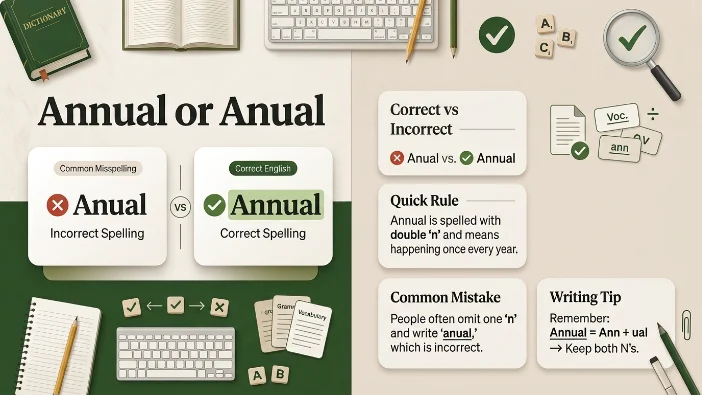
Annual is the correct English spelling, not “anual.” People write “anual” because that’s the correct form in Spanish, Portuguese, and French.In English, the word always takes a double n: annual means happening once every year. If you’re writing in English, drop the single-n version entirely.
If you’ve ever typed “anual report” and had your spell-checker light up red, you’re not alone. This mix-up happens constantly, especially among bilingual writers, students learning English as a second language, and anyone who regularly switches between English and a Romance language like Spanish or Portuguese.
Here’s the short version of what’s going on: “anual” isn’t a misunderstood English word with its own subtle meaning. It’s simply a misspelling one that happens to be the correct spelling in other languages. That’s exactly why it trips up so many careful, intelligent writers. Your brain isn’t making a random error; it’s borrowing a spelling rule from a language where that rule is completely valid.
By the end of this guide, you’ll know exactly why this confusion happens, how to spell “annual” correctly every time, and how to catch the mistake before it slips into a business email, a school paper, or a published article.
Annual vs Anual: What’s the Difference?
There isn’t a real difference in meaning, because only one of these is an English word. Annual is the only correct spelling in English. Anual is not recognized by Oxford Dictionary, Cambridge Dictionary, or Merriam-Webster as a standard English term it’s a spelling error that comes directly from Spanish and Portuguese, where “anual” is the correct and standard word.
| Feature | Annual (English) | Anual (Spanish/Portuguese) |
|---|---|---|
| Meaning | Occurring once a year | Occurring once a year |
| Part of Speech | Adjective / Noun | Adjective |
| Refers To | Yearly events, reports, plants, income | Yearly events (same concept) |
| Typical Usage | English writing, business, academic | Spanish and Portuguese writing |
| Example | “The annual meeting starts in March.” | “La reunión anual comienza en marzo.” |
| Common Confusion | Writers drop the second n out of habit | N/A this is the correct spelling here |
So the two words share an identical meaning and even a shared Latin root, but they belong to different languages. Using “anual” in an English sentence isn’t a stylistic choice or a regional variant it’s simply a typo that happens to look like a real word.
Is This a Grammar, Vocabulary, or Spelling Issue?
This is purely a spelling issue, not a grammar or vocabulary problem. Grammar concerns sentence structure and word order. Vocabulary concerns which word carries the right meaning. Spelling concerns how a word is written on the page and that’s where “anual” goes wrong.
Because “anual” doesn’t exist in English dictionaries, it isn’t a matter of formality either. You won’t find it used correctly in casual texting any more than in a formal academic paper. In business English, academic writing, and everyday conversation alike, “annual” is the only acceptable form.
The practical takeaway: if you catch yourself typing “anual,” treat it the same way you’d treat any typo fix it immediately, because there’s no context in English where it becomes correct.
Annual: Meaning, Usage, and Examples
Annual functions as an adjective meaning “happening once every year,” and it can also work as a noun referring to a plant that completes its life cycle in one year, or a publication released yearly (like a yearbook).
Pronunciation: AN-yoo-uhl.
Common collocations include annual report, annual income, annual meeting, annual leave, annual fee, and annual checkup.
Workplace example: “HR sent out the annual performance review schedule this morning.”
Academic example: “The university publishes an annual research summary every June.”
Technology example: “The software renews on an annual subscription basis.”
Email example: “Please find attached the annual budget forecast for your review.”
Daily conversation example: “We’re planning our annual family trip to the coast again this year.”
Learner mistake: Spanish and Portuguese speakers often write “anual” by direct habit, since it’s the correct spelling in their native language. Reading it aloud rarely helps catch the error, because the pronunciation is nearly identical.
Mini recap: Annual always takes two n’s in English, and it’s the only version you should ever use in an English sentence, whether you’re writing a report or a text message.
Why “Anual” Feels Correct (Even Though It Isn’t)
This section matters because understanding why the mistake happens makes it much easier to stop making it.
1. Spanish and Portuguese use “anual” correctly. If you speak either language, your brain has stored that spelling as accurate because it is, just not in English.
2. Autocorrect doesn’t always catch it. Some devices set to multilingual keyboards won’t flag “anual” as an error, especially if a second language is installed.
3. The words sound almost identical. English speakers pronounce “annual” with a soft double consonant that doesn’t sound dramatically different from the single-n version, so listening for the error doesn’t work well.
4. Fast typing skips double letters. Many people drop repeated letters when typing quickly, and double n‘s are a common casualty.
5. Visual memory misfires. If you’ve read “anual” often in Spanish-language documents, your eyes get used to seeing it, and it starts to look “right” even in English text.
6. Business templates get copied and reused. Once “anual” sneaks into a company template or shared document, it often gets copied forward for years without anyone catching it.
7. Spell-check gets skipped on short documents. People assume a one-line email or subject line doesn’t need proofreading, which is exactly where this typo tends to hide.
Common Mistakes Table
| Correct Sentence | Incorrect Sentence | Explanation |
|---|---|---|
| The annual conference is in October. | The anual conference is in October. | “Anual” is not a recognized English spelling. |
| She receives an annual bonus in December. | She receives an anual bonus in December. | Double n is required in English. |
| Our annual report is due Friday. | Our anual report is due Friday. | Even in business writing, “anual” is always wrong. |
| He renews his gym membership annually. | He renews his gym membership anually. | The adverb form also needs the double n. |
Quick Decision
- If you’re writing in English, always use annual there is no exception.
- If you’re writing in Spanish or Portuguese, anual is correct and expected.
- If you’re switching between languages in the same document, double-check every instance of this word before sending.
Real World Examples
Office communication: A manager writes, “Let’s finalize the annual budget before the end of the quarter,” in a team-wide email.
Business email: A vendor sends, “Your annual subscription renews on the 1st of next month,” as a billing reminder.
School or university: A professor announces, “The annual symposium will be held in the main auditorium this year.”
Customer support: A support agent explains, “Your annual plan includes priority access to new features.”
Technology: A software company markets, “Choose monthly or annual billing at checkout.”
Artificial Intelligence: An AI writing assistant flags “anual” as a spelling error and suggests “annual” automatically, since the tool is trained primarily on English text.
Daily conversation: A friend mentions, “We’re hosting our annual barbecue again this weekend.”
Annual in Modern Technology
Modern software, AI writing tools, and grammar checkers almost universally catch “anual” as a misspelling, because their training data is overwhelmingly English. Virtual assistants like voice-activated calendars will auto-correct spoken reminders to “annual” when transcribing. Chatbots trained for customer service default to “annual” in subscription and billing language. Business tools like invoicing platforms and HR software use “annual” as the standard term across dropdown menus and templates, so following that convention keeps your own writing consistent with what readers already expect.
Word Origin
Both “annual” and “anual” trace back to the Latin word annualis, itself derived from annus, meaning “year.” English preserved the doubled n from the Latin root, while Spanish and Portuguese simplified the spelling to a single n as the languages evolved separately from Latin. That shared ancestry is exactly why the words look and sound so similar they’re linguistic cousins, not unrelated terms that happen to collide.
Expert Insight
As a language instructor, I tell students that “anual” isn’t really a vocabulary mistake it’s a spelling habit borrowed from another language. The fix isn’t memorizing a definition; it’s training your eye to always expect two n’s in the English version. Once you consciously notice the double letter a few times, it becomes automatic, the same way any spelling pattern does with repetition.
Error Prevention Checklist
- Always use annual when writing in English, with no exceptions.
- Always use anual only when writing in Spanish or Portuguese.
- Never confuse them if you remember that English keeps the full Latin double n.
- Quick memory tip: think “annual” has “an” plus “nual” two n’s stacked together, just like two years stacked into one cycle.
Related Grammar Confusions
- Affect vs Effect one is a verb, the other a noun, and mixing them changes your entire sentence.
- Its vs It’s a classic apostrophe trap that changes possession into a contraction.
- Then vs Than comparison versus sequence, often swapped in fast writing.
- Complement vs Compliment one completes something, the other flatters someone.
- Principal vs Principle a person in charge versus a core belief or rule.
- Farther vs Further physical distance versus figurative progress.
- Advice vs Advise noun versus verb, distinguished by a single letter.
- Loose vs Lose a spelling pair that trips up even confident writers.
- Bi-annual vs Biannual vs Biennial three similar-looking words with genuinely different meanings.
- Continual vs Continuous repeated action versus uninterrupted action.
FAQs
Is “Anual” Ever Correct in English?
No, “anual” is never correct in standard English. It is not recognized as a valid English word in major dictionaries. The correct English spelling is always “annual” with a double n. However, “anual” is the correct spelling in some languages, including Spanish and Portuguese, which can cause confusion for bilingual writers.
Why Do People Misspell “Annual” as “Anual”?
Many people spell “annual” incorrectly as “anual” because of influence from their native language. Spanish and Portuguese speakers may transfer the spelling from their own languages into English, where the word looks and sounds almost identical but follows a different spelling rule.
Does Spell Check Always Catch “Anual”?
Most English spell checkers will identify “anual” as a spelling mistake and suggest “annual” instead. However, multilingual keyboard settings, language preferences, or documents containing multiple languages can sometimes allow this error to go unnoticed, especially in short text such as email subject lines or headings.
What Is the Difference Between “Annual” and “Annually”?
“Annual” is an adjective used to describe something that happens once every year or relates to a yearly period. For example, you might write “an annual report” or “an annual meeting.”
“Annually” is the adverb form of the word and describes how often an action happens. For example, “The company reviews its policies annually” means the review happens every year.
Is “Annual” Only Used for Reports and Meetings?
No. The word “annual” has many uses beyond reports and meetings. It can describe events, fees, subscriptions, activities, and other things connected to a yearly cycle. In biology, an annual plant is one that completes its life cycle within one year. The word can also refer to yearly publications known as annuals.
Conclusion
The bottom line is simple: “annual” is the only correct spelling in English, and “anual” belongs to Spanish and Portuguese, not English writing. The confusion makes complete sense once you understand it’s a cross-language spelling habit rather than a real vocabulary choice.
Next time you’re typing a report, an email, or a reminder, picture the double n stacking two years together annual, with both letters present, every single time.
3 thoughts on “Anual or Annual | Simple Grammar Guide For Error-Free Writing In 2026”