Quick Answer:
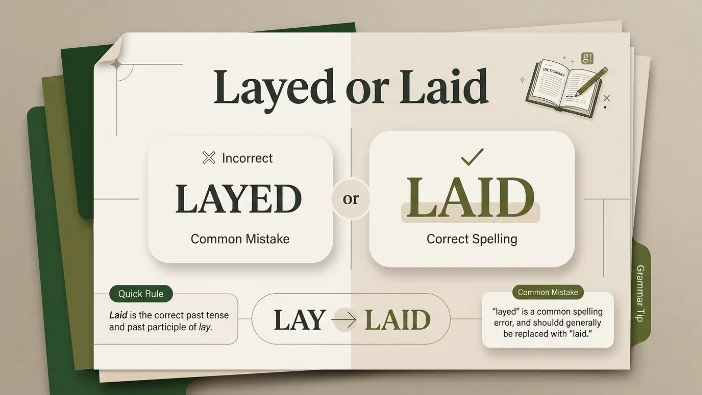
“Layed” is never correct in standard English it’s a common misspelling. Laid is the only correct past tense and past participle of the verb “lay,” as in “She laid the book on the table.” If you’re tempted to write “layed,” replace it with laid every single time.
If you’re unsure whether to write “Layed or Laid,” you’re not alone. These two forms can look similar, but only one is generally correct in standard English when using the past tense of “lay.” Understanding the difference can help you avoid common spelling and grammar mistakes.
In this guide, we’ll explain Layed or Laid, show you the correct form, and provide simple examples to make the rule easy to remember. Whether you’re writing an email, an assignment, or everyday English, you’ll know exactly which word to use.
Why This Mix-Up Happens So Often
- You might write a sentence like, “I layed the papers on my desk,” and immediately wonder whether something looks wrong. That hesitation is understandable. Layed or laid is a surprisingly common English spelling confusion, and it affects both native speakers and English learners.
- The main reason is that most English verbs form their past tense by adding -ed. We get walked from walk, talked from talk, and jumped from jump. Following that familiar pattern, it seems logical to turn lay into “layed.” However, lay is an irregular verb, so its past tense is laid.
- The confusion becomes greater because lay and lie are closely connected. Their forms overlap in ways that can be difficult to remember. For example, lay is the present tense of the verb meaning “to place something,” while lay is also the past tense of lie, meaning “to recline.” This unusual overlap makes it easy to choose the wrong form when writing quickly.
- Spoken English can make the problem harder to notice. When people talk, listeners generally understand the intended meaning from context, even when a speaker uses a nonstandard form. Writing is different. A spelling such as “layed” is immediately visible in an email, essay, application, or professional document, where even a small error can affect how polished the writing appears.
- The good news is that you don’t need to memorize a complicated rule. When lay means to put or place something, its past tense is always laid. For example, “I laid the papers on my desk” is correct. If you’re talking about reclining, you’re dealing with the separate verb lie, which has its own forms.
- Once you understand this distinction, the confusion becomes much easier to manage. The rest of this guide explains how lay, laid, and lain work, where “layed” goes wrong, and how to recognize the correct form more confidently in everyday and professional writing.
Laid or Layed: What’s the Real Difference?
There isn’t really a difference to weigh here, because only one of these two spellings exists in the English language. Laid is correct. Layed is not a recognized word in any standard dictionary, style guide, or grammar reference.
Laid functions as both the simple past tense and the past participle of the verb lay, which means “to put or place something down, usually carefully or in a specific position.” Because lay is a transitive verb, it always needs a direct object something is being laid down.
| Word | Status | Part of Speech | Meaning | Example |
|---|---|---|---|---|
| Laid | Correct | Verb (past tense/past participle) | Put something down | She laid her keys on the counter. |
| Layed | Incorrect | Not a standard word | N/A | ~~He layed the blanket down.~~ |
Here’s the recap: whenever you’re describing the act of placing something somewhere in the past, laid is the word you want. There’s no situation formal, informal, academic, or casual where “layed” becomes acceptable. Style guides like Merriam-Webster and the Cambridge Dictionary list laid as the sole past form of lay, and neither includes “layed” as a variant spelling.
Is This a Grammar Issue, a Spelling Issue, or Both?
The confusion around layed is mainly a spelling problem caused by an underlying grammar issue: irregular verb conjugation. Once you understand how lay changes in different forms, the correct spelling becomes much easier to remember.
Most regular English verbs form the past tense by adding ed. Irregular verbs don’t follow that pattern. Their forms may change in other ways, as you can see with go → went, buy → bought, and catch → caught. Lay is also irregular, and its past tense is laid, never layed.
How It Works in Different Types of Writing
The distinction matters regardless of the level of formality.
Formal and academic writing: In research papers, reports, legal documents, and other carefully edited material, laid is the only standard form. Writing layed can make an otherwise polished document appear careless.
Business English: The word appears frequently in professional expressions such as “the foundation was laid” and “the groundwork has been laid for the project.” These established phrases consistently use laid.
Everyday communication: The incorrect form often appears in texts, emails, and social media because writers may instinctively add ed to lay. Although informal writing is more forgiving, layed is still not the standard form.
Why Is “Lay” So Easy to Get Wrong?
Part of the difficulty comes from the larger system of irregular verbs in English. Some change their vowel, such as sing → sang and ring → rang. Others take completely different forms, such as go → went.
Lay → laid follows neither of those familiar patterns neatly. As a result, there isn’t a simple spelling formula that tells you what to write. The most reliable approach is to learn the forms together rather than trying to construct the past tense from the base word.
Why Repeated Exposure Helps
Laid appears in many familiar expressions, including:
laid the groundwork
laid down the law
laid to rest
laid bare
Seeing these expressions regularly reinforces the correct spelling. Over time, laid becomes visually familiar, while layed starts to look noticeably wrong.
The Practical Rule
When lay means to put or place something somewhere, its past tense and past participle are laid.
Lay → laid → laid
There is no standard context in which layed replaces laid. Whether you’re writing an academic paper, sending a work email, or posting casually online, laid is the correct form.
A Complete Guide to “Laid”
Meaning: Laid is the past tense and past participle of lay, meaning to place or set something down carefully.
Part of speech: Verb (irregular past form)
Common collocations: laid the table, laid down, laid off, laid out, laid back, laid to rest, laid a foundation, laid eyes on
Typical sentence pattern: Subject + laid + object + (location)
Example: “The contractor laid the tiles across the entire kitchen floor.”
Workplace example: “The manager laid out the quarterly targets during Monday’s meeting.”
Academic example: “The researcher laid the groundwork for future studies on climate migration.”
Technology example: “The engineering team laid the infrastructure for the new app before launch.”
Email example: “As discussed, I’ve laid out the proposed timeline in the attached document.”
Daily conversation example: “She laid her jacket over the chair when she got home.”
One learner mistake: Writing “I have layed the report on your desk” instead of “I have laid the report on your desk.” Because laid also serves as the past participle, it pairs with helping verbs like has, have, and had never “layed.”
Mini recap: Whenever an action of placing something happened in the past, or you’re using a helping verb like “has” or “had,” laid is your word.
A Complete Guide to “Lay”
Meaning: Lay, in its present tense form, means to place something down. It’s easy to mix up with lie, which means to recline or rest in a position and that’s usually where things go sideways.
Part of speech: Verb (present tense; also functions as the past tense of lie)
Common collocations: lay the foundation, lay it down, lay claim to, lay out a plan, lay low
Typical sentence pattern: Subject + lay + object (present tense action happening now or habitually)
Example: “Please lay the documents on my desk when you arrive.”
Workplace example: “Can you lay the invoices next to the printer before the meeting starts?”
Academic example: “Researchers often lay their assumptions out clearly in the introduction section.”
Technology example: “Developers typically lay the database structure before writing any front-end code.”
Email example: “I’ll lay out the next steps in tomorrow’s follow-up message.”
Daily conversation example: “Just lay the towel on the chair, and I’ll grab it later.”
One learner mistake: Confusing lay with lie, as in saying “I’m going to lay down” when you mean “I’m going to lie down.” Lay needs an object (you lay something down); lie does not (you, yourself, lie down).
Mini recap: Use lay in the present tense only when something or someone else is being placed down by the subject and remember that lay is also, confusingly, the past tense of the completely different verb lie.
When Not to Use “Layed”
“Layed” is not the standard past tense or past participle of lay. Whenever lay means putting or placing something somewhere, the correct past form is laid. The most common mistakes happen when writers assume the verb follows the regular pattern of adding ed.
Mistake 1: Writing “I layed it down”
The subject does not change the past tense. The correct sentence is “I laid it down.” The familiar ed ending can feel natural, but lay is an irregular verb, so it does not become layed.
Mistake 2: Using “layed” after has, have, or had
The past participle is also laid, so it remains unchanged in perfect tenses.
Incorrect: “She has layed the papers on the desk.”
Correct: “She has laid the papers on the desk.”
The same form applies with have and had.
Mistake 3: Writing “layed off” or “layed out”
Common expressions such as laid off, laid out, and laid down always use laid when they come from lay.
For example:
“Several employees were laid off last month.”
“She laid out the documents before the meeting.”
Mistake 4: Confusing “lay” with the past tense of “lie”
This is one of the trickiest parts of English verb usage. Lay is the past tense of lie when lie means to recline.
“Yesterday, I lay on the sofa all afternoon.”
But when lay means to place something somewhere, its past tense is laid:
“Yesterday, I laid the blanket on the sofa.”
The meaning of the sentence tells you which verb is being used.
Mistake 5: Relying completely on spell check
Automated tools can catch many errors, but they are not perfect. Some writing apps may overlook layed, particularly when their grammar checking is limited. When the sentence involves lay or lie, checking the meaning yourself is safer than relying entirely on software.
Mistake 6: Assuming informal usage makes it standard
You may occasionally encounter layed in informal writing or nonstandard speech. That does not make it the accepted standard form. In edited, academic, workplace, or professional writing, use laid.
Mistake 7: Avoiding “laid” because of confusion with “lie”
Learning the difference between lay and lie can sometimes create a new problem. Writers become so cautious that they avoid laid even when it is grammatically correct. If someone or something is placing an object somewhere, laid is the form you need for the past tense.
Mistake 8: Typing too quickly
Sometimes the problem is simply speed. Because layed looks like a plausible English verb, your eyes may not catch the error during a quick review. A short proofreading pause can prevent it from reaching a final document.
The Simple Fix
Whenever you use lay to mean put or place, remember its past forms:
Present: lay
Past: laid
Past participle: laid
So write “I lay the book down every evening,” “I laid the book down yesterday,” and “I have laid the book down.” Never replace laid with layed in standard English.
Common Mistakes Table
| Correct Sentence | Incorrect Sentence | Explanation |
|---|---|---|
| She laid the baby down gently. | She layed the baby down gently. | Laid is the only past tense form of lay. |
| He has laid the groundwork for success. | He has layed the groundwork for success. | Laid functions as the past participle after “has.” |
| The workers laid the bricks all morning. | The workers layed the bricks all morning. | “Layed” is not a recognized spelling in any context. |
| I laid my phone on the table. | I layed my phone on the table. | Even in casual writing, laid is required. |
| They were laid off last month. | They were layed off last month. | The phrasal verb “laid off” never takes the “-ed” spelling. |
Quick Decision Box
If you’re placing something down in the past, use laid.
If you’re describing yourself reclining in the past, the correct word is lay (the past tense of lie), not laid.
There is no situation where layed is correct replace it with laid every time you see it in your writing.
Real-World Examples of “Laid” in Action
Office communication: “The team laid out a detailed action plan before the client call.”
Business email: “I’ve laid the groundwork for our Q3 strategy in the attached slides let me know your thoughts.”
School or university: “The professor laid emphasis on citation accuracy throughout the semester.”
Customer support: “Once the technician laid the new cables, the connection issue was resolved.”
Technology: “The startup laid the technical foundation for its platform months before the public launch.”
Artificial Intelligence: “Early researchers laid the theoretical framework that modern machine learning still relies on.”
Daily conversation: “I laid my keys down right here has anyone seen them?”
“Laid” in Modern Technology
Technology writing leans on laid constantly, especially when describing groundwork, infrastructure, or planning stages. You’ll see it in phrases like “the developers laid the architecture” or “the system laid the framework for future updates.”
Artificial intelligence and machine learning content frequently uses laid when discussing foundational research: “Early computer scientists laid the mathematical groundwork that today’s AI models build on.”
Virtual assistants and voice assistants, ironically, need to get this exact grammar rule right when generating natural-sounding responses. If you’ve ever asked a voice assistant something and gotten a grammatically awkward reply, irregular verbs like lay and laid are often part of the reason they’re genuinely difficult for language models to handle consistently.
In software documentation, you’ll often read something like: “This update laid the groundwork for the next major release,” which is a natural, correct use of the word in a technical context.
Where “Laid” Comes From
Laid traces back to Old English “lecgan,” which meant to place or set down. Over centuries, English speakers shortened and adjusted the pronunciation, eventually settling on lay as the present tense and laid as the past form. This irregular pattern has stayed remarkably stable for hundreds of years, which is part of why laid has never evolved into a regular “-ed” form like “layed.” The spelling essentially fossilized early, long before spelling was standardized across English texts.
Interestingly, lecgan itself was a causative form of another Old English verb, licgan, which eventually developed into our modern lie. In other words, lay originally meant something close to “to cause to lie” you weren’t just reclining, you were making something else recline or rest in place. That causative relationship explains why lay always needs an object today: it’s baked into the word’s history. Once you see lay and lie as historically linked rather than accidentally similar, the overlap between their forms starts to make a lot more sense, even if it doesn’t make the spelling any easier to guess on sight.
Expert Insight
As a language instructor, I always tell students to memorize lay and laid as a pair, almost like flashcards, rather than trying to apply a general rule. Irregular verbs resist logic that’s what makes them irregular so pattern-matching from regular verbs will lead you astray every time. The fastest way to lock this in is repetition: write five sentences using laid correctly, read them aloud, and the correct spelling starts to feel natural within a day or two.
I also encourage students to keep a short “trouble list” of the handful of words that consistently trip them up, and lay/laid almost always belongs on that list. Reviewing it for thirty seconds before you write anything important an email, an essay, a report is often enough to catch the mistake before it happens, rather than after a reader points it out.
Error Prevention Checklist
- Always use laid when describing the past tense action of placing something down.
- Always use laid after helping verbs like has, have, or had.
- Never write layed it isn’t a word in any dictionary or style guide.
- Quick memory tip: if you can replace the verb with “placed” and the sentence still makes sense, laid is correct (“She laid/placed the book down”).
Related Grammar Confusions Worth Learning
Lay vs. Lie These two verbs overlap in confusing ways, and mastering the difference clears up dozens of everyday mistakes.
Lain vs. Laid Lain is the past participle of lie, while laid belongs to lay; mixing these up is extremely common.
Effect vs. Affect Another pair where one letter changes the entire meaning and part of speech.
Its vs. It’s A classic mix-up between a possessive pronoun and a contraction.
Then vs. Than Two words that sound similar but serve completely different grammatical roles.
Who vs. Whom Understanding subject and object pronouns makes this distinction much easier.
Farther vs. Further A subtle difference between physical and figurative distance.
Complement vs. Compliment Two words with nearly identical spelling but very different meanings.
Loose vs. Lose A spelling mix-up that happens even among confident writers.
Set vs. Sit Another transitive/intransitive verb pair that mirrors the lay/lie confusion closely.
FAQs
Is “layed” ever correct in British English?
No. “Laid” is the standard past tense and past participle of lay in both British and American English. The form layed is not accepted as a standard spelling for the verb meaning to put or place something somewhere.
What’s the difference between “laid” and “lain”?
The two forms belong to different verbs. “Laid” is the past tense and past participle of lay, meaning to put or place something down. “Lain” is the past participle of lie, meaning to recline or rest. For example, “She laid the book on the desk” but “She has lain on the sofa all afternoon.”
Why does spell check sometimes miss “layed”?
Spell checkers are useful, but they don’t catch every grammatical or spelling mistake. Some tools have limited dictionaries or focus mainly on obvious typing errors. Since layed resembles a possible regular verb form, certain applications may fail to flag it consistently.
Is “laid” used the same way in “laid off” and “laid back”?
The spelling is the same, but the expressions have different meanings. “Laid off” usually means that someone’s employment has been terminated, while “laid back” describes someone or something relaxed and easygoing. Both expressions contain the correct form laid.
What’s an easy way to remember “laid” instead of “layed”?
Try replacing the word with “placed.” If placed makes sense in the sentence, laid is probably the form you need. For example, “She laid the documents on the desk” works in the same basic way as “She placed the documents on the desk.
Is “lay” ever correct as a past tense verb?
Yes, but this is where lay and lie become confusing. Lay is the past tense of lie when lie means to recline or rest. For example, “Yesterday, I lay on the couch all afternoon.” However, when lay means to put something down, its past tense is laid: “Yesterday, I laid the book on the table.”
Conclusion
The takeaway here is refreshingly simple: laid is correct, and layed isn’t a real word at all. Once you internalize that lay is an irregular verb, the “-ed” instinct that leads to “layed” starts to fade, and laid becomes automatic.
If you ever catch yourself hesitating mid-sentence, just swap in “placed” as a mental test. If it fits, laid is exactly the word you need no exceptions, no regional variations, and no reason to second-guess yourself again.
4 thoughts on “Layed or Laid | Stop Making This Common Spelling Mistake In 2026”