Quick Answer
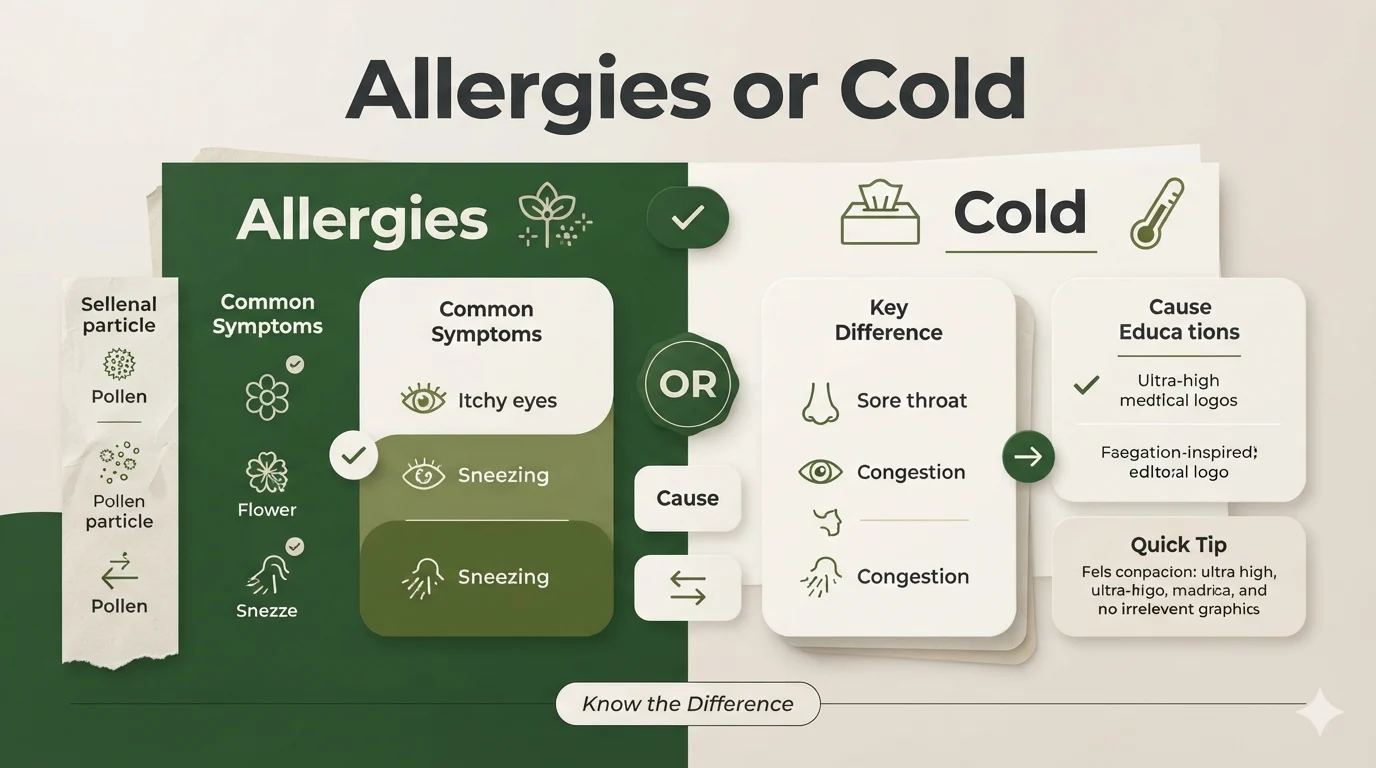
The difference between “allergies” and “cold” lies in their cause and duration: allergies are immune responses to triggers like pollen, while colds are viral infections. Allergies never cause fever and often involve itchy eyes; colds may include fever and body aches. Colds resolve in 1-2 weeks, while allergies persist with allergen exposure.
You wake up with a scratchy throat, a stuffy nose, and the urge to sneeze. Is it the start of a cold, or are your seasonal allergies flaring up again? It’s one of the most common questions in healthcare, and the confusion is understandable. Both conditions share overlapping symptoms, yet they require completely different approaches to treatment and prevention.
Understanding the distinction between “allergies” and “cold” is crucial not just for getting the right medication, but for managing your health effectively. Using the wrong word can mislead others about your condition and even delay proper care. This guide will help you master the difference so you can communicate with confidence and take the right steps to feel better.
What’s the Difference Between Allergies and a Cold?
The core distinction between allergies and a cold comes down to what triggers them. Colds are caused by viral infections, while allergies are a reaction by your immune system to harmless substances known as allergens . Although the symptoms can feel similar, the underlying mechanisms are entirely different.
To quickly see the difference, compare the key characteristics:
In short, if your symptoms appear suddenly after exposure to pollen and include itchy, watery eyes, you are likely dealing with allergies. If your symptoms develop gradually and include a fever or body aches, you are likely dealing with a cold .
Are “Allergies” and “Cold” Grammar, Vocabulary, or Usage Issues?
Distinguishing between “allergies” and “cold” is a usage issue. While both are nouns, the confusion doesn’t stem from grammar rules but from how we use these words to describe different medical realities. They are not interchangeable; using one when you mean the other can lead to significant misunderstanding.
In formal English, the distinction is critical. In a business email, writing “I have a cold” implies a temporary, contagious illness that might require sick leave. In contrast, “My allergies are bad today” suggests a non-contagious, ongoing condition. In academic and professional writing, precision matters. Misusing these terms can create ambiguity about the nature and severity of a health issue.
Here is a practical takeaway: If you are writing or speaking about a health condition, pause to consider the cause. If you are talking about a virus that you can pass to others, use cold. If you are talking about a reaction to an environmental trigger, use allergies.
Allergies: A Detailed Guide
Meaning and Usage
“Allergies” (plural noun) refers to a condition in which the immune system reacts abnormally to a foreign substance. These substances, known as allergens, are usually harmless to most people but trigger a defensive response in sensitive individuals . Common allergens include pollen, mold spores, pet dander, and dust mites .
Common Collocations and Sentence Patterns
- Seasonal allergies: Symptoms that appear during specific times of the year.
- Food allergies: Reactions to certain foods like peanuts or shellfish.
- Pet allergies: Reactions triggered by proteins found in pet saliva or dander.
- Allergy symptoms: The physical manifestations, such as sneezing, runny nose, and itchy eyes.
- Allergy season: The period when certain plants are pollinating.
Workplace Example:
“Because of my seasonal allergies, I’ll be working from home to avoid the high pollen count today.”
Academic Example:
“According to the study, children with a family history of asthma are at a higher risk of developing allergies.”
Technology Example:
“The app sends users real-time alerts when the pollen count is high, helping them manage their allergies more effectively.”
Email Example:
“Subject: Out of Office. I’m currently out of the office due to severe allergies. I’ll respond to emails when I return.”
Daily Conversation:
“I think my allergies are starting up; my eyes are so itchy.”
One Common Learner Mistake
A frequent error is using the singular “allergy” when referring to general sensitivity. While “allergy” is correct for a specific trigger (e.g., “I have a peanut allergy”), the plural “allergies” is more common when discussing overall sensitivity (e.g., “My allergies are terrible in the spring”).
Mini Recap: “Allergies” are your immune system’s overreaction to a trigger, leading to symptoms like sneezing, a runny nose, and itchy, watery eyes.
Cold: A Detailed Guide
Meaning and Usage
A “cold” is a noun referring to a contagious viral infection that affects the upper respiratory tract . It is commonly caused by rhinoviruses and is typically mild, resolving on its own within a week or two . Unlike allergies, a cold is an infectious illness that can be spread from person to person.
Common Collocations and Sentence Patterns
- Common cold: The standard term for this viral infection.
- Head cold: A cold with symptoms mostly in the head, like a runny nose and sneezing.
- Chest cold: A cold with symptoms in the chest, often including a persistent cough.
- Catch a cold: To become infected with the virus.
- Come down with a cold: To begin experiencing cold symptoms.
Workplace Example:
“I’m starting to feel under the weather; I think I’m coming down with a cold.”
Academic Example:
“Numerous studies have investigated the effectiveness of vitamin C in preventing the common cold.”
Technology Example:
“The new feature on the health app uses AI to distinguish between symptoms of a cold, flu, and allergies.”
Email Example:
“Subject: Meeting Reschedule. I’ve come down with a cold and need to reschedule our meeting for next week.”
Daily Conversation:
“Make sure you wash your hands often so you don’t catch a cold.”
One Common Learner Mistake
A common mistake is not using an article or using the wrong one. You say “a cold” to talk about the illness in general. For example, you would say, “I have a cold,” not “I have cold.” However, you can also use “cold” as an adjective to describe temperature, which often confuses learners.
Mini Recap: A “cold” is a viral infection that causes symptoms like a runny nose, sore throat, cough, and sometimes a fever. It’s contagious and usually lasts 7 to 10 days.
When Not to Use Each Word
Avoid using “allergies” when describing a contagious, short-term illness. Instead, use cold.
- Incorrect: I think I have allergies; my throat is sore, and I have a fever.
- Why: Colds cause sore throats and fevers; allergies generally do not .
- Use “cold”: I think I have a cold; my throat is sore, and I have a fever.
Avoid using “cold” when describing a recurring, non-contagious reaction. Instead, use allergies.
- Incorrect: I always get a cold when the pollen count is high.
- Why: This is a seasonal reaction to a trigger, not a virus.
- Use “allergies”: I always get allergies when the pollen count is high.
Common Mistakes Table
Decision Box
- If you mean a viral infection that is contagious and may involve a fever, use cold.
- If you mean a sensitivity to an environmental trigger causing symptoms like itchy eyes and a clear runny nose, use allergies.
Real-World Examples
- Office Communication:
- “Janet’s been sneezing all morning. I hope she doesn’t have a cold.”
- “I told my boss it’s just allergies, so I’m not contagious.”
- Business Email:
- “I will need to reschedule our call. I have a bad cold and have lost my voice.”
- “I’m working remotely today due to severe allergies.”
- School or University:
- “If you have a cold, please stay home to avoid infecting the class.”
- “The student’s allergies were so bad during the exam that the professor allowed her to take it in a separate room.”
- Customer Support:
- “I’m sorry you’ve had to wait; my agent is out with a cold today.”
- “The support team member is working from home due to her severe allergies.”
- Daily Conversation:
- “I feel awful. I think it’s a cold my head is pounding.”
- “My allergies are acting up; I’m sneezing like wild.”
Modern Technology and the Allergies vs. Cold Distinction
In the modern era of digital health, artificial intelligence (AI), and sophisticated apps, the distinction between allergies and a cold has moved from a personal guess to a data-driven conclusion. The technology sector has made identifying the difference a key feature of healthcare and smart devices.
- Artificial Intelligence and Chatbots: AI-powered symptom checkers are becoming increasingly accurate. They use complex algorithms to differentiate between “allergies” and “cold” by analyzing patterns in user-reported symptoms. If a user reports itchy eyes but no fever, the AI will likely conclude it’s allergies .
- Virtual and Voice Assistants: Both Siri and Google Assistant can answer basic medical queries. If you ask, “Hey Siri, do I have a cold or allergies?” they will provide a quick summary of the key distinguishing factors, such as fever duration and itchy eyes.
- Health and Tracking Apps: Apps like Zocdoc and WebMD allow users to track their symptoms over time. They can show seasonal patterns, helping users see that their “cold” actually occurs every spring, indicating allergies. Allergy-specific apps also provide localized pollen counts, linking physical symptoms directly to environmental data.
- Wearable Technology: Smartwatches are beginning to monitor more complex health data. While they can’t diagnose a cold from allergies, by tracking heart rate and body temperature, they can identify the presence of a fever a clear sign that a “cold” might be the culprit rather than “allergies” .
Word Origin and Development
The word “allergies” originated in the early 20th century. It was coined by Austrian pediatrician Clemens von Pirquet in 1906, from the Greek words “allos” (other) and “ergon” (reaction or work), meaning an “altered reaction” .
The word “cold” has a much older history, dating back to Old English. It is derived from the Proto-Germanic kaldaz and has always been associated with low temperature. Its use to describe the common viral illness likely comes from the perception that people get sick when exposed to cold weather.
Expert Insight
From an educator’s perspective, the most effective way to master this distinction is to think like a healthcare professional. Medical professionals don’t just memorize symptoms; they look for a pattern. As a language teacher, I encourage my students to do the same. Consider the whole picture. For example, if a student says, “I have a cold,” but also mentions “itchy eyes” and that it happens every year when the flowers bloom, I would correct them. It’s not just about choosing the right word; it’s about understanding the story those words tell. Once you connect the word to the underlying logic, you’ll rarely make a mistake.
Error Prevention Checklist
- Always use allergies when talking about a reaction to a specific trigger like pollen, dust, or pets.
- Always use cold when talking about a contagious viral infection.
- Never confuse them if you are experiencing a fever; allergies do not cause fevers.
- Quick memory tip: “Cold” is contagious; “allergies” are not. It’s that simple.
Related Grammar Confusions
- Affect vs. Effect: Understanding the difference between a verb and a noun is crucial for clear communication.
- Its vs. It’s: A classic grammar confusion that involves understanding possession versus a contraction.
- Principle vs. Principal: A mix-up between a rule and a person, which can be confusing in academic and professional writing.
- Complement vs. Compliment: It’s helpful to learn when something goes well together versus when you are saying something nice.
- Further vs. Farther: Learning the distinction between physical distance and metaphorical distance is a common usage issue.
- Who vs. Whom: An excellent way to improve your formal English and understand pronouns.
- That vs. Which: This is key to mastering restrictive and non-restrictive clauses.
- Lay vs. Lie: One of the most confusing verb pairs in English, involving transitive and intransitive verbs.
- Less vs. Fewer: A great example of a usage rule that applies to countable and uncountable nouns.
- Stationary vs. Stationery: A pair of homophones that test your spelling and vocabulary knowledge.
FAQs
How can I tell if I have allergies or a cold?
Look for these key differentiators: allergies typically cause itchy, watery eyes and never cause a fever. Colds often cause a sore throat, cough, and sometimes a low-grade fever . Allergy symptoms appear suddenly after exposure to an allergen, while cold symptoms develop gradually over a few days .
Do allergies make you tired like a cold?
Yes, both can cause fatigue. However, the exhaustion from a cold is often accompanied by body aches, while allergy fatigue is due to the constant immune response and poor sleep from congestion .
Can I have allergies and a cold at the same time?
Yes, it is possible to have both simultaneously. Allergies can inflame your nasal passages, making it easier for a cold virus to take hold and cause an infection, leading to a situation often called “rhinosinusitis” .
How long do allergies last compared to a cold?
A cold typically lasts 7 to 10 days, though a cough may linger. Allergy symptoms persist as long as you are exposed to the allergen, which can be several weeks or even months, depending on the season .
Are colds or allergies contagious?
Only colds are contagious. They are caused by viruses and can spread through droplets in the air or by touching contaminated surfaces. Allergies are an internal immune response and cannot be passed from person to person .
Do allergies cause a fever?
No, allergies do not cause a fever. A fever is the body’s response to an infection, such as a cold or the flu. If you have a fever, it is almost certainly not just allergies .
Conclusion
The choice between “allergies” and “cold” is more than a vocabulary test; it’s a communication skill that impacts how others understand your health and well-being. We’ve clarified that a cold is a viral infection, while allergies are an immune response. By paying attention to key symptoms like fever, itchy eyes, and the duration of your illness, you can confidently choose the right word.
A simple rule to remember: If it’s contagious and you feel feverish, it’s a cold. If it’s seasonal, itchy, and recurrent, it’s allergies.
Read More Related Articles:
- Losing vs Loosing | How One Extra “O” Changes the Entire Meaning In 2026
- Successfully or Succesfully | Easy Trick to Remember the Correct Spelling Forever In 2026
- Usage vs Useage | Stop Making This Spelling Mistake in Your Writing In 2026

Lucas Mitchell is a content writer at synoseek.com. He writes simple, thoughtful pieces that focus on everyday ideas, observations and general knowledge topics. His work is shaped by a calm, realistic tone that keeps the reader engaged without overstatement.