Quick Answer
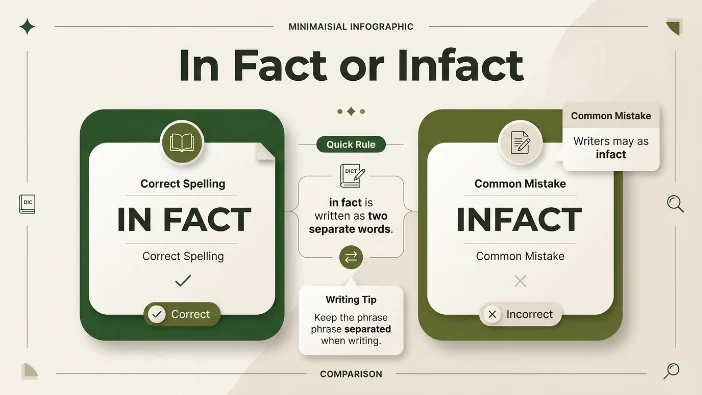
In fact is the only correct form it’s always written as two separate words. “Infact” is a common misspelling that has never been accepted in standard English, whether formal or casual. Writers merge the words because they hear the phrase spoken quickly, but dictionaries, style guides, and grammar checkers all confirm that in fact must remain two words in every context.
If you’re wondering about In Fact or Infact, you’re not alone. This phrase is often written incorrectly because it sounds like one word when spoken quickly. Knowing the correct form can help you write more clearly and confidently.
In this guide, we’ll explain In Fact or Infact, show you which spelling is correct, and provide simple examples to make the difference easy to remember. Whether you’re writing an email, article, or everyday message, using the right form will keep your English polished.
Why This Small Phrase Trips Up So Many Writers
You’re drafting an email, a school essay, or a quick text to a coworker, and you want to add emphasis to a point you just made. The phrase “in fact” comes to mind naturally it’s one of those small connector phrases that makes writing feel more confident and direct. Then your fingers move faster than your brain, and “infact” slips out instead.
This mix-up happens constantly, and it’s not really about intelligence or education. It’s about how English speakers process spoken language versus written language. When we talk, “in fact” gets compressed into something that sounds almost like one word. Our brains hear a single smooth sound, so when it’s time to write it down, some people assume it should look the way it sounds.
The problem is that written English doesn’t always follow the shortcuts of spoken English. In fact is a fixed two-word phrase, and treating it as one word infact creates a spelling error that spell checkers, teachers, and editors will flag every time. By the end of this guide, you’ll know exactly why the two-word version is correct, how the phrase functions grammatically, and how to avoid ever second-guessing yourself again.
In Fact: What’s the Difference?
There isn’t really a “difference” between infact and in fact in the way there is between, say, affect and effect. One of these is a real, standard English phrase. The other is a spelling mistake that happens to look like a word.
In fact functions as an adverbial phrase. It’s used to introduce a statement that strengthens, clarifies, or slightly contradicts what came before it. It signals to the reader: “I’m about to give you something more precise or more surprising than what I just said.”
Infact has no dictionary entry, no grammatical function, and no accepted use in any style guide American or British. It exists only as a typo or a misunderstanding of how the real phrase is spelled.
| Feature | In Fact | Infact |
|---|---|---|
| Meaning | Introduces a statement that emphasizes or clarifies a previous point | No meaning; not a recognized word |
| Part of Speech | Adverbial phrase | Not applicable |
| Refers To | A stronger or more accurate version of a prior statement | Nothing it’s a spelling error |
| Typical Usage | Formal writing, business communication, academic writing, everyday speech | Never correct in any context |
| Example | “In fact, the meeting was moved to Friday.” | Incorrect: “Infact, the meeting was moved to Friday.” |
| Common Confusion | Sometimes merged when written quickly or typed on mobile devices | Mistaken for a valid contraction similar to “cannot” or “into” |
So the real takeaway here is simple: there’s only one correct answer, and it’s the two-word version. But understanding why helps the correct spelling stick in your memory permanently, so let’s look at the grammar behind it.
Is In Fact a Grammar, Vocabulary, or Usage Issue?
This is really a spelling and usage issue rather than a grammar rule in the traditional sense. English doesn’t have a rule that explains why some two-word phrases eventually merge into one word (like “into” or “cannot”) while others stay separate forever (like “in fact” or “in order”). It comes down to convention how the language has settled over centuries of use.
In fact belongs to a category of English called adverbial phrases of emphasis. These are short expressions that modify an entire sentence rather than a single word. Other phrases in this same family include “as a matter of fact,” “in reality,” and “in truth.” None of these ever get squeezed into a single word, and “in fact” follows that same pattern.
From a vocabulary standpoint, there’s no alternate spelling to memorize. “Infact” isn’t a shortened or informal version the way “gonna” is an informal version of “going to.” It’s simply incorrect.
In terms of usage across different settings:
- Formal English and business writing: Always use “in fact.” It’s appropriate in reports, proposals, and professional emails.
- Academic writing: “In fact” is common in essays and research papers, especially when introducing supporting evidence or a clarifying detail.
- Everyday conversation: The two-word form is standard here too the phrase simply gets pronounced quickly, which is where the confusion originates.
The practical takeaway: there is no situation, formal or informal, spoken or written, where “infact” becomes acceptable. If you remember nothing else from this article, remember that.
In Fact: A Complete Usage Guide
Meaning: “In fact” introduces a statement that reinforces, clarifies, or sharpens a point already made. It often signals that what follows is more specific, more surprising, or more accurate than the previous sentence suggested.
Pronunciation: /ɪn fækt/ two distinct syllables blending smoothly, which is exactly why people mistakenly write it as one word.
Part of Speech: Adverbial phrase (sometimes classified as a discourse marker or connective phrase).
Common Collocations: “in fact, it turned out,” “in fact, the opposite is true,” “in fact, research shows,” “in fact, most people,” “in fact, I would argue.”
Typical Sentence Patterns: It usually appears at the start of a sentence, followed by a comma, though it can also appear mid-sentence for a slightly different rhythm.
- Workplace example: “The client wasn’t upset about the delay. In fact, she appreciated the extra time to review the contract.”
- Academic example: “The study did not support the original hypothesis. In fact, the data pointed in the opposite direction.”
- Technology example: “The new update didn’t slow down the app. In fact, load times improved by nearly 30 percent.”
- Email example: “Thanks for checking in everything is on track. In fact, we’re slightly ahead of schedule.”
- Daily conversation example: “I thought I’d hate the movie, but in fact, it was one of the best ones I’ve seen this year.”
One Learner Mistake: Non-native English speakers sometimes place “in fact” where “actually” or “in reality” would sound more natural, or they omit the comma after it at the start of a sentence. Both issues are minor, but they can make writing feel slightly stiff.
Mini Recap: “In fact” is a two-word phrase used to add emphasis or clarification. It almost always needs a comma after it when it opens a sentence, and it works equally well in formal and casual writing.
Infact: Why It Doesn’t Exist as a Word
There isn’t a meaningful “guide” to write for infact because it isn’t a word but it’s worth understanding exactly why it keeps showing up anyway, since that helps prevent the mistake long-term.
Most instances of “infact” come from three sources: fast typing, autocorrect failing to catch the error, and a mental shortcut based on similar-looking words like “indeed,” “instead,” or “into,” which genuinely are single words. Because those words follow a similar “in + word” pattern, some writers assume “in fact” follows the same rule. It doesn’t.
Common collocation with infact: none, since it isn’t part of standard English.
Typical appearance: almost exclusively in rushed writing texts, social media captions, first drafts, and non-native English learner essays.
One learner mistake: Assuming that because “instead” and “indeed” are single words, “infact” should be too. English vocabulary doesn’t follow one universal pattern for merging phrases, so this assumption leads directly to the error.
Mini recap: Infact isn’t a word, isn’t a variant spelling, and isn’t accepted in any dictionary. Every instance of it in real writing should be corrected to “in fact.
When Not to Use In Fact (and Where People Go Wrong)
1. Never write it as one word, regardless of tone. Even in casual texting, “infact” is incorrect. Autocorrect might not catch it, but a careful reader will.
2. Don’t use “in fact” as a replacement for “actually” in every sentence. It works similarly to “actually,” but overusing it in short bursts makes writing sound repetitive. Mix in alternatives like “in reality” or “as it turns out.”
3. Avoid starting too many sentences in a row with “in fact.” It’s an emphasis phrase, and emphasis loses power when it’s overused. Save it for moments that genuinely need highlighting.
4. Don’t forget the comma after it when it opens a sentence. “In fact the results were surprising” reads as rushed. “In fact, the results were surprising” reads as polished.
5. Don’t use it to introduce something that isn’t actually a fact. The phrase implies accuracy and certainty. Using it to introduce an opinion or assumption weakens your credibility as a writer.
6. Avoid pairing it with unnecessary qualifiers. Phrases like “in fact, actually” or “in fact, truly” are redundant. Choose one emphasis phrase per sentence.
7. Don’t confuse it with “in effect,” which has a different meaning. “In effect” relates to something being functionally true or in force, while “in fact” relates to factual accuracy.
8. Don’t use it as a sentence on its own. “In fact.” isn’t a complete thought. It needs a supporting statement to function correctly.
Common Mistakes Table
| Correct Sentence | Incorrect Sentence | Explanation |
|---|---|---|
| “In fact, the report was finished a day early.” | “Infact, the report was finished a day early.” | “In fact” must always be two words. |
| “She wasn’t nervous. In fact, she felt confident.” | “She wasn’t nervous. Infact she felt confident.” | Missing comma and incorrect spelling both weaken clarity. |
| “In fact, most customers preferred the new design.” | “In fact most customers preferred the new design.” | The comma after an introductory phrase is expected in standard English. |
| “The app didn’t crash. In fact, it ran smoother than before.” | “The app didn’t crash, infact it ran smoother than before.” | Using a comma instead of a period before “in fact” creates a run-on sentence. |
| “In fact, I disagree with that assumption.” | “Infact I disagree with that assumption.” | Combining the words removes the phrase’s grammatical clarity. |
Quick Decision Box
If you’re introducing a statement that clarifies, strengthens, or slightly contradicts a previous point, use in fact always two words, always with a comma when it starts a sentence.
There is no situation where infact is the correct choice. If you’ve typed it, fix it before hitting send.
In Fact in Real-World Communication
Office communication: “I know the deadline felt tight. In fact, we finished with two days to spare.”
Business email: “We appreciate your patience during the transition. In fact, customer satisfaction scores have gone up since the update.”
School or university: “Many students assume the essay needs a strict five-paragraph structure. In fact, professors often prefer a more flexible approach.”
Customer support: “I understand your frustration with the delay. In fact, I’ve already escalated your case to our priority team.”
Technology: “The software wasn’t designed for large files. In fact, the developers are releasing a patch next week to fix that limitation.”
Artificial Intelligence: “People assume AI tools always sound robotic. In fact, modern language models are trained to sound conversational and natural.”
Daily conversation: “I thought the restaurant would be packed. In fact, we got a table right away.”
In Fact in Modern Technology
Digital tools have quietly become one of the biggest reasons “infact” shows up as often as it does. Predictive text and autocorrect are trained to recognize common words, but they don’t always catch phrase-level spelling issues the way a human editor would.
In artificial intelligence writing tools, chatbots, and virtual assistants, correct phrasing matters even more, since these tools often generate large volumes of text quickly. A well-trained AI writing assistant will always output “in fact” as two words, because it reflects real-world usage data, not shortcuts.
Voice assistants like Siri or Google Assistant will transcribe “in fact” correctly when you speak it aloud, since speech-to-text systems are built around real phrase patterns rather than guesses. This is actually a helpful trick: if you’re unsure whether you typed the phrase correctly, say it aloud and see how a voice assistant transcribes it.
In business software and grammar-checking tools like Grammarly or the built-in spell checkers in Word and Google Docs, “infact” is automatically flagged as an error. If your writing tool isn’t catching it, it’s worth double-checking your settings.
A Note on Where the Phrase Comes From
In fact” comes from the Latin word factum, meaning “a thing done” or “a deed.” The phrase entered English through French and Latin influence during the medieval period, originally used in legal and formal writing to distinguish something proven or actual from something assumed or claimed. Over time, “in fact” moved from strictly legal contexts into everyday English, keeping its core meaning: something true, actual, or confirmed. That history is part of why the phrase has never merged into a single word it developed as a prepositional phrase from the start, not as a compound word like “indeed” or “instead,” which formed differently in Old and Middle English.
Expert Insight
As a language instructor, one thing I remind students constantly is that spoken English and written English don’t always match. We compress sounds when we talk, but that compression doesn’t give us permission to compress spelling. “In fact” is a perfect example of this. If you ever catch yourself unsure whether a common phrase should be one word or two, try slowing down and pronouncing each part separately. If the phrase clearly has two distinct grammatical roles like “in” acting as a preposition and “fact” acting as a noun it almost always stays two words in writing, no matter how fast it sounds when spoken.
Error Prevention Checklist
- Always use in fact when introducing a clarifying or emphasizing statement.
- Always place a comma after “in fact” when it begins a sentence.
- Never write infact it has no accepted use in any English dictionary.
- Never rely solely on autocorrect; manually double-check this phrase in fast-typed messages.
- Quick memory tip: If “indeed” or “instead” tempts you to merge “in fact” too, remember that not all “in-” phrases behave the same way. When in doubt, keep it as two words.
Related Grammar Confusions Worth Learning
- Effect vs. Affect One is usually a noun, the other a verb, and mixing them up is one of the most common English errors.
- A Lot vs. Alot Similar to infact, “alot” is a frequent misspelling of a two-word phrase.
- In Order To vs. Inorder To Another phrase people mistakenly merge into one word.
- All Right vs. Alright A subtler case, since “alright” is gaining informal acceptance despite style guides preferring “all right.”
- In Spite Of vs. Inspite Of Follows the exact same merging mistake pattern as “infact.
- Into vs. In To Unlike “in fact,” this one genuinely does have two correct forms depending on context.
- Nonetheless vs. None the Less A useful comparison for understanding how some phrases do eventually merge over time.
- In Regards To vs. In Regard To A common business-writing mix-up worth mastering for professional communication.
- As a Matter of Fact vs. In Fact Nearly identical in meaning, but useful to understand for varying sentence structure.
- Because Of vs. Due To Not a spelling issue, but a frequently confused usage pair in formal writing.
FAQs
Is “infact” ever correct in any variety of English?
No. “Infact” is not a recognized spelling in standard American, British, Australian, or Canadian English. The correct form is always “in fact,” written as two separate words.
Why does autocorrect sometimes miss “infact”?
Autocorrect does not catch every spelling error. Depending on the software, “infact” may be overlooked or interpreted as a name, abbreviation, or intentional word. For important writing, proofreading is still useful even when spell check is enabled.
Do I need a comma after “in fact”?
Not always. When “in fact” introduces a sentence or is used as an introductory phrase, a comma is commonly used: “In fact, the results were better than expected.” In the middle of a sentence, punctuation depends on how the phrase fits into the sentence.
What are some alternatives to “in fact”?
Depending on the context, you can use “actually,” “in reality,” “indeed,” “in truth,” or “as it turns out.” Each has a slightly different tone, so choose the option that best matches your sentence.
Can I use “in fact” in academic writing?
Yes. “In fact” is perfectly acceptable in academic writing when it adds emphasis or introduces information that supports a point. However, avoid using it repeatedly, as frequent repetition can make your writing sound less polished.
Is “in fact” the same as “in effect”?
No. “In fact” means that something is true or accurate, while “in effect” usually means that something is essentially or practically the case. For example, “In fact, she completed the project” confirms a fact, while “The new rule is in effect” means the rule is now active.
Conclusion
The confusion between infact and in fact ultimately comes down to one simple truth: only one of these is a real English phrase. In fact carries centuries of grammatical history, a clear function as an emphasis phrase, and consistent recognition across every major dictionary and style guide. Infact is nothing more than a fast-typing habit that never earned a place in the language.
If you want a rule you’ll never forget, think of it this way: “in” is a preposition, “fact” is a noun, and prepositions and nouns don’t fuse together just because they’re often spoken quickly. Keep them separated on the page, and you’ll never write this phrase incorrectly again.
1 thought on “In Fact or Infact | Grammar Rule You Need to Know In 2026”