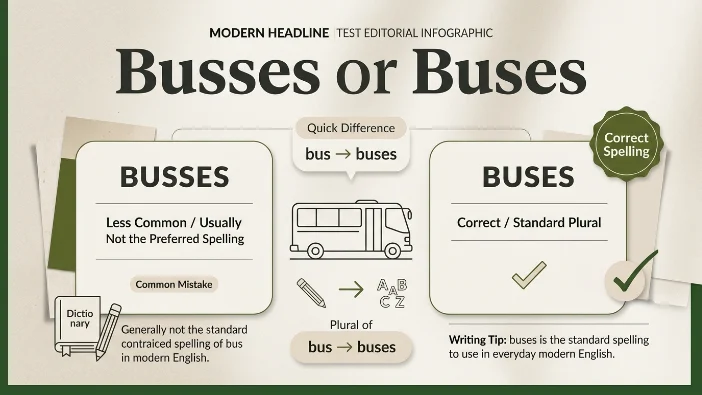
Quick Answer
In modern English, buses is the correct and standard spelling for the plural of “bus,” used by every major style guide and dictionary. Busses is a rarely used variant that also happens to be the plural of “buss,” an old-fashioned word meaning a kiss. Unless you’re writing formal or archaic prose, always choose buses.
You’re typing an email about the school pickup schedule, or maybe you’re editing a report on public transportation, and suddenly you stop. Is it two buses waiting outside, or two busses? Your spellchecker doesn’t flag either one, which makes the confusion worse. Both words look like they should follow the same rule as words like “kiss” becoming “kisses,” so doubling the S feels logical. That instinct is exactly why so many writers get this wrong.
Here’s the short version: a bus is the vehicle you ride to work or school, and its accepted plural is buses. A buss, on the other hand, is an old English word for a kiss, and its plural is busses. These two words sound identical when spoken aloud, but they mean completely different things in writing, which is why picking the wrong one can confuse a reader or make a professional document look careless.
This guide walks through the grammar behind both spellings, shows you exactly when each one applies, and gives you memory tricks so you never second-guess yourself again.
Buses or Busses: What’s the Difference?
The core difference comes down to word origin, not personal preference. Bus” is a modern, shortened form of “omnibus,” a Latin-derived word meaning “for all.” Because “bus” is a shortened word, English treats it a little differently than a full three-letter word like “gas” or “yes.” The accepted plural, recognized by Merriam-Webster, Oxford, and Cambridge dictionaries alike, is buses, formed simply by adding “-es.
“Buss,” by contrast, is a genuine old English word, unrelated to buses at all, referring to a kiss or the act of kissing. Since “buss” already ends in a double S, its plural naturally becomes busses, following the same pattern as “kiss” and “kisses” or “pass” and “passes.”
| Meaning | Part of Speech | Refers To | Typical Usage | Example | Common Confusion |
|---|---|---|---|---|---|
| Vehicles for transport | Noun (plural) | Multiple buses | Everyday, business, technical writing | “Three buses arrived late today.” | Written as “busses” by mistake |
| Kisses | Noun (plural, archaic) | Multiple kisses | Poetic, literary, historical writing | “He gave her two gentle busses.” | Rarely used or recognized today |
| Transports by bus | Verb (third person) | Action of bussing people | Education, logistics | “The district buses students from three towns.” | Sometimes doubled unnecessarily |
So here’s the quick recap: if you’re talking about vehicles, buses is almost always correct. If you somehow find yourself writing about kisses in an old-fashioned or poetic sense, busses is technically valid, though it will strike most modern readers as unfamiliar. And if you’re using “bus” as a verb, meaning to transport people or to clear dishes from a table, the spelling gets a little more flexible, which we’ll cover shortly.
Is Buses or Busses a Grammar, Vocabulary, or Usage Issue?
This isn’t really a grammar rule in the traditional sense, like subject-verb agreement or comma placement. It’s a spelling and vocabulary issue rooted in how English handles words that were borrowed or shortened from other sources.
Technically, both “buses” and “busses” are grammatically valid plural forms, just for different base words. The confusion isn’t about grammar rules being broken; it’s about writers not realizing they’re actually choosing between two separate words that happen to look nearly identical.
In formal English, business writing, and academic work, buses is the only spelling you should use for vehicles. Style guides like APA and Chicago Manual of Style default to buses without exception. In everyday conversation, this distinction barely matters because nobody hears the difference when you speak. The issue only surfaces in writing, which is exactly why it trips up so many people, including native speakers.
One practical takeaway: if you’re ever unsure, default to buses. It’s correct in nearly every context you’ll encounter, and busses is such a rare word today that using it for vehicles will almost always read as a typo rather than a stylistic choice.
Buses: Meaning, Usage, and Examples
Buses is the standard plural of “bus,” referring to large motor vehicles designed to carry multiple passengers along a set route.
As a noun, it’s straightforward: one bus, two buses, three buses. There’s no irregular pattern to memorize once you accept that “bus” behaves like a normal short word ending in a single consonant.
Common collocations include “school buses,” “city buses,” “tour buses,” “double-decker buses,” and “bus schedules.” You’ll also see it paired with verbs like “arrive,” “depart,” “run,” and “wait,” as in “the buses run every fifteen minutes.”
Here’s how it shows up across different settings:
Workplace example: “Facilities confirmed that two shuttle buses will run between the parking garage and the main office starting Monday.”
Academic example: “The study compared commute times for students who relied on public buses versus those who drove personal vehicles.”
Technology example: “The transit app shows real-time locations for all buses currently on route 12.”
Email example: “Hi team, just a reminder that the airport shuttle buses leave every thirty minutes from the front entrance.”
Daily conversation example: “I missed the last two buses, so I ended up walking home.”
A common learner mistake is writing “busses” here out of habit, especially if the writer learned the “double the consonant” rule for words like “stop” becoming “stopped.” That rule applies to certain verb forms, not to this particular plural noun, which is why it doesn’t transfer over correctly.
Mini recap: When you mean vehicles, always write buses. There’s no exception worth remembering for standard modern usage.
Busses: Meaning, Usage, and Examples
Busses is the plural of “buss,” an older English noun and verb meaning a kiss, or the act of kissing someone affectionately.
This word has largely fallen out of everyday use. You’re far more likely to encounter it in classic literature, poetry, or historical texts than in a modern news article or business email. Its pronunciation matches “buses” exactly, which is part of why the spelling confusion persists.
As a verb, “to buss” means to kiss, so “she busses him on the cheek” would mean she kisses him on the cheek. As a plural noun, “busses” refers to multiple kisses.
Because this word is archaic, workplace, academic, technology, and email examples don’t really apply in a natural way. It survives mostly in older writing and literary contexts.
Literary example: “The poem described gentle busses exchanged beneath the willow tree.”
Historical example: “Old letters from the era often referenced fond busses sent between distant lovers.”
A common mistake happens in reverse: writers occasionally see “busses” used correctly in classic literature and assume it’s simply an alternate spelling for vehicles, when it’s actually an entirely different word with its own history.
Mini recap: Unless you’re deliberately writing in an old-fashioned or poetic style, you’ll rarely need busses at all, and never for vehicles.
When Not to Use Each Word
Knowing when to avoid a word is just as useful as knowing when to use it. Here are the situations where writers most often choose the wrong spelling.
Writing about vehicles in formal documents. Never use busses here, even though it looks similar to other doubled-consonant plurals. Buses is the only professional choice.
Referring to public transportation schedules. Transit authorities, city websites, and news outlets universally use buses. Busses would look like an error in this context, not a stylistic variation.
Writing dialogue set in modern times. If a character in contemporary fiction is talking about riding the bus, busses would feel jarringly out of place and pull readers out of the story.
Trying to sound more “correct” by doubling the consonant. Some writers assume doubling letters looks more advanced or formal. With this particular word, the opposite is true; doubling the S actually signals a mistake to most readers.
Using busses in technical or business reports. Reports about fleet management, transportation logistics, or public infrastructure should stick to buses throughout for consistency and professionalism.
Autocorrect override situations. Some spellcheckers won’t flag busses because it’s a real word, just not the one you meant. Don’t assume the absence of a red squiggly line means you chose correctly.
Writing for international audiences. Both American and British English prefer buses for vehicles, so there’s no regional exception to fall back on here.
Poetic or historical writing about kissing, used incorrectly. If you are intentionally using the archaic sense, make sure context makes that clear, or readers will assume it’s simply a typo for buses.
Common Mistakes Table
| Correct Sentence | Incorrect Sentence | Explanation |
|---|---|---|
| “The school buses arrive at 7:45 a.m.” | “The school busses arrive at 7:45 a.m.” | Vehicles always take the “buses” spelling. |
| “Two tour buses were parked outside the museum.” | “Two tour busses were parked outside the museum.” | “Busses” incorrectly applies the kiss-related word to vehicles. |
| “Passengers boarded the buses one at a time.” | “Passengers boarded the busses one at a time.” | Formal writing should never use busses for transportation. |
| “The poem described soft busses at dusk.” | “The poem described soft buses at dusk.” | Here, the poetic meaning of kisses requires busses, not buses. |
| “City buses run less frequently on holidays.” | “City busses run less frequently on holidays.” | Transit-related writing should consistently use buses. |
Quick Decision
If you mean vehicles that transport people, use buses.
If you mean an old-fashioned word for kisses, use busses.
When in doubt, use buses. It’s correct in the overwhelming majority of real-world writing situations.
Real World Examples
Office communication: A facilities manager sends a memo saying, “The company buses for the retreat will depart from the north lobby at 8 a.m. sharp.
Business email: A logistics coordinator writes, “We’ve confirmed three additional buses for the conference shuttle service due to higher attendance.”
School or university: A university newsletter announces, “Campus buses will run on a reduced schedule during the winter break.”
Customer support: A transit company’s support agent responds, “I’m sorry for the inconvenience. Our buses on Route 4 are currently experiencing delays due to road construction.”
Technology: A ride-tracking app description reads, “Track your buses in real time and get alerts when your stop is approaching.”
Artificial Intelligence: A voice assistant responds to the query “when’s the next bus” by pulling live data and saying, “The next two buses on this route arrive in six and nineteen minutes.”
Daily conversation: A parent tells a friend, “The kids take two different buses depending on which after-school activity they have.”
Buses or Busses in Modern Technology
Buses shows up constantly in transportation technology, from GPS-based tracking apps to AI-powered scheduling systems used by city transit authorities. Virtual assistants like Siri, Alexa, and Google Assistant all rely on the buses spelling when answering questions about public transportation, and this consistency reflects standard modern usage rather than any special technical rule.
Interestingly, “bus” also appears in computing as a completely unrelated technical term, referring to a communication system that transfers data between components inside a computer, such as a “data bus.” In that context, the plural is also buses, following the same standard rule. So whether you’re talking about a computer’s internal architecture or a fleet of city vehicles, buses remains the correct spelling either way.
Software interfaces, chatbots, and AI transit tools never use busses, since the archaic kissing-related word has no place in technical or transportation contexts. This reinforces a simple rule: modern technology writing sticks to buses across the board.
Word Origin
Bus” comes from “omnibus,” a Latin word meaning “for all,” originally used to describe horse-drawn public carriages in early 19th-century France before spreading to English. Over time, English speakers shortened “omnibus” to simply “bus,” and the plural naturally followed standard English pluralization rules, becoming buses.
“Buss,” on the other hand, has older Germanic and possibly imitative roots, unrelated to Latin entirely, and has been used in English literature for centuries to describe an affectionate kiss. Because it’s a much older, fully formed word rather than a shortened one, it follows the standard “add -es after a double consonant” pattern, producing busses.
Understanding this origin makes the distinction much easier to remember: buses came from a shortened borrowed word, while busses comes from a complete, old English word entirely unrelated to transportation.
Expert Insight
As a language instructor, I always tell students that spelling confusion like this usually isn’t about grammar rules at all, it’s about assuming two similar-looking words must follow the same pattern. Buses and busses aren’t variations of the same word; they’re two entirely different words that happen to sound alike. Once a learner sees them as separate vocabulary items rather than competing spellings, the confusion tends to disappear almost immediately.
Error Prevention Checklist
- Always use buses when writing about vehicles, transportation, or anything a passenger might ride.
- Always use busses only in historical, literary, or poetic writing referring to kisses, and rarely elsewhere.
- Never confuse them if you remember that “bus” is a shortened word, while “buss” is a complete, older word with its own separate meaning.
- Quick memory tip: think “one bus, many buses,” the same simple pattern as “gas” becoming “gases.”
Related Grammar Confusions
- Affect vs. Effect — One of the most common grammar mix-ups in English, worth mastering for clearer writing overall.
- Its vs. It’s — A classic apostrophe confusion that trips up even experienced writers.
- Farther vs. Further — Understanding the distance versus degree distinction sharpens precise writing.
- Fewer vs. Less — Knowing when to use each helps with countable versus uncountable nouns.
- Compliment vs. Complement — Two words that sound alike but carry very different meanings.
- Who vs. Whom — A grammar rule that still confuses many native English speakers.
- Lay vs. Lie — One of the trickiest verb pairs due to overlapping conjugations.
- Bused vs. Bussed — A closely related spelling debate involving the verb form of “bus.
- Advice vs. Advise — A simple noun-versus-verb distinction that’s easy to master once learned.
- Principal vs. Principle — Another classic homophone pair worth reviewing alongside this topic.
FAQs
Is “busses” ever correct for vehicles? Some dictionaries list busses as a rare, secondary variant for vehicles, but it’s almost never used in modern writing. Buses is the standard, widely accepted spelling, and using busses for vehicles will likely confuse readers or look like a mistake.
Why do “buses” and “busses” sound the same? They’re pronounced identically because English spelling doesn’t always reflect word origin. Buses comes from the shortened word “bus,” while busses comes from the separate, older word “buss,” yet both happen to sound alike when spoken.
Is “bused” or “bussed” correct for the past tense? Both spellings appear in dictionaries, but “bused” is more common in American English, especially in AP style, while “bussed” appears more often in British English and older texts.
Does British English spell it differently than American English? No, both American and British English use buses as the standard plural for vehicles. The spelling doesn’t change based on region for this particular word.
Is “buss” a real word or just a typo? Buss is a real, though archaic, English word meaning a kiss. It’s not a typo, but it’s rarely used in contemporary writing outside of literature or historical texts.
Why doesn’t spellcheck catch “busses” when I mean vehicles? Spellcheckers only flag words that don’t exist. Since busses is a real word, just with a different meaning, most spellcheckers won’t catch the error, which is why understanding the distinction yourself matters.
Conclusion
The difference between buses and busses ultimately comes down to two unrelated words that happen to share a pronunciation. Buses refers to vehicles and follows standard English pluralization, while busses is an old-fashioned word for kisses that rarely appears in modern writing.
If you remember just one rule from this entire guide, let it be this: when in doubt, choose buses. It’s correct for nearly every situation you’ll encounter, whether you’re writing a business email, a school newsletter, or a technical report about public transportation.