Quick Answer
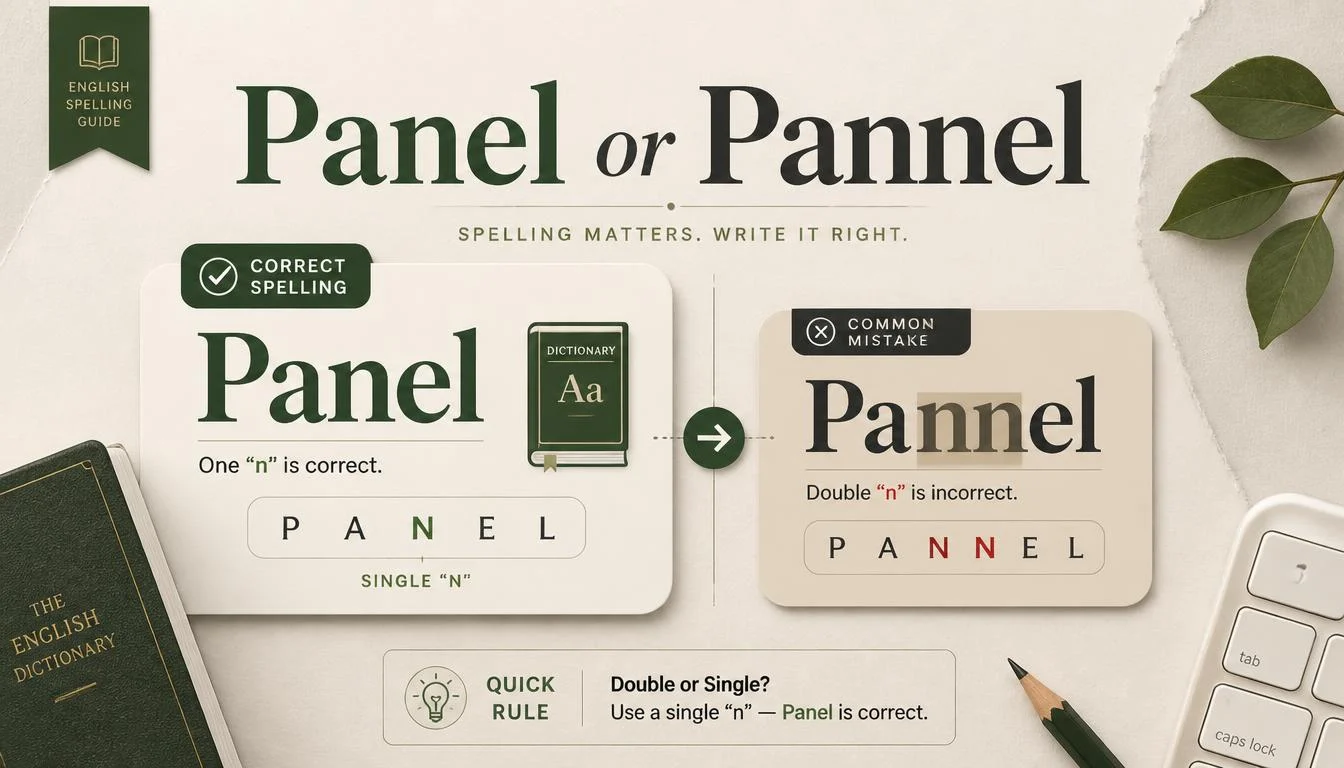
Panel or pannel confuses many writers, but only one spelling is real English. Panel is correct used for control panels, discussion panels, and wall panels. Pannel is a misspelling with an extra “n” that never appears in standard dictionaries. Always write panel, no matter the context.
You’re typing an email about tomorrow’s discussion panel, and your fingers hesitate for a second. Is it panel or pannel? That extra “n” looks strangely convincing once you stare at it long enough, and spellcheck doesn’t always catch it fast enough to stop you from hitting send.
This mix-up happens more often than people admit. Part of the confusion comes from words like “channel,” “funnel,” and “tunnel,” which double their final consonant before adding a suffix. Your brain borrows that pattern and applies it where it doesn’t belong. The result is a spelling mistake that can quietly undercut your credibility in a business email, a school assignment, or a professional report.
Getting this right matters more than it might seem. A misspelled word in a formal document a panel discussion invite, a technical manual describing a control panel, or a job application mentioning a review panel can make a reader pause and question your attention to detail. In this guide, you’ll learn exactly why panel is correct, why pannel keeps showing up anyway, and how to make sure you never second-guess yourself again.
Panel or Pannel: What’s the Difference?
There is no real difference between panel and pannel because pannel isn’t a word. Panel is the only accepted spelling in English, and pannel is simply an incorrect variant caused by a common spelling instinct.
Panel functions as both a noun and a verb. As a noun, it refers to a flat, distinct section of a surface (a wood panel on a door), a group of people assembled to discuss or judge something (a panel of judges), or a control interface (a solar panel or an instrument panel). As a verb, it means to decorate or construct something using panels, as in “the walls were panelled in oak” (British spelling) or “paneled in oak” (American spelling).
Pannel, on the other hand, has no dictionary entry, no accepted usage, and no grammatical function. It exists only as a typo.
| Meaning | Part of Speech | Refers To | Typical Usage | Example | Common Confusion |
|---|---|---|---|---|---|
| Flat section of a surface | Noun | Doors, walls, vehicles | Construction, design | “The door panel cracked.” | Written as “pannel” |
| Group of people | Noun | Experts, judges, committees | Business, media, academia | “She sat on the panel.” | Written as “pannel” |
| Control interface | Noun | Machines, dashboards, software | Technology, engineering | “Check the control panel.” | Written as “pannel” |
| To construct with panels | Verb | Walls, furniture | Interior design, carpentry | “They panelled the study.” | Written as “pannelled” |
In every one of these cases, the correct spelling stays the same: one “n,” never two. Once you accept that pannel simply isn’t a real option, choosing correctly becomes automatic rather than something you have to think through each time.
Is “Panel or Pannel” a Grammar, Vocabulary, or Spelling Issue?
This is a spelling issue, not a grammar or vocabulary problem. Grammar concerns sentence structure and word relationships; vocabulary concerns meaning and word choice between two valid options. Pannel fails at an earlier stage it’s simply not a recognized word, so there’s no meaning to compare and no grammatical rule to apply.
This distinguishes “panel or pannel” from genuine vocabulary confusions like “affect” versus “effect,” where both words exist and serve different purposes. Here, only one form is real. The confusion is purely orthographic, meaning it lives in how the word is written rather than in what it communicates.
In formal English, business writing, academic papers, and professional emails, “pannel” is always treated as an error, no exceptions apply. Spellcheck tools will flag it, style guides won’t recognize it, and any reader familiar with English will notice it immediately. There’s no casual register where doubling the “n” becomes acceptable, unlike some regional spelling variants (such as “colour” versus “color”) that shift based on British or American English. Panel is spelled identically in both traditions.
The practical takeaway: if you ever see “pannel” in a draft, treat it the same way you’d treat a typo like “recieve” instead of “receive.” Fix it immediately, and move on.
Panel: Meaning, Usage, and Examples
Panel comes from a single, stable spelling used across every English-speaking region. It’s pronounced PAN-uhl, with stress on the first syllable, and functions primarily as a noun, though it also works as a verb when discussing paneling a wall or surface.
Common collocations include “discussion panel,” “control panel,” “panel of experts,” “solar panel,” “panel discussion,” and “advisory panel.” Typical sentence patterns place panel after an article (“the panel,” “a panel”) or paired with a descriptive word before it (“expert panel,” “judging panel”).
Workplace example: “The HR team assembled a panel to review candidates for the senior developer role.”
Academic example: “Students presented their thesis findings to a panel of three professors.”
Technology example: “The technician replaced the damaged panel on the server’s front interface.”
Email example: “I’d like to confirm your availability for the panel discussion scheduled next Thursday at 2 PM.”
Daily conversation example: “Did you see that TV panel arguing about the election results last night?”
One common learner mistake involves adding an unnecessary second “n” when forming related words, writing “pannelist” instead of “panelist,” or “pannelled” instead of “paneled.” The rule stays consistent: panel keeps one “n” through every form and every tense.
Mini recap: Panel is the only correct spelling, used for physical surfaces, groups of people, and control interfaces, and it never doubles its final “n” in any related word form.
Pannel: Why This Spelling Doesn’t Exist
Pannel has no meaning, no dictionary listing, and no accepted grammatical role because it’s a misspelling rather than an actual word. It shows up in casual writing, social media posts, and even some business documents, almost always by accident.
The mistake typically stems from analogy with other English words. Words like “channel,” “funnel,” “tunnel,” “kennel,” and “flannel” all double the “n” before adding “el,” so it feels natural to expect “panel” to follow the same pattern. But English spelling doesn’t always follow consistent rules, and panel happens to be one of the exceptions.
There’s no pronunciation difference to guide you here, either, since “pannel” would be pronounced identically to “panel” if it existed. This makes the error harder to catch by ear and easier to catch only through visual memory or spellcheck.
Workplace example (incorrect): “Please review the pannel before the meeting.” should read “panel.”
Academic example (incorrect): “The pannel of reviewers approved the thesis.” should read “panel.”
Technology example (incorrect): “The control pannel needs recalibration.” should read “panel.”
Email example (incorrect): “Thank you for joining our expert pannel.” should read “panel.”
Daily conversation example (incorrect): “That solar pannel on the roof looks brand new.” should read “panel.”
One learner mistake worth flagging: writers who get this wrong once often repeat it consistently throughout an entire document, since they’re relying on a mental rule rather than checking each instance. This is why running a full document search for “pannel” before submitting any formal writing is worth the extra thirty seconds.
Mini recap: Pannel isn’t a word in any form, in any context, and in any English-speaking region it’s simply panel written with a spelling pattern borrowed from unrelated words.
When Writers Commonly Misspell Panel as Pannel
1. Rushed typing. When typing quickly, fingers often add an extra letter out of habit, especially right after typing similar double-consonant words.
2. Influence from other “-nnel” words. Channel, funnel, tunnel, and flannel all use double “n,” creating a false pattern that gets misapplied to panel.
3. Non-native English spelling instincts. Some languages use consistent doubling rules that don’t map onto English, leading learners to double consonants where English doesn’t require it.
4. Autocorrect gaps on older devices. Some spellcheck tools and older software don’t flag “pannel” as clearly as modern tools do, letting the error slip through.
5. Copying from unedited sources. If a writer references an unedited forum post, unofficial guide, or non-native content source containing the error, they may unknowingly repeat it.
6. Confusion with “panelling” in British English. British English legitimately doubles the “l” in verb forms like “panelling” and “panelled.” Writers sometimes overcorrect and mistakenly double the “n” as well, assuming the whole word follows a doubling pattern.
7. Visual memory errors. Writers who’ve seen the word “pannel” misspelled somewhere else in a text message, a sign, or a rushed document may unconsciously store that incorrect version as familiar.
8. Lack of proofreading in casual contexts. Social media captions, quick texts, and informal notes rarely get a second read, letting spelling errors like this one slide by unnoticed.
Remembering the “one n” rule becomes easier once you associate panel with similarly spelled words like “level,” “model,” and “travel” (in American English), all of which keep a single consonant before “el.
Common Mistakes Table
| Correct Sentence | Incorrect Sentence | Explanation |
|---|---|---|
| The judging panel announced the winners. | The judging pannel announced the winners. | Panel always uses a single “n.” |
| We installed a new solar panel yesterday. | We installed a new solar pannel yesterday. | No context changes the spelling. |
| She was invited to join the advisory panel. | She was invited to join the advisory pannel. | “Advisory panel” is a fixed collocation. |
| The control panel lit up red. | The control pannel lit up red. | Technical terms follow the same rule. |
| The room was panelled in dark wood. | The room was pannelled in dark wood. | Only the “l” doubles in British spelling, not the “n.” |
| He sits on three different panels. | He sits on three different pannels. | Plural forms don’t change the spelling rule. |
Decision Box
If you’re writing about a flat surface, a group of experts, or a control interface always use panel. There is no situation, formal or informal, where pannel is correct. If you catch yourself typing two “n’s,” stop and correct it before moving on.
Panel in Real-World Communication
Office communication: A manager sending a meeting invite writes, “Please join the panel review scheduled for Friday afternoon.”
Business email: A recruiter tells a candidate, “You’ll be interviewed by a three-person panel representing engineering, product, and HR.”
School or university: A professor announces, “Final presentations will be evaluated by a faculty panel next week.”
Customer support: A support agent explains, “Your issue has been escalated to our technical review panel for further investigation.”
Technology: A user manual instructs, “Locate the reset button on the rear panel of the router.”
Artificial Intelligence: A conference organizer notes, “The AI ethics panel will discuss data privacy concerns in emerging technology.”
Daily conversation: A friend mentions, “I watched a debate panel on the news last night, and it got pretty heated.”
Each of these examples reinforces the same pattern: panel appears constantly across formal and informal settings, and the spelling never changes regardless of tone or industry.
Panel in Modern Technology
Panel shows up constantly in technology writing, and getting the spelling right matters more here than almost anywhere else, since technical documentation gets referenced repeatedly by different readers.
In artificial intelligence and software design, “admin panel” and “dashboard panel” describe the interface where users manage settings or monitor data. Virtual assistants and chatbots often reference “control panels” when explaining how users adjust preferences or permissions. Voice assistants integrated into smart homes frequently connect to a “panel” that manages connected devices, lighting, or security systems.
Business tools like project management software or analytics platforms also use “panel” to describe modular sections of a dashboard, such as a “reporting panel” or “notifications panel.” Because these terms appear in interface labels, help documentation, and user guides, a spelling mistake here isn’t just a grammar slip it can create confusion about whether a described feature actually exists in the product.
Given how often panel appears in tech writing, treating the single “n” spelling as non-negotiable saves both writers and readers unnecessary confusion.
Word Origin
Panel traces back to Old French “panel” or “pan,” referring to a piece of cloth or a section of something larger. This connects to the Latin word “pannus,” meaning a piece of cloth. Over centuries, English adopted the word to describe flat sections of material, and later extended it metaphorically to groups of people assembled for a shared purpose, much like distinct “sections” brought together.
Interestingly, the Latin root “pannus” does contain a double “n,” which may partly explain why the misspelling “pannel” feels intuitively plausible to some writers. But English simplified the spelling to a single “n” long before the word took its modern form, and that simplified spelling has remained standard ever since.
Expert Insight
As a language instructor, I tell students that spelling confusion almost always traces back to pattern-matching rather than carelessness. Panel gets misspelled because the brain recognizes a familiar shape “-annel” or “-nnel” from other common words and assumes consistency where none exists. The fix isn’t memorizing a rule in isolation; it’s building a mental association between panel and other single-consonant words like “level,” “novel,” and “model.” Once that association forms, the correct spelling becomes automatic rather than something you have to consciously verify every time.
Error Prevention Checklist
- Always use panel when referring to a flat surface, a group of people, or a control interface.
- Never write pannel it has no valid use in any context, formal or informal.
- Never confuse this with British spelling variants like “panelling,” which only doubles the “l,” not the “n.”
- Quick memory tip: Panel has one “n,” just like “level” and “model” think “one and done.”
Related Grammar Confusions Worth Learning
- Affect vs. Effect one of the most common vocabulary confusions in English, worth mastering for clearer writing.
- Council vs. Counsel two words that sound identical but serve completely different purposes.
- Complement vs. Compliment an easy mix-up that can change the meaning of a sentence entirely.
- Principal vs. Principle a classic confusion that trips up even experienced writers.
- Stationary vs. Stationery a spelling distinction that matters in professional and academic writing.
- Cannel vs. Channel related to today’s topic, since “channel” legitimately doubles its “n.”
- Discreet vs. Discrete two words with subtle but important meaning differences.
- Advice vs. Advise a noun-verb pair that frequently gets swapped incorrectly.
- Its vs. It’s a foundational grammar rule every writer should have memorized.
- Practice vs. Practise a spelling variant that shifts between American and British English.
FAQs
Is “pannel” ever correct in British English?
No. British English uses panel with a single n, just like American English. The spelling does change in some verb forms, with British English using panelling and panelled with a doubled l, not a doubled n.
Why does “pannel” look so believable?
Pannel can look convincing because it resembles words such as channel, funnel, and tunnel, which contain a double n. This can make writers assume that panel follows the same spelling pattern, even though it does not.
Does spellcheck always catch “pannel”?
Most modern spellcheckers will flag pannel as an error. However, older software, mobile keyboards, or applications with limited spellchecking may not always catch it, especially when you’re typing quickly.
Is “panelist” spelled with one “n” or two?
Panelist is spelled with one n. It follows the same spelling as panel, so pannelist is incorrect.
What’s the correct plural form of panel?
The plural of panel is panels. Simply add s to the singular form without changing the internal spelling.
Does “pannel” appear in any dictionary at all?
Pannel is not a standard spelling of the common English word panel. In standard modern English, panel is the correct spelling.
Conclusion
The debate over panel or pannel really isn’t a debate at all. Panel is correct in every context professional, academic, casual, and technical while pannel is simply a misspelling that borrows its double “n” from unrelated words like channel and tunnel.
Once you recognize that panel keeps a single “n” no matter how it’s used, you’ll stop hesitating over the spelling entirely. A simple way to remember it for good: panel has “one and done” one “n,” and nothing more.
Read More Related Articles
- Happened or Happend | Master the Correct Usage in Minutes In 2026
- Anual or Annual | Simple Grammar Guide For Error-Free Writing In 2026
- Successfully or Succesfully | Easy Trick to Remember the Correct Spelling Forever In 2026

Lucas Mitchell is a content writer at synoseek.com. He writes simple, thoughtful pieces that focus on everyday ideas, observations and general knowledge topics. His work is shaped by a calm, realistic tone that keeps the reader engaged without overstatement.
9 thoughts on “Panel or Pannel | Quick Guide to the Correct English Spelling In 2026”