Quick Answer
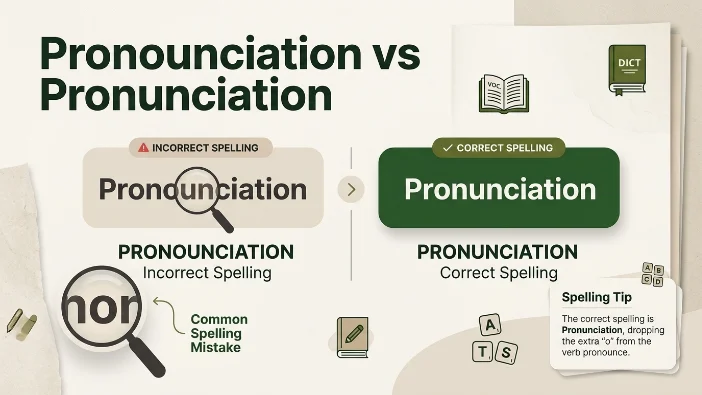
Pronunciation is the correct spelling in standard English, while pronounciation is a common misspelling that doesn’t appear in any major dictionary. The confusion happens because the related verb, “pronounce,” contains an “o” that many writers mistakenly carry over into the noun form. Always write pronunciation.
You say the word every day, but when it comes time to write it down, something strange happens. Your fingers want to type “pronounciation” even though your eyes tell you it looks wrong. This is one of the most common spelling slips in the English language, and there’s a very logical reason it keeps tripping people up.
The word you’re looking for is pronunciation, a noun that describes the way a word or language is spoken aloud. Its cousin, pronounce, is a verb meaning to say a word correctly or clearly. The problem is that pronounce has an “o” right in the middle of it, and when English speakers form the noun, their brain assumes that “o” should stay put. It doesn’t. The noun drops the “o” and becomes pronunciation, not pronounciation.
This single letter might seem trivial, but getting it wrong in a resume, an email to a client, or a school assignment can quietly undermine your credibility. Spelling mistakes like this one are noticed by teachers, employers, and readers even when they don’t say anything about it. In this guide, you’ll learn exactly why this mistake happens, how to remember the correct spelling permanently, and how the word behaves in real sentences, from classroom essays to workplace emails to voice assistant technology.
Pronounciation vs Pronunciation: What’s the Difference?
There is no real difference between these two spellings because only one of them is an actual word. Pronunciation is the standard, dictionary-approved noun. Pronounciation is simply an incorrect spelling that happens so often it has started to feel familiar, even though it has never been accepted as correct English.
Here’s the important part: this isn’t a case like “affect versus effect,” where two different words carry two different meanings. This is a single word with one correct form and one persistent typo. Understanding that distinction is the first step to fixing the habit for good.
| Feature | Pronunciation | Pronounciation |
|---|---|---|
| Meaning | The way a word or language is spoken | No accepted meaning |
| Part of Speech | Noun | Not a real word |
| Dictionary Status | Listed in Oxford, Cambridge, Merriam-Webster | Not listed in any major dictionary |
| Typical Usage | Formal and informal writing, academic work | Common misspelling only |
| Example | “Her pronunciation of French words is excellent.” | Incorrect: “Her pronounciation of French words is excellent.” |
| Common Confusion | Spelled with “pronounce” pattern in mind | Comes from misapplying the verb spelling to the noun |
So the recap here is simple. If you’re comparing spellings, you’re not really comparing two legitimate options. You’re comparing one correct word against one incorrect variation that a huge number of fluent speakers, students, and even professional writers accidentally produce. Once you see the pattern clearly, the mistake becomes much easier to catch before you hit send.
Is Pronunciation a Grammar, Vocabulary, or Spelling Issue?
This is purely a spelling issue, not a grammar or vocabulary problem. Grammar concerns how words function together in a sentence, and vocabulary concerns which word carries the right meaning. Neither applies here, because pronounciation isn’t a competing word with its own definition. It’s simply a misspelled version of pronunciation.
This distinction matters because spelling errors are treated differently depending on the setting. In casual text messages or quick chat conversations, a spelling slip barely registers. In formal English, business English, and academic writing, however, spelling accuracy reflects attention to detail. A cover letter, a research paper, or a client proposal with “pronounciation” instead of “pronunciation” can make a reader pause, even if only for a second, and that pause works against you.
In everyday conversation, nobody will interrupt you to correct your spelling since speech has no spelling at all. But the moment this word appears in writing, whether in an email, a text caption, or a printed document, only one version is acceptable. The practical takeaway: treat this as a spelling rule to memorize, not a grammar concept to study.
Understanding “Pronounce”: Where the Confusion Starts
The verb pronounce means to say a word or sound in a particular way, especially in a way that follows the accepted standard of a language. It’s pronounced “pruh-NOWNS,” with stress on the second syllable.
As a verb, pronounce fits naturally into sentences describing an action.
Workplace example: During the meeting, the new manager asked her assistant to pronounce the client’s name correctly before the call began.
Academic example: The professor asked each student to pronounce the Latin term slowly so the whole class could hear the syllables.
Technology example: The voice assistant struggled to pronounce the unusual street name correctly, repeating it in a flat, robotic tone.
Email example: “Could you let me know how to pronounce your last name? I want to get it right when I introduce you at the conference.”
Daily conversation example: “I never know how to pronounce ‘quinoa’ until someone says it out loud for me.
The most common learner mistake here isn’t misusing the verb itself. It’s assuming the noun form simply adds “-iation” to the end of “pronounce” without changing anything else. That assumption is exactly where “pronounciation” comes from.
Mini recap: Pronounce is the action word. It describes what a speaker does with their mouth and voice. Keep this separate in your mind from the noun that describes the overall result.
Understanding “Pronunciation”: The Correct Noun Form
Pronunciation is the noun that refers to the accepted or actual way a word, name, or language is spoken. It’s pronounced “pruh-nun-see-AY-shun,” and notice that the second syllable uses “nun,” not “noun.” That sound shift is actually one of the best memory tools available, and we’ll return to it shortly.
Common collocations include “correct pronunciation,” “native pronunciation,” “difficult pronunciation,” and “improve your pronunciation.”
Workplace example: The training manual included an audio guide so new employees could practice the correct pronunciation of technical product names.
Academic example: Linguistics students spend an entire semester studying pronunciation patterns across different English dialects.
Technology example: Many language learning apps now use speech recognition to score a user’s pronunciation in real time.
Email example: “Attached is a short audio clip demonstrating the pronunciation of the company name for your reference before the interview.”
Daily conversation example: “I always mix up the pronunciation of ‘February.’ Is the first ‘r’ silent or not?”
The most frequent learner mistake is inserting an extra “o” after the “pr” section, turning the word into “pronounciation.” Because the verb “pronounce” is so familiar, the brain assumes the noun should look almost identical.
Mini recap: Pronunciation is the noun. It’s the result, the pattern, the accepted way of speaking a word aloud. Say it slowly and you’ll notice it actually sounds different from “pronounce,” even though the words are clearly related.
When Writers Commonly Misspell This Word
Understanding exactly when this mistake happens makes it far easier to catch before you publish or submit your writing.
1. Right after typing the verb “pronounce.” When your fingers just typed p-r-o-n-o-u-n-c-e, they naturally want to repeat that same letter pattern in the next related word. This muscle memory is the single biggest cause of the error.
2. When writing quickly without proofreading. Fast typing, especially in emails or social posts, skips the mental pause needed to check spelling against memory.
3. In academic writing under deadline pressure. Students rushing through essays about language, linguistics, or communication skills often default to the more “logical-looking” spelling instead of the actual correct one.
4. When relying on sound instead of spelling. Some regional accents pronounce the word in a way that makes the incorrect “oun” spelling feel more natural to write.
5. In professional documents translated from other languages. Non-native English speakers sometimes apply spelling patterns from their first language, where a similar sound might genuinely include an “o.
6. When autocorrect fails to catch it. Not every spellchecker flags “pronounciation,” particularly in older software or basic browser extensions, which lets the error slip through untouched.
7. In handwritten notes and quick messages. Without spellcheck as a backup, writers rely purely on memory, and memory tends to favor the version that “matches” the verb.
8. When teaching or tutoring others. Ironically, some teachers and tutors misspell the word while creating materials about pronunciation itself, passing the error along to students.
Remembering the correct spelling comes down to one reliable trick: pronunciation contains the word “nun” in its middle syllable, not “noun.” If you can picture that small chunk of letters, the correct spelling becomes far easier to lock in permanently.
Common Mistakes Table
| Correct Sentence | Incorrect Sentence | Explanation |
|---|---|---|
| Her pronunciation of Spanish is nearly perfect. | Her pronounciation of Spanish is nearly perfect. | The noun form never includes an extra “o” after “pr.” |
| I want to improve my pronunciation before the interview. | I want to improve my pronounciation before the interview. | “Pronunciation” drops the “o” found in the verb “pronounce.” |
| The app rates your pronunciation using AI. | The app rates your pronounciation using AI. | Software and technical writing require the standard spelling. |
| Please check the pronunciation guide attached below. | Please check the pronounciation guide attached below. | Formal documents always use the dictionary spelling. |
| Correct pronunciation builds listener trust. | Correct pronounciation builds listener trust. | The extra “o” is never part of the accepted spelling. |
Decision Box
If you’re describing the action of saying a word aloud, use pronounce (verb).
If you’re describing the overall way a word is spoken, use pronunciation (noun), and remember: no extra “o,” think “nun,” not “noun.
Real-World Examples
Office communication: A new hire emails HR asking for guidance on the pronunciation of a coworker’s name before their first team meeting, avoiding an awkward mispronunciation in person.
Business email: A sales representative writes, “I’ve attached an audio file so you can hear the correct pronunciation of our product line before the client call.”
School or university: A professor grades an essay and circles “pronounciation” in red, reminding the student that spelling accuracy affects overall clarity and professionalism.
Customer support: A support agent tells a customer, “Our pronunciation guide on the website will help you say the ingredient names correctly.”
Technology: A podcast host uses an online pronunciation dictionary to confirm how to say a guest’s unfamiliar last name before recording.
Artificial Intelligence: A voice assistant developer tests hundreds of sample sentences to measure how accurately the AI models human pronunciation patterns.
Daily conversation: Two friends debate whether “gif” has a hard or soft “g,” settling the argument by checking an online pronunciation resource together.
Pronunciation in Modern Technology
Pronunciation has become a central concept in modern technology, especially as voice-based tools become part of daily life. Virtual assistants like voice-activated speakers rely on pronunciation models to understand spoken commands and respond in a natural-sounding voice. When these systems misjudge pronunciation, users often notice immediately, since a name or word said incorrectly feels jarring even in casual use.
Chatbots and text-to-speech software also depend heavily on accurate pronunciation databases. Developers train these systems using massive collections of recorded speech, mapping written words to their correct spoken form. Business tools built around video calls and translation now include real-time pronunciation feedback, helping international teams communicate more clearly across accents and languages.
Language learning apps take this even further, using speech recognition to score a learner’s pronunciation against native speaker recordings. This shift means the word “pronunciation” appears constantly in technical documentation, user interfaces, and app store descriptions, which makes spelling it correctly even more important for developers and content writers working in this space.
Word Origin
Pronunciation traces back to the Latin word “pronuntiare,” meaning to proclaim or announce. Old French adapted this into “pronunciacion,” and English eventually settled on the modern spelling, pronunciation. Interestingly, the verb “pronounce” evolved along a slightly different path in Middle English, which is exactly why the noun and verb ended up with different internal spellings despite sharing the same root meaning. This small historical detail explains why the two words look related but aren’t spelled identically.
Expert Insight
As a language instructor, I always tell students to separate sound from spelling when learning tricky word pairs like this one. Your ear hears “pro-NOUN-ciation” because of how the syllables get stressed in casual speech, but your eye needs to remember a completely different internal pattern. The fastest way to fix a stubborn spelling habit is to slow down, write the word by hand a few times, and consciously notice the “nun” in the middle. Once that visual pattern replaces the sound-based guess, the correct spelling tends to stick permanently.
Error Prevention Checklist
- Always use pronounce when describing the action of saying a word aloud.
- Always use pronunciation when describing the overall way a word is spoken.
- Never confuse them if you remember that pronunciation contains “nun,” not “noun.”
- Quick memory tip: “A nun teaches pronunciation,” a slightly odd sentence, but one that’s nearly impossible to forget.
Related Grammar Confusions
Affect vs Effect One is usually a verb and the other a noun, and mixing them up is one of the most common errors in professional writing.
Advice vs Advise The spelling changes based on whether you’re using a noun or a verb, similar to the pronounce and pronunciation pattern.
Complement vs Compliment These words sound identical but carry completely different meanings, making them easy to misuse in emails.
Definitely vs Definately Another frequently misspelled word where an extra or misplaced letter creates a nonstandard version.
Accommodate vs Acommodate A double-letter mistake that trips up even confident writers in formal documents.
Recommend vs Reccomend A classic double-consonant confusion that shows up constantly in cover letters and reviews.
Separate vs Seperate One of the most searched spelling questions in English, driven by how the word sounds when spoken quickly.
Grammar vs Grammer A simple but surprisingly common typo, especially among learners studying English grammar itself.
Judgment vs Judgement A spelling difference tied to American versus British English conventions, useful for business writers working internationally.
Occurrence vs Occurence Another double-letter trap that frequently appears in reports and academic papers.
FAQs
Is “pronounciation” ever considered correct in any English dialect?
No. “Pronounciation” is not a standard spelling in British, American, Australian, or other varieties of English. It is simply a common misspelling of “pronunciation.” There is no dialect where the incorrect spelling is accepted as a standard variant.
Why does “pronounce” have an “o” while “pronunciation” does not?
This difference comes from the historical development of the two words. Although “pronounce” contains an o before the final consonant sound, the noun developed with a different spelling pattern. As a result, the correct form is “pronunciation,” not “pronounciation.”
Do Microsoft Word and Google Docs flag “pronounciation”?
Usually, yes. Modern word processors and browsers with spell checking enabled generally recognize “pronounciation” as a misspelling and suggest “pronunciation.” Still, spell check should not be your only safeguard, especially when working with specialized software or disabled dictionaries.
Is “pronunciation” spelled differently in British and American English?
No. Both British and American English use “pronunciation.” Unlike words such as colour and color, there is no regional spelling difference here. The form “pronounciation” is incorrect regardless of which variety of English you use.
What’s an easy way to remember the spelling?
A useful trick is to focus on the middle of the word. Pronunciation contains “nun,” while the incorrect spelling often appears when writers carry the “ou” from pronounce into the noun. Remembering pronounce → pronunciation can help you avoid adding the extra o.
Is “mispronunciation” a correct word?
Yes. “Mispronunciation” is a standard English noun that means an incorrect way of pronouncing a word or sound. It follows the same spelling pattern as “pronunciation,” so it does not contain the extra o found in the common misspelling “pronounciation.
Conclusion
The takeaway here is refreshingly simple: pronunciation is the only correct spelling, and pronounciation, however familiar it might look, has no place in polished writing. The confusion almost always comes from borrowing the “o” out of the verb “pronounce” and mistakenly carrying it into the noun form.
Next time you’re typing this word, pause for one second and picture the middle syllable spelled “nun,” not “noun.” That small mental checkpoint is enough to prevent one of the most common spelling slips in English, whether you’re writing a school essay, a business email, or a quick text to a friend.
6 thoughts on “Pronounciation vs Pronunciation | Common Error You Can Avoid In 2026”