Quick Answer
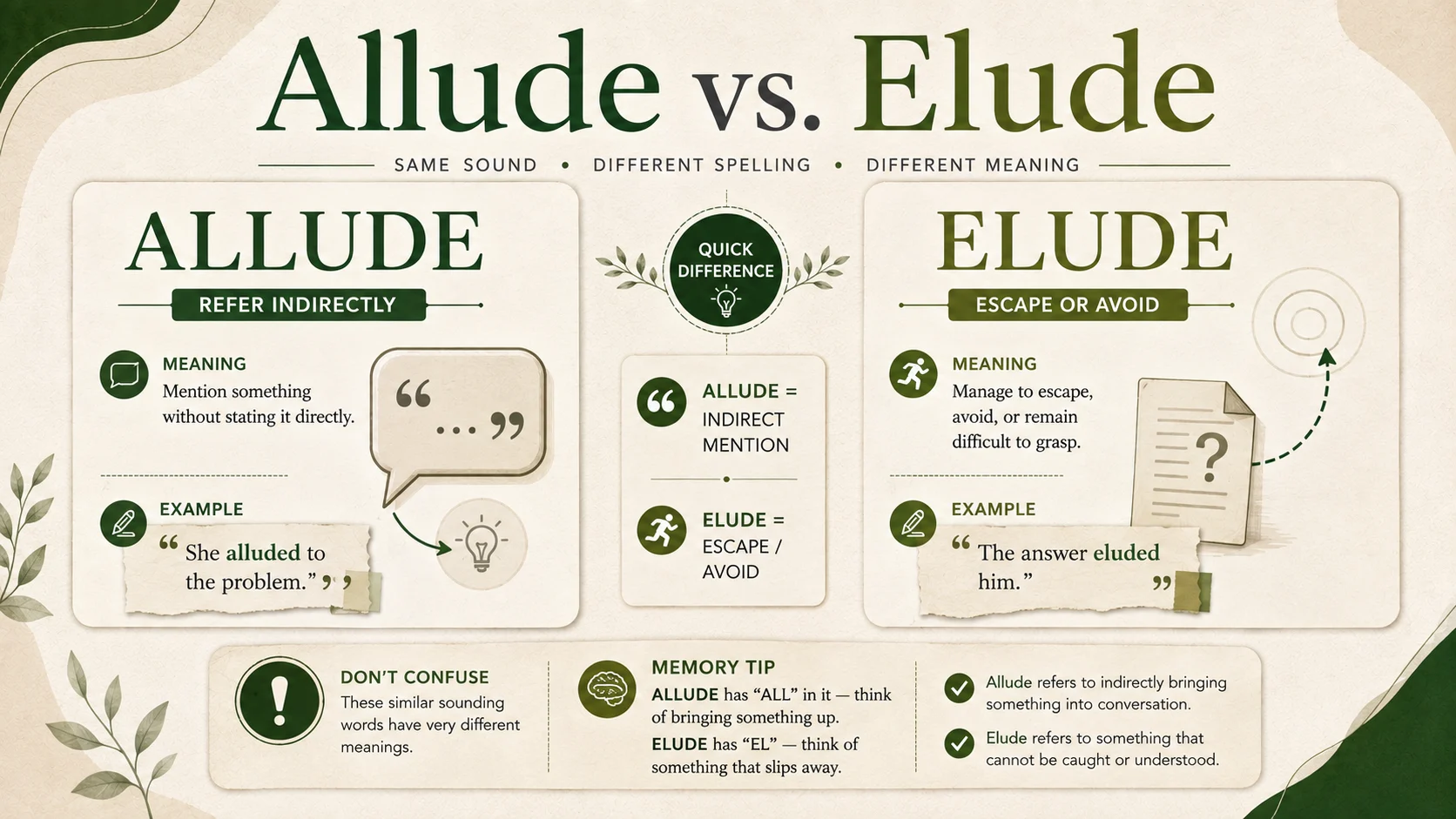
Allude means to hint at or refer to something indirectly, while elude means to escape, evade, or remain difficult to understand. The main difference is that allude is about making a reference (and is usually followed by “to”), while elude is about avoiding or being out of reach.
Many people mix up “allude” and “elude” because they look and sound almost identical. Both words are verbs, and both entered English around the same time, which doesn’t make things any easier. But here’s the problem: using the wrong word can change your entire sentence’s meaning. Imagine telling your boss you “eluded to the quarterly report” instead of “alluded to it.” That small mistake could make you sound like you were trying to avoid a conversation rather than making a helpful reference.
In this guide, you’ll learn exactly when to use each word and how to remember the difference. We’ll skip the textbook definitions and dive straight into practical examples you can actually use. By the end, you’ll never second-guess which word belongs in your sentence again.
What’s the Difference Between Allude and Elude?
Here’s the simple distinction: you allude when you hint at something without directly mentioning it. You elude when you escape or avoid something.
Both words are verbs, but they serve completely different purposes in a sentence. Allude is almost always followed by the preposition “to.” You allude to something. Elude, on the other hand, takes a direct object. Something eludes someone or something eludes capture.
| Feature | Allude | Elude |
|---|---|---|
| Meaning | To hint at or refer indirectly | To escape, avoid, or remain out of reach |
| Part of Speech | Verb | Verb |
| Followed by | Usually “to” | Direct object |
| Focus | Suggestion, reference, hint | Evasion, escape, failure to grasp |
| Example | “She alluded to past mistakes.” | “The answer eludes me.” |
| Common Confusion | Sometimes misused when “elude” is intended | Sometimes misused when “allude” is intended |
Think of it this way: allude is about saying something without saying it directly. Elude is about something getting away from you.
Is This a Grammar, Vocabulary, or Usage Issue?
The confusion between allude and elude falls somewhere between vocabulary and usage. It’s not a grammar mistake in the sense of sentence structure—both words function correctly as verbs. Instead, it’s a vocabulary error that happens when writers grab the wrong word because the spellings are so similar.
In formal writing contexts like business reports, academic papers, and professional emails, this distinction matters. Most style guides, including those that follow Merriam-Webster or dictionary.com, emphasize that these words are not interchangeable. Using “allude” when you mean “elude” (or vice versa) signals a lack of precision that can undermine your credibility.
In everyday conversation, people might not notice the difference as quickly, but in writing, the error stands out. The good news? This is one of the easier word pairs to master once you have a solid memory trick.
Allude: Definition, Usage, and Examples
Allude means to make a casual or indirect reference to something without naming it directly. When you allude to something, you assume your audience has enough background knowledge to understand what you’re hinting at.
The word traces back to the Latin allūdere, meaning “to play beside” or “to make a playful allusion to”. It entered English in the early 1500s and has held its meaning of indirect reference ever since.
Common Patterns
- Allude + to + object: “The article alluded to political tensions.”
- Allude + that (less common but acceptable): “He alluded that changes were coming.”
Natural Examples
Workplace Context
“The CEO alluded to upcoming layoffs without giving specifics.”
Academic Context
“The professor alluded to a famous study during the lecture.”
Everyday Conversation
“She kept alluding to the surprise party, but I pretended not to notice.”
Email Context
“In my previous email, I alluded to the budget concerns we discussed.”
Technology Context
“The developer alluded to a bug in the system during the meeting.”
One Common Learner Mistake
Wrong: “She alluded the reason for her absence.”
Right: “She alluded to the reason for her absence.”
The preposition “to” is essential. Without it, the sentence sounds awkward and incomplete.
Elude: Definition, Usage, and Examples
Elude means to escape from or avoid something, whether physically, mentally, or figuratively. It comes from the Latin ēlūdere, which meant “to deceive” or “to evade,” and entered English in the mid-1600s.
Unlike allude, elude doesn’t need a preposition. It takes a direct object and usually describes someone or something that can’t be caught, understood, or achieved.
Common Patterns
- Elude + person: “Sleep eluded her.”
- Elude + capture/understanding: “The criminal eluded capture for months.”
Natural Examples
Workplace Context
“Despite careful planning, a definitive solution eluded the team.”
Academic Context
“The concept eluded several students until we did practical examples.”
Technology Context
“The source of the software glitch eluded the debugging team for weeks.”
Email Context
“We’ve tried every approach, but the answer eludes me at this stage.”
Everyday Conversation
“The perfect recipe for the dish eluded me all afternoon.”
One Common Learner Mistake
Wrong: “The answer alludes me.”
Right: “The answer eludes me.”
If something is hard to grasp or escapes your understanding, you want “elude,” not “allude”.
When NOT to Use Each Word
Many writers accidentally choose the wrong word because they’re moving too quickly or because they’ve heard one term used incorrectly. Here are situations where you should pause and choose carefully:
Allude Mistakes
| Why the Mistake Happens | Which Word is Correct | How to Remember |
|---|---|---|
| You mean to say someone escaped or avoided, but you write “alluded” instead. | Elude | “Elude” sounds like “escape”—both start with “E.” |
| You’re talking about a reference, but you think “allude” requires a person. It doesn’t. | Allude | “Allude” is about hinting, not avoiding. |
| You’re talking about something being hard to understand. | Elude | If it’s hard to understand, it eludes you. |
| You’re mentioning a rule or guideline indirectly. | Allude | If you’re referring to it, you allude to it. |
| You’re avoiding responsibility. | Elude | If you escape duty, you elude it. |
| You’re referencing pop culture in a casual conversation. | Allude | You allude to a movie or song. |
Common Confusion Table
| Correct Sentence | Incorrect Sentence | Explanation |
|---|---|---|
| “He alluded to the scandal.” | “He eluded to the scandal.” | “Allude to” means to reference; “elude” can’t take “to”. |
| “The escapee eluded police.” | “The escapee alluded police.” | “Elude” means evade; “allude” needs “to”. |
| The meaning eludes me. | The meaning alludes me. | If you don’t understand, it eludes you. |
| “She alluded to our conversation.” | “She eluded our conversation.” | She referenced it, she didn’t avoid it. |
Decision Box
Use “allude” if:
- You want to hint at something indirectly.
- You’re making a reference that isn’t explicit.
- You can replace the word with “refer to” or “hint at.”
Use “elude” if:
- Something escapes or evades you.
- You can’t grasp or understand something.
- You can replace the word with “escape” or “avoid.”
Real-World Examples
Here are practical situations where you might need these words in everyday life:
Office Communication
“The manager alluded to possible promotions during the quarterly meeting but didn’t mention specific names.”
Business Email
“I don’t want to allude to the internal conflict in my response, but I need to acknowledge it professionally.”
School or University
“The theory eluded me at first, but I finally understood it after studying the examples.”
Customer Support
“The answer to the customer’s complaint eludes our team right now, but we’re gathering more information.”
Technology
“The software bug eluded the QA team through three rounds of testing.”
Daily Conversation
“Mom kept alluding to a surprise for my birthday, but I couldn’t figure out what it was.”
Allude and Elude in Modern Technology
In the technology and AI space, these words take on specific meanings:
Allude
When you talk about generative AI, chatbots, or voice assistants, you might say a system “alludes to” information. AI systems often allude to underlying data patterns without explicitly citing their sources.
Elude
In tech contexts, bug fixes, software solutions, or data insights can elude development teams. “The root cause eluded the debugging team for weeks.”
Word Origin
Both words share a common ancestor: the Latin ludere, meaning “to play.” Allude comes from allūdere, or “to play beside,” which evolved into making a playful reference. Elude comes from ēlūdere, meaning “to play away” or “to deceive,” which later shifted to “evade” and “escape”.
While their histories are connected, their meanings have traveled in very different directions. Understanding their origins can help you remember that they’re fundamentally different despite their similarities.
Expert Insight
When I teach my students the difference between ‘allude’ and ‘elude,’ I tell them to visualize the word ‘A’ for ‘Addition’ and ‘E’ for ‘Escape.’ ‘Allude’ is adding a hint—you’re saying something without saying it. ‘Elude’ is escaping—you’re getting away, or something is getting away from you. Once you hear that distinction in your head, the correct word often follows naturally.
Error Prevention Checklist
- Use “allude” when: You’re making an indirect reference (and always include “to”).
- Use “elude” when: Something is escaping, avoiding, or failing to be understood.
- Never confuse them when: You’re talking about a subtle hint versus a physical or mental escape.
- Quick memory tip: Allude = About a reference; Elude = Escape.
Related Grammar Confusions
If this word pair trips you up, you might also want to explore other commonly confused words to sharpen your writing:
- Affect vs. Effect – One is usually a verb, the other a noun.
- Complement vs. Compliment – One completes, the other praises.
- Principal vs. Principle – One is a person or primary thing; the other is a rule.
- Stationary vs. Stationery – One is still; the other is paper goods.
- Its vs. It’s – Possessive vs. contraction.
- Lose vs. Loose – One means misplace; the other means not tight.
- Than vs. Then – Comparison vs. sequence.
- Farther vs. Further – Physical distance vs. metaphorical distance.
FAQs
Can “allude” be used without “to”?
Usually, no. “Allude” is normally followed by “to” when referring to an indirect reference. For example, “The speaker alluded to the earlier discussion.” Using allude without the expected preposition is generally considered incorrect in standard usage.
Can “elude” be used with “to”?
No. “Elude” normally takes a direct object and does not require “to.” For example, you can say “The suspect eluded the police” or “She eluded capture.” The incorrect phrase “elude to” often results from confusing elude with allude to.
What are the noun forms of “allude” and “elude”?
The noun form of “allude” is “allusion,” which means an indirect reference. The noun “elusion” exists but is uncommon. Depending on the context, “elusiveness” is often more natural when describing the quality of being difficult to find, understand, or capture.
Do “allude” and “elude” sound exactly the same?
No. They sound similar but have different initial vowel sounds. “Allude” begins with an “uh” sound, while “elude” begins with an “ee” sound. The difference can be subtle in fast speech, which makes the words easy to confuse when writing.
Which word is more common in everyday English?
“Elude” is often more familiar in everyday contexts because it commonly describes escaping or avoiding someone or something. “Allude” is frequently used in academic, literary, and professional writing when referring indirectly to a person, idea, event, or subject.
Conclusion
The difference between allude and elude is simple once you know what to look for: allude is about hinting and reference (always with “to”), and elude is about escape and avoidance. One word points toward something indirectly; the other points away from something that’s out of reach.
Keep this memory rule in mind: Allude is About adding a hint. Elude is about Escaping. With that distinction in place, you’ll never misuse these words again. And if you do catch yourself hesitating, just ask: “Am I making a reference, or is something getting away from me?” The answer will point you to the right word every time.