Quick Answer
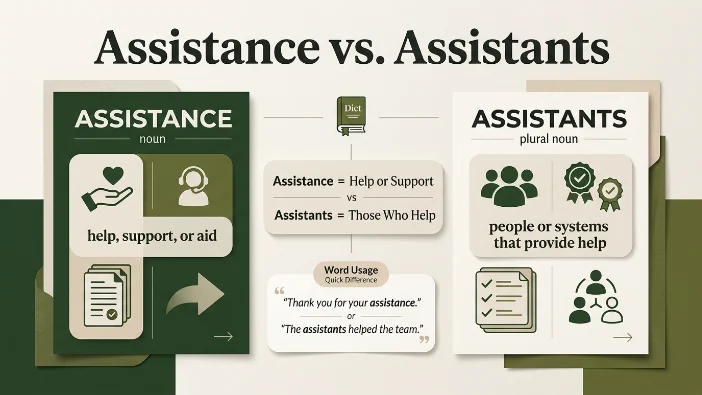
The main difference between “assistance” and “assistants” is that “assistance” refers to help or support (a concept), while “assistants” refers to people or tools that provide help (physical entities). “Assistance” is a singular noun, whereas “assistants” is the plural form of “assistant.” Understanding this distinction prevents common writing errors in professional communication.
Have you ever stared at your screen, unsure whether to write “I need assistance” or “I need assistants”? You’re certainly not alone. This confusion is remarkably common among English learners and even native speakers, particularly in fast-paced work environments where clear communication matters.
The confusion stems from both words sharing the same root and dealing with the general concept of help. However, they serve entirely different grammatical functions and refer to completely different things. One describes an abstract concept the act of helping. The other describes actual people or things that do the helping.
In this guide, we’ll clear up this confusion once and for all. You’ll learn exactly when to use each word, how to avoid embarrassing mistakes, and why these distinctions matter in professional writing. Whether you’re writing business emails, academic papers, or just trying to sound more polished in everyday communication, understanding the difference between “assistance” and “assistants” will make your writing more precise and professional.
What’s the Difference Between Assistance and Assistants?
Assistance” and “assistants” are related but serve completely different functions in English. Simply put, assistance is an uncountable noun meaning “help” or “support.” It’s an abstract concept something you provide, receive, or request. You can’t touch assistance; you can only experience or observe it.
On the other hand, assistants is the plural form of “assistant,” which refers to a person, machine, or software application that provides help. Assistants are concrete entities they have physical form, names, or specific functions. When you say “assistants,” you’re talking about multiple helpers, not the help itself.
Comparison Table
| Aspect | Assistance | Assistants |
|---|---|---|
| Meaning | Help, support, or aid | People or tools that provide help |
| Part of Speech | Uncountable noun | Plural countable noun |
| Refers To | An abstract concept or action | Physical or digital entities |
| Typical Usage | “I need assistance with my application.” | “The assistants completed the training.” |
| Example | “The company provides financial assistance.” | “Our virtual assistants handle customer queries.” |
| Common Confusion | Mistakenly used as a plural noun | Mistakenly used to mean “help |
The critical distinction lies in whether you’re referring to the act of helping or the helpers themselves. When you ask for assistance, you’re requesting help. When you refer to assistants, you’re talking about the people or tools that might provide that help.
Is This a Grammar, Vocabulary, or Usage Issue?
This distinction falls into all three categories, but for different reasons.
Grammar classification: The primary issue is grammatical. “Assistance” is an uncountable noun that takes singular verb agreement. “Assistants” is a plural countable noun that requires plural verb agreement. Using them incorrectly affects subject-verb agreement and overall sentence structure.
Vocabulary difference: These are distinct lexical items with different meanings. While they share a common root, they have evolved to represent different concepts. Understanding their specific definitions helps expand your vocabulary precision.
Usage difference: This is perhaps the most practical aspect. In everyday communication, using the wrong word can confuse your audience. Saying “I need assistants” when you mean “I need assistance” suggests you’re looking for people, not help. This changes the entire meaning of your request.
Are they interchangeable? Absolutely not. In formal English, business writing, and academic contexts, using these words correctly signals professionalism and attention to detail. Using them incorrectly suggests carelessness or limited language proficiency.
Practical takeaway: Treat “assistance” as an abstract concept and “assistants” as concrete entities. This mental distinction will guide you toward the correct choice every time.
Understanding “Assistance” in Detail
Meaning and Definition
Assistance” means help, support, or aid provided to someone in need. It’s an uncountable noun that describes the action or process of helping rather than the helper themselves. When you provide assistance, you’re offering support that makes a task easier or possible for someone else.
Pronunciation
Assistance is pronounced /əˈsɪs.təns/ in standard American English. The emphasis falls on the second syllable “sis.” Think of it as “uh-SIS-tens.”
Part of Speech
Uncountable noun (always singular). You cannot make “assistance” plural by adding an “s.” The correct form is always “assistance,” regardless of how much help is involved.
Common Collocations
- Provide assistance
- Offer assistance
- Need assistance
- Financial assistance
- Technical assistance
- Medical assistance
- Legal assistance
- Request assistance
- Receive assistance
Typical Sentence Patterns
- Someone + needs + assistance + with + something
- Our customers frequently need assistance with billing questions.
- Someone + provides/offers + assistance + to + someone
- The IT department provides technical assistance to all employees.
- Assistance + is + needed/available + for + something
- Financial assistance is available for eligible students.
Workplace Example
“After the merger, the HR team provided extensive assistance to employees navigating the new benefits system.”
Academic Example
“Graduate students often seek assistance from their advisors when formulating research questions.”
Technology Example
“The software’s help feature offers step-by-step assistance for troubleshooting common issues.”
Email Example
“Dear Team, I’m reaching out to request assistance with the quarterly report. The new data visualization tools require some expertise I’m still developing.”
Daily Conversation Example
“I’m going to need some assistance moving this couch it’s much heavier than it looks!”
One Learner Mistake
Incorrect: “Can you give me some assistances with my homework?”
Correct: “Can you give me some assistance with my homework?”
Why: “Assistance” is uncountable and never takes a plural form. Adding an “s” is grammatically incorrect.
Mini Recap
“Assistance” is always singular, describes help as a concept, and works with verbs like “provide,” “need,” and “request.” Never pluralize it, and remember it refers to the help itself rather than the helper.
Understanding “Assistants” in Detail
Meaning and Definition
“Assistants” refers to people, digital tools, or software applications that provide help to others. The singular form “assistant” describes someone who assists, while “assistants” is the plural form referring to multiple helpers. These helpers can be human employees, virtual chatbots, AI applications, or physical tools designed to make tasks easier.
Pronunciation
Assistants is pronounced /əˈsɪs.tənts/ in standard American English. The emphasis falls on the second syllable “sis” with a clear “ts” sound at the end to indicate the plural. Think of it as “uh-SIS-tents.”
Part of Speech
Plural countable noun. The singular form is “assistant.” Unlike “assistance,” you can have one assistant, two assistants, or many assistants.
Common Collocations
- Administrative assistants
- Virtual assistants
- Personal assistants
- Executive assistants
- Teaching assistants
- Digital assistants
- Voice assistants
- AI assistants
- Medical assistants
- Research assistants
Typical Sentence Patterns
- Someone + works as + a/an + assistant + (in/at + place)
- She works as an executive assistant at a law firm.
- Multiple assistants + perform + tasks
- Our virtual assistants handle customer inquiries 24/7.
- Someone + hires/employs + assistants + to + verb
- The director hired three assistants to help with event logistics.
Workplace Example
“The marketing team hired two assistants specifically for the product launch campaign.”
Academic Example
“Research assistants play a crucial role in data collection and analysis for large-scale studies.”
Technology Example
“Voice assistants like Siri and Alexa have transformed how we interact with our devices.”
Email Example
“Please direct all scheduling questions to my assistants, who will coordinate availability for the upcoming meeting series.”
Daily Conversation Example
“With all the chaos of the holiday season, I wish I had four assistants just to handle gift wrapping!”
One Learner Mistake
Incorrect: “I need assistant with this heavy box.”
Correct: “I need assistance with this heavy box.”
Why: Using “assistant” when you need “assistance” changes your meaning from “help” to “a helper.” Unless you’re specifically asking for someone to physically help you, you want “assistance.
Mini Recap
“Assistants” always refers to multiple helpers, whether human or digital. Count them, name them, and describe their specific functions. The singular “assistant” describes one helper, while “assistants” describes more than one.
When Not to Use Each Word
Situations Where People Choose the Wrong Word
1. When requesting help through email
Many professionals write “I need assistants with this project” when they truly need help, not additional staff. This mistake often occurs in fast-paced work environments where quick typing leads to errors.
Why it happens: Rushing through communication or assuming the words are interchangeable.
Correction: Use “assistance” when describing the help you need. “I need assistance with this project.”
Remember: If you’re not looking for people, you don’t need “assistants.”
2. When describing technology features
Writers often confuse “assistance” and “assistants” when discussing software tools. The software provides excellent assistants” is incorrect if you mean helpful features.
Why it happens: Misunderstanding the distinction between help as a concept and tools that provide help.
Correction: “The software provides excellent assistance” (if you mean helpful features) or “The software uses virtual assistants” (if you mean digital helpers).
3. In academic writing about support services
Some students write “The university offers many assistants for international students” when they mean support services.
Why it happens: Thinking that “assistants” is simply the plural of “assistance.”
Correction: “The university offers many assistance programs for international students” or “The university employs assistants to help international students.”
4. When discussing customer service
“I called for assistance, but none of the assistants could help” is correct. “I called for assistants, but none of the assistance could help” is incorrect and illogical.
Why it happens: Failing to distinguish between the person and the service they provide.
Correction: Match your word to the entity you’re referring to the service (assistance) or the people (assistants).
5. In job descriptions
Posting “We’re hiring assistance for the sales department” is incorrect when you mean staff.
Why it happens: Confusing the help you need with the helpers you want to hire.
Correction: Use “assistants” for positions or “assistance” for temporary help. “We’re hiring sales assistants” means new staff; “We need sales assistance” means temporary support.
6. When discussing AI and technology
Confusing these terms in AI contexts is increasingly common. “The AI provides excellent assistance” describes its helpful features. “The AI uses multiple assistants” describes helper agents within the system.
Why it happens: The rapid evolution of AI terminology leads to imprecise language.
Correction: Be specific about whether you’re referring to the support (assistance) or the helper entities (assistants).
7. In everyday conversation
“Can I get some assistants with this application?” is incorrect you’re asking for helpers, not help.
Why it happens: Overgeneralizing patterns from other plural nouns.
Correction: “Can I get some assistance with this application?” Keep “assistance” singular and conceptual.
8. When discussing financial aid
“Financial assistants” is often confused with “financial assistance.” The former suggests people who help with finances; the latter suggests monetary support.
Why it happens: Similar spelling and shared meaning create confusion.
Correction: If you mean money, use “assistance.” If you mean people, use “assistants.”
Common Mistakes Table
| Correct Sentence | Incorrect Sentence | Explanation |
|---|---|---|
| “I need assistance with my resume.” | “I need assistants with my resume.” | Unless you’re looking for people to help, you need “assistance” (help). |
| “The software provides excellent assistance.” | “The software provides excellent assistants.” | Software features provide “assistance” (help), not “assistants” (helpers). |
| “Our customer service assistants are highly trained.” | “Our customer service assistance are highly trained.” | “Assistance” is singular and refers to help; “assistants” are people you can train. |
| “Can you offer me some assistance?” | “Can you offer me some assistances?” | “Assistance” is uncountable and never takes an “s.” |
| “We’re hiring three administrative assistants.” | “We’re hiring three administrative assistance.” | You hire people (“assistants”), not help as a concept (“assistance”). |
| “The teaching assistants graded papers.” | “The teaching assistances graded papers.” | “Assistants” are people who do jobs; “assistance” cannot grade papers. |
| “Financial assistance is available for students.” | “Financial assistants are available for students.” | “Financial assistance” means money; “financial assistants” would be people who help with money. |
Decision Box
If you mean the action of providing help: Use ASSISTANCE.
If you mean the people or tools providing help: Use ASSISTANTS (or ASSISTANT for just one).
Remember: Assistance = help as a concept. Assistants = helpers as people or tools.
Real-World Examples
Office Communication
“I appreciate the assistance you provided on the quarterly report.” (You’re thanking someone for their help, not calling them an assistant.)
“Can we bring in temporary assistants during the holiday rush?” (You want extra people, not just help.)
Business Email
“Dear Patricia, I’m writing to request your assistance with the client presentation next week.” (You want someone’s help, not to hire someone.)
“The executive assistants will coordinate the meeting schedule.” (You’re referring to specific people with defined roles.)
School or University
“The university offers tutoring assistance for first-year students.” (The help itself is available, not the people.)
“Our teaching assistants host review sessions every Thursday.” (You’re talking about the people who teach.)
Customer Support
“Customers requiring assistance should press zero to reach a representative.” (They need help, not people.)
“Our support assistants are trained to handle technical issues.” (The people who provide help.)
Technology
“The new update includes voice assistance for navigation.” (The feature provides help, not a person.)
“AI assistants now handle basic customer queries across most platforms.” (Digital helpers that do specific tasks.)
Daily Conversation
“Do you need any assistance carrying those groceries?” (Offering help, not suggesting you become someone’s assistant.)
“With all these guests arriving, I’m going to need a few assistants.” (You want extra helpers.)
Modern Technology and Digital Assistants
In today’s digital landscape, the distinction between “assistance” and “assistants” has become particularly relevant. Technology has given us a new category of “assistants” that aren’t human.
Virtual Assistants: Software applications like Alexa, Siri, and Google Assistant are properly called “assistants.” They serve as helpers, responding to commands and performing tasks. When you say “Alexa, set a timer,” you’re interacting with an assistant.
AI-Powered Assistants: Tools like ChatGPT, Claude, and specialized business AI systems often function as assistants. They provide help, but they’re the helpers themselves.
Software Assistance: The help menus, tutorials, and guidance within applications are “assistance.” Your word processor’s grammar check provides assistance, but it isn’t an assistant unless it’s named something like “Writing Assistant.”
Chatbots: Many are called “virtual assistants” and serve as assistants. The help they provide is “assistance.” So when you use a chatbot, you’re using an assistant to get assistance. This distinction matters professionally and academically.
Business Tools: Productivity platforms increasingly use both terms. “Our AI provides decision-making assistance” describes help. “Our AI assistants analyze data” describes the tools providing that help.
The growth of AI has made this distinction more important than ever. Understanding the difference shows you’re keeping up with professional language standards and can communicate precisely about technology.
Word Origins
Both “assistance” and “assistant” trace their roots to the Latin word assistentem, meaning “standing by” or “being present.” The verb assistere combined “ad-” (meaning “to” or “toward”) and “sistere” (meaning “to stand” or “cause to stand”).
Over centuries, the terms evolved differently in English. “Assistance” emerged as the abstract noun describing the act of standing by someone the help itself. “Assistant” became the person who stands by to help.
Interestingly, “assistant” entered English as an adjective meaning “helpful” before becoming a noun for a helper. The plural “assistants” naturally followed as people began working in teams.
This history explains why the distinction matters: one word describes the action, the other describes the actor. Understanding this origin helps you remember which word to use in which context.
Expert Insight
From a language teaching perspective, I find that students generally understand this distinction once they grasp the difference between abstract concepts and concrete entities. The challenge isn’t understanding “assistance” versus “assistants” it’s remembering to apply that understanding in real-time communication.
My most effective teaching strategy involves asking students to complete the sentence “I need…” If they complete it with a verb or noun phrase describing an action (“to finish,” “with the report”), they typically need “assistance.” If they complete it with a number or specific description (“a new,” “trained,” “reliable”), they need “assistant” or “assistants.”
This practical test works across proficiency levels. The words themselves aren’t complicated. The confusion comes from their similar sound and shared meaning. A simple mental rule “assistance is help, assistants are helpers” often resolves the issue instantly.
Error Prevention Checklist
- ☐ Always use “assistance” when referring to help as a concept or action.
- ☐ Always use “assistants” when referring to multiple people or tools that provide help.
- ☐ Never pluralize “assistance” it’s always singular and uncountable.
- ☐ Don’t confuse “assistant” with “assistance” one helper versus the help they provide.
- ☐ Match your verb to your noun singular with “assistance,” plural with “assistants.”
- ☐ Ask yourself: Am I describing help or helpers? This question usually points to the correct choice.
- ☐ Quick memory tip: Assistance has no “s” at the end because help doesn’t have a plural. Assistants has an “s” because helpers come in groups.
Related Grammar Confusions
Affect vs. Effect: Similar abstract/concrete distinction affect is usually an action (to influence), effect is usually a result or thing.
Advice vs. Advise: One is a noun (guidance), the other is a verb (to guide) parallel to assistance (help) vs. assist (to help).
Principal vs. Principle: One describes a person or primary thing, the other describes a rule or belief.
Compliment vs. Complement: Similar sounds with very different meanings one is praise, the other is completion.
Accept vs. Except: Accept is to receive; except is to exclude.
Than vs. Then: One compares, the other indicates sequence.
Your vs. You’re: One shows possession, the other is a contraction.
Its vs. It’s: One shows possession, the other is a contraction.
There, Their, and They’re: Location, possession, and contraction a classic trio.
Whose vs. Who’s: Possession versus contraction.
FAQs
Is “assistance” plural?
No. Assistance is an uncountable noun, so it does not normally have a plural form. You can say some assistance, additional assistance, or a lot of assistance, but assistances is not standard in ordinary English.
Can “assistant” mean the same as “assistance”?
No. Assistant refers to a person or tool that provides help, while assistance refers to the help itself. For example, an assistant can provide assistance.
How can I remember the difference?
Think of assistance as the help and assistant as the helper. If you’re talking about what someone provides, use assistance. If you’re talking about who or what provides it, use assistant.
Is “assistants” just the plural of “assistant”?
Yes. Assistant becomes assistants in the plural. However, assistants is not the plural of assistance. Since assistance is generally uncountable, it does not normally take an -s ending.
When should I use “assistance” instead of “help”?
Both words can mean support, but assistance often sounds more formal or professional. Help is more versatile and natural in everyday conversation, while assistance is common in business, academic, customer service, and other professional settings.
Why do people confuse “assistance” and “assistant”?
The words share the same root and are closely related in meaning, which makes them easy to mix up. The key difference is grammatical: assistant identifies the helper, while assistance describes the help being provided.
Can “assistant” be used as an adjective?
Yes. Assistant can function as a noun modifier in expressions such as assistant manager, assistant professor, and assistant director. It describes a position that supports or ranks alongside the person named in the main noun.
Does the distinction matter for AI assistants?
Yes. An AI assistant is the tool that provides support, while assistance refers to the support itself. For example, “The AI assistant provides assistance with scheduling” uses both words correctly.
Is “assistance” used only in formal writing?
No. Although assistance is especially common in professional and formal communication, it can also be used in everyday speech. For example, “Do you need any assistance?” is a perfectly natural and polite question.
Can I use both “assistance” and “assistants” in one sentence?
Absolutely. The two words refer to different things, so they can naturally appear together. For example, “Our assistants provide assistance to customers” correctly distinguishes the people providing help from the help itself.
Conclusion
The difference between “assistance” and “assistants” is straightforward once you understand the core concept: assistance is the help you need, and assistants are the helpers who provide it. One is an abstract noun, always singular, describing an action or support. The other is a plural noun, describing specific entities people, tools, or technologies that do the helping.
Mastering this distinction elevates your professional communication instantly. In business emails, academic papers, and everyday conversations, using these words correctly signals attention to detail and linguistic precision. It’s one of those small language choices that makes a big impression.
The rule is simple: if you can count it, it’s assistants (one assistant, two assistants). If you can’t count it, it’s assistance (some assistance, much assistance, but never assistances). Remember this, and you’ll never confuse them again.