Quick Answer
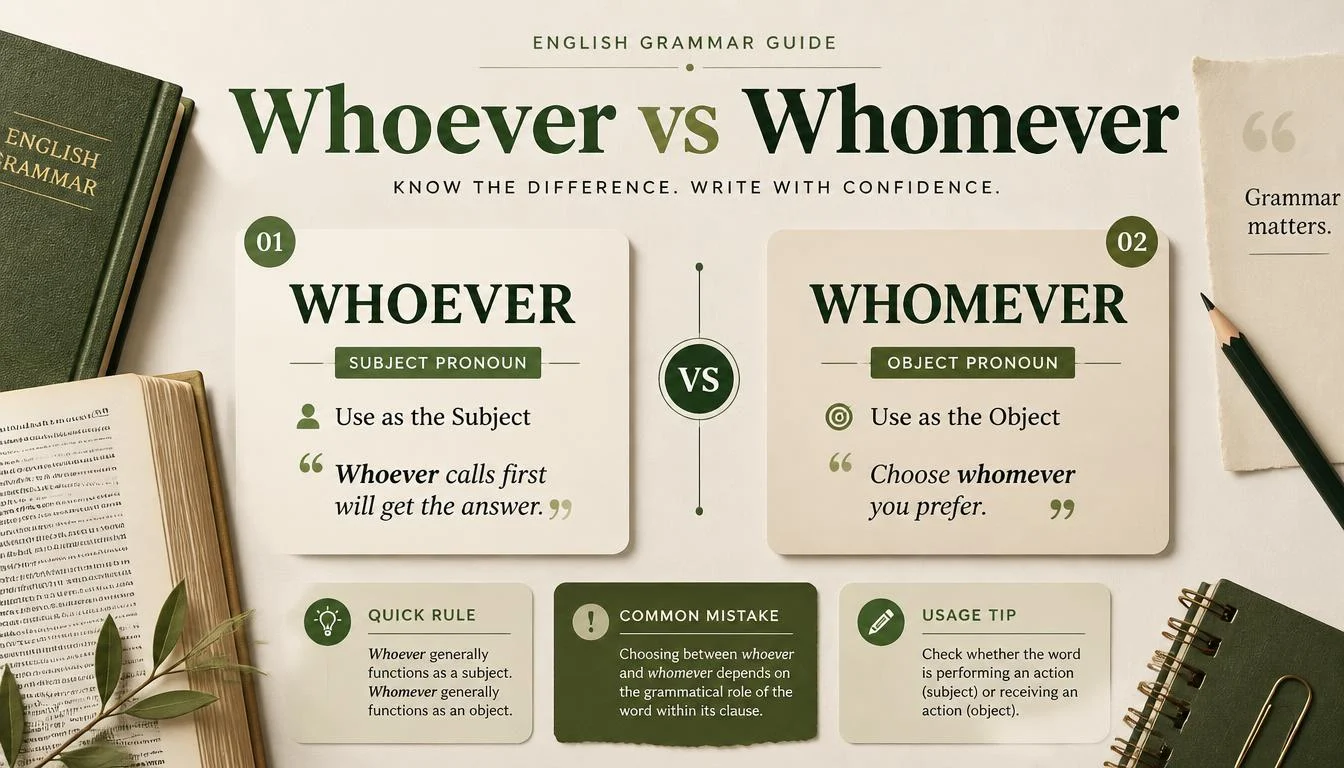
Use whoever as the subject of a verb, and use whomever as the object of a verb or preposition. If you can replace the word with “he” or “she,” choose whoever. If “him” or “her” fits better, choose whomever. This one substitution trick solves almost every case where writers second-guess themselves.
You’re halfway through an email, staring at a sentence like “Give the award to whoever finishes first” or “Give the award to whomever finishes first,” and suddenly neither one looks right. That hesitation is completely normal. Whoever and whomever are two of the most misused words in English, even among people who write for a living.
Whoever is a subject pronoun. It performs the action in a clause, much like “he” or “she.” Whomever is an object pronoun. It receives the action, similar to “him” or “her.” The confusion happens because both words often sit right after a preposition like “to” or “for,” which tricks people into assuming the object form must be correct every time. It isn’t.
Getting this wrong doesn’t just look sloppy in a resume or a formal report it can shift how careful and credible your writing appears to a reader. By the end of this guide, you’ll know exactly how to tell the two apart in seconds, without memorizing grammar terms you’ll forget by next week.
Whoever vs Whomever: What’s the Difference?
The core difference comes down to grammatical role: whoever acts, whomever gets acted upon.
Whoever functions as a subject. It starts an action inside its own clause, the same way “I,” “he,” or “they” would. Whomever functions as an object. It sits on the receiving end of a verb or a preposition, filling the same role as “me,” “him,” or “them.”
Here’s where most people get tripped up: the word right before whoever or whomever is often a preposition, such as “to,” “with,” or “for.” Writers assume that because a preposition needs an object, whomever must always follow it. But that’s only true if whomever is the object of that preposition directly. If a whole clause follows the preposition instead, and whoever or whomever is the subject of that clause, then whoever is correct regardless of the preposition sitting in front of it.
| Meaning | Part of Speech | Refers To | Typical Usage | Example | Common Confusion |
|---|---|---|---|---|---|
| Performs the action | Subject pronoun | The doer of a verb | Start of a clause, before a verb | Whoever calls first gets the job. | Assumed to need object form after prepositions |
| Receives the action | Object pronoun | The receiver of a verb or preposition | After a verb or preposition, with no verb following it | Choose whomever you trust most. | Overused in formal writing where whoever is correct |
Once you isolate the clause that whoever or whomever belongs to, the choice becomes almost mechanical. Ask what role the word plays inside its own small clause, not in the sentence as a whole. That single habit clears up nearly every mistake people make with this pair.
Is Whoever/Whomever a Grammar Issue, a Vocabulary Issue, or a Usage Issue?
This is purely a grammar issue, not a vocabulary one. Both words share the same core meaning “any person who” so a dictionary won’t help you pick the right one. The distinction lives entirely in sentence structure and case, the same category of rule that governs “who” versus “whom.”
Vocabulary-wise, there’s zero difference. Whoever and whomever mean the same thing in plain conversation. Usage is where they split. In formal English, academic writing, and business correspondence, the subject-object distinction still matters and readers notice when it’s wrong. In everyday conversation, most native speakers default to “whoever” almost universally, even in spots where whomever is technically correct, because “whomever” can sound stiff when spoken aloud.
The two words are not interchangeable in writing that’s meant to be precise, such as legal documents, academic papers, or professional emails to clients. In casual texting or spoken English, using “whoever” everywhere rarely raises an eyebrow. The practical takeaway: reserve the effort of getting whomever exactly right for formal writing, and don’t stress about it in casual speech.
Whoever: The Complete Guide
Meaning: “Whoever” means “any person who” or “no matter who,” and it always acts as the subject of a verb.
Part of speech: Indefinite relative pronoun, functioning as a subject.
Common collocations: whoever wins, whoever calls, whoever wants, whoever decides, whoever shows up, whoever is responsible.
Typical sentence pattern: Whoever + verb + (rest of clause). The word is almost always followed directly by a verb, with no noun or pronoun squeezed in between.
Workplace example: “Whoever finishes the quarterly report first can leave early on Friday.”
Academic example: “Whoever submits the strongest thesis proposal will receive the research grant.”
Technology example: “Whoever configures the server settings should also update the documentation.”
Email example: “Please forward this message to whoever handles vendor contracts.”
Daily conversation example: “Whoever ate the last slice of pizza owes me one.”
One learner mistake: Many learners write “Give it to whomever asks first,” assuming the preposition “to” demands whomever. But “asks” needs a subject, and that subject is whoever, not whomever. The preposition is attached to the entire clause “whoever asks first,” not to the pronoun alone.
Mini recap: If the word directly precedes a verb and answers “who is doing this,” it’s whoever, no matter what comes before it in the sentence.
Whomever: The Complete Guide
Meaning: “Whomever” means “any person whom” and always functions as an object either the object of a verb or the object of a preposition.
Part of speech: Indefinite relative pronoun, functioning as an object.
Common collocations: whomever you choose, whomever they hire, whomever you trust, ask whomever, notify whomever.
Typical sentence pattern: Subject + verb + whomever, or preposition + whomever, with no verb immediately following the word.
Workplace example: “The manager will promote whomever the team recommends.”
Academic example: “The scholarship committee interviewed whomever the professors nominated.”
Technology example: “Send the access request to whomever the IT department designates.”
Email example: “Please cc whomever you think should review this proposal.”
Daily conversation example: “Invite whomever you like to the party.”
One learner mistake: A common error is writing “Whomever calls should leave a message,” treating whomever as the subject of “calls.” Since “calls” needs a subject and whomever cannot fill that role, whoever is the correct choice here.
Mini recap: If a verb has already appeared and the pronoun is receiving the action rather than performing it, whomever is the safer pick.
When Not to Use Each Word
Mistake 1: Using whomever right after a preposition, automatically. Writers see “to,” “for,” or “with” and assume the object form is required. This happens because prepositions usually do take objects. The fix: check whether a full clause follows the preposition. If it does, find that clause’s own subject before deciding.
Mistake 2: Using whoever because it “sounds smoother.” Whoever often just feels more natural to say out loud, so people default to it even in object positions. Remember that formal writing rewards precision over comfort, especially in professional or academic contexts.
Mistake 3: Overcorrecting into whomever because it “sounds more proper.” Ironically, some writers assume whomever always sounds more formal and correct, so they insert it everywhere, including subject positions. This produces sentences like “Whomever wants the job should apply,” which is incorrect. Formality isn’t the deciding factor grammatical role is.
Mistake 4: Getting confused by interrupting phrases. Sentences like “Give it to whoever I believe deserves it” trip people up because “I believe” sits between whoever and its verb. Mentally remove the interrupting phrase: “whoever deserves it” makes the subject role obvious.
Mistake 5: Treating long sentences as one giant clause. The longer the sentence, the harder it is to isolate the relevant clause. Break sentences into smaller pieces mentally, and evaluate only the clause containing whoever or whomever.
Mistake 6: Ignoring the “he/him” substitution test. Writers who skip this test tend to guess based on instinct, which is unreliable for this particular pair. The substitution trick works almost every time and takes only a few seconds.
Mistake 7: Assuming spoken habits transfer to formal writing. Since most people say “whoever” constantly in speech, that habit bleeds into essays, cover letters, and reports where whomever is actually needed.
Mistake 8: Second-guessing correct usage. Some writers get whoever or whomever right on the first attempt, then talk themselves out of it because the word looks unfamiliar. Trust the substitution test over your gut reaction.
Common Mistakes Table
| Correct Sentence | Incorrect Sentence | Explanation |
|---|---|---|
| Whoever left their umbrella can pick it up at the front desk. | Whomever left their umbrella can pick it up at the front desk. | “Left” needs a subject, so whoever is correct. |
| Give the tickets to whomever you invited. | Give the tickets to whoever you invited. | “Invited” already has a subject (“you”), so whomever is the object. |
| The prize goes to whoever answers first. | The prize goes to whomever answers first. | “Answers” needs a subject, making whoever correct despite the preposition “to.” |
| Hire whomever the panel recommends. | Hire whoever the panel recommends. | “Recommends” has its own subject (“the panel”), so whomever is the object. |
| Whoever wrote this report did excellent work. | Whomever wrote this report did excellent work. | “Wrote” needs a subject, so whoever fits. |
Decision Box
If the word comes right before a verb with no other subject nearby, use whoever. If a subject and verb already exist, and the word is receiving the action, use whomever. Still unsure? Swap in “he” (whoever) or “him” (whomever) and see which sounds right.
Real World Examples
Office communication: “Please route this ticket to whoever is on call this weekend.”
Business email: “We’ll send the contract to whomever your legal team assigns.”
School or university: “Whoever completes the extra credit assignment will receive bonus points.”
Customer support: “I’ll transfer you to whomever handles billing disputes.”
Technology: “The system automatically notifies whoever is listed as the project owner.”
Artificial intelligence: “The chatbot escalates the conversation to whomever the support queue assigns next.”
Daily conversation: “Whoever finds my keys gets a coffee on me.”
Whoever and Whomever in Modern Technology
Artificial intelligence tools, virtual assistants, and chatbots deal with this exact grammar distinction constantly, since much of their language is built around routing tasks, permissions, and requests to people.
In AI-generated customer support scripts, you’ll often see phrasing like “This request will be forwarded to whomever manages your account,” which correctly uses whomever as the object of “forwarded to.” Voice assistants like Siri or Alexa tend to simplify this in spoken responses, since spoken English leans heavily on whoever regardless of grammatical role a practical choice, since sounding natural in speech usually matters more than technical precision.
Business software that automates approvals or task assignments frequently uses this pattern too: “Route the request to whoever submitted the original ticket” versus “Assign the task to whomever the manager selects.” Well-trained AI writing tools and grammar checkers are increasingly good at catching these errors, but they still occasionally flag correct sentences as wrong when interrupting phrases confuse the underlying pattern-matching. Human review still matters here, especially in professional software copy.
Word Origin
Both words trace back to Old English “hwa,” meaning “who,” combined with “-ever” to create an indefinite meaning “any person who,” rather than a specific individual. The object form “whom” developed from the dative case in Old English, a grammatical case marking indirect objects and objects of prepositions, which explains why whomever still carries that objective function today. As English gradually dropped most of its case endings over the centuries, whom and whomever became some of the last visible survivors of that older case system, which is part of why they now feel formal or even old-fashioned to modern ears.
Expert Insight
Here’s a habit worth building: whenever you hit a whoever/whomever decision, mentally rewrite the clause as a short, standalone sentence using “he” or “him.” If “he” fits, whoever is correct. If “him” fits, whomever is correct. This works because whoever and whomever behave exactly like the pronouns “he” and “him” in terms of subject and object roles English just doesn’t preserve many of these case distinctions anymore, so this pair stands out as one of the few places it still shows up clearly.
Error Prevention Checklist
- Always use whoever when the word directly precedes a verb with no other subject present.
- Always use whomever when a subject and verb already exist and the word is receiving the action.
- Never confuse them if you isolate the clause and apply the he/him substitution test first.
- Quick memory tip: “he” and “whoever” both end without an “m” subjects; “him” and “whomever” both contain an “m” objects.
Related Grammar Confusions
Who vs Whom The direct parent pair of whoever and whomever, following the exact same subject-object logic on a smaller scale.
Whoever vs Whosoever Useful for writers who encounter older or more formal texts, where “whosoever” appears as an archaic variant.
That vs Which Another pair where grammatical role, not meaning, determines the correct choice in a sentence.
Fewer vs Less A classic count-versus-mass distinction that trips up even experienced writers in everyday usage.
Affect vs Effect Worth mastering since it’s one of the most searched grammar confusions in professional writing.
Its vs It’s A small apostrophe carries a big grammatical difference between possession and contraction.
Who’s vs Whose Closely related to the whoever/whomever confusion, since it hinges on the same who-family pronouns.
Lay vs Lie Another verb pair where the correct form depends entirely on sentence structure.
Farther vs Further Helpful for writers who want precision between literal and figurative distance.
Whomever vs Whoever in Legal Writing Worth exploring separately, since contracts and legal documents rely heavily on getting this distinction exactly right.
FAQs
Is It Ever Okay to Just Use “Whoever” Everywhere?
In casual speech and informal writing, yes. Most native speakers use “whoever” this way and it rarely causes confusion. In formal writing, academic papers, or professional documents, however, it is better to take a moment to choose the grammatically correct form.
Does “Whomever” Sound Outdated?
It can sound quite formal, especially in everyday conversation. That is why it appears much less often in casual speech. Still, “whomever” remains useful in careful, professional, and academic writing where grammatical precision is important.
How Do I Decide Quickly Under Time Pressure, Like During an Exam?
Isolate the clause containing “whoever” or “whomever” and ignore the rest of the sentence. Then substitute “he” or “him.” The option that sounds natural will usually show you which word is correct.
Can “Whoever” or “Whomever” Start a Sentence?
Yes. Both words can begin a sentence when they perform the correct grammatical role. For example, “Whoever calls, take a message” is correct because “whoever” is the subject of “calls.” “Whomever calls, take a message” is incorrect because “calls” requires a subject.
Why Do Interrupting Phrases Like “I Think” or “She Believes” Make This Harder?
Interrupting phrases can come between the pronoun and its verb, making the sentence structure harder to recognize. They can cause you to focus on the wrong part of the sentence. Mentally removing the interrupting phrase often makes the correct choice much clearer.
Is This Rule Different in British English Versus American English?
No. The underlying grammar rule is the same in both varieties of English. The main difference is stylistic. British formal writing may retain “whom” and “whomever” slightly more often, while American English increasingly favors “who” and “whoever” in many contexts.
Conclusion
The whoever versus whomever debate really comes down to one question: is the word acting, or is it being acted upon? Whoever performs the verb’s action, while whomever receives it, and no amount of formality or sentence complexity changes that underlying rule.
Next time you’re stuck between the two, skip the guesswork and run the quick substitution test swap in “he” for whoever or “him” for whomever, and let your ear do the rest. That one small habit will keep this classic grammar trap from ever slowing you down again.
Read More Related Articles:
- Shiny or Shiney | Avoid This Simple Spelling Error in English In 2026
- Occasion or Ocassion | Common Mistake Explained with Real-Life Examples In 2026
- Cacoon or Cocoon | Simple Rule You’ll Never Forget In 2026

Zoe Chambers works as a content writer at synoseek.com, contributing thoughtful pieces on everyday subjects and ideas. She writes in a simple, grounded way, often drawing from real-world experiences. Her focus is on keeping content natural, clear and easy for readers to connect with.
1 thought on “Whoever vs Whomever | Simple Rule That Ends the Confusion for Good In 2026”