Quick Answer
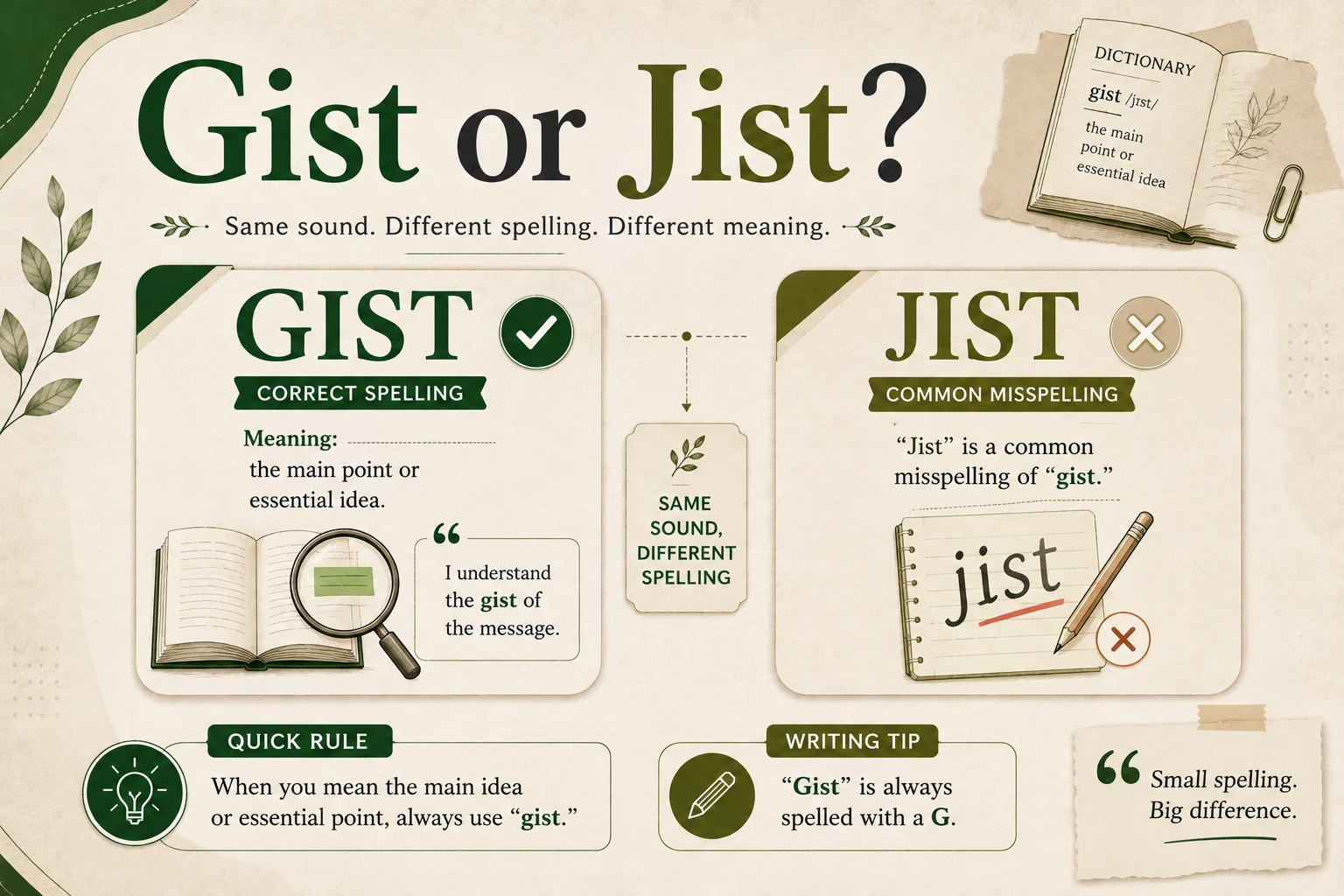
Gist is the correct spelling. It means the main point or essence of something, as in “give me the gist of the report.” Jist is a common misspelling based on how people pronounce the word quickly in casual speech. Only “gist” appears in dictionaries and formal writing, so it’s the one you should always use.
You’ve probably said it a hundred times without ever writing it down: “Just give me the jist of it.” Then one day you go to type that sentence in an email, and you freeze. Is it “gist” or “jist”? The pronunciation doesn’t help much, because both versions sound nearly identical when spoken out loud, and the word is often blended with “just” in fast conversation, which only adds to the confusion.
Here’s the short version. Gist” refers to the essential meaning or main idea of something a summary stripped down to its core. “Jist” isn’t a recognized English word at all. It’s a phonetic spelling that developed because people write words the way they hear them, and “gist” happens to sound like it could start with a J.
This mix-up matters more than it seems. Using “jist” in a business email, an academic paper, or a resume signals a spelling error to anyone reading closely, and that can quietly undercut your credibility even when your ideas are solid. By the end of this guide, you’ll know exactly why “gist” wins, where the confusion comes from, and how to make sure you never second-guess yourself again.
Gist vs Jist: What’s the Difference?
The real difference is simple: one is a word, and the other is a mistake. Gist” is the standard, dictionary-recognized noun meaning the central point of an argument, story, or piece of writing. Jist” has no independent meaning of its own it exists only because it mimics the sound of “gist.
Think about how the word actually gets used. Someone skims a long report and says, “Just tell me the gist.” A teacher summarizes a novel’s plot in two sentences and calls it “the gist of the story.” A lawyer might even use the word in a more technical sense, referring to the essential grounds of a legal claim. In every one of these cases, the correct spelling is “gist,” never “jist.
| Meaning | Part of Speech | Refers To | Typical Usage | Example | Common Confusion |
|---|---|---|---|---|---|
| Main point or essence | Noun | Summary of an idea, story, or argument | Formal and casual writing | “I only caught the gist of what she said.” | Misspelled as “jist” due to pronunciation |
| Not a standard word | No accepted meaning | Should not be used in writing | Often confused with “gist” or blended with “just” |
So the recap here is short and simple: “gist” is real, “jist” is not, and no dictionary treats them as interchangeable spellings. If you remember nothing else from this article, remember that one sentence.
Is Gist vs Jist a Grammar, Vocabulary, or Spelling Issue?
This isn’t really a grammar problem in the traditional sense, since grammar deals with sentence structure and word order. It’s a spelling and vocabulary issue. Gist” is an established noun with a fixed, correct spelling, and “jist” is simply an incorrect rendering of that same sound.
The confusion happens because English spelling doesn’t always match pronunciation in predictable ways. The letter G can produce a soft “juh” sound before certain vowels think of “gym,” “giant,” or “gene” so it’s completely reasonable that someone would guess “jist” is spelled with a J. That guess is understandable, but it’s still wrong.
In formal English, academic writing, business communication, and professional documents, only “gist” is acceptable. There is no informal exception where “jist” becomes correct, not even in casual texting or conversation, though you will sometimes see it used that way online. If you’re writing anything meant to be taken seriously, the practical takeaway is this: always default to “gist,” and treat “jist” as a spelling error to catch and fix.
Gist: Meaning, Usage, and Examples
Gist” is a noun, pronounced with a soft G, so it rhymes with “wrist” or “fist” rather than “gift.” It refers to the essential or central meaning of something the part that matters most once you strip away the details.
Common collocations include “get the gist,” “give me the gist,” “catch the gist,” and “the gist of the argument.” Notice the pattern: the word almost always follows a verb about understanding or communicating, because that’s exactly what “gist” is for summarizing what something is really about.
Workplace example: “I didn’t have time to read the whole proposal, but I got the gist from the summary slide.”
Academic example: “The professor asked students to explain the gist of Kant’s argument in under three sentences.”
Technology example: “The AI assistant condensed the fifty-page manual into a short paragraph that captured the gist perfectly.”
Email example: “Here’s the gist of the client’s feedback: they want a faster turnaround and a simpler design.”
Daily conversation example: “I only watched half the movie, but I think I got the gist of what happened.”
One common learner mistake is treating “gist” as if it needs an article every time, like “a gist” or “gists” in plural form. While plural use technically exists in some contexts, it’s rare and can sound awkward. Most native speakers use “gist” as a singular, definite idea “the gist,” not “a gist of many things.”
Mini recap: “Gist” is a real noun meaning the core idea of something, almost always paired with verbs like “get,” “give,” or “catch,” and pronounced with a soft G sound.
Jist: Why It Isn’t a Real Word
“Jist” doesn’t appear as a standard entry in Oxford Dictionary, Cambridge Dictionary, or Merriam-Webster. It’s what linguists call an eye dialect spelling a version of a word written the way it sounds rather than the way it’s actually spelled, often used informally to represent regional or casual speech patterns.
Because English speakers hear “gist” and “just” blending together in fast speech (“just give me the jist”), the two words start to bleed into each other visually as well. Some people even assume “jist” is a shortened or dialect form of “just,” which adds another layer of confusion.
Workplace example (incorrect): “Can you jist send me the highlights?” This should be “just send me” or “give me the gist,” depending on intended meaning.
Casual texting example: You might see “jist” used informally between friends, but it still reads as a typo rather than a stylistic choice to anyone paying close attention.
Technology example: Autocorrect tools and grammar checkers will consistently flag “jist” as a misspelling, which is one more sign that it hasn’t earned recognized status.
The mistake happens almost entirely because of sound, not because “jist” carries its own distinct meaning. Once you understand that, the fix is easy: whenever you’re tempted to write “jist,” pause and ask whether you mean the summary of something. If you do, the correct word is “gist,” every single time.
Mini recap: “Jist” isn’t found in any major dictionary, it has no unique meaning, and it exists only as a mispronunciation-based error for “gist.
When Not to Use Each Word
Never use “jist” in professional writing. Emails, reports, resumes, and cover letters should always use “gist.” A single misspelling like this can distract a reader from otherwise strong content.
Don’t use “jist” in academic papers. Professors and editors will mark it as a spelling error, and spell-check software in most word processors will flag it automatically.
Avoid “gist” when you actually mean “just.” Some writers overcorrect and start inserting “gist” into sentences where “just” belongs, such as “I gist wanted to check in.” That’s a different error entirely, and it happens when people become overly cautious after learning about this confusion.
Don’t assume “jist” is a regional or dialect spelling that’s acceptable in writing. Even though the pronunciation might reflect regional speech patterns, the written form remains “gist” everywhere in standard English.
Never use “jist” in subtitles, captions, or transcriptions meant for publication. Transcribers sometimes default to phonetic spelling when working quickly, but published captions should always use standard spelling.
Watch out for autocomplete suggestions on mobile keyboards. Some predictive text systems will suggest “jist” simply because you’ve typed it before, which can reinforce the habit.
Don’t rely on how a word sounds in your head as proof of correct spelling. This is the root cause of almost every “gist vs jist” mistake, and it applies to many other commonly confused English word pairs as well.
Remember the connection to “digest.” Both words share a Latin root related to carrying or bearing meaning, and thinking of “gist” alongside “digest” (as in “digesting information”) can help you remember the G spelling.
Common Mistakes Table
| Correct Sentence | Incorrect Sentence | Explanation |
|---|---|---|
| “Can you give me the gist of the meeting?” | “Can you give me the jist of the meeting?” | “Jist” is not a recognized spelling in any dictionary. |
| “I only need the gist, not every detail.” | “I only need the jist, not every detail.” | The correct noun for summarizing an idea is always “gist.” |
| “She explained the gist of her research in one slide.” | “She explained the jist of her research in one slide.” | Academic writing requires standard spelling. |
| “I just finished reading the report.” | “I gist finished reading the report.” | This sentence needs “just” as an adverb, not “gist” as a noun. |
| “The gist of his argument was that prices would rise.” | “The jist of his argument was that prices would rise.” | “Gist” functions correctly here as the subject of the sentence. |
Quick Decision Box
If you mean the main point or summary of something, use gist.
If you mean “only” or “simply,” use just.
“Jist” should never appear in your writing if you’re tempted to type it, you almost certainly mean “gist.”
Gist and Jist in Real-World Situations
Office communication: A manager scanning a long thread might reply, “Thanks I got the gist, let’s discuss in the meeting,” rather than reading every message in detail.
Business email: A project update might read, “Here’s the gist of where we stand: we’re on schedule but slightly over budget.”
School or university: A student reviewing lecture notes the night before an exam might say, “I don’t remember every detail, but I understand the gist of the theory.”
Customer support: A support agent summarizing a customer’s complaint for a colleague might write, “The gist of the issue is that the shipment arrived damaged.”
Technology: A product manager reading user feedback might note, “The gist across most reviews is that the app is fast but the interface feels cluttered.”
Daily conversation: Friends catching up after missing an event might ask, “What happened? Just give me the gist.”
Each of these examples shows the same pattern “gist” shows up whenever someone needs the short version of something longer, and correct spelling matters just as much in a quick internal email as it does in a formal report.
Gist in Modern Technology
Summarizing information has become one of the most valuable skills in the digital world, and that’s exactly why “gist” shows up so often in technology contexts. AI writing tools and virtual assistants are frequently asked to condense long documents into short summaries, and users often phrase that request using this exact word: “give me the gist of this article.”
Voice assistants like Siri or Alexa may be asked to “give the gist” of a news story, and chatbots built for customer service or research often include summarization features explicitly labeled as tools that “extract the gist” of longer text. Software documentation, meeting transcription tools, and email assistants use the same language when describing their condensing features.
Interestingly, since these tools rely on written commands and transcribed speech, correct spelling actually matters for search and command accuracy. Searching “AI tool to get the jist of an article” may still return results because search engines can interpret intent, but typing the correct spelling in professional prompts, documentation, or product descriptions remains the standard expected of careful writers.
Where the Word “Gist” Comes From
“Gist” has a genuinely interesting history rooted in law. It comes from Anglo-French legal language, from the phrase “cest action gist,” meaning “this action lies,” referring to the point on which a legal case rested or depended. Over time, English speakers borrowed the word to describe the essential point of any argument or piece of writing, not just legal claims.
That legal root also explains the connection to the word “lie” not in the sense of dishonesty, but in the older sense of resting or existing. The “gist” of a case is the ground it stands on, and the “gist” of a story is the point the whole thing rests on. Knowing this history can help the spelling stick, since it clarifies that “gist” has always been G-I-S-T, with no J version ever existing in its legal or literary usage.
Expert Insight
As a language instructor, I often tell students that pronunciation-based spelling mistakes like this one aren’t a sign of poor English skills they’re actually a sign of listening closely. You heard the word correctly; you just guessed at the letter that matched the sound. The fastest way to fix this permanently is to connect “gist” to a word you already spell correctly, like “digest,” since both share that hard G sound in writing even though “gist” sounds softer when spoken. Once that visual link forms in your memory, the mistake tends to disappear for good.
Error Prevention Checklist
- Always use gist when referring to the main point, summary, or essence of something.
- Always use just when you mean “only,” “simply,” or “recently.”
- Never confuse them if you remember that “jist” doesn’t exist in any dictionary at all.
- Quick memory tip: link “gist” to “digest” both involve condensing information, and both are spelled with a G.
Related Grammar Confusions Worth Learning
- Affect vs Effect one is usually a verb, the other usually a noun, and mixing them up is one of the most common English errors.
- Its vs It’s a classic apostrophe mistake that changes meaning entirely.
- Then vs Than comparison versus sequence, easily confused in fast writing.
- Complement vs Compliment two words that sound identical but mean very different things.
- Discreet vs Discrete a subtle spelling difference with a big impact on meaning.
- Loose vs Lose one extra letter completely changes the pronunciation and meaning.
- Advice vs Advise noun versus verb, distinguished only by a single letter.
- Emigrate vs Immigrate direction matters, and so does the prefix.
- Farther vs Further physical distance versus figurative distance.
- Principal vs Principle a school leader versus a fundamental truth, easy to mix up in writing.
FAQs
Is “jist” a word in any dictionary?
No. Jist is not a standard spelling in modern English. In ordinary writing, it is considered a misspelling of gist, which is the correct word for the main point or essential idea of something.
Why do people spell “gist” as “jist”?
The confusion comes from pronunciation. The g in gist makes a soft j sound, so the word sounds as though it could be spelled jist. However, the correct spelling is always gist.
Is “gist” formal or informal?
Gist works in both formal and informal communication. You can use it in everyday conversation, emails, articles, and professional writing when referring to the main or essential point of something.
Can “gist” be used as a verb?
In standard usage, gist is primarily a noun. You would normally say summarize something, explain the main point, or give the gist of something rather than using gist as a verb.
What’s the difference between “gist” and “summary”?
A gist is the central idea or most important point, usually expressed briefly. A summary can provide more detail and cover several key points while still being shorter than the original content.
Does “jist” become correct in casual texting?
No. Even in casual messages or social media posts, jist is generally treated as a spelling mistake. Informal writing may be less strict, but the correct spelling remains gist.
Conclusion
The difference between “gist” and “jist” comes down to one simple fact: only one of them is an actual word. Gist” is the correct, dictionary-recognized noun for the main point or essence of something, while “jist” is a phonetic mistake that happens because of how the word sounds when spoken quickly.
Next time you’re tempted to type “jist,” picture the word “digest” instead both are about condensing information, and both start with G. Remember that one small trick, and you’ll never confuse “gist” with “jist” again.
2 thoughts on “Gist or Jist | Stop Making This Common Spelling Mistake In 2026”