Quick Answer
“Covered” means something has been handled, protected, insured, or included so no gaps remain. Whether you are talking about a task, a financial risk, or a literal surface, English offers plenty of substitutes. Five of the best alternatives are: taken care of, handled, insured, protected, and included.
Looking for other ways to say “covered”? The word can have different meanings depending on the context. You might use it to talk about handling a task, paying a cost, including information, or protecting something.
In this guide, you’ll find 30+ natural alternatives to “covered” for different situations. Each phrase includes a simple explanation and example to help you choose the right wording for professional and everyday communication.
Why People Search for Other Ways to Say Covered
“Covered” is one of those small, flexible words that native English speakers use constantly, but it can start to sound repetitive, vague, or even unprofessional depending on the context. Someone drafting a client email might want a phrase that sounds more polished than “don’t worry, you’re covered.” A student preparing for an interview might want to avoid sounding casual. A content writer might simply need variety so their writing doesn’t repeat the same word five times in one paragraph.
People searching for alternatives to covered are usually looking for one of a few things: professional English phrases for business writing, informal expressions in English for everyday conversation, or a clearer way to say something in a specific situation like insurance, teamwork, or physical protection. There is also a real difference between spoken and written usage. In speech, people often say things like “I got you” or “it’s all good,” while written English, especially in emails, tends to favor phrases like “this has been addressed” or “the matter is resolved.” Understanding that difference is the key to choosing the right alternative to covered for any situation.
Tone Ladder
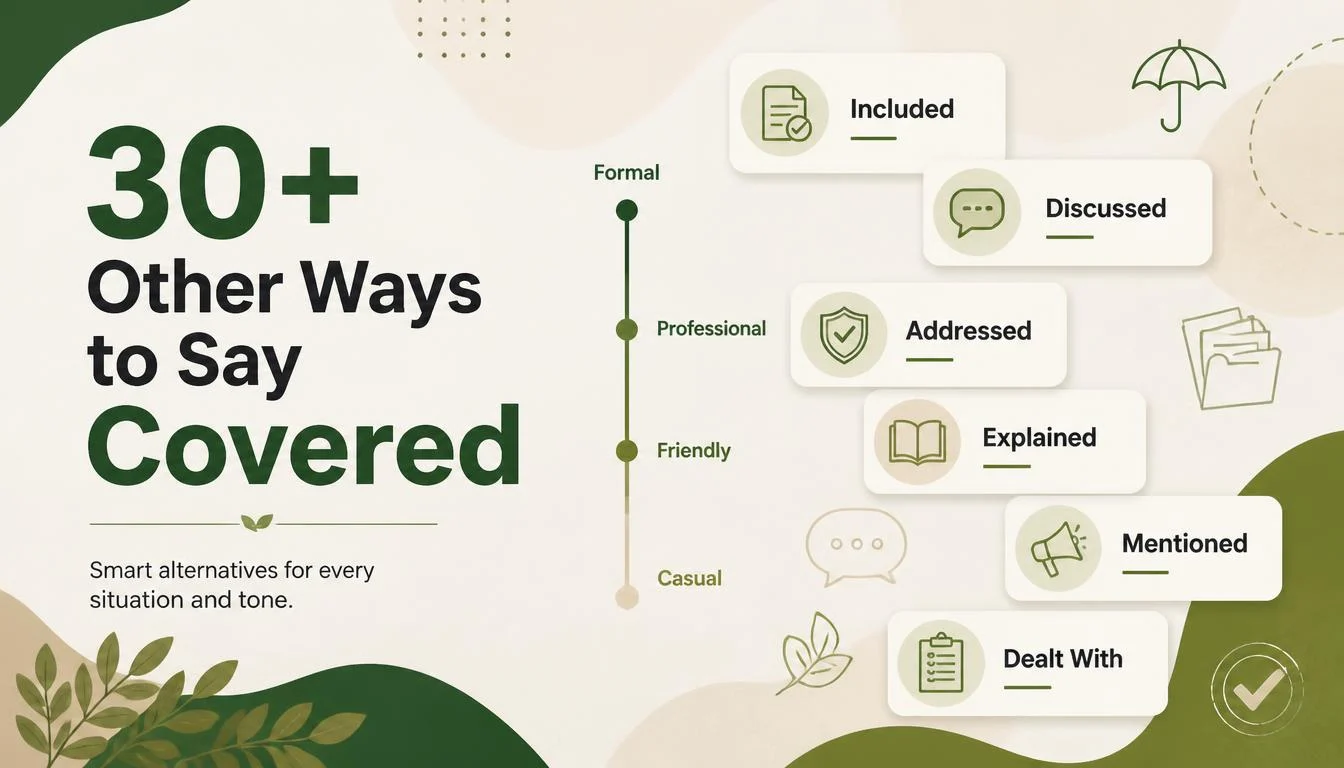
Not every synonym for covered carries the same weight. Some sound stiff and corporate, others sound like something you’d only say to a close friend. Ranking these phrases on a tone ladder helps you match the right words to the right audience.
At the very formal end, you’ll find phrases like “the matter has been fully addressed” or “this falls within the scope of coverage,” which suit legal, medical, or financial writing. Formal alternatives such as “handled” or “accounted for” work well in business emails and reports. Neutral phrases like “taken care of” or “sorted” sit comfortably in most everyday professional conversations. Casual expressions such as “I got it” or “we’re good” are common in spoken English among coworkers or friends. Informal phrases like “no worries, I gotchu” belong strictly in relaxed, personal conversations and should be avoided in writing.
Generally speaking, formal and neutral phrases sound more professional and are safer for written communication, while casual and informal expressions are better suited to spoken English between people who already know each other well.
Tone Classification Table
| Phrase | Tone Level | Formality | Best Situation |
|---|---|---|---|
| The matter has been fully addressed | Very Formal | High | Legal or official correspondence |
| Handled | Formal | High | Business emails, reports |
| Accounted for | Formal | High | Finance, project updates |
| Taken care of | Neutral | Medium | General workplace conversation |
| Sorted | Neutral | Medium | Casual professional chats |
| On it | Casual | Low | Team messaging apps |
| I got it | Casual | Low | Spoken conversation with peers |
| No worries, I gotchu | Informal | Very Low | Close friends, informal texting |
Quick Selection Guide
If you’re heading into a job interview, “I made sure that was handled” or “I took full responsibility for that” will sound confident and professional. For an email, “this has been addressed” or “please rest assured this is included in the plan” strikes the right tone. At a networking event, something like “I’ve got that under control” or “that’s already accounted for” comes across as capable without sounding stiff. In a casual conversation with friends or close coworkers, “don’t worry, I got it” or “we’re all set” feels natural and warm.
Real-Life Conversation Transformations
Job Interview Scenario
Before: “Yeah, I covered that part of the project myself.”
After: “I personally took ownership of that portion of the project and made sure it was fully handled from start to finish.”
Networking Event Scenario
Before: “Don’t worry, I got that covered.”
After: “That’s already accounted for, so you can focus on the bigger picture.”
Email Scenario
Before: “Just letting you know this is covered.”
After: “I wanted to confirm that this matter has been fully addressed and no further action is needed on your end.”
Casual Conversation Scenario
Before: “I got you covered, don’t stress.”
After: “Relax, I’ve got it handled. You don’t need to worry about a thing.”
30+ Other Ways to Say Covered
Taken Care of
Meaning: Something has been fully handled or resolved.
Explanation: A warm, reassuring phrase that works in both personal and light professional settings.
Example: “The paperwork is taken care of, so we can move forward.”
Tone: Neutral
Best use: Everyday workplace conversation
Worst use: Formal legal documents
Context variability: Works for tasks, favors, and responsibilities alike.
Handled
Meaning: Managed competently and completely.
Explanation: A confident, professional word often used to show ownership of a task.
Example: “I’ve handled the client’s request already.”
Tone: Formal
Best use: Business emails, interviews
Worst use: Casual texting, where it can sound overly formal
Context variability: Common in project management and customer service contexts.
Sorted
Meaning: Organized and resolved.
Explanation: Popular in British English, it suggests something has been neatly settled.
Example: “The travel arrangements are all sorted.”
Tone: Neutral
Best use: Casual professional conversations
Worst use: Highly formal legal writing
Context variability: Works well for logistics, plans, and small tasks.
Insured
Meaning: Protected financially against loss or damage through a policy.
Explanation: A precise term used specifically in financial and legal contexts.
Example: “Your vehicle is fully insured against theft.”
Tone: Formal
Best use: Insurance, finance, legal documents
Worst use: Everyday casual speech unrelated to money or risk
Context variability: Rarely used outside financial or protective contexts.
Protected
Meaning: Kept safe from harm, risk, or damage.
Explanation: A broad term that fits both literal and figurative safety.
Example: “Your data is protected by encryption.”
Tone: Neutral to Formal
Best use: Security, safety, and legal contexts
Worst use: Minor everyday tasks where it may sound exaggerated
Context variability: Used across technology, law, and personal safety topics.
Under Control
Meaning: Managed without chaos or risk of failure.
Explanation: Suggests confidence and steady management of a situation.
Example: “The situation is under control, no need to panic.”
Tone: Neutral
Best use: Crisis management, workplace updates
Worst use: Overly casual chats where it may sound dramatic
Context variability: Works for both emergencies and routine tasks.
Dealt With
Meaning: Addressed and resolved.
Explanation: A straightforward, slightly informal way to say a task is finished.
Example: “That issue has already been dealt with.”
Tone: Neutral
Best use: Internal team communication
Worst use: Very formal reports, where “addressed” sounds better
Context variability: Common for problems, complaints, and disputes.
Included
Meaning: Made part of a larger set or plan.
Explanation: Useful when talking about scope, packages, or plans.
Example: “Breakfast is included in your hotel booking.”
Tone: Neutral
Best use: Contracts, service descriptions
Worst use: Situations about personal responsibility rather than scope
Context variability: Frequently used in sales, travel, and service industries.
Accounted For
Meaning: Tracked, recorded, or included properly.
Explanation: Common in finance and logistics to confirm nothing is missing.
Example: “All the expenses are accounted for in the report.”
Tone: Formal
Best use: Financial reporting, audits
Worst use: Casual conversation about unrelated topics
Context variability: Best suited to numbers, inventory, and budgets.
Wrapped Up
Meaning: Completed or finalized.
Explanation: A friendly, energetic phrase often used at the end of projects.
Example: “We wrapped up the deal by Friday.”
Tone: Casual
Best use: Team updates, informal check-ins
Worst use: Formal legal or medical writing
Context variability: Popular for projects, meetings, and negotiations.
Secured
Meaning: Made safe or guaranteed.
Explanation: Implies both physical safety and guaranteed outcomes.
Example: “The building is secured for the night.”
Tone: Formal
Best use: Security, contracts, agreements
Worst use: Casual daily tasks
Context variability: Common in real estate, security, and finance.
Backed
Meaning: Supported or guaranteed by something else.
Explanation: Often used when talking about financial or personal support.
Example: “The loan is backed by collateral.”
Tone: Neutral
Best use: Finance, partnerships
Worst use: Physical or literal covering situations
Context variability: Frequently used in business and investment contexts.
Guarded
Meaning: Watched over and kept safe.
Explanation: Suggests active protection rather than passive coverage.
Example: “The entrance is guarded around the clock.”
Tone: Formal
Best use: Security and safety contexts
Worst use: Everyday personal tasks
Context variability: Common in physical security and cautious behavior.
Shielded
Meaning: Protected from something harmful.
Explanation: Often figurative, describing protection from criticism or danger.
Example: “She was shielded from the negative press.”
Tone: Formal
Best use: Legal, emotional, or reputational protection
Worst use: Simple daily errands
Context variability: Works in both emotional and physical protection contexts.
On It
Meaning: Already working on or handling something.
Explanation: A quick, energetic way to confirm responsibility.
Example: “Need this done by noon? I’m on it.”
Tone: Casual
Best use: Team chats, quick replies
Worst use: Formal emails or reports
Context variability: Best for immediate tasks rather than long-term plans.
In Safe Hands
Meaning: Being looked after by someone trustworthy.
Explanation: A warm, reassuring idiom.
Example: “Don’t worry about the kids, they’re in safe hands.”
Tone: Neutral
Best use: Personal reassurance, caregiving contexts
Worst use: Strictly financial or legal writing
Context variability: Common in caregiving, service, and trust-based situations.
Squared Away
Meaning: Fully organized and completed.
Explanation: A relaxed but confident way to confirm something is finished.
Example: “The travel logistics are squared away.”
Tone: Casual
Best use: Informal updates among colleagues
Worst use: Formal client communication
Context variability: Frequently used in planning and logistics.
Locked Down
Meaning: Firmly secured or finalized.
Explanation: Suggests certainty and control over an outcome.
Example: “We locked down the venue for the event.”
Tone: Casual to Neutral
Best use: Event planning, negotiations
Worst use: Sensitive emotional conversations
Context variability: Common in business deals and event coordination.
Finished
Meaning: Completed entirely.
Explanation: A simple, direct term for completion.
Example: “The report is finished and ready to send.”
Tone: Neutral
Best use: Task updates
Worst use: Ongoing or ambiguous responsibilities
Context variability: Best for clearly defined, completed tasks.
Managed
Meaning: Supervised and successfully carried out.
Explanation: Suggests active oversight rather than simple completion.
Example: “The entire event was managed smoothly.”
Tone: Formal
Best use: Leadership and project contexts
Worst use: Small personal favors
Context variability: Common in workplace and organizational settings.
Looked After
Meaning: Cared for attentively.
Explanation: A gentle, personal way to describe protection or attention.
Example: “The old residents are well looked after.”
Tone: Neutral
Best use: Caregiving, hospitality
Worst use: Financial or legal contexts
Context variability: Works well for people, pets, and personal belongings.
Attended To
Meaning: Given proper care or attention.
Explanation: A formal way to confirm something has received necessary action.
Example: “Your request has been attended to promptly.”
Tone: Formal
Best use: Customer service, formal correspondence
Worst use: Casual daily speech
Context variability: Common in service industries and formal replies.
Provided For
Meaning: Supplied with what is needed, often financially.
Explanation: Suggests responsibility for someone’s needs or wellbeing.
Example: “The family is well provided for.”
Tone: Formal
Best use: Financial planning, family responsibility
Worst use: Small everyday tasks
Context variability: Frequently used in estate planning and family contexts.
Safeguarded
Meaning: Actively protected from potential harm.
Explanation: A strong, formal term often used in policy and legal writing.
Example: “Employee data is safeguarded under strict policies.”
Tone: Very Formal
Best use: Legal, HR, and compliance writing
Worst use: Casual conversation
Context variability: Common in policy, privacy, and legal documentation.
Cloaked
Meaning: Hidden or covered from view, often figuratively.
Explanation: A literary term suggesting concealment.
Example: “The plan was cloaked in secrecy.”
Tone: Formal to Literary
Best use: Creative writing, dramatic descriptions
Worst use: Everyday practical conversation
Context variability: Best suited to storytelling and figurative language.
Concealed
Meaning: Kept hidden from sight or knowledge.
Explanation: A neutral, precise term for hiding something.
Example: “The exit was concealed behind a bookshelf.”
Tone: Neutral to Formal
Best use: Descriptive or legal writing
Worst use: Casual reassurance about tasks
Context variability: Works for physical objects and confidential information alike.
Masked
Meaning: Disguised or hidden beneath a surface.
Explanation: Often used figuratively to describe hidden emotions or facts.
Example: “Her disappointment was masked by a smile.”
Tone: Neutral
Best use: Emotional or descriptive writing
Worst use: Practical task-related conversations
Context variability: Common in storytelling and emotional description.
Draped
Meaning: Physically covered with fabric or material.
Explanation: A literal, visual term for covering an object.
Example: “The furniture was draped in white sheets.”
Tone: Neutral
Best use: Descriptive or interior design writing
Worst use: Figurative or task-based situations
Context variability: Strictly literal, used for physical covering.
Blanketed
Meaning: Completely covered, often used for snow or fog.
Explanation: A vivid, descriptive term for widespread coverage.
Example: “The town was blanketed in snow overnight.”
Tone: Neutral to Literary
Best use: Weather and nature descriptions
Worst use: Business or task-related contexts
Context variability: Almost exclusively literal and descriptive.
Enveloped
Meaning: Completely surrounded or wrapped.
Explanation: A formal, literary term suggesting total coverage.
Example: “The valley was enveloped in mist.”
Tone: Formal to Literary
Best use: Descriptive and creative writing
Worst use: Everyday casual speech
Context variability: Best for atmospheric or emotional description.
Usage Comparison Table
| Phrase | Spoken Use | Written Use | Context |
|---|---|---|---|
| Taken care of | High | Medium | General tasks |
| Handled | Medium | High | Business, interviews |
| Insured | Low | High | Finance, legal |
| On it | High | Low | Team chats |
| Safeguarded | Low | High | Policy, HR |
| Blanketed | Low | Medium | Weather, description |
| Squared away | Medium | Low | Informal updates |
Email and LinkedIn Ready Expressions
For professional greetings, you might open with “I hope this message finds you well” before confirming that something has been addressed. When introducing yourself professionally, a line like “I specialize in making sure every detail is fully accounted for” works well. LinkedIn connection messages can include phrases such as “I’d love to connect and discuss how I can help ensure your project is fully covered from start to finish.” For follow-up lines, try “Just confirming that this matter has been handled on our end” or “Please let me know if anything still needs to be addressed.”
Native Speaker Insight
Native English speakers rarely say the full phrase “I have got you covered” in casual speech. Instead, it’s shortened to “I got you” or simply “I got it.” In writing, however, the fuller and more formal versions like “this has been addressed” or “rest assured, everything is accounted for” sound more natural and polished. Phrases like “cloaked” or “enveloped” can sound unnatural or overly poetic if used in everyday business writing, since they belong more to descriptive or creative contexts. The safest, most natural professional alternative in most situations is simply “handled” or “taken care of.”
Common Mistakes and What Not to Say
One common mistake is using overly literary words like “cloaked” or “enveloped” in a business email, which creates a tone mismatch and can sound unintentionally dramatic. Another mistake is using very informal phrases like “no worries, I gotchu” in professional writing, which undermines credibility. Grammar mistakes also appear when people mix tenses, saying something like “it was covering” instead of “it was covered” or “it has been covered.” Overusing formal phrases like “safeguarded” in casual conversation can also sound stiff and unnatural, so it’s important to match the tone to the setting.
Expansion Phrases
Related expressions that pair naturally with alternatives to covered include greeting variations like “thanks for reaching out” and introduction phrases such as “allow me to walk you through what’s included.” Polite communication alternatives include “please don’t hesitate to reach out if anything is missing,” while conversational English upgrades might replace “it’s covered” with “you’re all set” or “everything’s in order.”
Decision-Making Table
| Situation | Best Phrase | Why It Works |
|---|---|---|
| Job interview | Handled | Sounds confident and professional |
| Formal email | This has been addressed | Clear and polished |
| Insurance context | Insured | Precise and industry-appropriate |
| Team chat | On it | Quick and casual |
| Legal document | Safeguarded | Strong, formal, and precise |
| Friendly conversation | I got it | Warm and natural |
Quick Fast List
The fastest and most versatile alternatives to “covered” are handled, taken care of, insured, protected, sorted, accounted for, on it, and safeguarded.
Mini Quiz
1. Which phrase is best for a formal business email?
A) I gotchu
B) This has been addressed
C) On it
D) Squared away
Answer: B
2. Which word fits best in an insurance context?
A) Cloaked
B) Insured
C) Blanketed
D) Draped
Answer: B
3. Which phrase suits a casual team chat?
A) Safeguarded
B) On it
C) Enveloped
D) Provided for
Answer: B
4. Which phrase would sound unnatural in a business email?
A) Handled
B) Accounted for
C) Cloaked
D) Addressed
Answer: C
5. Which phrase works best for describing snow covering a town?
A) Blanketed
B) Handled
C) Insured
D) On it
Answer: A
FAQs
Is It Polite to Say “You’re Covered” in a Professional Setting?
Yes. However, phrases like “you’re all set” or “this has been addressed” often sound more polished in formal writing.
What Is More Professional Than Saying “Covered”?
“Handled,” “addressed,” or “accounted for” are generally considered more professional alternatives.
Can I Use Casual Alternatives Like “On It” in an Email?
It is best reserved for internal, informal team communication rather than client facing emails.
What Do Native Speakers Say Instead of “Covered” in Conversation?
Native speakers often say “I got it,” “I got you,” or “we’re good” in casual spoken English.
What Is the Best Alternative for “Covered” in an Insurance Context?
“Insured” or “protected” are the most accurate and industry appropriate choices.
Conclusion
Choosing the right alternative to “covered” comes down to understanding your audience and setting. A formal email calls for words like handled or addressed, while a quick chat with a coworker might only need a simple “on it.” By paying attention to tone, from very formal phrases like safeguarded to casual ones like squared away, you can communicate more naturally and confidently in any situation.
With a little practice, switching between these alternatives becomes second nature, helping your writing and speech feel more varied, professional, and genuinely native.