Quick Answer
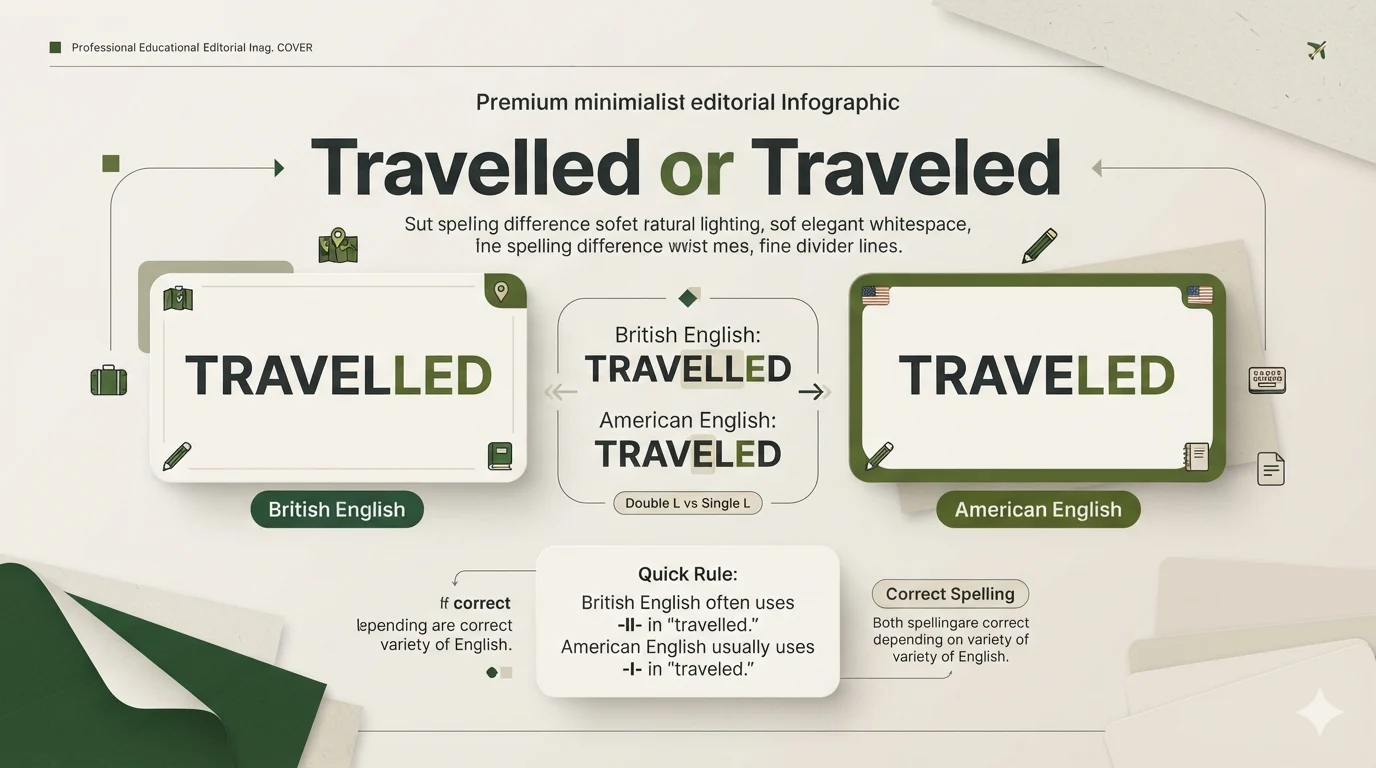
The difference between travelled and traveled is purely regional spelling. Traveled with one L is standard in American English, while travelled with two Ls is used in British, Canadian, Australian, and other Commonwealth English varieties. Both spellings are correct depending on your audience and location.
If you are writing an email to a client in London, a report for a Sydney-based company, or a blog post for American readers, you might pause before writing the past tense of travel. Is it travelled or traveled? This common spelling dilemma confuses English learners, professionals, and content creators alike.
These two spellings mean exactly the same thing they refer to the past tense or past participle of the verb travel. The difference is not about meaning, grammar, or correctness. It is entirely about geography and which English dialect you are using. Choosing the wrong spelling can create an impression of carelessness or inattention to detail, especially in professional writing.
This article explains the simple rules for using travelled versus traveled and helps you navigate regional spelling conventions with confidence. You will learn why both spellings exist, which one to use in different contexts, and practical memory tricks to avoid mistakes.
What’s the Difference Between Travelled and Traveled?
Travelled and traveled are two accepted spellings of the same word. The only difference is regional preference. American English uses traveled with one L, while British English and its derivatives use travelled with two Ls.
| Aspect | Traveled (American) | Travelled (British/Commonwealth) |
|---|---|---|
| Meaning | Past tense of travel | Past tense of travel |
| Part of Speech | Verb (past tense/past participle) | Verb (past tense/past participle) |
| Refers To | The action of journeying from one place to another | The action of journeying from one place to another |
| Typical Usage | US, Latin America, US-influenced contexts | UK, Canada, Australia, New Zealand, South Africa |
| Example | “She traveled to New York last week.” | “She travelled to London last week.” |
The key takeaway is simple: both spellings are correct within their respective English variants. There is no grammatical difference between them, and they can be used interchangeably as long as you are consistent with the chosen regional spelling.
Is This a Grammar, Vocabulary, or Usage Issue?
This is primarily a usage issue with spelling conventions, not a grammar or vocabulary difference. Travelled and traveled are not two different words with distinct meanings. They are alternative spellings of the same verb form, distinguished by regional orthographic preferences rather than grammatical function.
Grammar classification: Both words function identically as the past tense and past participle of the verb travel. For example, “I have traveled extensively” and “I have travelled extensively” are grammatically identical.
Vocabulary difference: There is no vocabulary difference. Both words share the same dictionary definition and refer to the same action.
Usage difference: The difference lies in usage conventions. American English simplifies many words that British English keeps with double letters such as color vs colour and canceled vs cancelled following the pattern of what linguist Noah Webster advocated.
Interchangeability: The words are interchangeable in meaning but not in accepted usage across regions. You cannot mix spellings within a single document if you are following a specific regional standard.
Formal English: In formal writing, consistency with regional convention is expected. American publications use traveled, while British publications use travelled.
Business English: Choose the spelling that matches your audience’s location. If your clients are mostly American, use traveled. For Commonwealth audiences, use travelled.
Academic writing: Follow your institution’s style guide or the preferred English variant of the publication you are submitting to.
Everyday conversation: Both spellings are understood globally, but using the regional variant appropriate to your location is more natural.
Practical takeaway: The difference is spelling, not meaning. Choose one variant and stick with it throughout your writing.
Traveled: American English Spelling
Traveled is the standard spelling in American English for the past tense and past participle of travel. This spelling follows the pattern of other American simplifications, such as canceled, labeled, and modeled.
Pronunciation: /ˈtrævəld/ (TRAV-uld)
Part of speech: Verb (past tense and past participle)
Common collocations:
- well-traveled
- heavily traveled
- traveled extensively
- traveled abroad
Typical sentence patterns:
- “Subject + traveled + destination/time”
- “Subject + have/has + traveled + time/distance”
Natural workplace example:
“After our CEO traveled to the Singapore office, she implemented new communication protocols that improved team collaboration across time zones.”
Academic example:
“The researchers traveled to remote regions of the Amazon to collect soil samples for their climate change study.”
Technology example:
“The autonomous vehicle traveled 800 miles without human intervention, setting a new benchmark for the industry.”
Email example:
“I have traveled to San Francisco twice this quarter for client meetings, and the team has been incredibly responsive to our proposals.”
Daily conversation example:
“We traveled all the way to the Grand Canyon, but the kids fell asleep before we reached the scenic overlook.”
One learner mistake:
“I have traveled to Canada last summer.” (Use past simple, not present perfect, for specific past time: “I traveled to Canada last summer.”)
Mini recap:
Traveled with one L is the go-to spelling in US English. Use it when writing for American audiences, following American style guides, or publishing in US-based media.
Travelled: British and Commonwealth English Spelling
Travelled is the standard spelling in British English, as well as in Canada, Australia, New Zealand, South Africa, and other Commonwealth countries. This spelling retains the double L that characterizes traditional English spelling.
Pronunciation: /ˈtrævəld/ (TRAV-uld) – the same as the American variant
Part of speech: Verb (past tense and past participle)
Common collocations:
- well-travelled
- widely travelled
- travelled extensively
- travelled overseas
Typical sentence patterns:
- “Subject + travelled + destination/time”
- “Subject + have/has + travelled + time/distance”
Natural workplace example:
“Our managing director travelled to the Dubai conference last month and secured three major contracts for the coming fiscal year.”
Academic example:
“The expedition team travelled through the Himalayan passes, documenting rare species previously unknown to Western science.”
Technology example:
“Data from the rover travelled millions of miles across space before reaching the mission control center in Germany.”
Email example:
“Having travelled to our European headquarters on several occasions, I can recommend the hotel near the office for your upcoming visit.”
Daily conversation example:
“My grandparents travelled all over the world, and their stories about different cultures inspired me to study anthropology.”
One learner mistake:
“She travelled to Paris at the moment.” (Use present or future for current action: “She is travelling to Paris right now.”)
Mini recap:
Travelled with two Ls is preferred outside the United States. Use it when writing for British, Canadian, Australian, or other Commonwealth audiences.
When NOT to Use Each Word
There are no situations where one spelling is grammatically incorrect, but there are times when choosing the wrong regional variant can appear unprofessional or out of place.
1. American corporate communications:
If you are writing an internal memo for a US-based company, using travelled with two Ls will stand out as British spelling and may be perceived as inconsistent.
2. British academic submissions:
British universities expect British spelling conventions. Submitting an essay with traveled instead of travelled may result in the editor marking it as an error.
3. Mixed audience documents:
When writing for an international audience, choose one variant and apply it consistently. Inconsistent spelling suggests carelessness.
4. Style guide requirements:
If your organization follows a specific style guide (APA, Chicago, etc.), refer to its preferred English variant. Chicago Manual of Style, for example, uses American spelling conventions.
5. Publications targeting specific regions:
A magazine in Sydney expects Australian English. A publication in Toronto expects Canadian English. Both use travelled with double L.
6. Software localization:
When translating or localizing software interfaces, ensure spelling matches the target audience’s English variant.
Why this mistake happens:
The confusion arises because writers encounter both spellings online and may not realize the spelling difference is regional. Mixing British and American spellings is common, especially among non-native English speakers.
How to remember:
- America has one L – “One L for America”
- Britain has two Ls – “Two Ls for London”
Common Mistakes Table
| Correct Sentence | Incorrect Sentence | Explanation |
|---|---|---|
| “I traveled to Chicago last week.” | “I travelled to Chicago last week.” | For an American audience, traveled is preferred. Travelled would still be understood but looks out of place. |
| “We have travelled throughout Scotland.” | “We have traveled throughout Scotland.” | For a British audience, travelled is expected. Traveled may be perceived as an error. |
| “She is a well-traveled executive.” | “She is a well travelled executive.” | American English uses one L even in the adjective form. Canadian English often uses travelled. |
| “The route is heavily travelled by tourists.” | “The route is heavily traveled by tourists.” | British and Commonwealth English use the double-L spelling. |
| “They travelled 500 miles in one day.” | “They travelled 500 mile’s in one day.” | Apostrophe misuse, not a spelling issue. Focus on the correct verb form. |
| “I have traveled extensively.” | “I have travelled extensively.” | Both are correct depending on audience, but mixing spellings in one document is inconsistent. |
| “The road less traveled” | “The road less travelled” | The famous phrase uses American spelling. Either is fine depending on context, but the original uses one L. |
| “He travels frequently for work.” | “He travelled frequently for work.” | Using the present tense incorrectly. Past tense has a different time reference. |
Decision Box
- If you are in the United States or writing for an American audience: Use traveled with one L.
- If you are in the United Kingdom, Canada, Australia, or any Commonwealth country: Use travelled with two Ls.
- If you are writing for a global audience: Pick one spelling and stick with it consistently.
- If you are unsure which is correct: Check your organization’s style guide or your word processor’s language settings.
Real-World Examples
Office communication:
American: “The sales team traveled to the regional conference and reported a 20% increase in leads.”
British: “The sales team travelled to the regional conference and reported a 20% increase in leads.”
Business email:
American: “I’ve traveled to our East Coast offices three times this year, so I’m familiar with the facilities.”
British: “I’ve travelled to our East Coast offices three times this year, so I’m familiar with the facilities.”
School or university:
American: “The professor traveled to Greece for her sabbatical research on ancient pottery.”
British: “The professor travelled to Greece for her sabbatical research on ancient pottery.”
Customer support:
American: “Your order traveled through our distribution network and should arrive by Wednesday.”
British: “Your order travelled through our distribution network and should arrive by Wednesday.”
Technology:
American: “The satellite traveled 22,000 miles to reach its geostationary orbit.”
British: “The satellite travelled 22,000 miles to reach its geostationary orbit.”
Daily conversation:
American: “We traveled by train across Europe for a month.”
British: “We travelled by train across Europe for a month.”
Travelled or Traveled in Modern Technology
The regional spelling rule applies consistently in modern technology contexts. Software interfaces are often localized with regional spelling variants, and tech publications align with their audience’s expectations.
Artificial Intelligence and Chatbots:
AI applications such as virtual assistants are typically programmed with region-specific spelling. Apple’s Siri, for example, reflects the spelling conventions of the device’s language setting.
Virtual Assistants:
When using voice assistants, the spelling appears on screen based on the device’s region settings. Users in the US see “traveled,” while UK users see “travelled.”
Software and Business Tools:
Project management platforms, CRM systems, and email clients display language based on the user’s chosen locale. Consistency in spelling contributes to a professional user experience.
Global Content Strategy:
Digital marketing professionals create separate content versions for US and UK audiences, applying traveled and travelled accordingly. This attention to detail improves engagement and credibility with target readers.
Word Origin and History
The verb travel originates from the Old French word travailler, meaning “to work or toil.” The spelling of its inflected forms has evolved differently in American and British English.
American simplification:
Noah Webster, the American lexicographer, advocated for simplified spellings in his dictionaries. He preferred shorter versions of words, which is why American English spells traveled with one L.
British tradition:
British English retained the double consonant pattern for words ending in a vowel followed by L. According to this convention, when adding a suffix beginning with a vowel, the L is doubled. Hence, travel becomes travelling and travelled.
The modern split:
Today, the one-L spelling is standard in American English, while the two-L spelling is standard in British English and its Commonwealth variants.
Expert Insight
The confusion between travelled and traveled persists because both spellings appear frequently online and in print. As a language instructor, I emphasize regional consistency with my students rather than memorizing arbitrary rules. Your audience determines the correct spelling not the dictionary. If your readers are in the United States, use traveled. If they are in the UK, Canada, or Australia, use travelled. Consistency matters as much as correctness. A document with mixed spellings reads as less polished, regardless of which spelling you choose.
Error Prevention Checklist
- Always use “traveled” when: You are writing for an American audience or following US English conventions.
- Always use “travelled” when: You are writing for a British, Canadian, Australian, or Commonwealth audience.
- Never confuse them if: You can identify your target audience’s location. The spelling choice depends entirely on the reader’s regional expectation.
- Quick memory tip: America has A single L (traveled). Britain has Both Ls (travelled).
Related Grammar Confusions
- Canceled vs Cancelled – Same rule applies: one L in American, two in British.
- Labeled vs Labelled – Follows the same American simplification pattern.
- Modeled vs Modelled – Another example of the American one-L convention.
- Traveler vs Traveller – The noun form follows the same regional rule.
- Traveling vs Travelling – The present participle uses the same spelling distinction.
- Color vs Colour – American simplification of words ending in -our.
- Honor vs Honour – Same pattern as color/colour.
- Center vs Centre – American vs British spelling of the same noun.
- Defense vs Defence – American vs British spelling.
- License vs Licence – American and British noun/verb distinctions.
FAQs
Which is correct, traveled or travelled?
Both are correct; the choice depends on your regional English variant. Traveled is used in American English, while travelled is preferred in British, Canadian, Australian, and other Commonwealth English varieties.
Why does American English use one L in traveled?
Noah Webster, the American lexicographer, preferred simpler spellings. He advocated using fewer letters where possible, which is why American English spells traveled, canceled, and labeled with one L.
Can I use travelled and traveled interchangeably?
You can use both, but you should be consistent with your chosen regional convention. Mixing spellings in a single document looks unprofessional. Choose one spelling based on your audience.
Is it travelling or traveling?
The same rule applies: traveling is American English, and travelling is British and Commonwealth English. Choose the spelling that matches your regional context.
What about traveler vs traveller?
The noun forms follow the same regional pattern. Traveler is American, while traveller is British and Commonwealth. This applies consistently to all forms of the word.
Conclusion
The difference between travelled and traveled is straightforward: it is a regional spelling difference, not a grammatical or vocabulary distinction. American English favors traveled with one L, while British English and its Commonwealth variants use travelled with two Ls.
When writing, consider your audience first. If your readers are American, use traveled. If they are British, Canadian, Australian, or from other Commonwealth countries, use travelled. Consistency throughout your document demonstrates attention to detail and professionalism.
Remember the simple rule: “America has A single L” (traveled), and “Britain has Both Ls” (travelled). This memory trick will help you choose the correct spelling every time.
Read More Related Articles:
- Pronounciation vs Pronunciation | Common Error You Can Avoid In 2026
- Privilege vs Priviledge | Learn the Correct Word Fast In 2026
- Suing or Sueing | Don’t Let This Spelling Trip You Up In 2026

Caleb Dawson is a content writer at synoseek.com, where he works on simple, reader-focused articles across a range of everyday topics. His writing style is practical and grounded, aiming to present information in a clear and relatable way without unnecessary complexity.
2 thoughts on “Travelled or Traveled | Correct Spelling Depends on This Simple Rule In 2026”