Quick Answer:
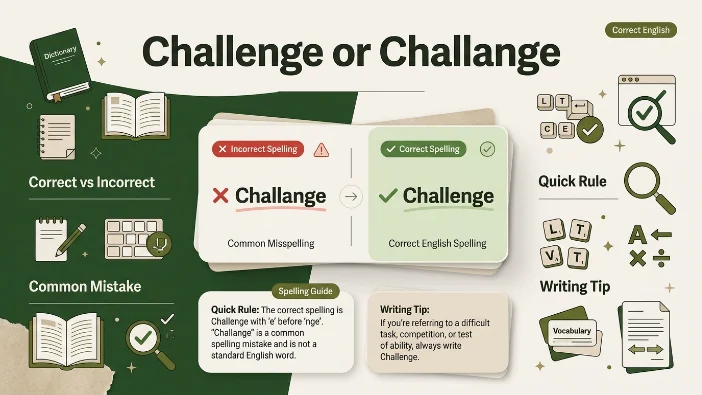
Only challenge is correct English spelling. Challange is a common misspelling that comes from how the word sounds when spoken quickly, not from any accepted grammar rule. Every major dictionary, including Oxford and Merriam-Webster, lists challenge as the sole standard form for writing, speaking, and academic use.
Many writers wonder whether Challenge or Challange is the correct spelling. It’s a common mistake because both words sound similar, but only one is accepted in standard English.
In this guide, you’ll learn the difference between Challenge or Challange, discover the correct spelling, see real-world examples, and get simple memory tricks to help you avoid this spelling error in the future.
Why So Many People Type “Challange” Without Noticing
If you’ve ever paused halfway through typing this word and wondered whether it needs an “e” or an “a,” you’re not alone. Thousands of people search for “challenge or challange” every month, and most of them aren’t confused about what the word means. They’re confused about how it’s spelled, because the mistake feels natural once you say the word out loud.
Say “challenge” slowly and you’ll notice the middle syllable comes out sounding closer to “lahnj” than “lehnj.” That small gap between pronunciation and spelling is exactly where the error sneaks in. English does this constantly, and challenge happens to be one of the words that trips up native speakers and English learners alike, often without either group realizing it.
This guide clears up the confusion for good. You’ll learn why challenge is the only correct form, why challange keeps showing up anyway, and how to make sure you never second-guess this spelling again, whether you’re writing a business email, a school assignment, or a quick text to a friend.
Challenge vs Challange: What’s the Real Difference?
There isn’t a real difference in meaning, because challange isn’t a word. Challenge is a noun and a verb referring to a difficult task, a test of ability, or an act of questioning something. Challange is simply a spelling error, and dictionaries do not recognize it as an alternate or informal version.
| Feature | Challenge | Challange |
|---|---|---|
| Meaning | A difficult task or a test of ability; to question or dispute | None — not a recognized word |
| Part of Speech | Noun, Verb | N/A |
| Dictionary Status | Standard entry in all major dictionaries | Absent from every dictionary |
| Typical Usage | Formal and informal writing, business, academic, casual speech | Appears only as a typing error |
| Common Confusion | Middle vowel sound leads writers to guess “a” instead of “e” | Mistaken for a valid alternate spelling |
So the comparison here isn’t between two legitimate words competing for the same meaning, the way “affect” and “effect” do. It’s closer to comparing “definitely” with “definately.” One is correct. The other is a spelling habit that needs to be corrected, not a stylistic choice.
Is This a Grammar Issue, a Vocabulary Issue, or a Spelling Issue?
This is purely a spelling issue, not a grammar or vocabulary problem. The grammar rules for using challenge as a noun or verb stay exactly the same regardless of how someone mistypes it. The vocabulary meaning doesn’t shift either, because challange has no meaning of its own to shift into.
Where this becomes a real problem is credibility. In formal English, business English, and academic writing, spelling errors like this one can quietly undercut an otherwise strong piece of writing. A hiring manager reading a cover letter, a professor grading an essay, or a client reviewing a proposal may not consciously flag the mistake, but it can still shape how careful and polished your writing appears.
In everyday conversation and casual texting, the stakes are lower, but the habit still matters. If your fingers are used to typing challange, that muscle memory eventually shows up in places where accuracy counts, like resumes, reports, or official documents.
Practical takeaway: Treat this the same way you’d treat any spelling correction. Once you fix the habit in casual writing, it stops appearing in formal writing too.
Understanding “Challenge” Properly
Meaning: A task, situation, or activity that requires significant effort, skill, or determination to complete. As a verb, it means to invite someone to compete, to question the validity of something, or to test someone’s abilities.
Pronunciation: CHAL-ənj (the second syllable is a soft, quick “uhn,” not a hard “ahn”)
Part of Speech: Noun and verb
Common Collocations: face a challenge, rise to the challenge, pose a challenge, accept a challenge, challenge yourself, challenge a decision, meet the challenge
Typical Sentence Patterns:
- “It was a real challenge to finish the project on time.”
- “She decided to challenge the referee’s call.”
- “The biggest challenge for new managers is delegating tasks.”
Workplace Example: “Onboarding remote employees has been a challenge for our HR team this quarter.”
Academic Example: “Balancing coursework with a part-time job is a common challenge among college students.”
Technology Example: “One challenge in building AI models is reducing bias in the training data.”
Email Example: “Thanks for flagging the issue. I understand this has been a challenge, and I’ll follow up with a solution by Friday.”
Daily Conversation Example: “Honestly, waking up early is my biggest challenge right now.”
One Learner Mistake: Non-native speakers sometimes write “challange” because their own language pronounces similar loanwords with an “a” sound in that position. This is especially common among speakers whose first language doesn’t distinguish clearly between the short “e” and short “a” sounds in unstressed syllables.
Mini Recap: Challenge works as both a noun and a verb, always spelled with an “e” in the middle, and it fits naturally into formal and informal English alike.
Understanding “Challange”
There isn’t a legitimate word here to explain, so instead, let’s look at where this spelling actually comes from and why it persists.
Where It Comes From: Challange isn’t a variant spelling used in older English, a regional dialect form, or an accepted informal spelling the way “gonna” or “wanna” are. It’s a pure typo that spreads because it looks plausible. The word “orange” ends the same way and is spelled correctly with an “a,” so writers sometimes unconsciously borrow that pattern.
Why It Feels Right: Auto-correct doesn’t always catch it if you’re typing quickly, and if you’ve seen the misspelling in a text message, a social media comment, or a group chat, your brain can start treating it as a familiar shape, even though it’s wrong.
One Learner Mistake: Some English learners assume that because “change” is spelled correctly with an “a” and “challenge” contains the word “change” inside it, both words should follow the same vowel pattern. They don’t. “Challenge” and “change” are unrelated in origin, even though they look similar on the page.
Mini Recap: Challange isn’t a spelling variation, a slang form, or a regional version of the word. It’s simply an error worth correcting, and once you notice why it happens, it becomes much easier to stop making it.
When Writers Commonly Get This Wrong
1. Typing quickly without proofreading. Speed typing on phones or in chat apps is where this mistake shows up most. The fix is simple: read your sentence back before hitting send, especially in professional messages.
2. Relying on pronunciation instead of spelling memory. Because the middle syllable sounds soft, some writers guess at the vowel instead of recalling the correct spelling. Sounding a word out doesn’t always work in English, and challenge is a clear example of why.
3. Confusing it with “change.” Since “challenge” contains “change,” writers sometimes assume the vowels should match. Remembering that challenge has its own separate origin can help break this habit.
4. Seeing the misspelling repeatedly online. User-generated content, including comments and captions, contains plenty of misspelled words. Repeated exposure to “challange” in casual spaces can make it feel more familiar than it should.
5. Non-native English speakers translating sound patterns. In several languages, similar-sounding loanwords use an “a” in that position, and this can carry over into English spelling by habit.
6. Autocorrect gaps on certain keyboards. Not every keyboard or app flags “challange” as incorrect, especially in casual messaging apps with lighter spell-check systems.
7. Writing under time pressure. Timed exams, quick email replies, and last-minute reports increase the chance of small spelling slips like this one.
8. Muscle memory from repeated typos. Once someone types a word incorrectly a few times, their fingers can default to that pattern, even if they know the correct spelling when asked directly.
Common Mistakes Table
| Correct Sentence | Incorrect Sentence | Explanation |
|---|---|---|
| “This project has been a huge challenge.” | “This project has been a huge challange.” | Challange is not a recognized spelling in any dictionary. |
| “I want to challenge myself this year.” | “I want to challange myself this year.” | The verb form always uses “e,” never “a.” |
| “The team accepted the challenge.” | “The team accepted the challange.” | Formal and business writing requires the standard spelling. |
| “She challenged his assumption.” | “She challanged his assumption.” | The past tense also keeps the “e” before adding “-d.” |
Quick Decision
If you’re writing the word that means a difficult task, a test of skill, or an act of questioning something, always use challenge. There is no situation, formal or informal, where “challange” is the correct choice. If you see it written that way, it needs to be corrected.
Real World Examples
Office Communication: “Let’s discuss the biggest challenge we’re facing with the Q3 rollout during tomorrow’s meeting.”
Business Email: “We understand this delay presents a challenge for your team, and we’re committed to resolving it quickly.”
School or University: “One challenge students face during finals week is managing sleep and study time.”
Customer Support: “We know the login issue has been a challenge. Our engineers are working on a fix now.”
Technology: “Reducing latency remains a major challenge for real-time translation apps.”
Artificial Intelligence: “Training AI models to understand context accurately is still a significant challenge.
Daily Conversation: “Honestly, staying consistent with workouts is my biggest challenge.”
Challenge in Modern Technology
The word challenge shows up constantly in tech writing, product descriptions, and AI documentation, which is part of why getting the spelling right matters more today than ever. Software companies describe user pain points as challenges. AI researchers write about the challenges of bias, hallucination, and data quality. Virtual assistants and chatbots are frequently marketed around how well they solve everyday challenges for users.
Voice assistants like Siri, Alexa, and Google Assistant are often described in reviews and documentation as tools built to handle “daily challenges,” from scheduling to reminders. In AI development specifically, terms like “engineering challenge” or “technical challenge” appear throughout research papers, product blogs, and internal documentation. A misspelling in this context, especially in published material, can look unpolished in an industry where precision matters.
Word Origin
Challenge traces back to the Old French word “chalenge,” which itself came from the Latin “calumnia,” meaning a false accusation or trick. Over centuries, the meaning shifted from accusation toward the modern sense of a difficult task or a call to compete. Understanding this origin helps explain why the word doesn’t follow the same spelling pattern as “change,” even though the two look similar. They simply come from different linguistic roots that happened to end up looking alike.
Expert Insight
As an English instructor, I tell students that the words most likely to trip you up aren’t the long, complicated ones. They’re the everyday words you already know how to say but rarely stop to look at closely. Challenge falls into that category. You’ve heard it a thousand times, so your ear trusts its own guess about the spelling. The fix isn’t memorizing a rule. It’s slowing down just enough to actually look at the word the next time you write it, until the correct spelling becomes the automatic one.
Error Prevention Checklist
- Always use challenge when writing about a difficult task, a test of ability, or an act of questioning something.
- Always use challenge in every tense: challenge, challenged, challenging.
- Never confuse it with “change,” even though the words look related.
- Quick memory tip: Challenge rhymes visually with “orange” in its ending, but always remember the middle sound uses an “e,” not an “a.” If in doubt, spell it slowly: c-h-a-l-l-e-n-g-e.
Related Grammar Confusions Worth Learning
- Definitely vs Definately: Another word where pronunciation misleads spelling, since the correct form has no “a” in the middle syllable.
- Separate vs Seperate: A frequently misspelled word because the “a” sound in the middle syllable often gets swapped for an “e.”
- Accommodate vs Acommodate: Learners often drop one of the double letters, changing the word’s correct structure.
- Effect vs Affect: Unlike challenge, this pair involves two real words with different meanings and uses.
- Occurred vs Occured: A classic double-letter mistake that changes the word’s accepted spelling.
- Recommend vs Reccomend: Similar to challenge, this word gets misspelled based on how quickly it’s pronounced.
- Embarrass vs Embarass: Another double-letter trap that confuses even confident writers.
- License vs Lisence: Worth learning because British and American English also spell this word differently depending on context.
- Necessary vs Neccessary: A commonly misspelled word due to its unusual double-letter pattern.
- Personnel vs Personal: Two real but different words that are easy to mix up in professional writing.
FAQs
Is challange ever correct in British English?
No. Both British and American English use the spelling challenge. Challange is not an accepted regional variation and is considered a spelling mistake in all standard forms of English.
Why do I keep spelling it as challange?
This is a common typing habit caused by muscle memory or writing too quickly. Because the words sound similar when spoken, many people accidentally replace the e with an a. Proofreading your writing can help you catch the mistake.
Will autocorrect always fix challange?
Not necessarily. While many modern spell checkers suggest challenge, some messaging apps, browsers, or basic text editors may not detect the error, allowing the misspelling to slip through.
Is challenging spelled the same way as challenge?
Yes. All forms of the word, including challenging, challenged, and challenges, keep the same base spelling challenge. Only the ending changes to match the word’s grammatical form.
Can challange ever be listed as a dictionary word?
No. Reputable dictionaries do not recognize challange as a valid word, informal spelling, or slang. It is simply a common misspelling of challenge.
What’s an easy way to remember the correct spelling?
Think of the word as chal + lenge and remember that challenge always contains “lenge,” not “lange.” Another simple tip is to associate it with “challenge accepted,” a phrase you’ll often see spelled correctly.
Conclusion
The comparison between challenge and challange isn’t really a comparison at all, since only one of these is a real word. Challenge is the standard, dictionary-approved spelling used in every form of English writing, from casual texts to formal business reports, while challange is simply a spelling slip that tends to come from how the word sounds rather than how it’s actually written.
If you remember one simple rule, make it this one: challenge always has an “e” in the middle, never an “a.” Once that spelling becomes second nature, you’ll never have to pause and second-guess it again.
2 thoughts on “Challenge or Challange | Learn the Right Spelling Once and for All In 2026”