Quick Answer
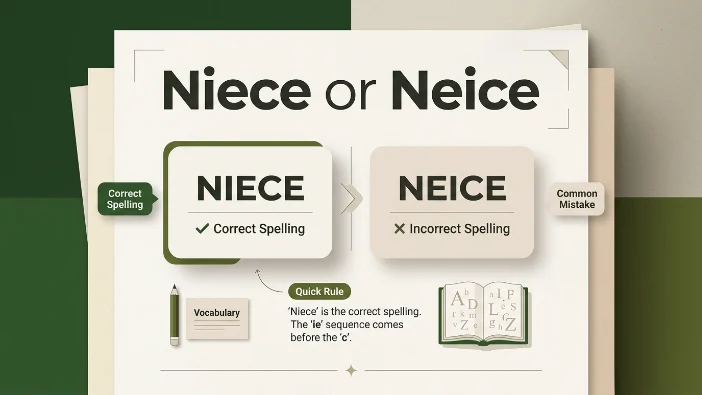
Niece is the correct spelling in English, while “neice” is a common misspelling with no dictionary standing. The word niece refers to your brother’s or sister’s daughter, or your spouse’s sibling’s daughter. People misspell it as “neice” because English has a confusing rule about when “i” comes before “e.” Always write niece, never neice.
You’re writing a family email, a birthday card, or maybe a school essay, and suddenly you freeze. Is it “niece” or “neice”? Both look strange once you stare at them long enough, and that’s exactly the trap English sets for you. The word niece means the daughter of your brother, sister, or sibling-in-law, and it’s one of those everyday family terms that should be simple to spell. Yet thousands of people type “neice” every single day, convinced it looks right.
This mix-up isn’t really about vocabulary. It’s about a spelling pattern that trips up even confident writers. Getting it wrong in a resume, a legal document, or a formal letter can make your writing look careless, even if your grammar is otherwise flawless. In this guide, you’ll learn exactly why “neice” feels so tempting, the actual spelling rule behind niece, and simple memory tricks that will make sure you never second-guess yourself again.
Niece: What’s the Difference?
There isn’t a real difference in meaning here, because “neice” isn’t an actual English word. It’s simply a misspelling of niece. But understanding why the mistake happens is the real value of this section, because once you see the pattern, you’ll stop making it.
Niece is a noun. It’s the female counterpart to “nephew,” and it describes a specific family relationship: the daughter of your sibling, or the daughter of your spouse’s sibling. The word comes from Old French “niece,” which itself traces back to Latin “neptis,” meaning granddaughter or descendant. Over centuries, the meaning narrowed to specifically mean a brother’s or sister’s daughter.
“Neice,” on the other hand, has no history, no dictionary entry, and no accepted usage anywhere in formal or informal English. It exists purely as a spelling error, almost always caused by confusion over vowel order.
| Term | Status | Meaning | Part of Speech | Typical Usage |
|---|---|---|---|---|
| Niece | Correct standard spelling | Daughter of your sibling or sibling-in-law | Noun | All writing contexts |
| Neice | Incorrect spelling | No meaning; misspelling of niece | Not a word | Should never be used |
So the real comparison isn’t between two valid options. It’s between one correct word and one common typo that has spread widely enough that people start to doubt themselves. That doubt is worth addressing directly, because once you understand the reasoning, the correct spelling becomes automatic.
Is Niece a Grammar, Vocabulary, or Spelling Issue?
This is purely a spelling issue, not a grammar or vocabulary problem. Niece functions correctly as a noun in every sentence structure; the only risk is writing the letters in the wrong order. There’s no version of English, formal or casual, academic or conversational, where “neice” is acceptable.
In formal English, business writing, and academic papers, spelling errors like this one stand out immediately to careful readers. A misspelled family term in a cover letter or a college application essay can quietly damage your credibility, even if the rest of your writing is strong. In everyday conversation and texting, the stakes are lower, but the habit of misspelling still tends to carry over into more formal writing if it isn’t corrected early.
The practical takeaway: there’s no context, formal or informal, where “neice” is the right call. Train your hand to write niece, and the confusion disappears for good.
The “I Before E” Rule and Why Niece Breaks the Pattern
Most people learned a little rhyme in elementary school: “I before E, except after C.” That rule is why so many writers instinctively want to write “neice.” After all, “receive,” “ceiling,” and “deceive” all follow the pattern where E comes before I after the letter C. Since “niece” doesn’t have a C in front of the vowel pair, some writers assume the “normal” rule should apply and flip the letters.
Here’s the catch: niece doesn’t follow the “except after C” clause at all, because it isn’t preceded by a C. It simply follows the standard “I before E” pattern, the same as words like “believe,” “relief,” “grief,” and “field.” The rhyme actually supports the correct spelling of niece; the confusion happens because people misapply the exception instead of the main rule.
It also helps to know that the classic rhyme has plenty of exceptions anyway (think “weird,” “science,” and “seize”), so relying on it as your only tool is risky. A better approach is pattern recognition through repetition and a couple of memory tricks, which we’ll cover shortly.
Niece: Meaning, Usage, and Everyday Examples
Meaning: Niece is a noun describing the daughter of one’s brother, sister, brother-in-law, or sister-in-law.
Pronunciation: It’s pronounced “neese,” rhyming with “geese” or “fleece.” Interestingly, hearing the word doesn’t help much with spelling it, since the “ee” sound could theoretically be written several ways in English.
Part of speech: Noun (specifically a kinship term, similar to nephew, aunt, and uncle).
Common collocations: “my niece,” “his niece,” “favorite niece,” “niece and nephew,” “niece’s birthday.”
Typical sentence patterns: Niece usually appears as the object or subject of a sentence involving family relationships, gift-giving, visits, or introductions.
Here’s how the word shows up naturally across different situations:
- Workplace example: “I’m leaving early on Friday because my niece’s dance recital starts at five.”
- Academic example: “The professor’s niece is applying to the same graduate program this fall.”
- Technology example: “I set up parental controls on my niece’s tablet before her visit.”
- Email example: “Just a reminder that my niece will be joining us for the holiday dinner this year.”
- Daily conversation example: “Have you met my niece yet? She just turned seven.”
One learner mistake: Non-native English speakers sometimes confuse niece with “cousin” or “nephew” because their native language may use a single word for multiple types of relatives. It’s worth remembering that niece specifically means a sibling’s daughter, not any young female relative.
Mini recap: Niece is simple once you separate the spelling issue from the meaning. The word always refers to a specific family relationship, is always spelled with I before E, and never has a real alternate form.
Why “Neice” Feels Right (Even Though It Isn’t)
Since “neice” isn’t a legitimate word, there’s no separate meaning or usage guide to give it. But it’s worth explaining why so many writers land on this exact misspelling, because understanding the “why” makes the correction stick.
Several patterns explain the confusion:
- The exception rule gets misapplied. As mentioned earlier, writers remember “except after C” and mistakenly assume every tricky “ie/ei” word follows that exception.
- Visual memory competes with sound. Words like “receipt,” “vein,” and “neighbor” use E-I, and frequent exposure to those words can bleed into how people spell niece.
- Autocorrect inconsistency. Not every device catches this error instantly, especially in casual typing apps, so the mistake can go uncorrected for years.
- Regional handwriting habits. Some people learned cursive or early spelling with looser rules around vowel pairs, which can create lasting muscle memory for the wrong order.
None of these reasons make “neice” acceptable, but they explain why the mistake is so persistent, even among fluent English speakers.
When Not to Use “Neice”
Since “neice” isn’t a word, the more useful framing is: here are the situations where writers commonly slip and write it by mistake, along with how to catch yourself.
1. Writing quickly without proofreading. Fast typing, especially in texts or emails, often skips the mental double-check that spelling requires. Slow down slightly when writing family terms you know are tricky.
2. Relying on sound instead of memory. Because “niece” and “neice” sound identical, your ear won’t warn you. Only visual memory of the correct spelling will catch it.
3. Confusing it with other “ei” words. If you’ve just typed “receive” or “ceiling,” your brain may carry that E-I pattern into the next word without you noticing.
4. Writing in a second language mindset. If your first language uses different vowel-pairing conventions, this specific English quirk can be genuinely difficult to internalize without deliberate practice.
5. Trusting autocorrect blindly. Some spellcheckers flag “neice” instantly; others, especially in messaging apps, won’t catch it at all.
6. Writing under stress or time pressure. Job applications, urgent emails, and exams are common places where this error appears, simply because there’s less mental space for double-checking spelling.
7. Copying handwriting from someone else’s mistake. If a family member, a card, or an old letter has spelled it “neice,” that visual can stick with you longer than the correct version.
8. Assuming it follows nephew’s pattern. Some writers subconsciously try to make niece “match” the spelling rhythm of nephew, even though the two words don’t share a root or a spelling pattern.
Common Mistakes Table
| Correct Sentence | Incorrect Sentence | Explanation |
|---|---|---|
| My niece is turning ten next week. | My neice is turning ten next week. | “Neice” reverses the correct I-before-E order. |
| I bought a gift for my niece. | I bought a gift for my neice. | The word should always be spelled niece, with no exceptions. |
| Her niece just started college. | Her neice just started college. | This is a straightforward spelling error, not a grammar issue. |
| We invited my niece and nephew to the wedding. | We invited my neice and nephew to the wedding. | Note that nephew doesn’t share the same vowel pattern, so it can’t be used to “check” niece’s spelling. |
Decision Box
If you’re referring to your sibling’s daughter, the correct word is always niece.
There is no situation where neice is correct. If you’re ever unsure, remember: it follows the standard “I before E” rule, just like “believe” and “field.”
Niece in Real-World Communication
Office communication: “I’ll be out of the office Thursday afternoon for my niece’s graduation ceremony.”
Business email: “Please note that my niece will be shadowing our team for career day next Tuesday.”
School or university: “The scholarship essay was written about the writer’s niece and her passion for marine biology.”
Customer support: “I’m calling to update the emergency contact information; I’d like to add my niece to the account.”
Technology: “My niece taught me how to use video filters on my phone last weekend.”
Artificial Intelligence: “I asked an AI chatbot to help me write a birthday message for my niece, and it suggested a few sweet lines about her love of painting.”
Daily conversation: “You’ll love my niece, she’s incredibly funny and asks the best questions.”
Each of these examples shows how naturally the word fits into ordinary communication, and how a small spelling slip could quietly undercut an otherwise polished message.
Niece in Modern Technology
Family vocabulary like niece comes up constantly in digital spaces, even though it might not seem like an obvious tech-related word. Voice assistants like Siri, Alexa, and Google Assistant are frequently asked to set reminders such as “remind me to call my niece” or “add my niece’s birthday to the calendar.” Since these systems rely on speech-to-text conversion, they always hear “neese” and must guess the correct spelling, which is part of why accurate training data matters so much for voice technology.
In chatbots and AI writing tools, users often type quick, unedited messages such as “help me write a card for my neice,” and a well-trained AI model should recognize the intended word and either gently correct it or interpret it correctly rather than getting confused. This is a small but telling example of how everyday spelling accuracy affects both human communication and machine understanding.
Software like grammar checkers and email autocorrect tools also play a growing role in catching this specific error. Most modern spellcheckers flag “neice” immediately, but browser-based text fields, especially on mobile keyboards, sometimes miss it. Relying on personal knowledge of the correct spelling is still the most reliable method, technology aside.
Where the Word “Niece” Comes From
Niece traces back to Old French “niece” (modern French uses “nièce”), which itself descended from the Latin word “neptis,” meaning granddaughter or female descendant. Interestingly, the Latin root also connects to “nephew,” which comes from “nepos.” Over time, English narrowed both words to their current, more specific meanings referring to a sibling’s children rather than descendants in general.
Knowing this small history doesn’t just satisfy curiosity, it also explains why niece doesn’t share a spelling pattern with nephew, even though the two words are closely related in meaning. They evolved from different Latin forms, which is part of why trying to match their spellings doesn’t work as a memory trick.
Expert Insight
As a language instructor, I’ve noticed that the words people misspell most often aren’t complicated vocabulary; they’re common, everyday words like niece, believe, and receive. The reason is simple: familiarity breeds a kind of spelling autopilot, where your brain trusts the sound of a word more than its actual letters. The fix isn’t memorizing more rules, it’s slowing down just slightly on words you already “know,” because that’s exactly where overconfidence creates errors.
Error Prevention Checklist
- Always use niece when referring to your sibling’s daughter, in every writing context.
- Never use neice; it has no correct usage anywhere in English.
- Remember that niece follows the standard “I before E” rule, since it doesn’t come after a C.
- Quick memory tip: think of “niece” and “believe” together, both follow the same I-before-E pattern, and neither has a C before the vowel pair.
Related Grammar Confusions Worth Learning
- Effect vs. Affect one of the most common grammar mix-ups in professional writing.
- Their, There, and They’re a classic homophone trio that trips up even experienced writers.
- Receive vs. Recieve another I-before-E exception worth mastering alongside niece.
- Complement vs. Compliment subtle spelling difference with very different meanings.
- Its vs. It’s a small apostrophe that changes meaning entirely.
- Stationary vs. Stationery easy to confuse visually, but very different in meaning.
- Principal vs. Principle commonly misused in academic and workplace writing.
- Nephew vs. Nephews plural forms of family terms often confuse learners too.
- Weird vs. Wierd another famous exception to the I-before-E rule.
- Believe vs. Beleive nearly identical confusion pattern to niece, worth studying together.
FAQs
Is “neice” ever an acceptable alternate spelling?
No. Neice is a common misspelling of niece and is not accepted as a standard alternative spelling. In formal, academic, or professional writing, always use niece.
Why does niece not follow the “except after C” rule?
The phrase “i before e except after c” is only a general spelling guideline, not a universal rule. In niece, the ie combination is not preceded by c, so the exception does not apply. Words such as receive and ceiling have ei because the ie/ei combination follows c.
What’s the difference between niece and nephew?
A niece is the daughter of your sibling, while a nephew is the son of your sibling. These terms can also refer to the children of your spouse’s siblings, depending on the family relationship being described.
How do you remember the correct spelling of niece?
A useful trick is to connect niece with words such as believe and field, which also use the ie pattern. You can also break it down mentally as nie + ce to reinforce the correct spelling.
Does autocorrect always catch “neice”?
No. Many modern spellcheckers and keyboards will flag neice, but some messaging apps or writing tools may not. Since technology doesn’t always catch word-choice and spelling errors, it’s still a good idea to proofread important writing manually.
Is niece a formal or informal word?
Niece works in both formal and informal English. It is a neutral term for a family relationship and is appropriate in everyday conversation, professional correspondence, legal documents, and academic writing.
Conclusion
The difference between niece and neice really comes down to one simple rule: niece is correct, and neice is a common but incorrect spelling with no place in standard English. Once you understand that the word follows the ordinary I-before-E pattern, rather than the “except after C” exception, the confusion tends to disappear for good.
If you want one rule to carry with you, remember this: niece rhymes with “fleece” and follows the same letter order as “believe.” Keep that connection in mind, and you’ll never second-guess this spelling again.
Read More Related Articles:
- Shiny or Shiney | Avoid This Simple Spelling Error in English In 2026
- Occasion or Ocassion | Common Mistake Explained with Real-Life Examples In 2026
- Cacoon or Cocoon | Simple Rule You’ll Never Forget In 2026

Zoe Chambers works as a content writer at synoseek.com, contributing thoughtful pieces on everyday subjects and ideas. She writes in a simple, grounded way, often drawing from real-world experiences. Her focus is on keeping content natural, clear and easy for readers to connect with.
1 thought on “Niece or Neice | Master the Correct Spelling in Seconds In 2026”