Quick Answer
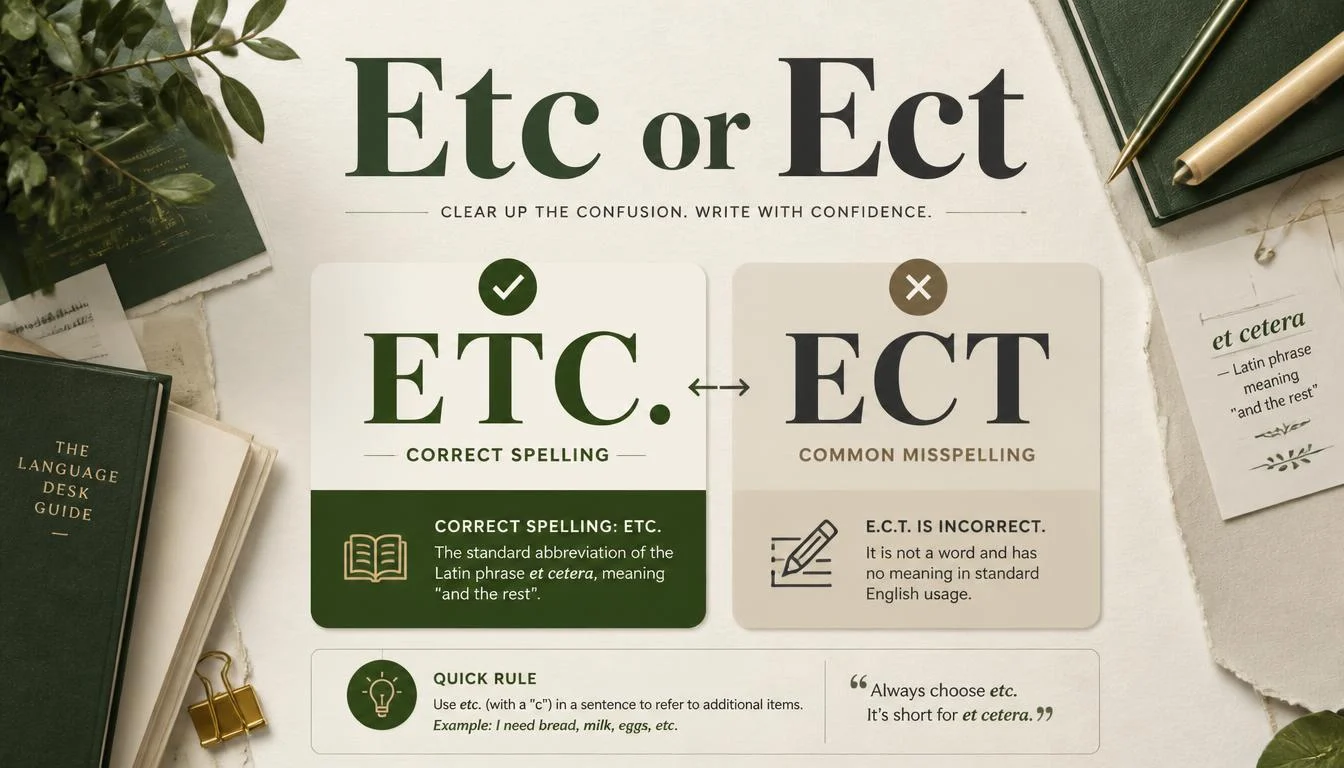
The correct spelling is etc (not “ect”), which is an abbreviation of the Latin phrase “et cetera” meaning “and other similar things” or “and so forth.” “Ect” is a common misspelling that should be avoided in all forms of writing. Remember that “etc” stands for “et cetera” and contains the letters E-T-C in that exact order.
Have you ever found yourself typing “ect” and wondering if it looks wrong? You’re not alone. This simple three-letter abbreviation creates surprisingly widespread confusion among native English speakers and language learners alike. The difference between “etc” and “ect” isn’t really a grammatical debate it’s a spelling issue that affects credibility, clarity, and professionalism in everything from casual emails to academic papers.
The confusion stems from how we hear and process the abbreviation. When spoken aloud, “et cetera” sounds like “et SET-er-uh,” and many people mistakenly assume the abbreviation follows the spoken pattern rather than the written Latin roots. This seemingly minor error can make your writing appear careless or undereducated, particularly in professional settings. In this guide, you will learn why “etc” is correct, why “ect” is incorrect, and how to use this versatile abbreviation confidently in any context.
What’s the Difference Between Etc and Ect?
The distinction is straightforward: “etc” is the correct abbreviation, while “ect” is simply a spelling error. There is no scenario where “ect” is acceptable in standard English writing.
| Aspect | Etc | Ect |
|---|---|---|
| Meaning | “And other things” (from Latin “et cetera”) | No meaning it’s a misspelling |
| Part of Speech | Abbreviation | Not recognized as a word |
| Refers To | Additional items in a list or category | Nothing |
| Typical Usage | Academic writing, business documents, everyday writing | Never used correctly |
| Example | “Bring pens, paper, notebooks, etc.” | “Bring pens, paper, notebooks, ect.” ❌ |
| Common Confusion | How to punctuate, whether to use in formal writing | Whether it’s a valid alternative spelling |
The takeaway is simple: use “etc” every time. Think of “et cetera” and remember that the abbreviation contains the first letters of those two words E and T from “et,” and C from “cetera.” That spells E-T-C in that exact order.
Grammar, Vocabulary, or Usage Issue?
This is primarily a spelling and usage issue rather than a grammar rule. Understanding this distinction helps writers approach the problem correctly.
Grammar Classification
“Etc” is an abbreviation, not a grammatical element with rules about conjugation or agreement. It functions as a shorthand way to conclude lists and doesn’t interact with other parts of speech in ways that require grammatical analysis.
Vocabulary Difference
This isn’t a vocabulary distinction because “ect” isn’t a word. The only relevant vocabulary term is “etc” (or “et cetera” in full). The confusion arises from spelling rather than word choice or meaning.
Interchangeability
No, these are not interchangeable. “Ect” is incorrect in all contexts formal, informal, academic, or professional. Using “ect” will make your writing appear unedited and careless.
Usage Across English Varieties
In American English, British English, Australian English, and all other standard English varieties, “etc” is the only acceptable spelling. The error “ect” appears universally among non-native speakers and young native speakers who haven’t learned the Latin root. The same rule applies regardless of whether you’re writing for business, academia, or everyday communication.
Practical Takeaway
Every time you type “ect,” your readers will notice. In professional contexts, this simple mistake can undermine your credibility. Train your fingers to type E-T-C by saying “et cetera” as you type the abbreviation.
Understanding Et Cetera (Etc)
“Etc” serves as one of the most useful tools in the English language for avoiding overly long lists. It signals that readers should infer additional examples from the same category without you needing to spell them all out.
Meaning and Pronunciation
Etc” means “and other similar things” or “and so forth.” When speaking, you pronounce it as “et SET-er-uh” because it is the abbreviated form of “et cetera.” Some people also say “etc” as individual letters, “E-T-C,” when referring specifically to the abbreviation.
Part of Speech
“Etc” functions as an abbreviation that indicates a continuation of a list or category. More practically, it serves as a shorthand device that shows there are additional similar items that have not been mentioned.
Common Collocations and Patterns
You will typically encounter “etc” in these patterns:
- At the end of a list: “The store sells apples, oranges, bananas, etc.”
- Following a category: “Bring camping equipment such as tents, sleeping bags, etc.”
- With a comma before it: Most style guides recommend a comma before “etc.” such as “Apples, oranges, etc.” However, punctuation conventions can vary depending on the style guide.
Professional Example
In her project proposal, Maria listed the required resources: “We will need whiteboards, markers, sticky notes, etc.” This told her team to gather the necessary office supplies without listing every item individually.
Academic Example
The research methodology chapter explained that “quantitative data was collected through surveys, experiments, existing databases, etc.” This concise abbreviation saved space while still conveying that other similar methods were included.
Technology Example
The software documentation warned users: “This feature works on Windows, macOS, Linux, etc.” This avoided listing every minor operating system version.
Email Example
A manager wrote: “Please review the budget, timeline, deliverables, etc. before tomorrow’s meeting.” The abbreviation guided team members to check all the relevant materials.
Daily Conversation Example
“Let’s get snacks, chips, dip, soda, etc. and meet at my place.” This communicates variety without requiring a detailed shopping list.
Learner Mistake
Some English learners incorrectly write “ect” because they hear the pronunciation. Others may write “etc.” but forget the period or use it incorrectly. The key is to remember the correct letter order: E-T-C.
Mini Recap
“Etc” is a useful abbreviation for incomplete lists. It works across many contexts and helps you avoid unnecessary enumeration. Just remember that the letters are E-T-C, not E-C-T.
Understanding the Misspelling: Ect
“Ect” exists only as a common typographical error. It appears across all types of writing, from student essays to business communications, but it never belongs there.
Why Does Ect Happen?
The misspelling occurs for several understandable reasons. When people hear “et cetera” spoken, they naturally hear “ek-SET-er-uh” and intuitively abbreviate based on sound. The spoken rhythm emphasizes the “SET” sound, so people mistakenly place the C before the T. Additionally, many common abbreviations follow the first-three-letters pattern (like “approx.” for approximately), so people apply this logic to “et cetera.” Young children learning to read often encounter the abbreviation before they’ve learned Latin roots, reinforcing the error through repetition.
Part of Speech
It has no part of speech because it’s not a real word. It appears only as an error in writing.
The Cost of This Mistake
The impact of writing “ect” varies by context.
- In a text message to a friend, it might go unnoticed or be seen as a minor typo. In a job application, it can signal carelessness.
- In academic writing, it may be corrected by professors.
- In business communication, it can subtly undermine professional credibility. The cost is always negative there’s never a benefit to using “ect.”
What “Ect” Never Means
No style guide or dictionary recognizes “ect” as a valid alternative. It does not carry a separate meaning, function, or usage. It’s purely an error.
How to Eliminate Ect From Your Writing
The most effective strategy is to mentally connect the abbreviation to its Latin origins whenever you type it. Think “ET CETERA” and write the first two letters (ET) and the first letter of the second word (C). That gives you E-T-C. With practice, your fingers will learn the pattern.
When Not to Use Each Word
Since “ect” is always wrong, focus on avoiding “ect” and using “etc” correctly. Here are situations where writers commonly misuse or misspell “etc.”
Avoid “Ect” in All Professional Writing
Resumes, cover letters, business emails, and internal communications should never contain “ect.” It instantly signals a lack of attention to detail. Double-check every instance of the abbreviation before sending important documents.
Never Use “Ect” in Academic Work
Professors and graders notice “ect” and may mark it as an error. In formal academic writing, this mistake can be particularly damaging because it suggests the writer hasn’t mastered foundational skills.
Avoid “Ect” in Published Content
Blog posts, articles, books, and website copy should never contain “ect.” These errors reduce authority and credibility, especially when readers are paying attention to grammar.
Don’t Use “Ect” in Daily Communication
Even in informal contexts like text messages or social media, using “ect” can make you appear less educated. Habits formed in casual writing carry over to more formal contexts.
Do Use “Etc” Appropriately
Use “etc” when you want to indicate that additional items of the same type exist but are unnecessary to list. Be specific enough that the reader understands what category you’re referring to.
How to Remember
Think of the phrase “Easily Type Correctly.” The first letters spell ETC, which matches the abbreviation. Alternatively, remember that “ect” contains “ct,” which you might associate with the word “incorrect.”
Correct vs. Incorrect Usage Examples
| Correct Sentence | Incorrect Sentence | Explanation |
|---|---|---|
| The store sells fresh produce apples, oranges, bananas, etc. | The store sells fresh produce apples, oranges, bananas, ect. | “Ect” is a misspelling; the correct abbreviation is “etc.” |
| Please review the agenda, budget, minutes, etc. | Please review the agenda, budget, minutes, ect. | This common error should be avoided in all professional correspondence. |
| The course covers grammar, composition, literature, etc. | The course covers grammar, composition, literature, ect. | Remember “ET CETERA” to write the abbreviation correctly. |
| We need to order desks, chairs, whiteboards, etc. | We need to order desks, chairs, whiteboards, ect. | “Ect” distracts readers and undermines your credibility. |
| The report includes financial data, projections, analyses, etc. | The report includes financial data, projections, analyses, ect. | Always write “etc” in academic and business writing. |
| We’ll need volunteers for setup, cleanup, registration, etc. | We’ll need volunteers for setup, cleanup, registration, ect. | The correct spelling is essential for a professional appearance. |
Quick Decision Guide
Use “etc” when you want to say “and other similar things” or “and so forth.”
You’re including a representative list rather than a complete one.
Use “etc” when your reader can easily infer the additional items.
The category must be clear enough that the reader understands what’s missing.
Use “etc” in informal and most formal writing.
It’s widely accepted when used appropriately and spelled correctly.
Never use “ect” in any context.
There is no scenario where this spelling is acceptable.
Never use “etc” when clarity requires a complete list.
Don’t abbreviate if listing everything is essential for understanding.
Never use “etc” to refer to people.
Use “and others” or “et al.” instead to avoid dehumanizing language.
Real-World Examples
Office Communication
“Please bring your laptop, charger, presentation materials, etc. to the meeting room.” This concise instruction saves time while clearly communicating expectations.
Business Email
“Regarding the project launch, we’ll need marketing materials, press releases, social media posts, etc. ready by Friday.” The abbreviation helps avoid unnecessarily long bullet lists in an email.
School or University
“The reading list includes Shakespeare, Dickens, Austen, etc. for the survey course.” This signals to students that they should expect additional authors of similar literary stature.
Customer Support
“We offer support via email, phone, chat, etc., available 24/7.” This tells customers about available channels without an exhaustive list.
Technology
“Settings can be adjusted for brightness, volume, notifications, etc.” This guides users to the relevant configuration options.
Artificial Intelligence
“AI systems can analyze images, process language, recognize patterns, etc.” This describes capabilities without technical depth.
Daily Conversation
“Let’s pack swimsuits, towels, sunscreen, etc. for the beach trip.” This practical use signals completeness without overplanning.
Modern Technology and “Etc”
In the digital age, “etc” appears everywhere from voice commands to software interfaces. Understanding its proper usage is more important than ever.
Artificial Intelligence
AI systems often process lists and categories, using “etc” in their outputs to indicate incomplete enumerations. When interacting with AI, you’ll frequently see patterns like “The chatbot can assist with bookings, reservations, customer inquiries, etc.” Understanding that “etc” means “and other similar tasks” helps you interpret AI responses accurately.
Virtual and Voice Assistants
Voice assistants like Siri, Alexa, and Google Assistant often use “etc” in their text responses. However, when speaking, they say “et cetera” to be clear. Voice search queries sometimes include “etc,” showing that people naturally use this abbreviation even in spoken queries.
Software User Interfaces
“Adjust font, size, color, etc.” appears in configuration menus. Developers use “etc” to save interface space while communicating that more options exist.
Online Communication
In digital writing, “etc” serves as shorthand that makes social media posts, comments, and messages more efficient. While informal, it’s still essential to spell it correctly.
Email and Document Automation
Email templates and document builders often include “etc” as a placeholder, suggesting additional items. Proper spelling in these templates ensures a professional appearance for all users.
Word Origins
Understanding the Latin roots of “etc” makes the correct spelling unforgettable.
Origin
“Et cetera” comes directly from Latin. Et” means “and,” while “cetera” means “the rest” or “other things.” Put together, the phrase means “and the rest” or “and other things.
Historical Development
The abbreviation “etc.” appears in ancient Roman writings, showing that even the Romans valued brevity. Latin writers used it much as we do today: to indicate that a list continued without needing to write every item.
Evolution into English
English adopted “et cetera” and its abbreviation during the Middle Ages, when Latin was the language of scholarship and law. The abbreviation appears in centuries of English manuscripts, legal documents, and academic writing.
Why This History Matters
Knowing the Latin origin directly prevents the “ect” error. Since “et” is a complete Latin word spelled E-T, and “cetera” starts with C, the abbreviation must begin with E-T-C. There’s no way to get “ect” from the original Latin.
Expert Insight
After teaching English to thousands of students, I’ve noticed that spelling errors like “ect” often become ingrained habits that are surprisingly hard to break. The problem isn’t that students don’t know better it’s that they’ve typed it wrong so many times that their fingers have memorized the wrong pattern.
The most effective solution I’ve found is simple: pause before you type “etc” and say “et cetera” in your mind. This brief moment of reflection interrupts the automatic habit and lets you check the spelling. With consistent practice, your fingers will eventually learn the correct pattern, and you won’t need to think about it anymore.
This approach works because it uses auditory learning to reinforce visual spelling. You’re training your brain to associate the sound with the correct written form, creating a stronger memory connection than either method alone.
Error Prevention Checklist
- ✔ Always use “etc” when you need to indicate “and other similar things.”
- ✔ Always type “ETC” never “ECT” in any context.
- ✔ Never confuse “etc” with “ect” there is no correct usage of the latter.
- ✔ Never use “etc” in place of a complete list when all items are necessary.
- ✔ Never use “etc” to refer to people use “et al.” or “and others” instead.
Quick Memory Tip
Say “et cetera” silently as you type the abbreviation. “ET” from “et” + “C” from “cetera” = ETC. If you write “ect,” you’re writing “and” as “ec,” which makes no sense in Latin.
Related Grammar Confusions
These common errors also confuse writers. Each one involves a mistaken letter order, misplaced letters, or similar abbreviation confusion. Learning these patterns helps you avoid similar mistakes in the future.
“Ect” vs. “Etc” The exact error discussed here. Remember that “ect” has no place in writing.
“Exetera” vs. “Et Cetera” Some people mishear “et cetera” as “exetera,” which creates confusion. The correct Latin phrase has no X sound.
“And etc” vs. “Etc” “Etc” already means “and so forth,” so adding “and” creates redundancy. Don’t write “and etc.”
“Ect…” vs. “Etc.” Period placement matters. In American English, use a period after “etc” (unless you’re using British style without a period).
“Ectetera” vs. “Etcetera”While the full word is sometimes written as “etcetera” (one word), the abbreviation remains “etc.”
“Ect” vs. “Ecclesiastical” Another ECT word, but unrelated to the abbreviation.
“Et al.” vs. “Etc.”These serve different purposes. “Et al.” refers to people (authors), while “etc.” refers to things.
“E.g.” vs. “Etc.” “E.g.” means “for example” and introduces specific examples. “Etc.” follows examples to indicate more exist.
“I.e.” vs. “Etc.”“I.e.” means “that is” and clarifies. “Etc.” indicates continuation.
FAQs
Is “ect” Ever Acceptable in Formal Writing?
No, “ect” is not an acceptable spelling in formal writing. It is a common misspelling of “etc.” Always use “etc.” when you mean “et cetera” to maintain accuracy and professionalism.
Should I Use a Period After “etc”?
Yes. In American English, “etc.” is normally written with a period because it is an abbreviation of “et cetera.” British English may sometimes use “etc” without a period depending on the style guide being followed.
Can I Use “etc.” in Formal Academic Writing?
Yes, “etc.” can be used in academic writing when it clearly shows that a list continues. However, it is best used sparingly. Make sure the reader can easily understand what type of items the list includes.
What Is the Difference Between “etc.” and “et al.”?
“Etc.” refers to additional things, ideas, or items in a list. “Et al.” refers to additional people, especially authors in academic citations. Therefore, “etc.” should not be used when referring to people.
Do I Put a Comma Before “etc.”?
Many style guides, including APA and Chicago, recommend placing a comma before “etc.” when it appears at the end of a list. However, punctuation rules can vary by style guide, so follow the requirements of the specific format you are using.
Why Do People Spell It “ect”?
People often write “ect” because of how the abbreviation sounds when spoken. The pronunciation can make it easy to assume the spelling follows the sound. Remembering the original Latin phrase “et cetera” can help you avoid this common spelling mistake.
Conclusion
The difference between “etc” and “ect” comes down to one simple fact: “etc” is correct and “ect” is a common but avoidable spelling error. Understanding the Latin origins “et” meaning “and” and “cetera” meaning “the rest” makes the correct spelling unforgettable. Every time you type “etc,” you’re using a shortcut that has served writers for centuries.
The practical rule to remember is this: always type E-T-C in that exact order. Say “et cetera” in your mind as you write, and you’ll never confuse the abbreviation again. This small attention to detail will improve your writing’s professionalism and credibility across every context from casual text messages to formal academic papers. Now that you know the difference, you can write with confidence, knowing your abbreviation is always correct.
Read More Related Articles
- Happened or Happend | Master the Correct Usage in Minutes In 2026
- Anual or Annual | Simple Grammar Guide For Error-Free Writing In 2026
- Successfully or Succesfully | Easy Trick to Remember the Correct Spelling Forever In 2026

Caleb Dawson is a content writer at synoseek.com, where he works on simple, reader-focused articles across a range of everyday topics. His writing style is practical and grounded, aiming to present information in a clear and relatable way without unnecessary complexity.
7 thoughts on “Etc or Ect | Clear Up This Common Confusion In 2026”