Quick Answer:
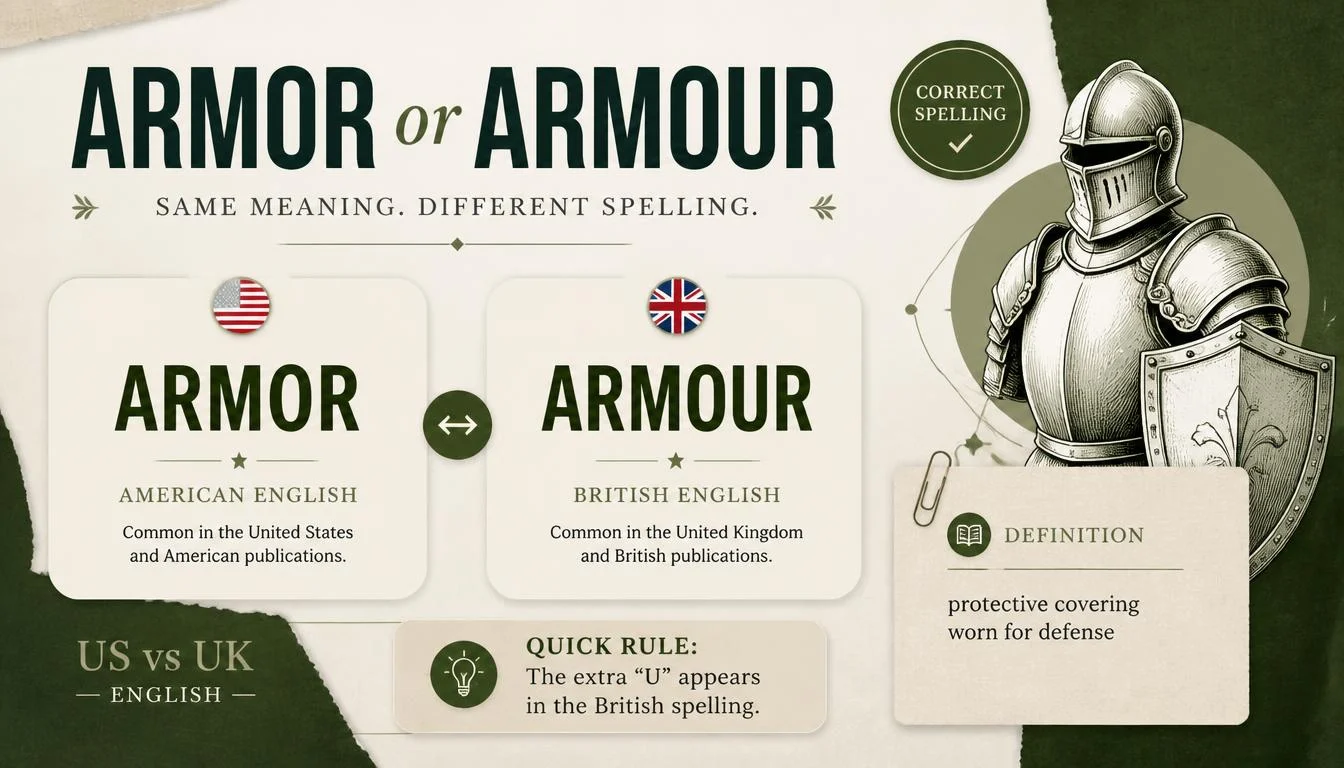
Both spellings are correct, but they belong to different English varieties. Armor is the American English spelling, while armour is the British English spelling. The choice between armor or armour depends entirely on your audience: use armor for US readers and armour for UK, Canadian, or Australian readers.
If you’re wondering whether to write armor or armour, both spellings are correct. The difference comes down to regional English, with each form preferred in different varieties of English.
In this guide, we’ll explain when to use armor and armour, along with simple examples to help you choose the right spelling. Understanding this American and British English difference can make your writing more consistent and accurate.
Why This Small Spelling Difference Trips Up So Many Writers
You’re drafting an email, writing a game description, or finishing a school essay, and suddenly you stop typing. Is it “the knight wore heavy armor” or “the knight wore heavy armour”? Neither version looks wrong, and that’s exactly the problem. Your spellchecker might accept one and flag the other, depending on which language setting your document uses, and that inconsistency is enough to make anyone doubt themselves.
This confusion isn’t really about grammar. It’s about regional spelling conventions that developed over centuries, long before anyone worried about style guides. Armor and armour mean exactly the same thing and function the same way in a sentence. The only real difference is geography. Once you understand where each spelling comes from and who uses it, you’ll never second-guess yourself again.
In this guide, you’ll learn the history behind both spellings, which industries and countries favor each one, how to stay consistent in your own writing, and how to avoid the small mistakes that make documents look unpolished. By the end, choosing between armor or armour will feel automatic.
Armor or Armour: What’s the Difference?
The core difference between armor and armour is regional spelling, not meaning. Armor is used in American English, while armour is used in British English and most Commonwealth countries, including Canada, Australia, and New Zealand.
Both words refer to the same thing: protective covering, whether it’s metal plating worn by a soldier, the shell of an animal, or a defensive layer in a video game. Neither word carries a different definition, a different pronunciation, or a different grammatical role. They are spelling variants of a single noun, similar to color and colour or favorite and favourite.
| Meaning | Part of Speech | Refers To | Typical Usage | Example | Common Confusion |
|---|---|---|---|---|---|
| Protective covering or defense | Noun (also used as a verb, “to armor/armour”) | Physical protection, military gear, or figurative defense | American English writing, US publications, tech and gaming content | “The tank’s armor withstood the blast.” | Writers switch spellings mid-document without realizing it |
| Protective covering or defense | Noun (also used as a verb) | Physical protection, military gear, or figurative defense | British, Canadian, Australian, and Commonwealth writing | “The knight’s armour gleamed in the sunlight.” | Spellcheckers set to US English mark “armour” as incorrect |
So which one should you use? If your audience is American, choose armor. If you’re writing for a British, Canadian, Australian, or international Commonwealth readership, choose armour. The word itself never changes meaning, only its spelling shifts based on where your reader lives.
Is Armor vs Armour a Grammar, Vocabulary, or Usage Issue?
Armor vs armour is a usage and regional spelling issue, not a grammar or vocabulary problem. Both words are nouns with identical meanings, identical pronunciations, and identical grammatical behavior. The only variable is which national spelling convention you’re following.
This puts armor and armour in the same category as other American versus British spelling pairs: color/colour, honor/honour, center/centre, and organize/organise. These aren’t cases where one word is “correct” and the other is a mistake. They’re parallel standards that exist because American English simplified certain French-derived spellings during the 18th and 19th centuries, while British English kept the older forms.
In formal English, business English, and academic writing, consistency matters more than which variant you pick. A US company report should use armor throughout. A UK academic paper should use armour throughout. Mixing both spellings in the same document, even if each instance is technically valid, reads as careless editing.
In everyday conversation, texting, or casual social media posts, most native speakers won’t notice or care which spelling you use. The stakes rise significantly in published content, official documents, and anything representing a brand, school, or organization.
Practical takeaway: Pick one spelling based on your target audience or style guide, then commit to it for the entire piece of writing.
Armor: Meaning, Usage, and Examples
Armor is the American English spelling of the noun and verb referring to protective covering, most commonly associated with military equipment, but also used figuratively and in technology contexts.
Part of speech: Noun (uncountable in most contexts) and verb.
Common collocations: body armor, tank armor, armor plating, suit of armor, armor up, emotional armor, armor-piercing.
Typical sentence patterns: “[Subject] + wears/wore + armor,” “[Object] + is protected by + armor,” “armor-piercing + [noun].”
Workplace example: “The safety team recommended upgrading the vehicle’s armor before the next field deployment.”
Academic example: “Medieval historians often study how plate armor evolved in response to advances in crossbow design.”
Technology example: “The game’s new update lets players craft custom armor sets using rare materials found only in the final level.”
Email example: “Attached is the updated spec sheet for the new armor coating we’re testing on the prototype.”
Daily conversation example: “He joked that his thick winter coat was basically his personal armor against the cold.”
One learner mistake: Non-native speakers writing for American publications sometimes default to “armour” out of habit from British textbooks, which then gets flagged by US style guides and editors.
Mini recap: Armor is the go-to spelling for anything written in American English, from military reports to video game descriptions to casual metaphors about protecting your feelings.
Armour: Meaning, Usage, and Examples
Armour is the British English spelling of the same noun and verb, used throughout the United Kingdom, Canada, Australia, New Zealand, and much of the Commonwealth.
Part of speech: Noun (uncountable in most contexts) and verb.
Common collocations: suit of armour, chain mail armour, armour plating, knight’s armour, armoured vehicle, tortoise’s armour.
Pronunciation note: Armour and armor sound identical when spoken aloud in most English accents; the difference is purely written.
Museum descriptions in London frequently reference medieval armour when cataloguing historical exhibits, and British schools teach students about it as part of their history and literature.
Natural workplace example: “The engineering firm in Manchester is bidding on a contract to supply armoured plating for the new fleet.”
Academic example: “Her dissertation examines how the design of armour changed across three centuries of European warfare.”
Technology example: “The British studio’s new title features detailed armour customization inspired by real medieval blacksmithing techniques.”
Email example: “Please confirm the delivery date for the armoured vehicle parts before we finalize the contract.”
Daily conversation example: “She said putting on her favorite blazer felt like slipping into armour before a tough meeting.”
One learner mistake: American learners studying British literature sometimes switch back to “armor” halfway through an essay because their default keyboard settings or spellcheckers are set to US English.
Mini recap: Armour is the standard spelling across the UK and most Commonwealth nations, appearing consistently in history books, government documents, and British media.
When Not to Use Each Word
Even though armor and armour mean the same thing, using the wrong regional spelling in the wrong context creates small but noticeable inconsistencies. Here are the situations where writers most often get it wrong.
Writing for a US company blog but defaulting to British spelling. This happens when a writer has read a lot of British content or learned English using UK textbooks. If your audience and client are American, use armor consistently.
Writing for a UK, Canadian, or Australian client and slipping into American spelling. This often happens because American English dominates so much of the internet, including autocorrect tools and templates. Double-check your document’s language setting before submitting.
Switching spellings within the same article. This is one of the most common mistakes in freelance and student writing. A writer starts with “armor” in the introduction, then unconsciously types “armour” later in the piece. Editors catch this quickly, and it signals inconsistent proofreading.
Trusting autocorrect blindly. Word processors often default to one regional setting. If your software is set to UK English, it may auto-correct “armor” to “armour” even when you’re writing for an American audience, and vice versa.
Assuming international brands always use one spelling. Global companies sometimes localize their spelling by region, meaning their US website says armor while their UK site says armour. Always check the specific document or region you’re writing for rather than assuming a universal standard.
Using the “wrong” spelling in academic citations. If you’re quoting a source that uses armour, keep that spelling inside the quotation marks even if your own essay uses armor, and vice versa. Altering a direct quote’s spelling is considered inaccurate citation practice.
Ignoring style guide instructions. Many publications, including US-based ones with international readers, specify a required spelling in their style guide. Following the house style takes priority over personal preference.
To remember the difference quickly: if you picture a US flag, think armor. If you picture a UK flag, think armour. The extra “u” is a small but reliable marker of British spelling patterns you’ll also see in colour, favour, and honour.
Common Mistakes Table
| Correct Sentence | Incorrect Sentence | Explanation |
|---|---|---|
| “The American soldier’s armor was tested in extreme heat.” | “The American soldier’s armour was tested in extreme heat.” | US military writing should consistently use the American spelling, armor. |
| “The museum in London displayed medieval armour from the 1400s.” | “The museum in London displayed medieval armor from the 1400s.” | British institutions and publications use armour as the standard spelling. |
| “This report uses armor throughout to match our US style guide.” | “This report uses armor in the first section and armour later on.” | Mixing spellings within one document breaks consistency, even if both are individually valid. |
| “The Canadian firm’s proposal referred to armoured trucks.” | “The Canadian firm’s proposal referred to armored trucks.” | Canada generally follows British spelling conventions, including armoured. |
| “Her essay on Australian military history used armour consistently.” | “Her essay on Australian military history used armor consistently.” | Australian English follows British spelling norms, so armour is standard there. |
Quick Decision Box
- If you’re writing for American readers, US publications, or US-based clients, use armor.
- If you’re writing for British, Canadian, Australian, or other Commonwealth readers, use armour.
- If you’re unsure who your audience is, check your client’s style guide, your company’s regional website, or simply pick one spelling and stay consistent throughout the entire document.
Armor vs Armour in Real World Situations
Office communication: A US-based project manager writing internal memos about safety equipment would write “protective armor,” while a colleague in the London office describing the same gear would write “protective armour.”
Business email: An American vendor emailing a quote might write, “Our armor coating meets all current safety standards,” while their British counterpart might reply, “We’ll confirm the armour specifications by Friday.”
School or university: A US high school student writing a history paper on medieval Europe would use armor, while a British university student writing the same essay for a UK institution would use armour.
Customer support: A gaming company’s US support team might tell a player, “Your character’s armor stats reset after the patch,” while the UK support team would phrase it as, “Your character’s armour stats reset after the patch.”
Technology: Software documentation for a game built by a US studio typically uses armor in menus and item descriptions, while a UK-developed game usually labels the same feature armour.
Artificial Intelligence: When AI writing tools generate content, they often default to American spelling unless specifically instructed to use British English, which is why armor appears more frequently in AI-generated text unless the prompt specifies otherwise.
Daily conversation: An American friend might say, “I need some emotional armor before that family dinner,” while a British friend might say the same thing using “emotional armour.
Armor or Armour in Modern Technology
Modern technology has actually made this spelling distinction more visible than ever, because software localization forces companies to pick one version per region.
In artificial intelligence writing tools and chatbots, the default output is usually American English, so you’ll see armor far more often unless you specifically request British spelling. Virtual assistants and voice assistants developed by US companies, such as those built into American smartphones, typically process and generate the word as armor in transcriptions and responses.
Video game studios handle this carefully. A single game might ship with two versions of its text files: one using armor for the North American release and another using armour for the UK, Australian, and other Commonwealth releases. Players sometimes notice this when comparing screenshots from different regions and wonder why the spelling changed, not realizing it’s simply localization at work.
Business software and enterprise tools, especially those built by American companies like Microsoft, often default their spellcheck dictionaries to American English, flagging armour as a misspelling unless the user manually switches their language settings to English (UK), English (Canada), or English (Australia).
Chatbots and customer service bots trained primarily on American English data sets tend to default to armor, which is worth knowing if you’re building or customizing a chatbot for a British or Australian audience and need to adjust its language settings accordingly.
Where the Word Armor or Armour Comes From
Both spellings trace back to the same root: the Old French word “armure,” which itself descended from the Latin “armatura,” meaning equipment or arms. When the word entered Middle English, it was often spelled “armure” or “armoure.”
Over time, British English retained a spelling closer to the French original, keeping the “our” ending, similar to colour, favour, and honour. American English, heavily influenced by lexicographer Noah Webster in the early 1800s, deliberately simplified many “our” endings to “or” to create a more streamlined, distinctly American spelling system. This is why armor, color, and honor look the way they do in the United States today.
Understanding this history helps explain why the spelling difference isn’t random. It’s the result of a conscious effort by American English to diverge stylistically from British English after the countries became politically separate.
Expert Insight
As a language instructor, I always tell students that spelling variants like armor and armour aren’t really “grammar mistakes” in the traditional sense. They’re regional identity markers. Getting this right isn’t about memorizing a rule so much as knowing your audience. If you consistently ask yourself, “Who is going to read this, and where are they from?” before you write a single sentence, spelling choices like this one become second nature instead of a source of anxiety.
Error Prevention Checklist
- Always use armor when writing for American audiences, US publications, or US-based companies.
- Always use armour when writing for British, Canadian, Australian, or other Commonwealth audiences.
- Never confuse them if you check your document’s language setting before you start writing, not after.
- Quick memory tip: British spelling keeps the “u,” just like colour, favour, and honour. American spelling drops it, just like color, favor, and honor.
Related Grammar Confusions Worth Learning
Color vs Colour: The same American versus British spelling pattern applies here, making it one of the most searched spelling comparisons in English.
Honor vs Honour: Another Noah Webster-era simplification that follows the identical “or” versus “our” rule as armor and armour.
Center vs Centre: This pair involves letter order rather than a missing vowel, but it follows the same American-British divide.
Organize vs Organise: This comparison focuses on the “ize” versus “ise” suffix, a separate but related regional spelling pattern.
Traveling vs Travelling: This one involves consonant doubling rules that differ between American and British English.
Gray vs Grey: A common color-name spelling difference that often confuses learners the same way armor and armour does.
Defense vs Defence: This pair follows the “se” versus “ce” pattern, another classic American-British spelling divide.
Practice vs Practise: In British English, this pair also distinguishes between noun and verb forms, adding an extra layer of nuance.
Realize vs Realise: Like organize and organise, this comparison highlights the “ize” versus “ise” debate that spans many English verbs.
Mold vs Mould: A lesser-known but equally useful example of the same silent vowel pattern seen in armor and armour.
FAQs
Is armor or armour the correct spelling?
Both are correct. Armor is standard in American English, while armour is standard in British English and most Commonwealth countries. Neither spelling is grammatically wrong; the choice depends entirely on your target audience and regional style guide.
Do Canadians use armor or armour?
Canadians generally follow British spelling conventions, so armour is the more common and accepted spelling in Canadian English, appearing in Canadian newspapers, government documents, and educational materials.
Why does my spellcheck mark armour as wrong?
Most spellcheckers default to American English unless manually changed, which causes them to flag armour as a misspelling. Switching your document’s language setting to English (UK), English (Canada), or English (Australia) will resolve this.
Is armored or armoured correct for the past tense?
Armored is the American spelling, while armoured is the British spelling of the same past tense verb form. This follows the same regional spelling pattern as armor and armour.
Which spelling should I use for a global audience?
When writing for an international or mixed audience, many writers choose armor because American English is widely used online. However, the best choice ultimately depends on your publication’s style guide and target audience. The most important thing is to remain consistent.
Does armor or armour affect pronunciation?
No. Armor and armour are pronounced the same way in standard English. The difference is purely in spelling and reflects regional English conventions.
Conclusion
The debate between armor and armour was never really about right or wrong. It comes down to a single, simple factor: which version of English your reader expects. Armor belongs to American English, while armour belongs to British and Commonwealth English, and both spellings describe the exact same concept of protective covering, whether literal or figurative.
The next time you pause mid-sentence wondering which spelling to use, skip the guesswork. Identify your audience first, then let that decision guide your spelling for the entire piece. Keep it consistent from your first sentence to your last, and this small stylistic choice will never trip you up again.
Read More Related Articles:
- Or Nah Lyrics | Why This Song Still Stands Out In 2026
- Sergeant vs Sargeant | Avoid This Common Spelling Mistake In 2026
- Flys or Flies | Right Choice Made Simple In 2026

Zoe Chambers works as a content writer at synoseek.com, contributing thoughtful pieces on everyday subjects and ideas. She writes in a simple, grounded way, often drawing from real-world experiences. Her focus is on keeping content natural, clear and easy for readers to connect with.
3 thoughts on “Armor or Armour | Simple Rule Behind Both Spellings In 2026”