Quick Answer
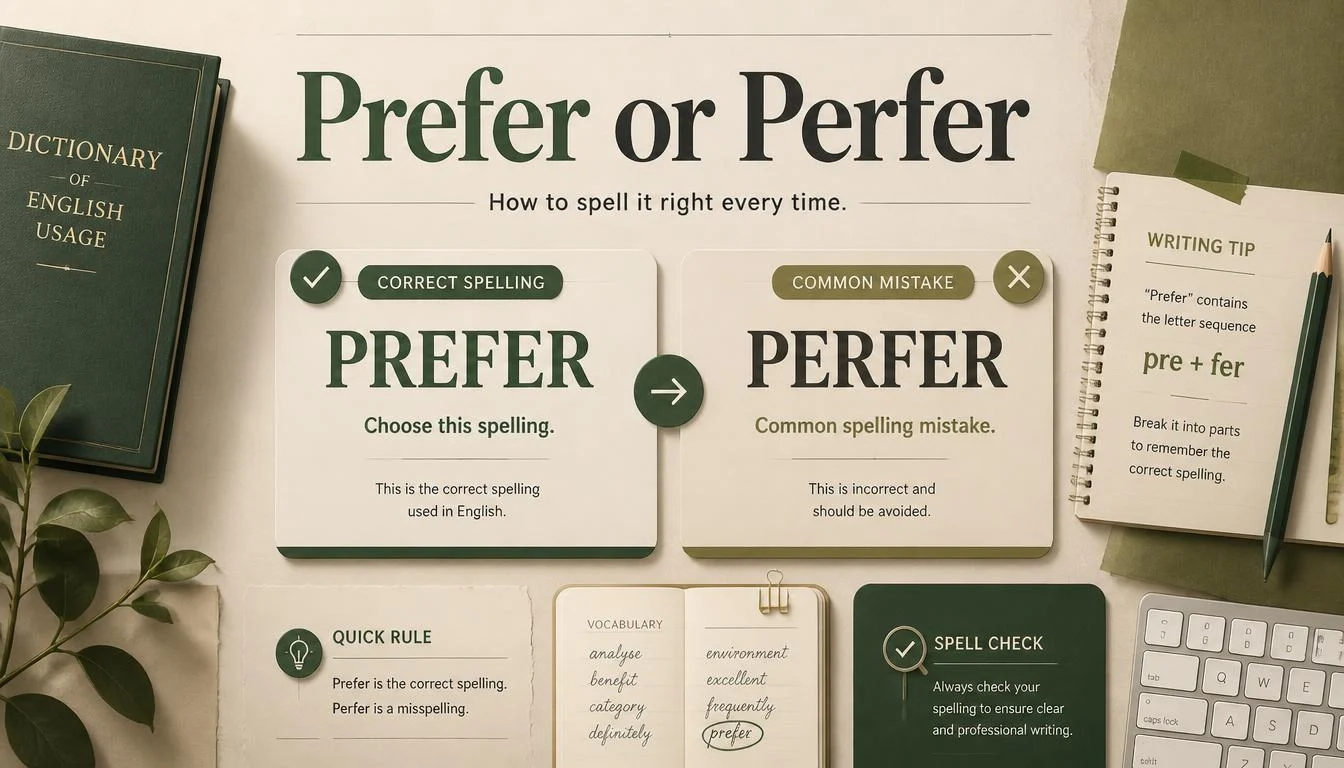
The correct spelling is prefer. “Perfer” is a common misspelling and is never correct in standard English. “Prefer” is a verb meaning to like one thing more than another or to choose something over other options.
If you’ve ever paused while typing and wondered whether “prefer” has an “r” after the first “e” or the second, you’re not alone. The confusion between “prefer” and “perfer” is a common stumbling block for many writers. It often happens simply because of the way the word sounds when spoken quickly or the result of a fast typing error.
Using the incorrect spelling, “perfer,” can signal a lack of attention to detail, which is a significant mistake in professional, academic, or formal writing. This guide will clearly explain the difference between these two spellings, show you the correct way to use “prefer,” and give you practical tips to ensure you never misspell it again. You will learn why the correct word is always “prefer” and how to use it confidently in any context.
What’s the Difference?
The core difference between “prefer” and “perfer” is simple: one is a real word, and the other is not.
- Prefer (verb) : To like someone or something better than someone or something else; to choose one thing over another.
- Perfer: This is not a word in the English language. It is a misspelling of “prefer”.
All major dictionaries, including Oxford, Cambridge, and Merriam-Webster, list only “prefer” as the correct spelling. “Perfer” is a spelling error that should be avoided in all forms of writing.
| Feature | Prefer | Perfer |
|---|---|---|
| Part of Speech | Verb | Not a word |
| Meaning | To like better or value more highly | No meaning |
| Correct? | Yes | No |
| Usage | Standard in all forms of English | Common spelling error |
The correct spelling is “prefer.” It should be used in every context where you are expressing a choice or preference.
Is “Prefer” a Grammar, Vocabulary, or Usage Issue?
The “prefer vs. perfer” question is primarily a spelling or vocabulary issue. “Prefer” is the correct word, while “perfer” is an incorrect spelling. However, the word “prefer” itself also involves specific grammar patterns that are important to use correctly.
Using “prefer” correctly means not only spelling it right but also following its grammatical rules.
- Grammar: “Prefer” is a transitive verb, which means it needs an object (a noun, a gerund, or an infinitive) to complete its meaning.
- Example with Noun: I prefer tea.
- Example with Gerund: She prefers reading.
- Example with Infinitive: They prefer to eat early.
- Usage: “Prefer” is a relatively formal word. In everyday conversations, native speakers often use alternatives like “like…better” or “would rather” to express the same idea.
- Formal: I prefer tea to coffee.
- Informal: I like tea better than coffee.
Practical Takeaway: Always use the spelling prefer. Furthermore, remember that this verb is often followed by the preposition “to,” not “than,” when comparing two things.
A Detailed Guide to Using “Prefer”
Meaning
“Prefer” means to like one person or thing more than another or to choose one thing over something else because you like it better. It expresses a personal choice or a greater liking for one option among several.
Pronunciation
The pronunciation of “prefer” is /prɪˈfɜːr/ (pri-FUR). It has two syllables: “pre-” and “-fer.” The common misspelling “perfer” likely arises because the “r” sound is prominent, and people sometimes swap the letters when typing or writing quickly.
Common Grammar Patterns
Here are the standard patterns for using “prefer” correctly:
A key reminder: When making a comparison, use the preposition “to” or “over,” not “than”. The structure “prefer + noun/gerund + over + noun/gerund” is also acceptable in modern English, though “to” remains the more traditional choice.
Real-World Examples for “Prefer”
- Workplace: “I prefer to hold meetings in the morning when everyone is fresh.”
- Business Email: “Thank you for your proposal. We would prefer to move forward with the first option.”
- Academic Writing: “Researchers often prefer qualitative methods to gain deeper insights into human behavior.”
- Technology: “Most users prefer a simple, intuitive interface over a complex one with many features.”
- Daily Conversation: “I prefer pizza to burgers, but let’s get whatever you want.”
Why “Perfer” Is Always Incorrect
“Perfer” is an error that occurs for a few key reasons:
- Phonetic Spelling: People often spell words based on how they sound, and “prefer” is pronounced with an “r” sound after the first syllable, which might lead some to place the “r” incorrectly. The word is pronounced /prɪˈfɜːr/, and this common spelling misstep happens because the “r” sound in the first syllable can make the “e” sound slightly unclear.
- Typing Mistakes: If you’re typing quickly, it’s easy to accidentally type “perfer” or “perfer” due to the proximity of the ‘r’ and ‘e’ keys.
- Influence from Similar Words: While “refer” (to direct someone or something) is a correct word, “prefer” is not an extension of it. You wouldn’t add a “p” to make “perfer”; the “pre-” prefix is a distinct part of the word’s history, meaning “before”.
When Not to Use “Prefer”
While the main mistake is using the misspelling “perfer,” the correct word “prefer” can also be used incorrectly in terms of grammar. Here are situations to watch out for:
- Don’t use “than” for comparisons: Avoid using “than” with “prefer.” For example, “I prefer coffee than tea” is wrong. The correct phrasing is “I prefer coffee to tea”.
- Don’t mix infinitives and gerunds incorrectly: It’s grammatically awkward to use an infinitive after the first item and a gerund after the second in a “prefer…to…” structure. While “I prefer walking to swim” might be understandable, the correct form would be “I prefer walking to swimming” or “I prefer to walk rather than swim”.
- In overly casual conversation: While it’s not incorrect, the word “prefer” can sound very formal. In casual conversation, “I like chocolate better” or “I’d rather go later” are more natural-sounding than “I prefer chocolate” or “I would prefer to go later”.
Common Mistakes: A Quick Comparison Table
The Origin of “Prefer”
Understanding the history of “prefer” can help you remember the correct spelling. The word comes from the Latin word praeferre, which is a combination of “prae-” (meaning “before”) and “ferre” (meaning “to carry”). It literally meant “to carry before” or “to set before,” which evolved into “to place before others” or “to favor more.”
This explains why the spelling starts with “pre” (from “prae”), not “per”. The prefix “pre-” is a common English prefix meaning “before,” as in “preview” (to see before) or “prefix” (to fix before). Thinking of the “pre-” prefix can be a helpful reminder of the correct spelling.
Expert Insight
As language instructors, we often see students struggle with the unpredictable nature of English spelling. The “prefer vs. perfer” issue is a classic example of a phonetic error. When you hear a word like /prɪˈfɜːr/, your brain is processing a sequence of sounds, but mapping those sounds to letters isn’t always straightforward. The error comes from the common temptation to place the ‘r’ after the first syllable, creating a “per” sound. However, what’s crucial here is to remember the word’s function—it means “to choose before.” By connecting the spelling to its Latin root praeferre, you build a solid, logical foundation that prevents common errors.
How to Never Misspell “Prefer”
To avoid the “perfer” mistake, use these simple tips:
- Think of the Prefix “pre-“: The word starts with “pre-“, meaning “before,” just like in “previous” or “prevent.” You are saying you would place one thing before another in your preference.
- Sound It Out Slowly: Say the word slowly: “PRE-fer.” Focus on the “PRE” sound at the beginning.
- Create a Mnemonic: Remember: “To put one thing before another is to Put Really Everything first? No need for a complex one. Simply remember: Please Remember: Every time you write “prefer,” the “pre” comes first. The “pre” in “prefer” is not an afterthought.
Related Grammar Confusions
English is full of similar spelling challenges. Here are a few other common mix-ups to be aware of:
- Receive vs. Recieve: A classic “i before e” exception.
- Separate vs. Seperate: Another common case of vowel confusion.
- Believe vs. Beleive: Similar to “receive,” this one often trips people up.
- Definitely vs. Defiantly: A common autocorrect error that changes the meaning.
- Affect vs. Effect: A frequent point of confusion between a verb and a noun.
- Accept vs. Except: Mixing up the verb meaning “to receive” with the preposition meaning “excluding.
- Its vs. It’s: Confusing the possessive form with the contraction for “it is.”
- Then vs. Than: Misusing a word indicating time with a word used for comparisons.
- Your vs. You’re: A common mistake between the possessive and the contraction for “you are.”
- There, Their, and They’re: Confusing three distinct but commonly confused words.
FAQs
1. Is “perfer” ever correct?
No, “perfer” is never the correct spelling. It is a misspelling of the word “prefer.” Use “prefer” in all types of writing to express that you like something more than something else.
2. Why do people misspell “prefer” as “perfer”?
People often misspell “prefer” as “perfer” because of the pronunciation of the word, which can sound like “per-fer” when spoken quickly, leading to a common letter swap in writing. It’s also a simple, but common, typing error when the ‘e’ and ‘r’ are pressed in the wrong order.
3. What is the correct spelling: “prefer” or “perfer”?
The correct spelling is “prefer.” This is the only correct form recognized in all standard English dictionaries, including Oxford and Cambridge dictionaries. “Perfer” is a common mistake and should be avoided.
4. Can I use “perfer” in my writing?
No, you should never use “perfer” in your writing. It’s a misspelling and a grammatical error. Using it can make your writing appear unprofessional and may lead to deductions in academic or professional contexts.
5. Is “prefer” a real word?
Yes, “prefer” is a real verb in the English language. It means to like or choose one thing more than another. It is a standard word used in both formal and informal contexts.
6. What preposition should I use with “prefer”?
When comparing two things, use the preposition “to” or “over.” For example, “I prefer tea to coffee” or “I prefer tea over coffee.” Do not use “than” in this comparative structure.
Conclusion
In conclusion, the answer to the “prefer or perfer” question is clear. Prefer is the correct word. It means to like or choose one thing over another. Perfer is always a misspelling and should never be used in any context. This simple spelling rule is universal across all English-speaking countries and formal writing styles. Remember the word’s origin and prefix “pre-,” think of its correct pronunciation, and you will avoid this common mistake forever.
Using the correct spelling not only improves your writing’s accuracy but also demonstrates a command of the language that is crucial for professional and academic credibility. So, next time you are about to write perfer, stop and remember: the only correct choice is prefer.
Final Rule: Prefer it to Perfer.
Read More Related Articles:
- Usage vs Useage | Stop Making This Spelling Mistake in Your Writing In 2026
- Losing vs Loosing | How One Extra “O” Changes the Entire Meaning In 2026
- Successfully or Succesfully | Easy Trick to Remember the Correct Spelling Forever In 2026

Caleb Dawson is a content writer at synoseek.com, where he works on simple, reader-focused articles across a range of everyday topics. His writing style is practical and grounded, aiming to present information in a clear and relatable way without unnecessary complexity.
5 thoughts on “Prefer or Perfer | Clear Answer for English Learners In 2026”