Quick Answer
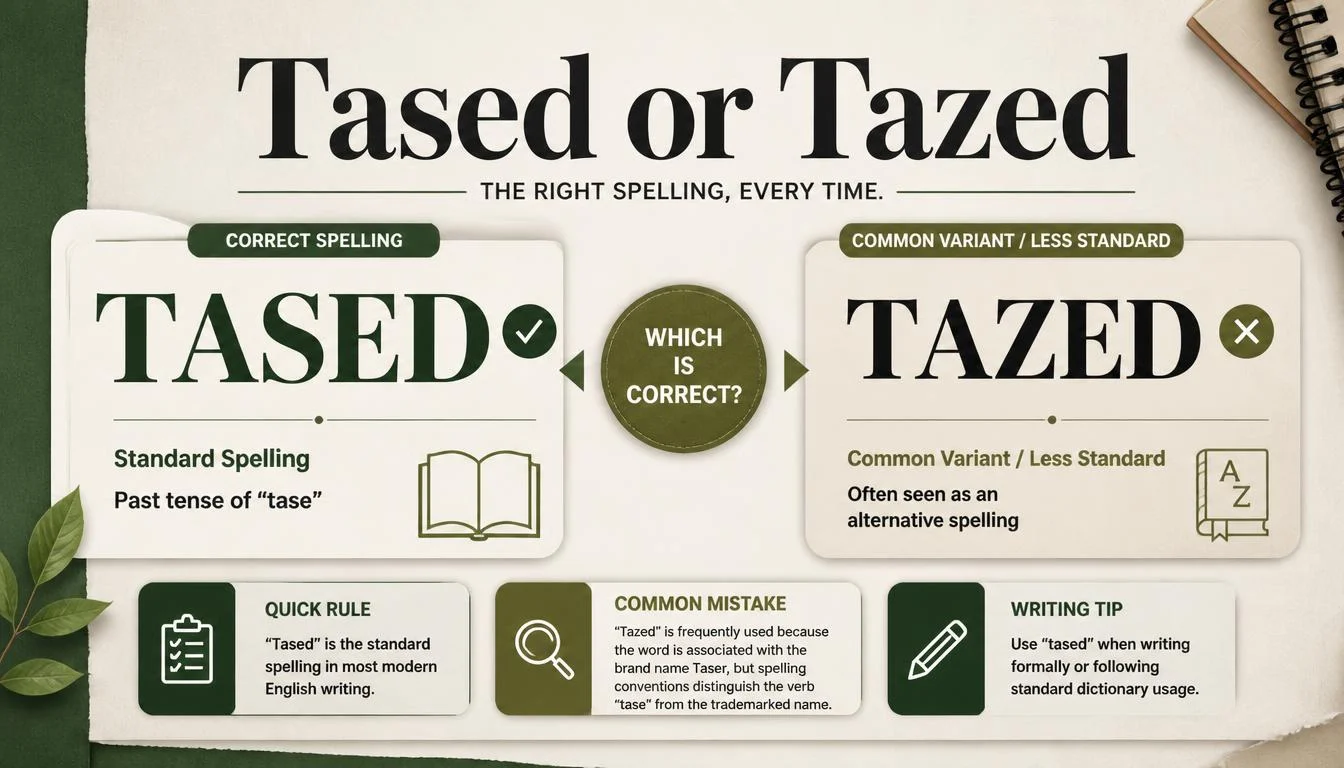
The correct spelling is tased. This is the past tense of the verb “to tase,” which means to shock someone with a Taser® device. “Tazed” is a common misspelling and is considered incorrect in formal writing, journalism, and professional contexts, though it sometimes appears in informal settings .
If you have ever written about a news story, described a scene in a book, or posted on social media about an incident involving a stun gun, you have probably paused, uncertain whether to type “tased” or “tazed.” It is a small difference one letter but it can make your writing look either professional and polished or careless and uninformed.
It is easy to see why this is a common point of confusion. The word sounds exactly the same whether you spell it with an ‘s’ or a ‘z.’ The device at the center of the action is a Taser, which is already a tricky word. When you turn a brand name into a verb, the rules can feel unclear.
This guide will clear up the confusion for good. We will explore the origin of the word, the grammatical rules that govern it, and why one spelling has become the accepted standard. By the end, you will have a clear understanding of the difference and a simple memory trick to ensure you never make a mistake again.
Tased or Tazed: What’s the Real Difference?
The core of the issue lies in correctly creating a verb from a trademarked brand name. The correct way to form the past tense of the verb “to tase” is by adding a simple “-d” to the end, resulting in “tased.” The alternative spelling, “tazed,” is generally considered a misspelling, a logical but incorrect guess based on the word’s pronunciation.
| Feature | Tased | Tazed |
|---|---|---|
| Meaning | The act of being shocked with a Taser® stun gun . | Same meaning as “tased. |
| Part of Speech | Verb (past tense and past participle of “tase”) . | Verb (same as “tased”). |
| Correctness | ✅ Correct. It is the accepted standard in dictionaries and formal writing . | ❌ Incorrect. Considered a misspelling in professional, academic, and journalistic contexts . |
| Typical Usage | News reports, legal documents, academic papers, official communications . | Casual online conversations, informal chat, social media comments . |
| Common Confusion | Many assume the verb should follow the pronunciation “tayzd,” leading them to spell it with a ‘z’ to match the sound. | Some incorrectly believe the ‘z’ spelling is an acceptable alternative or a more phonetically accurate spelling. |
While “tazed” is understood by most people in informal settings, using “tased” is always the safest and most professional choice. It demonstrates attention to detail and an understanding of standard English usage. If you want your writing to be taken seriously, especially in a professional context, “tased” is the way to go.
Is This a Grammar, Vocabulary, or Usage Issue?
This is primarily a usage and vocabulary issue, though it has a minor grammatical component. Let’s break it down:
- Vocabulary Difference: There isn’t a difference in definition; “tased” and “tazed” mean the exact same thing. The issue is purely about which spelling is recognized as correct. Think of it like “color” and “colour” they mean the same thing, but one is correct in American English, the other in British English. In this case, it is not a regional issue but a matter of standard versus non-standard spelling .
- Grammar Classification: The word itself is a verb. Specifically, “tased” is the simple past tense and the past participle. The “grammar” is not the problem; the spelling of the base form is. The verb “to tase” is a back-formation from “Taser,” and it is perfectly grammatical to use it in sentences like, “He was tased” .
- Usage: This is where the distinction matters. If you are writing a formal report, an academic essay, or a professional email, you should always use “tased.” Using “tazed” in these contexts will be considered a spelling error . In informal contexts, like a text message or a comment on social media, “tazed” is more common but still technically incorrect .
- Are they Interchangeable? No. While they might be used interchangeably in casual, poorly edited text, they are not truly interchangeable. “Tased” is the standard, and “tazed” is a non-standard, incorrect variant. Treating them as interchangeable will likely harm your credibility in formal writing.
The one practical takeaway: The spelling “tased” is the only correct choice for professional, academic, and journalistic writing.
What Does “Tased” Mean?
This is the correct, dictionary-approved word for the past tense of the verb “to tase” . It is a relatively new addition to the English language, born from modern technology.
- Meaning: To have been stunned or shocked with a high-voltage stun gun, specifically the Taser® brand device .
- Pronunciation: /teɪzd/ (rhymes with “amazed”).
- Part of Speech: Verb (past tense and past participle).
- Common Collocations: “Tased by police,” “tased and arrested,” “tased with a taser,” “tased in the chest.”
- Typical Sentence Patterns: “The suspect was tased,” “Police tased the man,” “The officer tased the aggressive dog.”
Real-World Examples
- Workplace (Security Report): “The security guard reported that the intruder was tased after failing to comply with verbal commands.”
- Academic (Sociology Paper): “The study’s findings suggested that suspects were more likely to be tased in situations involving high levels of perceived threat.”
- Technology (Product Description): “The new generation of stun guns can be set to a ‘warning’ mode before a suspect is tased.”
- Email (Internal Communication): “Let’s be careful about how we phrase our press release. We need to state that the individual was tased, not shot.”
- Daily Conversation: “I saw a video online where a guy got tased at a football game. He didn’t seem to feel it until after the shock was over.”
A Common Learner Mistake
- Learner Mistake: “The officer tazzed the suspect.”
- Why it happens: This mistake happens because the spelling tries to match the “z” sound of the word’s pronunciation. English spelling often doesn’t match pronunciation, and trying to force it can lead to errors.
- The Correction: “The officer tased the suspect.”
A Quick Recap on “Tased”
“Tased” is the only officially recognized, correct past-tense form of the verb “tase.” It is the version that belongs in dictionaries and formal writing. Its spelling is directly tied to its origin: the product name Taser.
What Does “Tazed” Mean?
Strictly speaking, “tazed” doesn’t have its own meaning. It is not a separate word with its own definition. Instead, it is an incorrect spelling of “tased” .
- Meaning: An incorrect spelling of “tased.” It is used informally by people who are either unaware of the correct spelling or are writing in a very casual context and prioritizing phonetic spelling over formal correctness.
- Pronunciation: /teɪzd/ (Identical to “tased”).
- Part of Speech: Verb (past tense and past participle of the non-standard verb “to taze”).
Real-World Examples (for the incorrect spelling)
- Online Comment (Informal): “The dude in the video totally got tazed!”
- Social Media (Text Post): “The police just tazed a guy on my street, wild stuff”
- Informal Chat: “I’d rather be pepper sprayed than tazed, tbh.”
The Learner Mistake
- Learner Mistake: Confusing “tazed” as an acceptable alternative spelling to be used in any context.
- Why it Happens: English learners may encounter the spelling “tazed” online and assume it’s a valid variant, much like “realize” and “realise.” They may also believe that spelling it with a ‘z’ more accurately represents the hard “z” sound in the word’s pronunciation .
- The Correction: Use tased in all formal and semi-formal contexts. If you are unsure, always default to “tased.”
A Quick Recap on “Tazed”
“Tazed” is not a dictionary word. It is a common, widespread misspelling of “tased.” You will see it in casual spaces on the internet, but it has no place in professional, academic, or published writing.
When Not to Use “Tazed” or “Tased”
Here are common situations where writers choose the wrong word, often “tazed” when they should use “tased.
- In a news headline: You should never use “tazed” in a news headline. A headline like “Man Tazed at Protest” will be immediately flagged as a spelling error by any editor.
- In an academic paper: A sociology or criminology paper describing police tactics should use the formal, correct spelling “tased.”
- In a legal document: Spelling matters in legal documents. A police report or a court document must use the correct terminology. “Tased” is the only acceptable form.
- When referring to the Taser brand: Since the verb comes from the brand name “TASER,” using “tased” is more consistent and respectful of the brand name itself.
- When a non-Taser device is used: While this is a separate issue, it’s good to know that some style guides suggest “tased” or “tasered” should only be used for the specific Taser brand. For other stun guns, you might use “stunned” or “electroshocked.” However, in modern usage, “tased” is often used generically, much like “xerox” or “kleenex.”
Common Mistakes Table
| Correct Sentence | Incorrect Sentence | Explanation |
|---|---|---|
| The suspect was tased after he refused to drop the weapon. | The suspect was tazed after he refused to drop the weapon. | The correct past-tense spelling is “tased.” |
| The officer tased the individual in the leg to ensure his safety. | The officer tazered the individual in the leg… | “Tasered” is also a correct variant, but “tased” is more common and efficient. The spelling “tazered” is always incorrect because the brand is spelled with an ‘s’. |
| The viral video shows the moment the police tased the robbery suspect. | The viral video shows the moment the police tazzed the robbery suspect. | “Tazzed” is an attempt to spell the hard “z” sound and is incorrect. |
| In 2007, the phrase “Don’t tase me, bro!” became an internet phenomenon. | In 2007, the phrase “Don’t taze me, bro!” became an internet phenomenon. | Even in informal internet culture, the spelling “tase” was used in the popular phrase. |
Decision Box: A Quick Guide
- Tased: If you are writing a formal report, a news article, an academic paper, or any professional communication, always use “tased.” It is the correct, dictionary-approved spelling.
- Tazed: If you are posting a casual comment on TikTok or texting a friend, you might get away with “tazed,” but it’s still technically a spelling mistake.
Real-World Examples of “Tased”
Let’s look at how “tased” is used in various practical situations.
- Office Communication: “The company’s new security protocol states that guards may only use their Tasers if a threat is imminent, and they must document every time a person is tased.”
- Business Email: “Regarding the incident at the warehouse: the individual was tased and detained. We are awaiting the full police report.”
- School or University: “The professor argued that the increased use of Tasers by law enforcement is a major ethical issue, focusing her lecture on the legal definition of when a person can legally be tased.”
- Customer Support: “A customer called to complain that he was tased by one of the security personnel at our event.”
- Technology: “The new body cameras are designed to activate automatically when an officer draws their Taser or when someone is tased.”
- Artificial Intelligence: “An AI trained on police reports learns the syntax surrounding the verb ‘tased’ and can accurately predict whether a subject was compliant or resistant.”
- Daily Conversation: “Can you believe that guy? He looked like he was about to attack the cop, and then he was tased and fell straight down.”
“Tased” in Modern Technology
The modern usage of “tased” is almost entirely tied to discussions of law enforcement, technology, and public safety.
- Body Cameras and Police Reports: The use of “tased” is crucial in the language of official police reports and legal documentation. With the rise of body cameras, the exact sequence of events leading up to someone being “tased” is more scrutinized than ever, making accurate language essential.
- The TASER Brand: The word remains directly tied to its brand origin. Taser International (now Axon) produces the device, and while “tased” has become generic, the spelling reinforces the brand name, much like “Kleenex” and “tissue.”
- Public Discourse: The term is frequently used in news reports and public discussions about police reform, and its correct spelling is a mark of professional journalism.
- AI and Data Analysis: In fields like computational linguistics and AI, the verb “tased” is used in datasets for training natural language processing models.
Word Origin: Taser to Tased
The story of “tased” is a fascinating example of how language evolves through brand names.
The word originates from the TASER®, an acronym for Thomas A. Swift’s Electric Rifle . The name was inspired by the fictional “Tom Swift” and his electric rifle, a device from a series of juvenile science fiction adventure novels popular in the early 20th century.
Over time, the proper noun “Taser” became a genericized trademark. Much like “to google” or “to xerox,” “to tase” emerged as a verb meaning “to use a Taser on someone” . This process of creating a verb from a noun is known as a “back-formation.” Think of it like the verb “to burgle” coming from the noun “burglar.” It is a common and natural process in English.
The correct spelling, “tased,” simply follows the spelling of the original brand name, “Taser.
Expert Insight: A Language Instructor’s View
One of the best ways to avoid common spelling mistakes is to understand the source of the error and build a mental bridge to the correct spelling. Here, the confusion arises from the fact that the letter ‘s’ in “Taser” is pronounced as a hard ‘z’ sound. Most people default to using a ‘z’ when they hear that sound.
The trick is to intentionally override your phonetic instinct. Instead of trying to “sound it out,” you need to “see” the word in your mind. When in doubt, visualize the word in a professional context, like a newspaper headline. A newspaper would never publish “tazed” because it is a spelling error. Make it a habit to use “tased” when you write, and the correct choice will become second nature. Create a simple mnemonic: Tased is standard.
Error Prevention Checklist
- ✅ Always use “tased” in formal writing, including essays, reports, and business communication.
- ✅ Always use “tased” if you want to sound educated and professional.
- ✅ Never confuse them if you are writing for an audience where grammar and spelling matter.
- ✅ Quick memory tip: Think Taser → Tased. The correct spelling follows the brand name, which uses an S, not a Z.
Related Grammar Confusions
Here are some other common grammar and vocabulary mix-ups worth learning.
- Lay vs. Lie: Mastering the difference between these two verbs is a cornerstone of good English.
- Affect vs. Effect: Knowing when to use the verb (affect) and the noun (effect) is crucial.
- Advise vs. Advice: Understanding the difference between a verb and a noun is a fundamental skill.
- Their, There, and They’re: This common homophone confusion is a frequent grammatical error.
- Its vs. It’s: A small apostrophe makes a huge difference in meaning.
- Who vs. Whom: Using the correct case for a pronoun is a sign of grammatical sophistication.
- Your vs. You’re: This is another classic example of a contraction versus a possessive.
- To vs. Too vs. Two: A common spelling error that involves a preposition, an adverb, and a number.
- Then vs. Than: Confusing the concept of time (“then”) with a comparison (“than”) is a common mistake.
FAQs
Is it “tased” or “tazed”?
The correct spelling is “tased.” “Tazed” is a common misspelling. Use “tased” in formal writing, news articles, academic papers, and other professional contexts.
Can “tazed” be used in informal writing?
You may see “tazed” in casual online conversations, social media posts, or informal messages, but it is still considered a nonstandard spelling. For consistent and accurate writing, “tased” is the better choice in any context.
Where does the word “tased” come from?
“Tased” comes from the brand name Taser, which was originally derived from “Thomas A. Swift’s Electric Rifle.” The verb tase developed from the brand name, giving us the past-tense form “tased.”
Is “tasered” a correct spelling?
Yes. “Tasered” is also used as a spelling of the past tense, although “tased” is more common and concise. The spelling “tazered” is not considered standard.
Are the pronunciations of “tased” and “tazed” the same?
Yes. “Tased” and “tazed” are pronounced identically, which is one reason the spelling mistake is so common. The difference is entirely in the written form.
Conclusion
The choice between “tased” and “tazed” comes down to a simple but important rule: “tased” is always correct, and “tazed” is a misspelling. While the phonetic spelling may tempt you to use a ‘z’, the history of the word demands an ‘s’.
Understanding the origin of the word from the Taser brand is the key to remembering the correct spelling. This knowledge is more than just a grammar lesson; it is a tool to ensure your writing is clear, professional, and credible. The next time you need to describe someone being shocked with a stun gun, you can do so with confidence, knowing you are using the correct and standard English spelling. Remember the trick: Taser uses an S, so tased must be correct.
Read More Related Articles:
- Shiny or Shiney | Avoid This Simple Spelling Error in English In 2026
- Occasion or Ocassion | Common Mistake Explained with Real-Life Examples In 2026
- Cacoon or Cocoon | Simple Rule You’ll Never Forget In 2026

Caleb Dawson is a content writer at synoseek.com, where he works on simple, reader-focused articles across a range of everyday topics. His writing style is practical and grounded, aiming to present information in a clear and relatable way without unnecessary complexity.
4 thoughts on “Tased or Tazed | Clear Up This Common Spelling Confusion In 2026”