Quick Answer
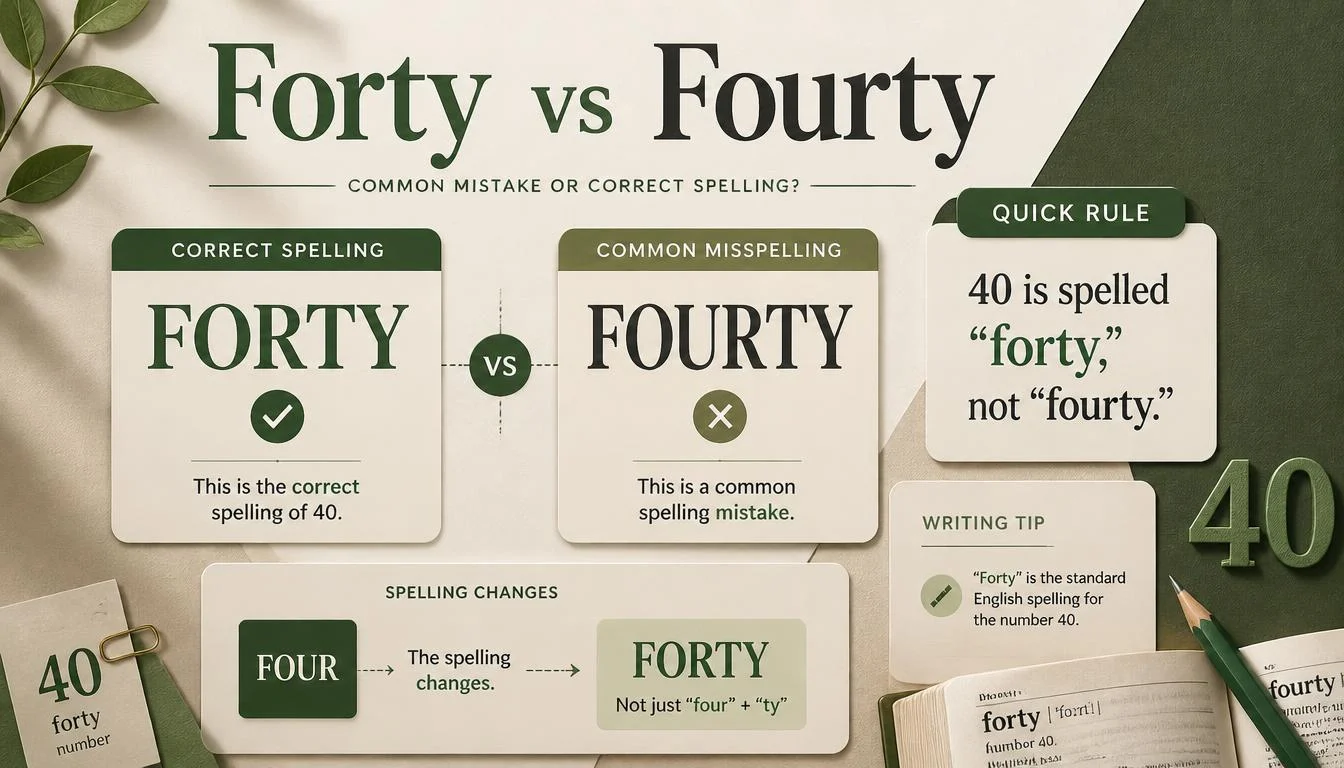
Forty is the only correct spelling of the number 40 in English. Fourty is a common misspelling that happens because people connect the word to “four.” Even though “four” contains a u, “forty” drops it. Every major dictionary, including Oxford and Merriam-Webster, lists “forty” as the sole accepted spelling for formal and everyday writing.
If you’ve ever wondered about Forty vs Fourty, you’re not alone. These spellings look almost identical, but only one is correct in standard English. Knowing the difference can help you avoid a common spelling mistake in emails, essays, and everyday writing.
The correct spelling is forty, not fourty. Although four is spelled with a “u,” that letter disappears when forming the word forty. In this guide, we’ll explain why forty is correct and show you how to use it confidently.
Why This Mix-Up Happens to So Many Writers
You already know how to count. You know what forty means. So why does the spelling trip up so many people, including native English speakers who write every day for work?
The answer sits in a strange corner of English spelling logic. The numbers four, fourteen, and fourteenth all keep the letter u. Then forty arrives and quietly drops it, without warning and without any obvious reason tied to pronunciation. Your brain builds a pattern from four, fourteen, and fourth, then assumes forty should follow the same rule. It doesn’t.
This small inconsistency creates a real problem in professional and academic writing. A misspelled number in an invoice, a research paper, a resume, or a business email can make a document look careless, even when everything else about it is well written. Readers notice spelling errors quickly, especially in numbers that appear in contracts, prices, ages, or measurements.
By the end of this guide, you’ll understand exactly why forty keeps its unusual spelling, how to remember it permanently, and where writers most often slip up. You’ll also see real examples from workplace emails, school writing, customer support, and even how spellcheck tools and AI systems handle this exact word.
Forty vs Fourty: What’s the Difference?
The real difference is simple: forty is a correctly spelled English word, while fourty is not a recognized word at all. It’s a spelling error, not an alternate form or regional variation.
Forty functions as a number, specifically a cardinal number representing the quantity 40. It works as an adjective when it describes a noun, as in “forty students,” and as a noun when it stands alone, as in “Forty is my favorite number to work with in budgeting.” Fourty carries no independent meaning. It exists only as a mistaken attempt to spell forty, usually influenced by the spelling of four.
| Meaning | Part of Speech | Refers To | Typical Usage | Example | Common Confusion |
|---|---|---|---|---|---|
| The number 40 | Adjective/Noun | Quantity or count | Ages, prices, time, measurements | She turned forty last week. | Written as “fourty” |
| Not a real word | N/A | N/A | Spelling error only | (Incorrect) He is fourty years old. | Mistaken for a valid spelling |
This confusion doesn’t come from grammar rules. It comes from a spelling exception that breaks the pattern set by related number words. Once you understand why the exception exists, the correct spelling becomes much easier to remember for good.
Is Forty a Grammar, Vocabulary, or Spelling Issue?
This is a spelling issue, not a grammar or vocabulary problem. Both words, if fourty were real, would function identically in a sentence. The issue lives entirely in how the word is written, not in how it’s used or what it means.
Grammatically, forty behaves like any other number. It can modify a noun (“forty dollars”), stand as a subject (“Forty is a round number”), or appear in compound expressions (“forty-five,” “forty-one”). There’s no grammar rule that changes based on spelling here.
From a vocabulary standpoint, there’s only one word to learn. Fourty isn’t a synonym, a variant spelling used in another English dialect, or an older historical form that fell out of use. It simply doesn’t exist as a word anyone should use.
In formal English, business writing, academic papers, and professional correspondence, “forty” is the only acceptable spelling. There is no context, no dialect, and no writing style where “fourty” becomes correct. This is one of those rare spelling rules in English that has zero exceptions.
Practical takeaway: If you ever see “fourty” in a document, whether it’s yours or someone else’s, it needs to be corrected. There’s no situation where the alternate spelling is acceptable.
Understanding Forty: The Word You Should Always Use
Forty means the number 40, written out in words rather than numerals. It’s pronounced “FOR-tee,” with the stress on the first syllable, and functions as both an adjective and a noun depending on how it’s placed in a sentence.
Common collocations include “in your forties,” “the roaring forties,” “forty winks,” and “forty-hour workweek.” These phrases show up often enough that recognizing them can help reinforce the correct spelling through repetition and familiarity.
Typical sentence patterns place forty directly before a noun it modifies, or on its own as a standalone number:
- Workplace example: “We need forty additional units before the shipment can go out this Friday.”
- Academic example: “The study surveyed forty participants between the ages of eighteen and thirty.”
- Technology example: “The app supports forty different language settings for global users.”
- Email example: “Please confirm the meeting is scheduled for forty minutes, not sixty.”
- Daily conversation example: “I only have forty dollars left until payday.”
One mistake learners frequently make is writing “forty” as “fourty” simply because they associate it visually with “four.” This connection feels logical, but English spelling doesn’t always follow logic consistently, and this is one of those cases.
Mini recap: Forty is the correct, standard spelling for the number 40, used the same way across formal writing, casual conversation, and professional documents.
Understanding Fourty: Why It Doesn’t Exist
Fourty isn’t a word with its own meaning, pronunciation, or grammatical role. It’s simply an incorrect spelling that writers produce when their brain pulls the u from “four” into a word that doesn’t need it.
There’s no legitimate collocation, sentence pattern, or professional context where “fourty” appears correctly. If you see it in a published document, a resume, or an email, it’s an error that should be fixed immediately.
- Workplace example (incorrect): “We shipped fourty boxes last quarter.” (Should read “forty boxes.”)
- Academic example (incorrect): “The experiment included fourty trials.” (Should read “forty trials.”)
- Technology example (incorrect): “The device supports fourty megapixels.” (Should read “forty megapixels.”)
- Email example (incorrect): “I’ll be there in fourty-five minutes.” (Should read “forty-five minutes.”)
- Daily conversation example (incorrect): “She’s turning fourty next month.” (Should read “forty next month.”)
One common learner mistake is assuming that because “four” keeps its u, every related number word should too. This assumption feels reasonable, but forty is the clear exception among the multiples of ten.
Mini recap: Fourty is not a word. Any time it appears, it needs to be replaced with the correct spelling, forty, without exception.
When Writers Commonly Choose the Wrong Spelling
Even confident writers slip into this mistake under certain conditions. Here are the situations where it happens most often, along with how to catch and correct it.
1. When typing quickly without reviewing the text. Speed writing, especially in emails or chat messages, often produces automatic errors. The brain defaults to the four-based spelling because it feels visually consistent.
2. When translating directly from another language. Some non-native English speakers translate numbers from languages where the spelling pattern doesn’t drop letters the way English does with forty. This creates a natural tendency to include the u.
3. When relying on memory instead of visual confirmation. People who learned numbers primarily through speech, rather than reading and writing, sometimes never see the correct spelling enough times to fully register it.
4. When autocorrect settings are turned off. Many writing tools catch this error automatically, but if autocorrect or spellcheck is disabled, the mistake can slip through unnoticed.
5. When writing compound numbers quickly. Words like “forty-five,” “forty-two,” or “forty-eight” require extra attention because the hyphen adds a second point where errors can creep in.
6. When a writer overgeneralizes number spelling rules. Since “four,” “fourteen,” and “fourth” all include the u, it seems logical that “forty” should follow suit. This overgeneralization is the single biggest cause of the mistake.
7. When proofreading focuses on other errors. Writers scanning for grammar mistakes or awkward phrasing sometimes skip over number spellings entirely, assuming they’re already correct.
8. When documents are edited by multiple people. In collaborative writing, one contributor might introduce the error, and it can go unnoticed if no one specifically checks numeral spellings during review.
Common Mistakes Table
| Correct Sentence | Incorrect Sentence | Explanation |
|---|---|---|
| She just turned forty this year. | She just turned fourty this year. | “Fourty” is never a valid spelling in any context. |
| The invoice totals forty-two dollars. | The invoice totals fourty-two dollars. | The u from “four” doesn’t carry into “forty.” |
| We hired forty new employees this quarter. | We hired fourty new employees this quarter. | Business writing requires the standard spelling. |
| The test has forty questions. | The test has fourty questions. | Academic writing follows the same rule with no exceptions. |
Quick Decision Box
If you’re unsure which spelling to use, remember this simple rule: there is no decision to make. Forty is always correct. Fourty is always wrong. If you can say “forty” out loud, write it with no u after the o.
Forty in Real-World Communication
Seeing forty used correctly across different real-life situations helps cement the spelling in memory far better than repetition alone.
Office communication: A project manager writes, “We’re allocating forty hours to this phase of development,” in a shared planning document, making sure the number reads clearly for the entire team.
Business email: A vendor responds, “Your order includes forty units at the discounted rate,” confirming both quantity and pricing in a professional tone.
School or university: A professor announces, “The final exam will include forty multiple-choice questions,” setting clear expectations for students preparing to study.
Customer support: A support agent tells a customer, “Your refund will process within forty business hours,” giving a specific and professional timeframe.
Technology: A product description reads, “This laptop battery lasts up to forty hours on a single charge,” a detail that matters to buyers comparing devices.
Artificial Intelligence: An AI chatbot response states, “I found forty relevant results for your search query,” demonstrating that even automated systems consistently use the correct spelling.
Daily conversation: A friend mentions, “I waited almost forty minutes for the bus this morning,” a casual but perfectly correct use of the word.
Forty in Modern Technology
Modern technology reinforces correct spelling more than most people realize. Virtual assistants like Siri, Alexa, and Google Assistant consistently generate “forty” when converting speech to text or displaying numerical values in written form, since their language models are trained on standardized dictionary spelling.
Chatbots and AI writing tools, including customer service bots and productivity software, follow the same standard. When these systems produce numbers in word form rather than numerals, they draw from verified language datasets that never include “fourty” as a valid output.
Business software, from invoicing platforms to project management tools, also defaults to “forty” in any auto-generated text, reports, or notifications. This consistency across technology platforms serves as a helpful, if indirect, confirmation for writers who want to double-check their spelling instinctively.
Where the Spelling Pattern Comes From
Forty traces back to Old English “feowertig,” a combination of “feower” (four) and “tig” (a suffix indicating a group of ten, similar to how “twenty” and “thirty” are formed). Over centuries, English spelling evolved and simplified, and the u that appears in “four” today was eventually dropped from “forty” during this process, even though it remained in related words like “fourteen” and “fourth.”
This historical shift explains why forty looks like an outlier among its number-word relatives. It isn’t a modern error or a stylistic choice. It’s simply how English spelling settled after generations of gradual change.
Expert Insight
As a language instructor, I always tell students that forty is one of the best examples of why English spelling can’t always be predicted through logic alone. Four, fourteen, and fourth all keep their u, so learners naturally expect forty to match. The best way to internalize the exception isn’t through memorizing spelling rules, but through repeated exposure in real writing. Read the word in context often enough, and your hand will eventually write it correctly without conscious thought.
Error Prevention Checklist
- Always use forty when writing the number 40 in any context, formal or casual.
- Never use fourty, since it isn’t a recognized English word in any dictionary.
- Remember that “four,” “fourteen,” and “fourth” keep the u, but “forty” does not.
- Quick memory tip: picture the number 40 as “for-ty,” dropping the u the same way “twenty” and “thirty” have no u either.
Related Grammar Confusions Worth Learning
- Thirty vs Thirdy Understanding why “thirty” doesn’t follow the spelling of “third” helps reinforce the same pattern seen in forty.
- Ninety vs Ninty This common misspelling drops a necessary letter, unlike forty, which adds one incorrectly.
- Affect vs Effect A classic vocabulary confusion that trips up writers at every skill level.
- Its vs It’s One of the most frequently misused word pairs in professional writing.
- Their vs There vs They’re A foundational spelling distinction every writer should master early.
- Less vs Fewer Understanding countable versus uncountable nouns clears up this frequent grammar mix-up.
- Advice vs Advise A spelling and vocabulary distinction based on noun versus verb usage.
- Complement vs Compliment Two words that sound alike but carry entirely different meanings.
- Farther vs Further A subtle distinction between physical distance and figurative degree.
- Principal vs Principle A common workplace and academic spelling error worth reviewing alongside numeral spelling mistakes.
FAQs
Is “fourty” ever acceptable in British English?
No. Both American and British English use forty as the correct spelling. There is no regional variation or dialect in which “fourty” is accepted as an alternative spelling of the number 40.
Why does “four” have a u but “forty” doesn’t?
The difference comes from historical spelling changes. Over time, the spelling of forty was simplified, while related words such as “four,” “fourteen,” and “fourth” retained the u. This makes forty an unusual spelling that is best learned as an exception.
Does spellcheck always catch “fourty”?
Most modern spellcheckers and grammar tools flag fourty as incorrect because it is not a standard dictionary spelling. However, spellcheck is not completely reliable. Manual proofreading is still useful, particularly in professional, academic, and published writing.
How do you spell numbers like 41 or 45 correctly?
Numbers from 41 to 49 use forty as their base spelling and are typically written with a hyphen when spelled out. For example, the correct forms are forty-one, forty-five, and forty-eight. The u is never added to these compound numbers.
Is “forty” a noun or an adjective?
Forty can function as both a noun and an adjective. As an adjective, it describes a noun, as in “forty dollars.” As a noun, it can stand on its own, as in “Forty is an even number.”
Why do non-native English speakers misspell “forty” so often?
Many learners naturally build spelling expectations from related words such as “four” and “fourteen.” Because English spelling does not always follow consistent patterns, this can make forty confusing. With regular reading and practice, the correct spelling becomes easier to recognize and remember.
Conclusion
The difference between forty and fourty comes down to one simple fact: only forty is correct, and fourty has no place in proper English writing, regardless of context or formality. The confusion happens because of natural spelling patterns from related words like four and fourteen, not because of any grammar rule or regional variation.
Once you remember that forty breaks the pattern deliberately, the correct spelling becomes second nature. Keep this simple rule in mind: if you’re writing the number 40, drop the u entirely and write forty, every single time.
Read More Related Articles:
- Pronounciation vs Pronunciation | Common Error You Can Avoid In 2026
- Privilege vs Priviledge | Learn the Correct Word Fast In 2026
- Suing or Sueing | Don’t Let This Spelling Trip You Up In 2026

Zoe Chambers works as a content writer at synoseek.com, contributing thoughtful pieces on everyday subjects and ideas. She writes in a simple, grounded way, often drawing from real-world experiences. Her focus is on keeping content natural, clear and easy for readers to connect with.
11 thoughts on “Forty vs Fourty | Stop Making This Common Spelling Error In 2026”