Quick Answer
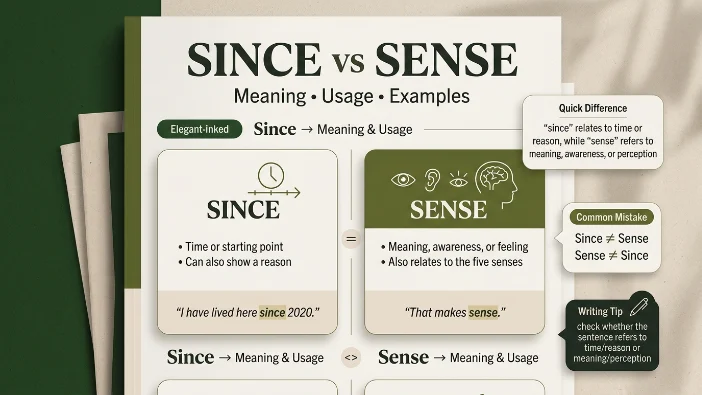
The difference between since and sense is simple: since refers to time or causation (meaning “from that time” or “because”), while sense relates to perception, feeling, or understanding (meaning “a physical feeling” or “good judgment”). Remember: since = time/reason, sense = feeling/meaning.
Have you ever typed “I haven’t seen him sense last Tuesday” and wondered if something looked off? Or maybe you’ve written “common since” when you meant “common sense”? You’re not alone. The since vs sense confusion is one of the most common word mix-ups in English writing, and it happens to native speakers and learners alike.
Here’s the truth: these words look similar on the page, sound somewhat alike in conversation, but mean completely different things. One deals with time and reasons, while the other deals with feeling and understanding. Getting them wrong isn’t just a spelling error, it changes what you’re actually trying to say.
By the end of this guide, you’ll never confuse since and sense again. We’ll break down exactly what each word means, show you how to use them correctly in real-world situations, and give you practical memory tricks that actually work.
What’s the Difference Between Since and Sense?
The core difference between since and sense comes down to their function and meaning in a sentence. Since is primarily about time or logical connection, while sense is about perception or awareness.
Here’s a quick breakdown:
| Aspect | Since | Sense |
|---|---|---|
| Meaning | From a particular time; because; as a consequence | A physical feeling; good judgment; awareness; meaning |
| Part of Speech | Preposition, conjunction, adverb | Noun, verb |
| Refers To | Time, duration, reason, causation | Senses (sight, touch, hearing, etc.), intuition, intelligence, understanding |
| Typical Usage | “Since 2010,” “since we met,” “since you asked” | “Sense of smell,” “common sense,” “make sense” |
| Example | “I’ve worked here since January.” | “I have a strange sense of unease.” |
| Common Confusion | Using when “because” or “from” fits | Using when “feeling” or “intelligence” fits |
The simplest way to remember? Since involves time or reason (think: “since the beginning” or “since you’re here”). Sense involves feeling or understanding (think: “sixth sense” or “sense of humor”).
Think about it this way: you can have a sense of something, but you can’t have a since of anything. You can talk about something happening since a specific time, but you can’t talk about something happening sense a specific time. That’s the core distinction that will help you avoid mixing them up.
Is Since vs Sense a Grammar, Vocabulary, or Usage Issue?
This confusion falls into all three categories, but for different reasons.
Grammar classification: Since functions as a preposition (“since Tuesday”), conjunction (“since you mentioned it”), and adverb (“I’ve since changed my mind”). Sense functions as a noun (“a sense of purpose”) and verb (“I sense something wrong”). Their grammatical roles are entirely different.
Vocabulary difference: These are completely separate words with distinct meanings. They share no overlapping definitions, which means choosing the wrong one creates a clear vocabulary error rather than a stylistic preference.
Usage difference: The primary reason people confuse since and sense is pronunciation. In many dialects, particularly American English, the vowel sounds can blend together in rapid speech. This leads to people writing what they think they heard, resulting in “sense” when they meant “since” and vice versa.
Are they interchangeable? Absolutely not. Using one when you mean the other changes the entire meaning of your sentence. “Since yesterday” refers to time; “sense yesterday” makes no sense at all.
Formal vs informal English: Both words appear across all registers of English. You’ll find since and sense in business writing, academic papers, everyday conversation, and formal documents. The choice isn’t about formality, it’s about using the correct word for what you mean.
The practical takeaway: If you’re writing about time or causation, you need since. If you’re writing about perception, understanding, or awareness, you need sense. There’s no overlap, no gray area, and no context where they’re interchangeable.
How to Use Since Correctly
Since has two main functions: expressing time and expressing causation. Understanding both will help you use it confidently in any situation.
What Since Means
Since indicates a point in time from which something continues or began, or it introduces a reason or explanation for something. It can refer to past events that continue to the present, a starting point, or a logical connection between ideas.
Pronunciation
Since is pronounced as /sɪns/ – one syllable, with a short “i” sound like in “sit.” The “c” is silent, so the sound is “sins” (though that’s a different word, so watch your spelling).
Part of Speech
Since can be three different parts of speech, making it versatile:
- Preposition: “I’ve been waiting since noon.”
- Conjunction: “Since you’re here, let’s get started.”
- Adverb: “She has since moved to London.”
Common Collocations and Sentence Patterns
Since commonly appears with:
- Specific time markers: Since Monday, since 2015, since last week
- Past events: Since we met, since I arrived, since she left
- Causal connections: Since that’s the case, since we agree
Real-World Examples
Workplace example:
“The quarterly report has been on my desk since Tuesday morning. Since I haven’t received your feedback yet, I’ll assume we’re moving forward with the current version.”
Academic example:
“Research on this topic has expanded significantly since the early 2000s, since new technology has enabled more detailed analysis of genetic patterns.”
Technology example:
“Since the last software update, users have reported faster load times. Since we’re seeing positive results, we’ll continue rolling out similar improvements.”
Email example:
“Since our meeting was rescheduled, I’ve updated the project timeline. Please review the changes since we need to finalize this by Friday.”
Daily conversation example:
“I haven’t been to that restaurant since they changed the menu. Since you’re such a foodie, let’s go check it out together.”
Common Learner Mistakes with Since
Mistake: Using since incorrectly with present perfect verbs.
Wrong: “I am here since 9 AM.”
Right: “I have been here since 9 AM.”
In English, since often pairs with present perfect tense (have/has + past participle) when referring to actions that started in the past and continue to the present.
Another common error: Using since to mean “for” when referring to duration.
Wrong: “I’ve worked here since three years.”
Right: “I’ve worked here for three years.”
Also right: “I’ve worked here since 2019.”
Use since with a specific starting point, and for with a duration.
Mini recap: Since is your word for time references (starting points) and causal explanations (reasons). It’s never used to describe feelings, perceptions, or judgments.
How to Use Sense Correctly
Sense is all about perception, awareness, and understanding. It’s a completely different word from since, and it serves a different purpose entirely.
What Sense Means
Sense refers to a physical feeling (like sight, touch, or hearing), an intuitive understanding, good judgment, or the meaning of something. It can function as either a noun or a verb.
Pronunciation
Sense is pronounced as /sɛns/ – one syllable with a short “e” sound like in “set.” It sounds very similar to since in natural speech, which is exactly why the confusion happens.
Part of Speech
- Noun: “He has a good sense of direction.”
- Verb: “I sense you’re uncomfortable with this decision.”
Common Collocations and Sentence Patterns
Sense commonly appears in phrases like:
- Physical senses: Sense of smell, sense of touch, sense of hearing
- Intuitive senses: Sense of humor, sense of direction, sense of timing
- Judgment: Common sense, business sense, fashion sense
- Feelings: Sense of loss, sense of achievement, sense of urgency
- Meaning: Make sense, in a sense, the sense of a word
Real-World Examples
Workplace example:
“You need to trust your business sense when negotiating this contract. I sense you’re hesitant, but your instincts have always been sharp when it comes to client relationships.”
Academic example:
“The researcher’s work demonstrates a sophisticated sense of theoretical frameworks, though one could argue that a deeper historical sense would strengthen the conclusions.”
Technology example:
“The AI’s pattern recognition gives it a sense of predictability that users find trustworthy. However, when users sense the system making errors, they lose confidence quickly.”
Email example:
“I have a sense that we’re missing something in our data analysis. Let’s review the numbers again – does this make sense to you, or should we consider additional variables?”
Daily conversation example:
“My sense of direction is terrible, so I rely completely on GPS. That makes sense for someone who gets lost in their own neighborhood.”
Common Learner Mistakes with Sense
Mistake: Confusing sense with “since” in fixed expressions.
Wrong: “That makes since.”
Right: “That makes sense.”
This is one of the most common errors in English writing, and it happens because the phrase “makes sense” sounds like “makes since” when spoken quickly. Always remember: things make sense, not “since.”
Another error: Using sense where since belongs.
Wrong: “I’ve known her sense we were in college.”
Right: “I’ve known her since we were in college.”
Mini recap: Sense is about perception, feeling, and understanding. If you can replace it with “feeling” or “judgment,” sense is the right choice.
When Not to Use Each Word
Understanding when to avoid each word is just as important as knowing when to use them.
Mistakes with Since
Why it happens: Writers often choose since when they mean sense because the words sound similar, or they use since incorrectly when talking about duration.
“Since” vs. “for”: Don’t use since with durations. Use for instead.
❌ “I’ve lived here since five years.”
✅ “I’ve lived here for five years.”
✅ “I’ve lived here since 2018.”
“Since” vs. “because”: Both can explain reasons, but since often suggests a logical progression or known information. Because is generally stronger and more direct.
❌ “Since the data shows a trend, but we need more evidence.”
✅ “Because the data shows a trend, we need more evidence.”
Mistakes with Sense
Why it happens: The most common error is using sense in time expressions instead of since.
“Sense” vs. “since” in time references:
❌ “I’ve been waiting sense 3 PM.”
✅ “I’ve been waiting since 3 PM.”
“Sense” vs. “sence”: Sence is a misspelling of sense and doesn’t exist in English. Always use sense.
“Make sense” vs. “make since”: Always “make sense.”
❌ “That doesn’t make since.”
✅ “That doesn’t make sense.”
How to Remember the Difference
Here’s a reliable memory trick: Since starts with S as in “Started” (time starts at a point). Sense starts with S as in “Senses” (your five senses).
Another approach: If you’re talking about “when” or “why,” use since. If you’re talking about “what you feel” or “what you understand,” use sense.
Common Mistakes Table
| Correct Sentence | Incorrect Sentence | Why It’s Wrong |
|---|---|---|
| “I’ve worked here since 2010.” | “I’ve worked here sense 2010.” | The sentence refers to a starting time, so since is needed, not sense. |
| “That makes perfect sense.” | “That makes perfect since.” | Sense means “logic” or “meaning” here. Since would mean “from that time,” which makes no sense. |
| “Since you’re coming, I’ll stay.” | “Sense you’re coming, I’ll stay.” | The word introduces a reason (“because”). Sense as a verb would mean “I perceive you’re coming,” which doesn’t fit. |
| “She has a great sense of humor.” | “She has a great since of humor.” | The phrase requires sense meaning “feeling” or “perception. |
| “We haven’t met since June.” | “We haven’t met sense June.” | The reference to a specific time requires since. |
| “I sense something is wrong.” | “I since something is wrong.” | The verb here means “perceive” or “feel,” so it needs sense. |
Quick Decision Tool
If you mean time or reason → use since
If you mean feeling or understanding → use sense
Quick Check:
- Can you replace it with “from that time”? → Use since
- Can you replace it with “feeling” or “perceive”? → Use sense
- Can you replace it with “because”? → Use since
- Is it part of “make sense”? → Use sense
Real-World Examples in Context
Let’s see how these words work in actual situations you might encounter.
Office Communication
Since: “Since the quarterly review is next week, I need your department’s numbers by Thursday.” (Reason)
Sense: “I sense the team is overwhelmed, so let’s push the deadline.” (Perception)
Business Email
Since: “Since we discussed the proposal last month, I’ve incorporated all your feedback.” (Time + reason)
Sense: “Does this direction make sense to you, or should we reconsider the approach?” (Understanding)
School or University
Since: “Since I started this course, my writing has improved significantly.” (Time)
Sense: “The assignment requires a strong sense of argumentation and clear reasoning.” (Judgment)
Customer Support
Since: “Since you contacted us about this issue three days ago, we’ve been investigating thoroughly.” (Time + reason)
Sense: “I sense your frustration, and I want to help resolve this quickly.” (Perception)
Technology and AI
Since: “Since implementing the new algorithm, system errors have dropped by 40%.” (Time + reason)
Sense: “Advanced AI systems demonstrate a remarkable sense of pattern recognition.” (Perception/understanding)
Daily Conversation
Since: “I haven’t eaten anything since breakfast.” (Time)
Sense: “I have a sense we’ve met somewhere before.” (Feeling/intuition)
Since and Sense in Modern Technology
With the rise of artificial intelligence and voice assistants, these words have become increasingly relevant in specific technological contexts.
Voice assistants like Siri, Alexa, and Google Assistant respond to commands and questions. You might say, “Since I’m driving, can you read my messages?” Here, since provides the reason for the request.
Artificial intelligence systems are designed to “make sense” of data, meaning they process and understand information. Data scientists frequently talk about whether their models “make sense” in real-world applications.
Chatbots often use since to explain their reasoning: “Since you mentioned billing issues, I’ll transfer you to our payment department.”
Machine learning relies on algorithms that “sense” patterns in data. Researchers talk about AI “sensing” user preferences to recommend content.
Business tools like CRMs (Customer Relationship Management) and analytics platforms help companies “make sense” of customer behavior and market trends.
The key takeaway? Technology uses both words in exactly the same way as general English. Since appears when explaining time or causation, sense appears when describing perception, understanding, or judgment.
The Origin of These Words
Understanding where these words come from can help cement their meanings in your memory.
Since comes from Old English sīþþan, meaning “after that” or “from that time.” It evolved through Middle English as sithen and eventually became the modern since. Its core meaning has always been about time and sequence, with the causal meaning (“because”) developing later as a natural extension.
Sense comes from Latin sensus, meaning “feeling” or “perception,” which itself comes from sentire meaning “to feel.” It entered English through Old French in the 14th century. The word has always been about perception, whether physical (sight, hearing) or intellectual (judgment, understanding).
The historical separation between these words is clear. Since has always been about chronology and causation. Sense has always been about perception and awareness. They developed completely independently and share no common linguistic root.
Expert Insight
Here’s a teaching perspective that experienced language instructors often share with students:
Students who confuse since and sense usually have one thing in common: they’re thinking about how the word sounds, not what it means. When you’re writing, slow down and ask yourself one question: ‘Am I talking about something that happened at a specific time or because of something, or am I talking about a feeling or understanding?’
If you focus on meaning rather than pronunciation, you’ll never make this mistake. Think of since as your ‘time and reason’ word. Think of sense as your ‘feeling and understanding’ word. When you read back your writing, substitute the word with that meaning. If ‘from that time’ fits, use since. If ‘feeling’ fits, use sense.
This approach works because it shifts your focus from spelling to meaning, which is exactly how native speakers learn to avoid common errors.
Error Prevention Checklist
Always use SINCE when:
- You’re referring to a specific starting point in time (“since Monday”)
- You mean “because” or “as a result of” (“since you’re here”)
- You’re talking about something that began in the past and continues now (“since we met”)
Always use SENSE when:
- You’re talking about physical perception (“sense of touch”)
- You mean “feeling” or “intuition” (“I sense trouble”)
- You’re referring to judgment or intelligence (“common sense”)
- You’re talking about meaning (“make sense”)
Never confuse them if:
- You remember that since = time/reason and sense = feeling/meaning
- You test the sentence by swapping with “because” or “feeling”
- You visualize the meaning before writing
Quick memory tip: “SINCE is about TIME (both have the letter T), and SENSE is about FEELINGS (both have the letter F).” Or simply: “Time is since, feeling is sense.”
Related Grammar Confusions
If you struggle with since vs sense, these related word pairs might also trip you up. Learning them together can help you avoid multiple common errors:
- Affect vs effect – Learn the difference between action and result
- Then vs than – Understand time vs comparison
- Your vs you’re – Distinguish possession from contraction
- Its vs it’s – Understand possession vs “it is”
- To vs too vs two – Distinguish direction, excess, and number
- They’re vs their vs there – Distinguish contraction, possession, and location
- Who vs whom – Learn subject vs object
- Which vs that – Distinguish non-essential vs essential clauses
- Lie vs lay – Understand intransitive vs transitive verbs
- Fewer vs less – Distinguish countable vs uncountable nouns
Each of these pairs causes confusion for similar reasons: similar sounds, overlapping contexts, or related meanings. Mastering them one by one will significantly improve your writing accuracy.
FAQs
Is “since” only used for time?
No, since can also mean “because” or “as a result of.” For example, “Since you’re not coming, I’ll go alone” uses since to mean “because.” However, the time-related meaning is more common.
Why do people confuse “since” and “sense” so often?
The confusion comes from their similar pronunciation. In quick speech, especially in American English, the vowel sounds can blend together. When people write what they hear, they sometimes choose the wrong word. Writing carefully and focusing on meaning helps eliminate this error.
Can “sense” ever be used to talk about time?
No, sense is never about time. If you’re referring to a specific time or duration, sense is always wrong. Use since for all time-related references.
What does “common sense” mean?
Common sense” means practical, sound judgment based on everyday experience rather than specialized knowledge. It’s always “common sense” (never “common since”). Think of it as the kind of good judgment most people share.
Is “make sense” always spelled with “sense”?
Yes. Make sense” is a fixed English expression meaning “to be logical or understandable.” It’s always spelled with sense and never since. There is no phrase “make since” in correct English.
Which word should I use in academic writing?
Both words appear frequently in academic writing, but for different purposes. Since appears in discussions of timing, duration, and causation. Sense appears in discussions of perception, understanding, and judgment. Use whichever fits your intended meaning.
Are “since” and “because” exactly the same?
Not exactly. Since and because both express causation, but since often suggests that the reason is already known or obvious to the listener, while because provides new or primary information. For example, “Since you’re already here” implies the person’s presence is obvious, while “because you asked” provides the reason for an action.
Conclusion
The difference between since and sense comes down to one simple distinction. Since is about time and reasons it marks when something started or explains why something happened. Sense is about feelings and understanding it refers to physical perception, intuition, judgment, and meaning.
Remember: if you’re talking about when something began, use since. If you’re talking about what you feel or understand, use sense. If you’re ever unsure, substitute the word with “from that time” for since or “feeling” for sense. The wrong choice will immediately become obvious.
The practical rule to carry with you: Time and reason take since. Feelings and understanding take sense. Keep that in mind every time you write, and you’ll never confuse these words again.