Quick Answer
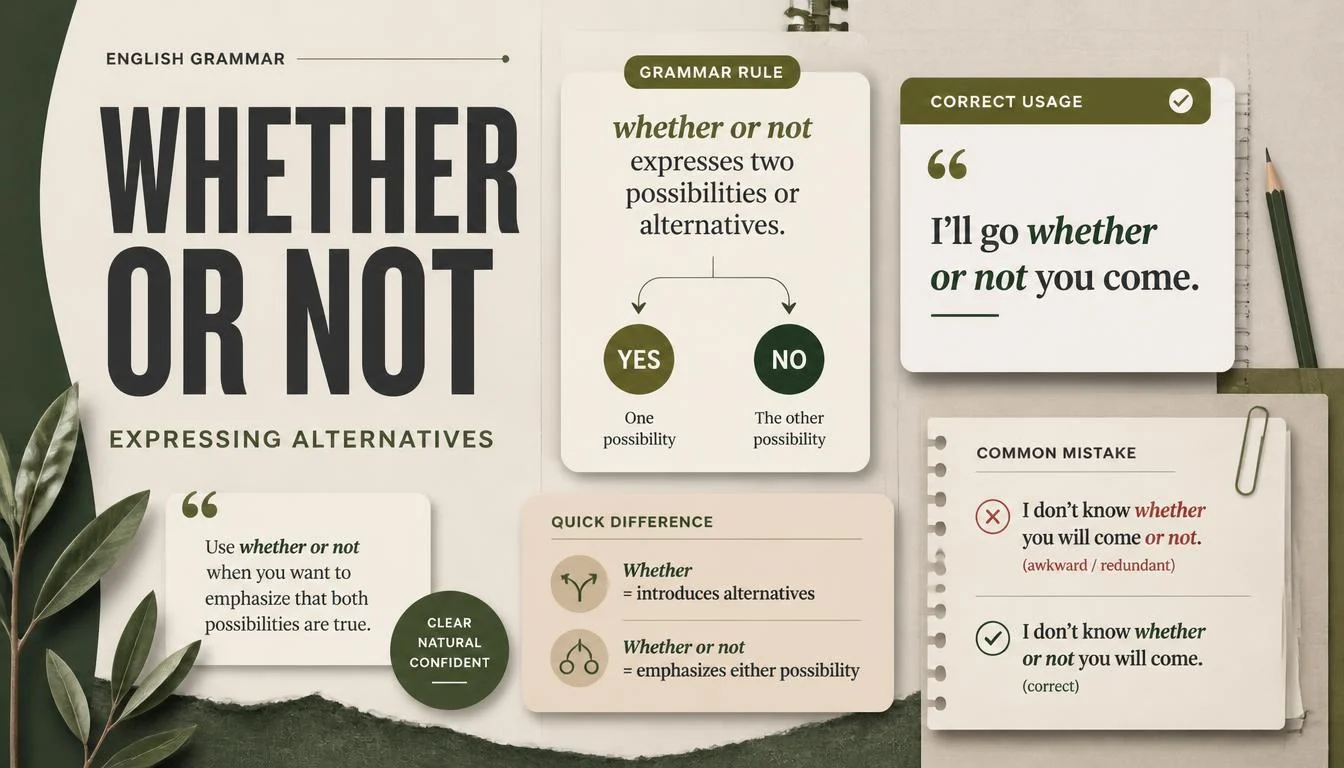
“Whether or not” means “regardless of which possibility occurs,” and it emphasizes that an outcome doesn’t depend on a condition. In most sentences, “or not” is optional and can be dropped without changing the meaning, since “whether” alone already implies two choices. You only need “whether or not” when you want to stress that something happens no matter what.
You’ve probably typed “whether or not” a hundred times without stopping to ask if you actually needed both words. Then someone a teacher, an editor, a strict-sounding grammar checker tells you “or not” is redundant, and suddenly you’re second-guessing every sentence you write. This confusion is incredibly common, and it trips up native speakers just as often as English learners.
Here’s the short version of the problem: “whether” is a conjunction that introduces two or more alternatives, so it already carries the idea of “or not” inside it. That means writing “whether or not” is sometimes unnecessary repetition. But not always. In certain sentences, dropping “or not” actually changes what you’re saying, or makes the sentence sound incomplete. Getting this wrong doesn’t just look sloppy it can genuinely confuse a reader about whether you’re describing a choice or an unavoidable outcome.
By the end of this guide, you’ll know exactly when “whether or not” is required, when it’s just padding, and how to make that call instantly in your own writing. We’ll walk through real examples from emails, workplace conversations, and even AI tools, so you can see the difference in context rather than just in theory.
Whether or Not: What’s the Difference?
The real difference isn’t between two competing words it’s between “whether” used alone and “whether” paired with “or not.” Both are grammatically correct, but they serve slightly different jobs depending on what you’re trying to say.
“Whether” by itself introduces a choice between two or more options, often within indirect questions or noun clauses. For example, “I don’t know whether she’s coming” already implies “or not coming” the alternative is built into the word. Adding “or not” here is optional and mostly a matter of rhythm or emphasis.
“Whether or not,” on the other hand, is used when you want to highlight that a result stays the same no matter which option happens. It usually pairs with clauses like “it doesn’t matter” or “regardless.” In these cases, removing “or not” can make the sentence feel unfinished, because the whole point of the sentence is that the outcome is unconditional.
| Meaning | Part of Speech | Refers To | Typical Usage | Example | Common Confusion |
|---|---|---|---|---|---|
| Introduces a choice between alternatives | Conjunction | A condition or possibility | Indirect questions, noun clauses | “I’m not sure whether he called.” | Assuming “or not” is always required |
| Emphasizes an outcome regardless of the condition | Conjunction phrase | An unconditional result | Statements about inevitability | “We’re leaving whether or not it rains.” | Assuming “or not” is always optional |
So the recap here is simple: “whether” alone works fine for most everyday questions and reported speech, while “whether or not” earns its place when you’re stressing that nothing will change the result. If you’re describing a decision that hasn’t been made yet, you probably don’t need “or not.” If you’re describing something that will happen regardless of a decision, you probably do.
Is Whether or Not a Grammar, Vocabulary, or Usage Issue?
This is mostly a usage issue rather than a strict grammar rule, which is exactly why it causes so much disagreement among writers and editors. Grammatically, both “whether” and “whether or not” are correct in nearly every context there’s no rule being broken when you use either one.
From a vocabulary standpoint, the two aren’t really separate words to memorize; they’re the same conjunction used with or without an added phrase. The usage difference comes down to emphasis and clarity rather than correctness. In formal English, especially academic and business writing, many style guides recommend dropping “or not” whenever it’s not adding meaning, since concise writing is usually viewed as more professional. In everyday conversation, people include “or not” constantly, often out of habit or for spoken rhythm, and it rarely sounds wrong to a listener.
Are they interchangeable? In most sentences, yes you can remove “or not” from “whether” clauses without losing meaning. The exception is when “whether or not” functions like “regardless,” in which case removing “or not” can weaken or change the sentence.
The practical takeaway: in polished writing, default to plain “whether,” and only add “or not” when you specifically mean “no matter what happens.
Whether: A Closer Look
“Whether” is a subordinating conjunction used to introduce a choice between two or more possibilities, often functioning like “if” in indirect questions.
Part of speech: Conjunction
Common collocations: whether or not, whether… or, know whether, decide whether, unsure whether
Typical sentence pattern: [Verb of doubt/decision] + whether + [clause]
Here’s how it shows up in real situations:
- Workplace: “Let me check whether the client approved the invoice before we send the reminder.”
- Academic: “The study didn’t clarify whether the results applied to younger participants.”
- Technology: “The app doesn’t tell you whether your message was actually delivered.”
- Email: “Could you confirm whether the meeting is still happening at 3 PM?”
- Daily conversation: “I honestly don’t know whether I locked the front door.”
One learner mistake: Many learners write “if” and “whether” as if they’re always interchangeable. They’re close, but “whether” is generally preferred before “or,” in formal writing, and when a choice not just a condition is being described. “I’ll go if it’s sunny” describes a condition; “I don’t know whether it’s sunny” describes uncertainty about a fact.
Mini recap: “Whether” quietly does the work of presenting options, and it rarely needs backup from “or not” unless you’re deliberately emphasizing an unconditional outcome.
Whether or Not: A Closer Look
“Whether or not” is the same conjunction reinforced with “or not,” most useful when a sentence needs to communicate that an outcome is fixed regardless of circumstances.
Part of speech: Conjunction phrase
Common collocations: whether or not it matters, whether or not you agree, succeed whether or not, whether or not conditions change
Typical sentence pattern: [Main clause about a fixed outcome] + whether or not + [condition]
Real examples across different settings:
- Workplace: “The project deadline stays the same whether or not the client sends feedback.”
- Academic: “Students must submit their essays whether or not they attended the review session.”
- Technology: “The software updates automatically whether or not you click ‘remind me later.'”
- Email: “We’ll proceed with the launch whether or not the vendor confirms shipping in time.”
- Daily conversation: “I’m going to the gym whether or not it’s raining.”
One learner mistake: Some writers add “or not” purely out of habit, even in sentences that are already asking a simple yes/no question rather than describing an unconditional result. “I don’t know whether or not she’s coming” works, but it’s often just as clear and tighter as “I don’t know whether she’s coming.”
Mini recap: “Whether or not” earns its keep when the sentence is really about something happening no matter what, not when it’s simply expressing uncertainty about one outcome.
When Not to Use “Whether or Not”
Here are the situations where writers commonly overuse “or not” and how to catch yourself doing it.
1. Simple indirect questions. If your sentence just reports uncertainty (“I wonder whether he called”), you don’t need “or not.” The alternative is already implied.
2. Formal or academic writing where concision matters. Style guides like the Chicago Manual of Style generally favor trimming unnecessary words, and “or not” is often flagged as filler in these contexts.
3. After verbs like “doubt,” “wonder,” or “ask.” These verbs already set up a binary choice, so adding “or not” is usually redundant. “I doubt whether or not he’ll show up” can simply become “I doubt whether he’ll show up.”
4. When “whether” is followed by “or” and another option. In sentences like “I don’t know whether he’s coming or staying home,” adding “or not” creates confusion about how many options exist.
5. In headlines or titles. Shorter is stronger here, and “whether” alone almost always reads more cleanly.
6. When rewriting for professional tone. If you’re editing a casual draft into something more polished, cutting “or not” is one of the easiest tightening edits available.
7. In résumé or cover letter language. These documents reward concise phrasing, and “whether or not” often signals unnecessary wordiness to hiring managers.
8. When the sentence already contains “regardless” or “no matter what.” Using both is redundant pick one.
Remembering the difference is easier if you ask yourself: “Am I describing an unavoidable outcome, or am I just unsure about one thing?” If it’s the second, drop “or not.”
Common Mistakes Table
| Correct Sentence | Incorrect Sentence | Explanation |
|---|---|---|
| “I’m not sure whether she signed the contract.” | “I’m not sure whether or not she signed the contract or the amendment.” | Adding “or not” alongside a second listed option creates ambiguity about how many choices exist. |
| “The store closes at nine whether or not it’s a holiday.” | “The store closes at nine whether it’s a holiday.” | Here, dropping “or not” removes the sense that the closing time is fixed regardless of the day. |
| “Please tell us whether you’ll attend the workshop.” | “Please tell us whether or not or if you’ll attend.” | Combining conjunctions this way is a common non-native error and creates a grammatically broken sentence. |
| “We’ll ship the order whether or not payment clears today.” | “We’ll ship the order whether payment clears today.” | Without “or not,” the sentence sounds like an open question rather than a guaranteed action. |
| “I doubt whether the flight will be on time.” | “I doubt whether or not the flight will be on time.” | “Doubt” already implies uncertainty about two outcomes, so “or not” adds nothing. |
Decision Box
If you’re describing an unconditional outcome something that happens no matter what use whether or not.
If you’re simply expressing uncertainty about one possibility, use whether alone.
Quick test: try adding “regardless of what happens” to your sentence. If it fits naturally, keep “or not.” If it feels repetitive, cut it.
Real World Examples
Office communication: “Whether or not the merger goes through, our team’s priorities stay the same this quarter.”
Business email: “Please confirm whether you’d like the invoice sent to accounting or directly to your inbox.”
School or university: “Whether or not you’ve read the assigned chapter, you’re expected to participate in Thursday’s discussion.”
Customer support: “We’ll process your refund whether or not you return the original packaging, as long as the item is unused.”
Technology: “The app tracks your steps whether or not you have your phone connected to Wi-Fi.”
Artificial Intelligence: “The chatbot logs the conversation whether or not the user completes the support form.”
Daily conversation: “I’m cooking dinner whether or not you’re hungry right now.”
Notice how each “whether or not” example describes something happening regardless of the condition, while a simple “whether” would work fine in a sentence that’s only asking about one uncertain fact.
Whether or Not in Modern Technology
Technology writing leans on “whether or not” constantly, mostly because software behavior is often designed to be consistent regardless of user input. Terms of service, privacy policies, and app descriptions frequently use it to communicate that a feature works the same way under any condition.
In artificial intelligence and virtual assistant design, you’ll often see phrasing like “the assistant collects usage data whether or not you enable voice commands,” which is a precise and necessary use of the phrase dropping “or not” here would misrepresent how the system actually behaves. Voice assistants and chatbots also use “whether” alone constantly in their own outputs, phrasing clarifying questions like “I’m not sure whether you meant Monday or Tuesday,” where “or not” would be unnecessary.
Software documentation tends to favor the trimmed version, “whether,” for cleanliness, while legal and policy language leans toward “whether or not” for precision and to avoid loopholes. If you’re writing product copy, matching this pattern will make your writing sound more professional and technically accurate.
Word Origin
Whether” comes from Old English “hwæðer,” meaning “which of two,” and it originally functioned as a way to directly ask about two alternatives. Over time, English speakers began pairing it with “or not” for extra emphasis, especially in spoken language, even though the alternative was already grammatically implied. This is a common pattern in language evolution reinforcing an idea for clarity or rhythm, even when it’s technically redundant.
Expert Insight
As a language instructor, I’d tell you this: don’t think of “or not” as wrong, think of it as optional weight. Every sentence can carry a little extra emphasis, but the best writers know when that weight helps the reader and when it just slows them down. Read your sentence out loud if the meaning stays exactly the same without “or not,” you probably don’t need it. If cutting it makes the sentence feel like it’s missing its point, keep it.
Error Prevention Checklist
- Always use whether alone when you’re expressing simple uncertainty about one outcome.
- Always use whether or not when the sentence is about a result that stays the same regardless of conditions.
- Never combine “whether or not” with “or” plus a second listed option it creates confusion.
- Quick memory tip: if “regardless” or “no matter what” fits naturally in the sentence, “or not” belongs there too.
Related Grammar Confusions
- If vs. Whether: Learning when to use “if” for conditions versus “whether” for choices clears up one of the most common learner errors.
- Regardless vs. Irregardless: Understanding why “irregardless” isn’t standard English helps writers avoid a widely mocked mistake.
- Whether… Or vs. Either… Or: These two structures look similar but serve very different grammatical purposes.
- Despite vs. In Spite Of: Both express contrast, but their grammatical patterns differ in subtle ways worth mastering.
- Although vs. Even Though: Knowing the slight tone difference helps writers sound more precise in formal contexts.
- Whether vs. Weather: A classic homophone mix-up that spelling checkers often miss.
- As Well As vs. And: Useful for writers who want to avoid overusing “and” in lists and comparisons.
- In Case vs. If: These conditional phrases are frequently confused by English learners preparing for exams.
- Unless vs. If Not: A closely related pair that often appears in the same sentences as “whether or not.”
- Whatsoever vs. Whatever: Another emphasis-based pair that mirrors the “whether or not” pattern of optional reinforcement.
FAQs
Is “whether or not” grammatically correct?
Yes, “whether or not” is completely grammatically correct. The question is usually about necessity rather than correctness. In many sentences, “or not” is optional because “whether” already expresses two alternatives. However, “or not” is useful when you want to emphasize that an outcome applies regardless of the condition.
Can you start a sentence with “whether or not”?
Yes, you can start a sentence with “whether or not.” For example, “Whether or not you agree, the policy takes effect Monday” is grammatically correct and natural. This structure is commonly used when you want to emphasize that the result remains the same regardless of someone’s choice or opinion.
Is it “whether or not” or “whether or not that”?
“Whether or not” can stand on its own and does not need “that” afterward. A construction such as “whether or not that you attend” is nonstandard and should be avoided in formal writing. Use “whether or not you attend” instead.
Should I use “whether” or “if” in formal writing?
Use “whether” when you are presenting alternatives or introducing an indirect question. It is often more precise in formal writing. “If” is generally better suited to conditional statements, although the two words can overlap in some contexts.
Is “or not” always unnecessary after “whether”?
No, “or not” is not always unnecessary. It can be omitted when “whether” already clearly expresses uncertainty between alternatives. However, including “or not” can emphasize that something will happen regardless of the condition, as in “Whether or not you attend, the meeting will continue.”
Does “whether or not” need a comma before it?
Usually, no. “Whether or not” normally flows directly into the rest of the sentence without a comma. A comma may be appropriate when the phrase introduces a dependent clause that comes before the main clause, such as “Whether or not you agree, we need to move forward.”
Conclusion
The difference between “whether” and “whether or not” comes down to emphasis, not correctness. “Whether” alone handles most everyday uncertainty just fine, since the alternative is already built into the word. “Whether or not” earns its extra two words only when you’re making the point that something will happen no matter what the circumstances are.
If you remember one rule from this entire guide, make it this one: use “whether or not” only when you could just as easily say “regardless.” Everywhere else, “whether” alone will make your writing tighter, clearer, and more confident.
Read More Related Articles
- Happened or Happend | Master the Correct Usage in Minutes In 2026
- Anual or Annual | Simple Grammar Guide For Error-Free Writing In 2026
- Successfully or Succesfully | Easy Trick to Remember the Correct Spelling Forever In 2026

Lucas Mitchell is a content writer at synoseek.com. He writes simple, thoughtful pieces that focus on everyday ideas, observations and general knowledge topics. His work is shaped by a calm, realistic tone that keeps the reader engaged without overstatement.
13 thoughts on “Whether or Not | Rules You Can Actually Remember In 2026”