Quick Answer
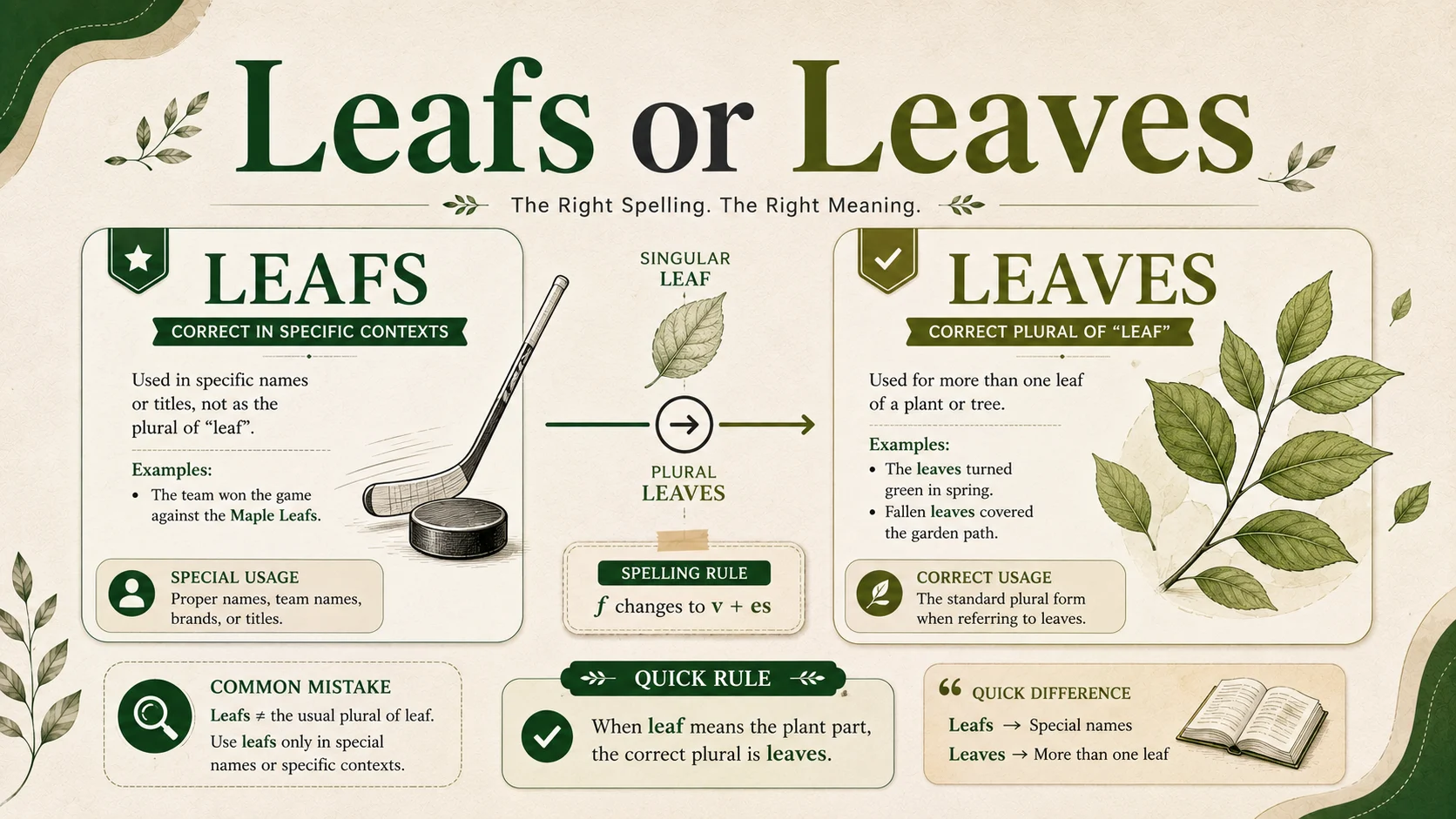
Leaves is the correct plural of “leaf” in almost every situation, including trees, paper, and metal sheets. Leafs only appears in special cases, mainly as the plural of proper nouns like the Toronto Maple Leafs, or as a verb form, as in “she leafs through a book.” When choosing between leafs or leaves, default to leaves unless you’re naming a specific team or using “leaf” as a verb.
Confused about leafs or leaves? Although leaves is the standard plural form of leaf, leafs is also correct in certain situations. The difference depends on whether you are referring to parts of a plant or using the word as a verb.
Understanding leafs or leaves can help you avoid common grammar mistakes and choose the correct form in everyday writing, professional communication, and academic work.
Why This Mix-Up Keeps Happening
You’re standing in front of a pile of autumn foliage, or maybe you’re proofreading a school essay, and suddenly you freeze. Is it “the leafs are falling” or “the leaves are falling”? It looks simple until you actually have to type it, and then your brain throws out two competing spellings that both feel oddly correct.
Part of the confusion comes from irregular English plurals. Most nouns just add an “s” at the end cat becomes cats, dog becomes dogs. But “leaf” belongs to a small, stubborn group of words ending in “f” or “fe” that swap that final letter for a “v” before adding “es.” Knife becomes knives. Wife becomes wives. Leaf becomes leaves. There’s no shortcut here, only a pattern you have to learn once and then trust.
The other layer of confusion is sports and pop culture. Anyone who follows hockey has seen “Toronto Maple Leafs” written a thousand times, and that spelling sticks in memory even though it breaks the normal rule. Once your brain gets used to seeing “leafs” attached to something official-looking, it starts to feel like a legitimate option everywhere else too. That’s how people end up writing “the leafs on the tree turned orange” in an email or school paper, when standard English calls for “leaves.”
Getting this right matters more than it might seem. In everyday writing, business communication, or academic work, using “leafs” where “leaves” belongs signals a grammar slip to anyone reading closely a teacher, an editor, a client. This guide walks through exactly when to use leaf, leaves, or leafs, why the exceptions exist, and how to remember the difference for good.
Leafs or Leaves: What’s the Difference?
The core difference is simple: “leaves” is the standard grammatical plural of the noun “leaf,” while “leafs” is a specialized spelling reserved for proper nouns and verb conjugation. Outside of those exceptions, “leafs” is considered a spelling mistake.
“Leaf” itself is a singular noun referring to a flat green part of a plant, a sheet of paper, or a thin layer of metal like gold leaf. When you’re talking about more than one of these things, English grammar requires the “-ves” ending, giving you “leaves.” This isn’t optional stylistic preference it’s a fixed rule for this category of noun.
“Leafs,” on the other hand, shows up in two legitimate contexts. First, it’s used as the plural for certain proper nouns, most famously the Toronto Maple Leafs NHL team, where the “s” was added directly instead of following the normal irregular pattern (team names often break plural rules on purpose). Second, “leafs” functions as a verb form, specifically the third-person singular present tense of “to leaf,” as in “he leafs through the newspaper every morning.”
| Meaning | Part of Speech | Refers To | Typical Usage | Example | Common Confusion |
|---|---|---|---|---|---|
| Standard plural of leaf | Noun | Multiple leaves (plant, paper, metal) | General writing, nature, business | “The leaves covered the driveway.” | Written as “leafs” by mistake |
| Proper noun plural | Noun (proper) | Toronto Maple Leafs hockey team | Sports writing, fan content | “The Leafs won last night.” | Assumed to follow standard grammar |
| Verb form | Verb | The action of flipping pages | Descriptive or narrative writing | “She leafs through old photographs.” | Confused with the noun plural |
So the short version: if you’re describing more than one leaf on a plant or a stack of paper, you want “leaves.” If you’re naming the hockey team or describing someone flipping through pages, “leafs” is correct. Everything else falls into “leaves” territory, and that single rule solves most of the confusion people run into.
Is Leafs or Leaves a Grammar, Vocabulary, or Usage Issue?
This is fundamentally a grammar issue, not a vocabulary problem, because both words come from the same root “leaf” and the confusion is about which plural form applies, not about meaning. You’re not choosing between two different words with different definitions; you’re choosing the correct inflected form of one word.
Specifically, this falls under irregular noun pluralization, a grammar category that also covers words like “wolf/wolves,” “half/halves,” and “shelf/shelves.” English inherited this pattern from Old English, where certain “f”-ending words naturally softened to a “v” sound when a plural or possessive ending was attached. Over centuries, that sound change got locked into spelling.
The two forms are not interchangeable in standard English. Leaves” is required in formal writing, academic papers, business communication, and everyday conversation whenever you’re talking about the plant part, paper, or metal. “Leafs” is only appropriate in the narrow verb context or when referring to a proper noun that has adopted its own plural convention and even then, it’s specific to that one context, not a general alternative spelling.
- In formal and academic English, there is zero flexibility here: “leafs” as a plural noun is treated as an error, the same way “childs” instead of “children” would be flagged.
- In business English, the same rule applies, though you’ll see “Leafs” capitalized correctly when writers are referring to the hockey team by name.
- In casual conversation, people sometimes say “leafs” out loud without anyone correcting them, since spoken English hides the mistake but the moment it’s written down, the error becomes visible.
Practical takeaway: treat “leaves” as your default in 95% of situations, and reserve “leafs” strictly for the hockey team or the verb form. If you’re ever unsure, ask yourself whether you’re naming a specific proper noun or describing an action if not, go with “leaves.”
Leaf: Meaning, Usage, and Examples
Leaf” (pronounced leef) is a singular noun with three common meanings: the flat, usually green part of a plant that grows from a stem or branch; a single sheet of paper, especially in a book (as in “a leaf from a manuscript”); or a thin sheet of metal, most often gold, used in decorative work. It can also function as a verb, meaning to turn pages or flip through something.
Common collocations include “green leaf,” “fallen leaf,” “leaf blower,” “leaf pile,” “gold leaf,” and “turn over a new leaf” an idiom meaning to start fresh with better habits. Typical sentence patterns place “leaf” as a subject or object: “A single leaf drifted past the window,” or “He picked up a leaf from the ground.”
Workplace example: “Please make sure the report is printed on a single leaf, not double-sided.”
Academic example: “The botany student examined the leaf’s structure under a microscope, noting the arrangement of veins.”
Technology example: “The design team used a leaf motif as the app’s loading icon.”
Email example: “Attached is the first leaf of the contract for your review before we send the full document.”
Daily conversation example: “There’s a leaf stuck to your shoe.”
One learner mistake: Non-native English speakers sometimes write “a leafs” when trying to say “a leaf,” mistakenly treating the plural form as if it were interchangeable with the singular. Remember: “leaf” is always singular, and “leaves” is always plural there’s no version where “leafs” replaces “leaf.”
Mini recap: “Leaf” is your singular, everyday word for one plant part, one sheet, or one thin layer of metal. It also doubles as a verb meaning to flip through pages.
Leaves: Meaning, Usage, and Examples
Leaves” (pronounced leevz) is the plural noun for more than one leaf, and it’s also the third-person singular verb form of “to leave,” meaning to depart. Context almost always makes clear which meaning is intended, since the noun usually appears with a determiner like “the” or “these,” while the verb appears after a subject like “she” or “the train.
As a plural noun, “leaves” pairs naturally with words like “autumn leaves,” “falling leaves,” “tea leaves,” “leaves of grass,” and “raking leaves.” As a verb, it shows up in patterns like “the bus leaves at noon” or “she leaves the office early on Fridays.”
Workplace example: “The team leaves the building by six most evenings, so schedule the delivery earlier.”
Academic example: “The essay compared how different tree species shed their leaves in response to seasonal temperature changes.”
Technology example: “The app’s autumn-themed interface features falling leaves as a subtle background animation.”
Email example: “Just a heads-up that the shipment leaves the warehouse tomorrow morning.”
Daily conversation example: “Can you rake up the leaves before it rains?”
One learner mistake: Learners sometimes write “the leafs” instead of “the leaves” when describing trees or plants, applying the “add an s” rule that works for most English nouns but not this irregular group. Since “leaf” ends in “f,” the rule shifts to “-ves,” and that exception has to be memorized rather than guessed.
Mini recap: “Leaves” covers both the plural of “leaf” and the verb form of “leave.” Context usually the word right before it tells you instantly which one you’re dealing with.
When Not to Use Each Word
1. Don’t write “leafs” when describing trees or plants. This is the single most common mistake. “The leafs on the maple tree are red” should always be “The leaves on the maple tree are red.” Remember it by picturing the “v” sound as the tree’s own signature trees always get leaves, never leafs.
2. Don’t use “leaves” when referring to the hockey team. If you’re a Toronto Maple Leafs fan, the correct spelling stays “Leafs,” even though it looks grammatically wrong. Team names are proper nouns and follow their own established spelling, not standard pluralization rules.
3. Don’t confuse “leaves” the noun with “leaves” the verb without checking context. In fast writing, it’s easy to misuse “leaves” as a plural noun when you actually meant a verb, or vice versa. Read the sentence back and check whether it needs a subject-verb match (verb) or a quantity of items (noun).
4. Don’t apply “leafs” to paper or documents. Multiple sheets of a manuscript or old book are “leaves,” not “leafs” this trips up students working with archival or historical texts.
5. Don’t use “leafs” for gold or metal sheets. In art and design, thin sheets of gold or silver are called “gold leaves” or “sheets of gold leaf” (singular used as a mass noun), never “gold leafs.”
6. Don’t assume “leafs” is a casual or informal version of “leaves.” Some writers think “leafs” is just a relaxed, spoken alternative, similar to how people say “gonna” instead of “going to.” It isn’t. “Leafs” outside of its two legitimate uses is a straightforward error, not a style choice.
7. Don’t drop the “Leafs” capitalization when talking about the team. Since it’s a proper noun, “Leafs” should be capitalized in every reference to the Toronto hockey club, even mid-sentence.
8. Don’t second-guess “leaves” in idioms. Phrases like “turning over a new leaf” use the singular “leaf,” while “reading tea leaves” uses the plural “leaves” mixing these up changes the phrase entirely, so it helps to learn common idioms as fixed units rather than swapping words freely.
Common Mistakes Table
| Correct Sentence | Incorrect Sentence | Explanation |
|---|---|---|
| The leaves fell from the tree overnight. | The leafs fell from the tree overnight. | “Leaf” is irregular; the plural requires “-ves,” not “-fs.” |
| The Toronto Maple Leafs play tonight. | The Toronto Maple Leaves play tonight. | Team names are proper nouns and keep their own established spelling. |
| She leafs through the magazine every morning. | She leaves through the magazine every morning. | The verb form here is “leafs,” matching third-person singular present tense. |
| The manuscript has three leaves of parchment. | The manuscript has three leafs of parchment. | “Leaf” as a sheet of paper still follows the standard irregular plural. |
| The gold leaves on the frame catch the light. | The gold leafs on the frame catch the light. | Decorative metal sheets pluralize the same way as plant leaves. |
| Rake the leaves before the storm arrives. | Rake the leafs before the storm arrives. | Everyday, casual writing still requires standard grammar rules. |
Quick Decision Box
- If you mean more than one leaf from a tree, book, or sheet of metal, use leaves.
- If you mean the Toronto hockey team, use Leafs, capitalized.
- If you mean someone flipping through pages, use leafs as a verb.
When in doubt, leaves is almost always the safe, correct choice.
Real-World Examples
Office communication: “Facilities asked everyone to stop propping the door open too many leaves are blowing into the lobby.”
Business email: “The autumn catalog features a leaf pattern on the packaging; please confirm before the print run leaves the design stage.”
School or university: “For the biology assignment, students collected five different leaves and labeled each by species.”
Customer support: “A customer wrote in asking whether the product ‘leafs’ scent fades over time the support rep gently corrected it to ‘leaves’ scent’ in the reply while still answering the question.”
Technology: “The smart home app leafs wait, that’s actually a great real example of the mistake should read ‘the app’s fall theme updates automatically as real leaves change color outside,’ based on the device’s location data.”
Artificial Intelligence: “AI writing assistants sometimes autocorrect ‘leafs’ to ‘leaves’ automatically, but they can still miss it when the surrounding sentence is unusual or informal.”
Daily conversation: “Watch your step, the porch is covered in wet leaves.”
Leafs or Leaves in Modern Technology
In everyday tech writing, “leaves” is the form you’ll almost always want, whether you’re describing a seasonal app theme, a nature documentary caption, or a product description involving foliage or paper texture. Software interfaces that use autumn or plant-based visuals think weather apps, journaling apps, or e-commerce sites selling seasonal decor consistently use “leaves” in their copy, and getting it wrong can make branded content look unpolished.
Virtual assistants and voice assistants like Siri, Alexa, or Google Assistant handle this correctly by default, since they’re trained on standard English grammar, but voice-to-text transcription can occasionally slip and produce “leafs” when a user says “leaves” quickly or with background noise. It’s worth proofreading any transcribed content before publishing.
Chatbots and AI writing tools generally default to “leaves” as well, but when a user’s prompt or input contains “leafs” (perhaps referencing the hockey team), some tools can get confused about which context applies. This is actually a useful test of a chatbot’s grammar accuracy a well-trained model should recognize sports references and switch spelling accordingly, without you needing to specify it.
For business tools generating automated content email templates, seasonal marketing copy, product descriptions it’s worth double-checking generated text for this exact mix-up, since “leafs” is common enough in casual internet writing that some models occasionally reproduce the error if it appears frequently in their training data.
Where the Words Came From
“Leaf” traces back to the Old English word leaf, which itself descended from a common Germanic root shared with German Laub and Dutch loof. The irregular plural pattern swapping “f” for “v” before adding “es” comes from an old sound-softening rule in Germanic languages, where a final “f” naturally voiced into a “v” sound when followed by another syllable. Over time, English spelling caught up to that pronunciation shift and locked it in permanently for words like leaf, wolf, and knife.
The Toronto Maple Leafs, founded in 1917, deliberately kept the simple “-s” plural for their team name rather than following standard grammar. This wasn’t a mistake it reflects a common pattern in English where proper nouns, especially brand names and team names, are allowed to break normal pluralization rules on purpose, the same way “Timbers” or “Miami Heat” don’t follow strict grammatical logic either.
Expert Insight
As a language instructor, one thing I always tell students is that irregular plurals like leaf and leaves aren’t really exceptions to be memorized in isolation they’re part of a small, predictable family. Once you learn that “f” and “fe” endings often shift to “v” before “-es,” you can apply that same logic to knife, wife, half, shelf, and wolf without relearning the rule each time. The trick isn’t memorizing every word individually; it’s recognizing the pattern and then learning the handful of exceptions, like “roof” and “belief,” that don’t follow it.
Error Prevention Checklist
- Always use leaves when talking about plants, trees, paper sheets, or metal sheets, no matter how casual the writing is.
- Always use Leafs (capitalized) when referring to the Toronto Maple Leafs hockey team specifically.
- Always use leafs as a verb when someone is flipping or turning pages.
- Never confuse them if you remember this: “leaf” describes one thing, “leaves” describes more than one thing, and “Leafs” is a name, not a grammar rule.
- Quick memory tip: if you can picture a “v” softly bending like a leaf in the wind, you’ll remember that the plural takes a “v,” not an “f.”
Related Grammar Confusions
Wolf vs. Wolves Follows the exact same irregular pluralization pattern as leaf and leaves, making it a natural next word to learn.
Knife vs. Knives Another “f” to “v” shift that trips up the same group of learners for the same reasons.
Half vs. Halves Useful for understanding how the rule extends beyond nature-related vocabulary into everyday measurement language.
Shelf vs. Shelves A household object that follows the identical irregular pattern, reinforcing the rule through repetition.
Loaf vs. Loaves Common in cooking and baking contexts, showing how the same rule applies across totally different topics.
Roof vs. Roofs Worth learning specifically because it breaks the pattern, helping readers understand that not every “f” word follows the “-ves” rule.
Its vs. It’s A completely different kind of confusion, but equally common, and worth mastering alongside irregular plurals.
Affect vs. Effect One of the most searched grammar confusions in English, useful for readers building broader confidence.
Fewer vs. Less Helps writers understand countable versus uncountable nouns, a concept closely tied to plural forms like leaves.
Who vs. Whom A classic grammar stumbling block that pairs well with irregular plurals as a “commonly confused words” learning set.
FAQs
Is it correct to say “the leafs are turning”?
No. When referring to more than one leaf, the correct plural is leaves. You would say, “The leaves are turning color.” The spelling leafs is not used as the standard plural noun.
Why is the hockey team called the Toronto Maple Leafs instead of Maple Leaves?
The Toronto Maple Leafs is an official proper name. Proper nouns can preserve nonstandard or unusual spelling choices as part of their established identity. The team has used Maple Leafs as its official name since its founding in 1917.
Is “leafs” ever correct?
Yes, but not as the regular plural of leaf. Leafs can be used as a verb, as in “She leafs through the magazine.” It also appears in the official name Toronto Maple Leafs.
What’s the plural of “leaf” when talking about paper?
The plural is still leaves. In publishing, bookbinding, or manuscript terminology, a leaf can mean a single sheet of paper, and multiple sheets are called leaves.
How can I remember when to use “leafs” versus “leaves”?
A simple rule is to remember that the noun leaf usually changes f to v before adding -es: leaf → leaves. If you are talking about multiple leaves on a tree, in a book, or in another ordinary context, leaves is the correct choice.
Does British English use a different plural for “leaf”?
No. Both British and American English use leaves as the standard plural of leaf. There is no regional spelling difference between the two forms.
Conclusion
The difference between leafs or leaves really comes down to one dependable rule: “leaves” is the standard plural for anything related to plants, paper, or metal sheets, while “leafs” is reserved for a proper noun the Toronto Maple Leafs or as a verb describing the act of flipping through pages. Once that distinction is clear, the confusion tends to disappear for good.
If you remember nothing else from this guide, remember this simple rule: leaves for nature and everyday writing, Leafs only for the hockey team. Apply that consistently, and you’ll never second-guess this spelling again.
3 thoughts on “Leafs or Leaves | Correct Plural and When Each Spelling Is Right In 2026”