Quick Answer
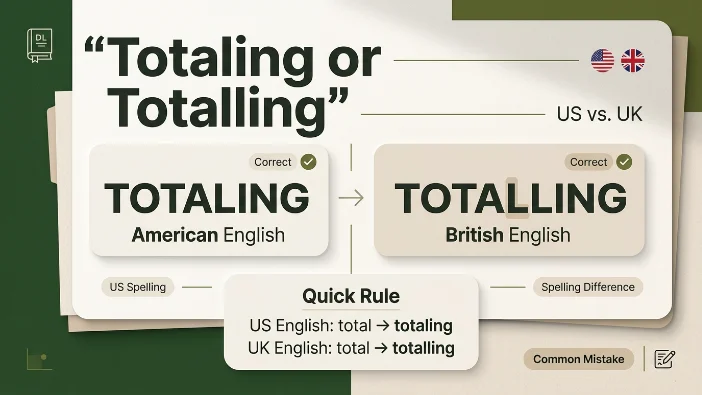
Totaling and totalling are both correct the choice depends on your English variety. American English uses totaling (one “L”), while British, Australian, and Canadian English use totalling (two “L”s). Neither spelling is a grammar mistake; it’s simply a regional spelling rule tied to how each dialect handles verbs ending in a single consonant after a short vowel.
Wondering whether totaling or totalling is the correct spelling? Both forms are correct, but the preferred spelling depends on which variety of English you use. Totaling is standard in American English, while totalling is more common in British English and other varieties that follow British spelling conventions.
Understanding the difference between totaling or totalling can help you choose the right form for your audience and maintain consistent spelling. In this guide, we’ll explain when to use each version with simple examples so you can write with confidence.
Why This Word Trips People Up
You’re writing an invoice, a report, or maybe a college essay, and you type “the expenses are totaling $4,200.” Then spellcheck underlines it. Or maybe it’s the opposite you write “totalling,” and autocorrect quietly changes it to “totaling” without asking. Now you’re wondering which one you actually got wrong.
Here’s the honest answer: you probably didn’t get anything wrong. This isn’t a case of one word being correct and the other being a typo, the way “definately” is simply wrong for “definitely.” Totaling and totalling are two accepted spellings of the same word, split along a very old and very consistent line American English on one side, British-based English on the other.
The confusion happens because most of us grow up seeing both spellings at different points in our lives. Maybe your school textbook used one version, your work software defaults to another, and a client email you received last week used a third variation you’d never even noticed before. Add in the fact that spellcheckers are often set to a specific regional dictionary, and you get a word that looks “wrong” no matter which version you pick, depending on whose screen you’re looking at.
By the end of this guide, you’ll know exactly which spelling to use depending on your audience, why English split into these two camps in the first place, and how to avoid looking inconsistent in professional writing which, frankly, matters more than most people realize when a document mixes both spellings by accident.
Totaling or Totalling: What’s the Difference?
The short answer: there is no difference in meaning, pronunciation, or grammar. The only difference is regional spelling convention.
Totaling is the American English spelling of the present participle (and gerund) form of the verb “total.” Totalling is the British English spelling of the exact same word. Both mean the same thing reaching a certain sum, amount, or overall figure, or (informally, especially in American usage) wrecking a vehicle beyond repair.
| Feature | Totaling (American) | Totalling (British) |
|---|---|---|
| Meaning | Adding up to a sum; summing | Adding up to a sum; summing |
| Part of Speech | Verb (present participle/gerund) | Verb (present participle/gerund) |
| Refers To | The act of reaching a total | The act of reaching a total |
| Typical Usage | US, and increasingly global business writing | UK, Australia, Canada, India, most Commonwealth countries |
| Example | “Sales are totaling $12,000 this quarter.” | “Sales are totalling £12,000 this quarter.” |
| Common Confusion | Assumed to be a misspelling of “totalling” | Assumed to be a misspelling of “totaling” |
Neither word is more “correct” in an absolute sense. Dictionaries on both sides of the Atlantic list their region’s version as standard. Oxford Dictionary lists “totalling” as the primary British form, while Merriam-Webster lists “totaling” as standard American usage. The real skill isn’t memorizing which one is right it’s knowing which one is right for the document you’re writing.
Is Totaling a Grammar, Vocabulary, or Usage Issue?
This is a spelling and usage issue, not a grammar issue in the traditional sense. Grammar concerns sentence structure word order, tense agreement, subject-verb agreement. Vocabulary concerns word choice picking the right word for the right meaning. What you’re dealing with here is neither of those. It’s a spelling convention that changes depending on regional dialect, similar to “color” versus “colour” or “traveling” versus “travelling.
Both words are fully interchangeable in meaning, so there’s never a situation where one is semantically correct and the other isn’t. What changes is appropriateness for context:
In formal English, consistency matters more than which specific spelling you pick. A legal contract, academic paper, or corporate report should stick to one regional standard throughout.
In business English, the correct choice usually depends on where your company or client is based. A US-based accounting firm should use “totaling.” A UK-based one should use “totalling.”
In academic writing, universities typically require the spelling convention of the country where the institution operates, or whatever style guide they’ve adopted (APA generally follows American spelling; many UK and Commonwealth universities expect British spelling regardless of style guide).
In everyday conversation, nobody will bat an eye either way, since the words sound identical when spoken.
The practical takeaway: pick your regional standard once, based on your audience, and apply it consistently through the entire piece of writing. Switching mid-document is the actual mistake not choosing “the wrong” spelling.
Totaling: The American Spelling Explained
Meaning: To add up to a specified sum, or to reach a certain amount when combined.
Part of speech: Verb, present participle/gerund form of “total” (base verb: to total; past tense: totaled).
Common collocations: totaling up, totaling more than, expenses totaling, sales totaling, a bill totaling, damages totaling.
Typical sentence pattern: [Subject] + is/are + totaling + [amount].
Here’s how it shows up across different real-life contexts:
Workplace example: “Can you send me the invoice totaling all three shipments before Friday’s meeting?”
Academic example: “The study surveyed 400 participants, with the control group totaling 210 respondents.”
Technology example: “The app is totaling your monthly spending automatically, so you won’t need to track receipts manually.”
Email example: “Attached is the updated budget, with projected costs totaling $18,750 for Q3.”
Daily conversation example: “I was totaling up the grocery bill in my head, and I think we’re over budget again.”
One learner mistake to avoid: Many non-native English speakers double the “L” out of habit, since most other “-ing” verbs that end in a single consonant after a short vowel (like “running” or “shopping”) do double the consonant in American English. But “total” ends in an unstressed syllable, and American spelling rules generally don’t double the final consonant in that situation hence “totaling,” not “totalling,” in the US.
Mini recap: In American English, stick to one “L.” Whether you’re writing a spreadsheet note, a business email, or a school report for a US audience, “totaling” is the form you want.
Totalling: The British Spelling Explained
Meaning: Identical to “totaling” to add up to a sum or reach a specific figure.
Part of speech: Verb, present participle/gerund form of “total” (base verb: to total; past tense: totalled).
Common collocations: totalling up, totalling more than, costs totalling, revenue totalling, figures totalling.
Typical sentence pattern: [Subject] + is/are + totalling + [amount].
Workplace example: “The finance team is totalling last quarter’s expenses before the board meeting on Monday.”
Academic example: “The dissertation reviewed sources totalling more than 60 academic journals.”
Technology example: “The software is totalling your data usage in real time, so you can track it throughout the billing cycle.”
Email example: “Please find enclosed the invoice, with charges totalling £2,340 for the month of March.”
Daily conversation example: “I’ve been totalling up how much we’ve spent on takeaways this month, and honestly, I don’t want to know.”
One learner mistake to avoid: Some writers who learned American English first drop the second “L” out of habit, even when writing for a UK, Australian, or Canadian audience. In British English, the general rule is that a single final consonant after a short vowel doubles before “-ing,” regardless of stress which is why “totalling” keeps the double “L,” unlike the American version.
Mini recap: If you’re writing for a UK, Australian, Canadian, Indian, or most Commonwealth audience, “totalling” with two “L”s is the expected spelling.
When Not to Use Each Word
Even though both spellings are technically correct depending on region, there are specific situations where using the “wrong” one creates real problems.
Mixing spellings within the same document. This is the single most common mistake. A report that uses “totaling” in paragraph two and “totalling” in paragraph five looks careless, even though each word is individually spelled correctly. Readers notice inconsistency far more than they notice which specific spelling convention you picked.
Writing for a client based in a different English-speaking region. If you’re a freelance writer in the US working for a UK-based client, defaulting to “totaling” without checking their style preferences can come across as a small but noticeable oversight, especially in polished business documents.
Academic submissions with a specified style guide. Some universities and journals explicitly require either American or British spelling, regardless of where the writer is from. Submitting the wrong regional spelling can flag your paper as inconsistent with formatting guidelines, even if the content is excellent.
Relying entirely on autocorrect without checking your settings. Many word processors default to whichever language pack was installed, not necessarily the one you intend to write in. Writers frequently discover mid-project that half their document uses one spelling and half uses another, purely because autocorrect quietly “fixed” some instances and missed others.
Legal and financial documents. Contracts, invoices, and financial statements often follow strict regional formatting standards. A US totaling error might seem trivial, but in formal financial documentation, consistency signals professionalism and reduces the appearance of a document being copy-pasted from multiple sources.
Marketing copy for a global audience. If your business serves both American and international customers, picking one spelling for your primary website copy (usually based on where your company is headquartered) and staying consistent avoids the appearance of a poorly localized, inconsistent brand voice.
International resumes and cover letters. If you’re applying for a job in the UK but you learned English primarily through American media or schooling, switching to British spelling conventions for that specific application shows attention to detail that recruiters do notice.
Common Mistakes Table
| Correct Sentence | Incorrect Sentence | Explanation |
|---|---|---|
| “The report shows sales totaling $50,000 this month.” (US) | “The report shows sales totalling $50,000 this month.” (mixed with US currency/context) | Mixing British spelling with clearly American context creates an inconsistent tone. |
| “Our costs are totalling £3,200 for the quarter.” (UK) | “Our costs are totaling £3,200 for the quarter.” (mixed with UK currency/context) | Using American spelling in a British business document breaks regional consistency. |
| “Damages totaled $1,200 after the accident.” (US, past tense) | “Damages totalled $1,200 after the accident.” in a US legal filing | US legal writing should consistently use single-L past tense (“totaled”), not the British double-L form. |
| “The final tally, totalling 312 votes, was announced Friday.” (UK) | “The final tally, totaling 312 votes, was announced Friday.” in a UK parliamentary report | UK official documents typically require British spelling conventions throughout. |
| “Expenses are totaling more than expected this year.” | “Expenses are totalling more then expected this year.” | Unrelated but frequent companion error: confusing “then” (time) with “than” (comparison). |
Decision Box
- If you’re writing for an American audience US clients, US-based companies, US academic institutions use totaling.
- If you’re writing for a British, Australian, Canadian, or most Commonwealth audience, use totalling.
- If you’re not sure who your audience is, check what spelling convention the rest of the document already uses, and match it. Consistency always wins over guessing.
Totaling and Totalling in Real-World Situations
Office communication: A project manager in New York emails their team: “Current project costs are totaling $84,000, which puts us slightly over budget.” Their counterpart in London, replying to the same thread, writes: “Understood I’ll have the totalling for the UK portion sent over by Thursday.” Neither is wrong; they’re simply following their own regional norms within the same conversation.
Business email: An American consultant sending an invoice to a US-based client writes, “Please find attached the invoice totaling $6,500 for services rendered in June.” The phrasing is standard, professional, and expected.
School or university: A UK university lecturer grading essays notes in feedback: “Your citation count is strong, totalling 24 references well above the minimum requirement.” American students studying abroad in the UK often need to adjust their default spelling to match their new academic environment.
Customer support: A support agent for a US software company writes in a resolution email, “Your account credits are now totaling $45, which will automatically apply to your next invoice.” Support scripts and templates typically follow the company’s home-country spelling standard.
Technology: A budgeting app built by a Canadian company might default to British-style spelling, showing users a notification that reads, “Your monthly subscriptions are totalling $89.99.” If the same app is localized for the US market, that same notification often gets rewritten as “totaling.”
Artificial Intelligence: AI writing tools and grammar checkers usually let you select a regional dialect (US, UK, Australian, Canadian) precisely because words like this one change spelling depending on your setting. If your AI-generated content keeps flip-flopping between “totaling” and “totalling,” it’s worth checking your language settings before you keep editing manually.
Daily conversation: Two friends texting about splitting a dinner bill might write, “our order’s totaling like $60 with tip” without a second thought informal, spoken-style writing rarely triggers this kind of regional scrutiny.
Totaling in Modern Technology
Modern software has made this spelling issue more visible than it used to be, mostly because so many tools now let users pick a regional dictionary.
Artificial intelligence and writing assistants typically default to American English unless a user manually switches settings, which means many non-US writers end up seeing “totaling” recommended even when “totalling” would be correct for their region.
Virtual assistants and voice assistants, like Siri or Google Assistant, don’t run into this issue directly since spoken language doesn’t reveal spelling but when these assistants transcribe speech into text (for example, dictating a note that says “expenses totaling two hundred dollars”), the output spelling depends on the device’s regional language setting, not the speaker’s accent.
Chatbots built for customer service often need explicit configuration to match a company’s regional spelling standard. A poorly configured chatbot serving both US and UK customers might inconsistently use both spellings across different conversations, which can look unpolished in transcripts or saved chat logs.
Software and business tools accounting platforms, invoicing systems, project management dashboards frequently allow users to toggle between US and UK English specifically because financial figures and totals appear so often in these tools. Getting this setting right early on saves a lot of manual correction later.
Business tools used by international teams often standardize on one spelling in their internal style guide, regardless of where individual employees are located, simply to keep shared documents, dashboards, and reports consistent.
Word Origin
Both spellings trace back to the same root: the Latin totalis, meaning “entire” or “complete,” which entered English through French in the late Middle Ages as “total.” The verb form to total, meaning to add up or amount to a certain sum developed centuries later.
The spelling split itself isn’t really about this specific word at all. It comes from a broader 19th-century divergence in English spelling conventions, largely shaped by Noah Webster’s efforts to simplify and standardize American English. Webster’s dictionaries generally avoided doubling a final consonant before “-ing” or “-ed” when the last syllable wasn’t stressed, which is why American English gives us “totaling,” “traveling,” and “canceling,” while British English keeps the doubled consonant in “totalling,” “travelling,” and “cancelling.
Expert Insight
Here’s something worth remembering the next time you second-guess yourself over this word: spelling variants like totaling and totalling aren’t a sign that English is broken or inconsistent they’re a sign that English adapted differently as it spread across different countries and cultures. When you’re teaching or learning this rule, it helps to stop thinking of it as “one correct answer with one exception” and instead think of it as “two correct systems, and you need to know which one your reader expects.” Once you frame it that way, the anxiety around picking the “wrong” spelling tends to disappear, because you’re no longer choosing between right and wrong you’re choosing between two audiences.
Error Prevention Checklist
- Always use totaling when writing for an American audience, US-based company, or American academic institution.
- Always use totalling when writing for a British, Australian, Canadian, or Commonwealth audience.
- Never confuse them if you remember this: fewer letters, US spelling American English generally trims extra letters compared to British English (color/colour, totaling/totalling).
- Quick memory tip: think of “totaling” as “trimmed” for American English, and “totalling” as keeping its “tall double L” for British English.
Related Grammar Confusions
Traveling vs. Travelling Follows the exact same American-versus-British spelling rule as totaling and totalling.
Canceling vs. Cancelling Another consonant-doubling difference worth learning if you often write for international audiences.
Color vs. Colour One of the most well-known American-British spelling splits, useful for understanding the broader pattern.
Realize vs. Realise A common “-ize” versus “-ise” difference that trips up many learners switching between English dialects.
Practice vs. Practise In British English, this pair splits by part of speech (noun vs. verb), unlike totaling, which is a pure regional spelling difference.
Modeling vs. Modelling Follows the same single-versus-double-L pattern, especially relevant in creative and technical writing.
Labeled vs. Labelled Another consonant-doubling pair that often confuses writers switching between American and British style guides.
Center vs. Centre A useful comparison for understanding how word endings differ between American and British spelling.
Total vs. Totally Worth reviewing separately, since learners sometimes confuse the adjective, verb, and adverb forms of “total.”
Amounting to vs. Totaling A useful vocabulary comparison for writers who want more variety when describing sums and figures.
FAQs
Is “totaling” or “totalling” correct in American English?
Totaling is the standard American spelling. It uses one l before -ing, following the usual US spelling convention for this word. American English writes the verb as totaling, while British English generally prefers totalling.
Is “totalling” correct in British English?
Yes. Totalling is the standard form in British English and is also common in Australian, Canadian, and other Commonwealth varieties. The doubled l reflects the spelling convention used in these forms of English.
Can I use both spellings in the same document?
It’s best to choose one spelling and stick with it. Both totaling and totalling are correct within their respective regional standards, but switching between them can make your writing appear inconsistent. Follow the style appropriate for your audience.
Does Microsoft Word tell me which spelling to use?
Usually, yes. Microsoft Word checks spelling according to the language or regional variety selected in its settings. If your document is set to English (US), it will generally prefer totaling. With English (UK) selected, totalling will normally be recognized as the preferred form.
Is “totaled” or “totalled” correct for the past tense?
Both forms are correct, depending on the variety of English. American English uses totaled, while British English uses totalled. The same regional distinction applies to totaling and totalling.
Why does “total” behave differently from words like “running” and “stopping”?
The difference comes from how consonant doubling is applied across English spelling systems. Words such as running and stopping double the final consonant because of their spelling and stress patterns. With total, the final syllable is unstressed. American English therefore keeps one l, while British English commonly doubles it before -ing and -ed.
Conclusion
The difference between totaling and totalling comes down to one thing: geography, not grammar. American English keeps a single “L,” while British, Australian, and Canadian English double it and both are fully correct within their own regional context. The real mistake isn’t picking one over the other; it’s mixing them within the same piece of writing or ignoring your audience’s expected spelling convention.
Next time you’re not sure which one to use, ask yourself who you’re writing for. If it’s a US audience, go with “totaling.” If it’s a UK, Australian, or Canadian audience, go with “totalling.” Stay consistent, match your reader’s expectations, and this small spelling choice will stop being a source of second-guessing.
7 thoughts on “Totaling or Totalling | American vs British English In 2026”