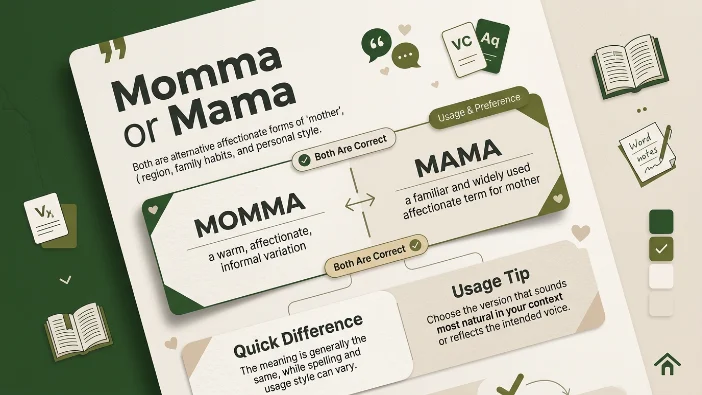
Quick Answer
The terms “momma” and “mama” both refer to a mother or female parent in informal English. While “mama” is the older, more historically established spelling with universal roots in baby talk, “momma” is a variant that emerged in the 19th century and is predominantly an American English spelling. Both words are synonyms and perfectly correct to use; the choice is purely a matter of regional preference, personal style, or the spelling you were raised with .
If you are an English learner or a writer, you might have paused mid-sentence, wondering whether to use “momma” or “mama.” Both terms feel comforting and familiar, and you know they both refer to “mother,” but the spelling difference can cause hesitation. It’s a common point of confusion, and using the “wrong” spelling for your audience might look like a typo to a native reader.
This guide will clear up the confusion once and for all. We will explore the subtle history and usage patterns of these two words so that you can confidently choose the right one for your context. By the end, you’ll understand the nuances behind these nearly identical terms.
What’s the Difference Between Momma and Mama?
At their core, there is no fundamental difference between “momma” and “mama.” Both are informal, affectionate nouns used to address or refer to one’s mother . However, while they are synonyms, they have different histories and are used with varying frequency across different regions and cultures. Understanding this background will help you choose the spelling that feels most natural and appropriate for your specific situation.
The core difference is that “mama” is the older, more universal term. It is a direct representation of the first sounds a baby makes (ma-ma) and appears in some form across nearly every Indo-European language . The word “momma,” on the other hand, is a 19th-century American English variant that was a broader pronunciation of “mama” . So, while they mean the same thing, “mama” has a more ancient and global feel, whereas “momma” feels distinctly American. Ultimately, spelling it one way or the other is a matter of habit, family tradition, or stylistic choice. For instance, someone might write, “My mama taught me how to cook,” while another might say, “I got this from my momma‘s recipe book.” The sentiment is identical.
Is Momma vs. Mama a Grammar, Vocabulary, or Usage Issue?
This distinction is not a matter of grammar or vocabulary, but strictly a matter of usage and spelling preference.
- Grammar: Neither word affects the grammatical structure of a sentence. Both function identically as common nouns. You can use them interchangeably: “My momma is here” and “My mama is here” are both grammatically perfect sentences.
- Vocabulary: Both words mean the same thing and are part of the informal English vocabulary. They are synonyms, so choosing one over the other doesn’t introduce a new or different concept .
- Usage: The difference comes down to usage conventions. “Mama” is the more universally recognized spelling, often associated with a child’s first word and used across many cultures . “Momma” is an alternative form that is particularly common in the United States . They are both correct, but which one you use depends on regional norms or personal preference. It’s important to note that using the wrong word won’t cause a major communication breakdown. It is a very minor stylistic choice that will not confuse a native English speaker.
Key Takeaway: You don’t need to worry about grammar or vocabulary rules here. Your choice is a social and stylistic one. It’s about fitting in with your audience’s expectations.
The Individual Word Guide
To help you decide which spelling to use, let’s look at each word individually, exploring its specific nuances and common uses. This detailed guide will give you a practical feel for how each word is used in the real world.
MAMA
Meaning: An informal word for mother . It is often a child’s first word and is used to express affection or closeness.
- Pronunciation: MAH-muh.
- Part of Speech: Noun.
- Common Collocations:
- “Mama bear”: A protective mother.
- “Mama’s boy”: A man who is excessively attached to his mother.
- “Mama and papa”: Refers to one’s parents.
- Typical Sentence Patterns:
- “My mama always told me to be polite.”
- “I’m going to call my mama tonight.”
- “It’s a family recipe from Mama.”
- Real-world examples:
- Workplace Example: “Even though I’m a senior executive, I’m still my mama’s daughter.” (Personal, humorous)
- Academic Example: “In her research, Dr. Smith notes that ‘mama’ appears as a child’s first word in various cultures.” (Direct quote)
- Technology Example: “With voice assistants, you can train them to recognize ‘Mama’ as a voice command to call your mother.” (A new, creative usage)
- Email Example: “Subject: Please call Mama. Hi Tom, just a reminder to call your mama—it’s her birthday tomorrow.” (Informal, personal)
- Daily Conversation Example: “What time is your mama picking you up from school?”
- One Learner Mistake: A common mistake is to think “mama” is less correct or childish. It is a perfectly respectable and widely used form in many English-speaking regions. Using it in a professional environment would be too informal. It would be better to use a phrase like “my mother” in a professional context.
- Mini Recap: “Mama” is the classic, universal, and very common spelling for “mother.” It is particularly strong in southern US culture and in many other languages around the world . It can also be used as a term of endearment for an attractive woman or one’s wife in some slang contexts .
MOMMA
Meaning: An informal American English word for mother, synonymous with “mama” .
- Pronunciation: MAH-muh.
- Part of Speech: Noun.
- Common Collocations:
- “Big momma”: A slang term for a large, motherly woman.
- “Whoa, momma!”: An exclamation of surprise or admiration .
- “My momma said…”: A classic way to start a sentence when quoting one’s mother.
- Typical Sentence Patterns:
- “My momma is the strongest person I know.”
- “You better listen to your momma.”
- “Don’t make me call your momma.”
- Real-world Examples:
- Workplace Example: “In the team meeting, John joked, ‘My momma didn’t raise no quitter!’ to boost morale.” (A lighthearted moment)
- Academic Example: “The 19th-century diary entries reveal that the children consistently referred to their mother as ‘momma’.” (A style choice in academic writing)
- Technology Example: “The internet’s ‘Yo Momma’ joke format has been a staple of online humor for decades.” (Pop culture reference)
- Email Example: “Hi momma! Just wanted to say I love you and I’ll be home for the holidays.” (A common way to start an email to one’s mother)
- Daily Conversation Example: “Momma always makes the best fried chicken.”
- One Learner Mistake: A common mistake is to assume “momma” is a misspelling of “mama” or “mommy.” However, it is a completely legitimate and established spelling in its own right. While “mommy” might be more common in some parts of the US, “momma” is a widespread and recognized alternative . It may be considered slightly more informal than “mama,” but both are very informal.
- Mini Recap: “Momma” is a distinctly American variant of “mama” that emerged in the early 19th century . It is a staple in Southern US dialects and has found its way into popular culture, often adding a folksy, affectionate, or humorous tone.
When Not to Use Each Word
Choosing the wrong word here won’t ruin a sentence, but understanding the subtle contextual cues can help you sound more natural. Here are a few situations where one spelling is often preferred.
- When writing for an international audience: Use mama. Because of its universality, “mama” is recognized and understood around the world. “Momma” might confuse or look strange to a reader from the UK or Australia who is more used to “mum” or “mummy” .
- When aiming for a classic, timeless tone: Choose mama. It has ancient roots and feels more traditional and established.
- When writing in a more formal context: Avoid both. In business letters, academic papers, or formal emails, using the word “mother” is always the safest and most professional choice.
- When writing in a distinctly American, folksy style: Use momma. It can add a layer of authenticity, warmth, and regional character to your writing .
- When you are using a direct quote or addressing a specific individual: Always use the spelling the person uses. If your mother signs her cards “Momma,” then use “Momma.”
- When writing in a language other than English: Stick to the word from that language. “Mama” is the spelling used in many languages like Spanish or German , but “momma” is strictly an English variant.
Common Mistakes Comparison Table
Decision Box: Quick Guide
- If you mean the female parent in a universal, global context, use Mama.
- If you mean the female parent and you are writing in American English or want a folksy, Southern feel, use Momma.
- Remember: the difference is one of usage and personal style, not of meaning.
Real-World Examples of Usage
Let’s look at how these words fit into various real-world scenarios. This will help you see the small but meaningful difference in their usage.
- Office Communication: “Hey team, does anyone know how to fix this printer? My mama is a tech whiz, but she’s not here to help.” (A lighthearted, informal comment).
- Business Email: “Dear Mr. Jones, thank you for your prompt reply. My mother will be delighted with the news.” (Both “mama” and “momma” are too informal here).
- School or University: “Professor, my mama always said, ‘If you’re going to do something, do it right.’ So I’m going to redo my entire project.” (A personal, slightly informal statement in a casual setting).
- Customer Support: “The customer, an elderly woman, kept calling her daughter mama, which threw off the young support agent.” (Here, “mama” is used to describe a cultural or generational speech pattern).
- Technology: “The ‘Always On’ feature in smart speakers means you can say ‘Hey Momma‘ to get a response, which is more natural for some users.” (A creative, custom use of the term).
- Daily Conversation: “I’m going to visit my momma for the weekend.”
Modern Technology and the Terms Momma and Mama
In the age of artificial intelligence and smart devices, our language is constantly evolving. Words like “momma” and “mama” are finding new life in how we interact with technology.
- Artificial Intelligence & Virtual Assistants: Companies are creating more personalized AI experiences. For example, you can change the “wake word” for your smart speaker. Some people choose “Mama” to make it feel more like a family member, especially in homes where English isn’t the primary language. This creates a more comfortable, familiar interaction.
- Customizable Chatbots: In business, a chatbot that provides customer support can be given a personality. A company might choose to have their bot use “momma” to convey a warm, motherly tone, appealing to certain demographics.
- Social Media Algorithms: The terms are also used in algorithms for content delivery. A user who frequently watches videos tagged with “momma” or “mama” might be served more family-oriented content. It’s a keyword that signals to the algorithm what kind of content you prefer.
Word Origin and Development
Exploring the word history can provide deeper insight into its meaning and proper usage. The story of “mama” and “momma” is a perfect example of how language evolves.
- Origin: The word “mama” dates back to the 1540s . It originates from the universal baby word ma-ma. This reduplication, or repeating of a sound, is common in many languages (e.g., papa, mama).
- Development: The word likely comes from a simple, instinctive sound babies make while feeding or babbling. This sound was then associated with the person who provides food and comfort: the mother.
- Modernization: The variant “momma” appeared much later, in the mid-19th century, specifically in American English . It was a broader, more colloquial pronunciation of “mama.” “Mamma” (with two ‘m’s) is another spelling variant that appeared around this time, which is closer to the Latin word mamma, meaning “breast” .
Expert Insight
As a seasoned language instructor, I often tell my students that the most important thing about language isn’t memorizing rigid, singular rules, but rather becoming aware of the subtle choices a writer makes. “Momma” or “mama”? It’s a fantastic example of this concept. It’s not a case of right or wrong, but a case of understanding the audience and context. If your aim is to write for a global audience, leaning toward “mama” is strategic. But if you’re writing dialogue for a character in the American South, “momma” will add a layer of authenticity. The key is in understanding these subtle differences.
Error Prevention Checklist
- Always use “mama” when:
- Writing for a global or non-American audience.
- You want to use the older, more established word.
- You are spelling the word as a child would.
- Always use “momma” when:
- You are writing in American English with a folksy or Southern tone.
- You are quoting a specific cultural reference (like a song).
- You are using it as an exclamation (“Whoa, momma!”).
- Never confuse them if:
- You know your audience. If you’re in the UK, “mama” is the most common spelling. In the US, either is acceptable .
- Quick memory tip: “Mama” is for the Mother of All Mankind—it’s a universal, ancient word. “Momma” adds an ‘o‘ for Oh-so-American style.
Related Grammar Confusions
Here are some other word pairs that often cause confusion for English learners and writers.
- Mom or Mum: Understanding the difference between American and British English.
- Mommy or Mummy: The casual or childlike forms for mother.
- Mother or Mumsy: Understanding formal and informal terms.
- Amoral or Immoral: Prefixes that completely change a word’s meaning.
- Grammer or Grammar: A common spelling mistake to avoid.
- Principal or Principle: Easily confused homophones with different meanings.
- Affect or Effect: A classic grammar headache.
- Imply or Infer: Understanding the speaker’s and listener’s roles.
- Who or Whom: Mastering object and subject pronouns.
FAQs
Is “momma” a real word or a misspelling?
Yes. Momma is a legitimate informal word for “mother,” particularly in American English. It is a variant of mama and is often associated with a warm, familiar, or affectionate tone.
Do Americans say “mama” or “momma”?
Americans use both mama and momma. The choice often depends on family preference, region, and personal style. Momma can have a more folksy or Southern feel, while mama is widely recognized and used across the United States.
Is “momma” or “mama” more grammatically correct?
Neither is more grammatically correct. Mama and momma are both nouns used informally to refer to a mother. The difference is primarily one of spelling, usage, and regional preference rather than grammar.
Is “momma” used in British English?
Momma is primarily associated with American English and is not the usual British term for mother. In British English, mum and mummy are much more common. Mama can appear in British English, but it may sound less typical depending on the context.
What is the slang meaning of “mama”?
In some informal contexts, mama can refer to an attractive or confident woman, a wife, or a woman being addressed affectionately. The exact meaning depends heavily on the speaker, relationship, and context, so it can sound playful, affectionate, or old-fashioned.
Conclusion
In the end, choosing between “momma” and “mama” is a matter of your personal or regional preference. Both terms are correct and loving ways to refer to one’s mother. “Mama” is the more universal, older word, while “momma” is a distinct American variant. Remembering this simple distinction will allow you to choose the right term for your audience, adding a sense of authenticity and style to your writing.
The most practical rule you can follow is this: consider who you are writing for. Is your reader in the US? If so, both are fine. Is your reader international? Then stick with “mama.” Ultimately, the message of love and respect behind the word is what truly matters.
1 thought on “Momma or Mama | Sweet Difference Between These Two Words In 2026”