Quick Answer
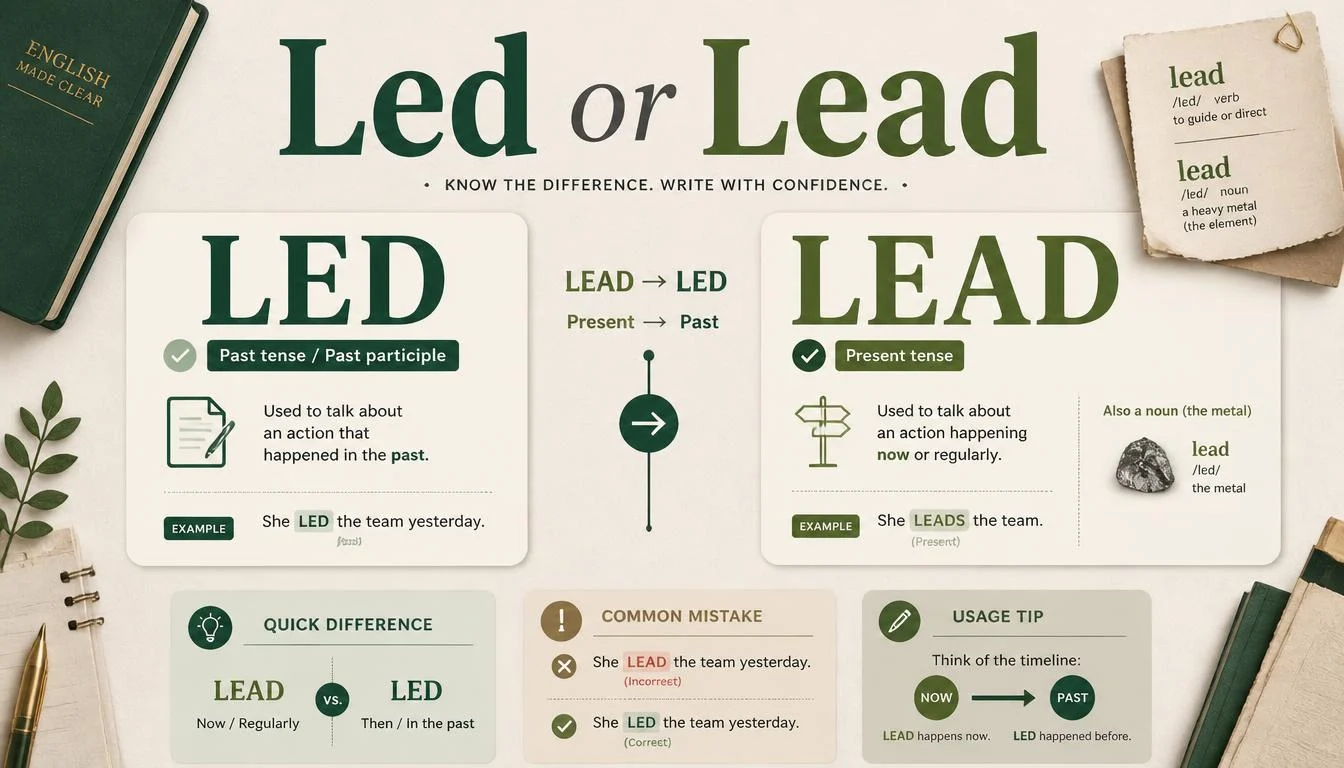
Use lead when talking about the present tense verb (to guide) or the metal element. Use led as the past tense and past participle of “to lead.” The confusion happens because “lead” (the metal) rhymes with “led,” while “lead” (the verb) rhymes with “seed.” When you’re describing something that already happened, the correct word is almost always led, not lead.
Confused about Led or Lead? These two words look closely related, but they have different meanings, pronunciations, and grammatical uses. Understanding the difference can help you avoid common spelling and pronunciation mistakes in everyday and professional writing.
The confusion often comes from the fact that lead can be pronounced in two different ways, while led is always pronounced the same way. In this guide, we’ll explain when to use each word with simple examples and practical tips.
Why This Mix-Up Happens So Often
You’re reading a report, an email, or a school essay, and you land on the sentence “She lead the meeting yesterday.” Something feels off, but you can’t quite name it. That hesitation is normal, and it happens to native speakers just as often as it happens to English learners.
The problem isn’t really about meaning. Most people already know that lead can mean “to guide” and that led describes something that happened in the past. The real issue is pronunciation. English spelling doesn’t always match sound, and lead is one of the clearest examples of that mismatch. The word lead can rhyme with “seed” or with “bed,” depending entirely on which meaning you intend. Led only ever rhymes with “bed.” That single fact is the root of almost every mistake people make with these two words.
Getting this wrong doesn’t just look careless on a resume or a business email. It can genuinely confuse a reader for a split second, especially in technical or formal writing where past and present actions need to be clear. This guide walks through the difference in plain language, shows you exactly when each word belongs, and gives you a few memory tricks that actually stick.
Led or Lead: What’s the Difference?
The short version: lead is a present tense verb (and also a metal), while led is strictly the past tense and past participle of that verb.
Lead, when used as a verb, describes an action happening now or in general “I lead a team of six people.” It’s also a noun referring to the dense metallic element used in batteries, pipes, and old paint. Led has only one job: it shows that the action of leading already took place “I led a team of six people last year.”
Here’s a side-by-side breakdown that makes the distinction easier to hold onto.
| Meaning | Part of Speech | Refers To | Typical Usage | Example | Common Confusion |
|---|---|---|---|---|---|
| To guide or direct (present) | Verb | An action happening now or generally | “Lead the discussion” | She leads the sales team. | Written as “lead” in past-tense sentences |
| Past tense/participle of “lead” | Verb | An action that already happened | “Led the discussion” | She led the sales team last quarter. | Misspelled as “lead” |
| A heavy metal | Noun | A physical element (Pb) | “Lead pipes,” “lead paint” | The old house still had lead pipes. | Confused with the verb “lead” |
Once you separate the timeline (present vs. past) from the object (the metal), the fog usually clears. Lead handles two very different jobs depending on context, while led has exactly one function and never changes.
Is Led or Lead a Grammar, Vocabulary, or Usage Issue?
This is primarily a vocabulary and spelling issue, not a grammar rule in the traditional sense. Both words follow standard verb conjugation patterns the trouble is that lead is an irregular verb, and its past tense doesn’t follow the usual “add -ed” pattern you’d expect.
Regular verbs like “walk” become “walked.” Lead doesn’t play by that rule. Instead of becoming “leaded,” it becomes led, a completely different spelling that happens to sound exactly like the metal. That irregularity, combined with the metal-noun coincidence, is what makes this pair genuinely tricky rather than just a typo people make out of laziness.
These two words are never interchangeable, in any register. Formal English, business writing, academic papers, and casual conversation all follow the same rule: present tense and general truths use lead, and past actions use led. There’s no context not even the most relaxed text message where swapping them is considered correct.
The one practical takeaway to hold onto: if you can replace the word with “guided” or “directed” and the sentence still makes sense in the past tense, you need led. If the sentence describes something happening now, you need lead.
Understanding “Lead” (The Verb and the Metal)
Lead is pronounced two different ways depending on meaning. As a verb, it rhymes with “seed” (/liːd/). As a noun referring to the metal, it rhymes with “bed” (/lɛd/) which is exactly why people confuse it with led in writing.
As a verb, lead means to guide, direct, or be in charge of something. It’s commonly paired with words like team, project, discussion, and initiative. As a noun, lead refers to the metallic element, but it also shows up in phrases like “a dog’s lead” (British English for leash) or “the lead in a play” (the main role).
Workplace example: “Maria will lead the onboarding process for new hires starting next month.”
Academic example: “The professor asked one student to lead the seminar discussion each week.”
Technology example: “Our product manager leads the sprint planning meeting every Monday.”
Email example: “Please lead the client call tomorrow since I’ll be traveling.”
Daily conversation example: “He always leads when we go hiking because he knows the trail.”
A common learner mistake is writing “She lead the project last year” instead of “She led the project last year.” The verb tense signals that the project is finished, so the past form is required.
Mini recap: Lead is your go-to word for anything happening now, anything general, or anything referring to the metal itself.
Understanding “Led” (Strictly Past Tense)
Led is the past tense and past participle of the verb lead, and it’s pronounced exactly like the metal /lɛd/. It has no other job. It’s never a noun, never a present tense verb, and never refers to anything metallic.
Because led is irregular, it doesn’t take the familiar “-ed” ending pattern the way regular verbs do. There’s no “leaded” in standard usage for this meaning, which sometimes throws off learners who are used to predictable conjugation.
Workplace example: “The new manager led the department through a difficult restructuring last spring.”
Academic example: “Her research led to a breakthrough in understanding soil erosion patterns.”
Technology example: “The engineering team led the migration to the new cloud platform in 2023.”
Email example: “Thank you for the update I heard you led the presentation beautifully.”
Daily conversation example: “That decision led us straight into an argument we didn’t need.”
A frequent mistake among learners is writing “The teacher have lead the class since 2010” instead of “The teacher has led the class since 2010.” Even in perfect tense constructions, led remains the correct past participle form.
Mini recap: Led always points backward in time. If you’re describing something that already happened, led is the only correct choice.
When Not to Use Each Word
Mistake 1: Using “lead” in past tense sentences. This happens because lead (the metal) already sounds like the correct past tense should sound. Writers hear /lɛd/ in their head and spell it “lead” instead of “led.” Remember: if the metal isn’t the topic, and the action already finished, you need led.
Mistake 2: Using “led” for present or future actions. Less common, but it happens when writers overcorrect after learning about this rule. “She will led the workshop” is incorrect future tense always pairs with lead, not led.
Mistake 3: Confusing “lead” the metal with “lead” the verb in the same sentence. For example, “The lead pipes lead to corrosion” is grammatically fine but visually confusing. Consider rewording for clarity, especially in technical writing.
Mistake 4: Writing “leaded” instead of “led” for the verb meaning. Leaded does exist as a word, but only in specific contexts like “leaded gasoline” or “leaded glass,” referring to something containing lead the metal. It is never the past tense of the verb.
Mistake 5: Assuming British and American English differ here. They don’t. Both dialects use led as the past tense across every register.
Mistake 6: Autocorrect silently swapping the word. Some spell-checkers won’t flag “lead” in a past-tense sentence because lead is a real word. This is one of the few grammar errors that slips past basic spell-check entirely, so proofreading by eye matters more here than usual.
Mistake 7: Overthinking simple sentences. When in doubt, say the sentence out loud and ask whether you’re describing something happening now or something finished. That single question resolves almost every case.
Common Mistakes Table
| Correct Sentence | Incorrect Sentence | Explanation |
|---|---|---|
| She led the team to victory last season. | She lead the team to victory last season. | Past action requires “led,” not “lead.” |
| He leads the finance department this year. | He led the finance department this year. | Ongoing, present-tense role uses “lead.” |
| The pipes were made of lead. | The pipes were made of led. | The metal is always spelled “lead,” never “led.” |
| Her advice led me to change my career. | Her advice lead me to change my career. | Completed past action needs “led.” |
| The coach will lead practice tomorrow. | The coach will led practice tomorrow. | Future tense pairs with “lead,” never “led.” |
Quick Decision Box
If you’re describing something happening now or in general, use lead. If you’re describing something that already happened, use led. If you’re talking about the metal, it’s always lead even though it sounds like “led.”
Say the sentence out loud. If it sounds like “bed” and describes a finished action, write led. If it sounds like “seed,” write lead.
Real-World Examples of Led or Lead in Action
Office communication: “Can you lead tomorrow’s stand-up? I led it last week and want to rotate the responsibility.”
Business email: “Following up on the project you led in March the client mentioned it was one of the smoothest rollouts they’ve seen.”
School or university: “The debate club president leads weekly practice sessions, but a guest speaker led last Thursday’s session.”
Customer support: “Our support lead handled the escalation, and her calm approach led to a quick resolution.”
Technology: “The DevOps team lead approved the deployment after their testing led to zero critical bugs.”
Artificial Intelligence: “The AI model’s training data led to biased outputs, which is why the new lead engineer is retraining it from scratch.”
Daily conversation: “That shortcut you mentioned actually led us to a dead end, so next time I’ll lead the way.”
Led or Lead in Modern Technology
In tech and AI contexts, both words show up constantly, usually without much confusion once you’re paying attention to tense. Job titles frequently use lead as a noun “team lead,” “tech lead,” “product lead” describing a role rather than an action. That’s a separate but related use worth noting, since it’s neither the metal nor a conjugated verb; it functions as a title, similar to “manager” or “director.”
Virtual assistants and chatbots are typically described using the verb form: “This assistant leads users through the setup process step by step.” When developers explain what already happened during testing or deployment, led takes over: “The update led to a 20 percent improvement in response time.”
Voice assistants and AI systems don’t have trouble with this distinction internally, since context resolves it easily for a language model. But for human writers documenting software changelogs, release notes, or AI training summaries, mixing up lead and led is one of the more common small errors that slips into technical documentation.
Where “Lead” and “Led” Come From
Both words trace back to Old English. The verb comes from lædan, meaning “to guide” or “to cause to go with one,” while led developed as its irregular past form through natural sound changes over centuries. The metal lead comes from a separate Old English word, lead, referring to the element itself a coincidence of sound rather than a shared origin.
This separate history explains why the metal and the past-tense verb ended up sounding identical despite having nothing to do with each other. It’s simply an accident of language evolution, not a deliberate design choice, though it’s created a permanent trap for writers ever since.
Expert Insight
When I taught English composition, I noticed that even strong writers who rarely made grammar mistakes would slip on lead and led specifically in cover letters and resumes often in the very sentence meant to showcase their leadership experience. The fix I gave students was simple: read your sentence and ask, “Is this happening now, or did it already happen?” That question, asked out loud, resolves the confusion faster than memorizing any rule. Muscle memory builds once you catch yourself doing it a few times, and after that, the correct word starts to feel automatic rather than something you have to calculate.
Error Prevention Checklist
- Always use lead when describing a current or general action, a future action, or the metal element.
- Always use led when describing a completed, past action including in perfect tenses like “has led” or “had led.”
- Never confuse them if you remember that led rhymes with “bed” and only ever refers to the past.
- Quick memory tip: “Today I lead, yesterday I led” say it as a mini rhyme and the pattern locks in.
Related Grammar Confusions Worth Learning
- Read vs. Read (past tense): Spelled identically but pronounced differently depending on tense, much like lead and led in reverse.
- Bear vs. Bare: Homophones that trip up writers in formal documents and casual texts alike.
- Affect vs. Effect: One of the most searched grammar confusions in English, with a similar cause-and-result pattern.
- Lose vs. Loose: A spelling mix-up rather than a tense issue, but equally common in everyday writing.
- Its vs. It’s: A punctuation-driven confusion that changes meaning entirely.
- Then vs. Than: Two small words with completely different grammatical jobs.
- Advice vs. Advise: A noun-verb pair similar in structure to lead and led.
- Complement vs. Compliment: Spelling twins with very different meanings.
- Principal vs. Principle: Frequently confused in academic and business writing.
- Farther vs. Further: A subtle distinction between physical and figurative distance.
FAQs
Is it “led” or “lead” in the past tense?
The correct past tense of lead is always led. Lead is used as the present tense verb, while led describes an action that has already happened. Using “lead” for a completed action is a common English spelling mistake.
Why does “lead” the metal sound like “led”?
The word lead, when referring to the metal, is pronounced like “led.” It comes from a different linguistic origin than the present tense verb lead, which has a different pronunciation. The identical spelling but different pronunciation can make these words confusing.
Is “leaded” ever correct?
Yes, leaded can be correct in specific contexts, such as “leaded glass” or “leaded gasoline,” where it refers to something containing the metal lead. However, leaded is not the past tense of the verb lead. The correct past tense is led.
Can “lead” and “led” ever be used interchangeably?
No. Lead and led have different grammatical functions and cannot be used interchangeably. Lead is the present tense form of the verb, while led is its past tense and past participle form.
How do I remember the difference between lead and led quickly?
A simple way to remember the difference is: “Today I lead, yesterday I led.” Use lead when the action is happening now or is generally true. Use led when the action has already happened.
Is “lead” a noun or a verb?
Lead can function as both a noun and a verb. As a verb, it means to guide, direct, or be in charge. As a noun, it can refer to the metal, a leash in British English, or a starring or primary role, depending on the context.
Conclusion
The difference between led and lead comes down to timing, not meaning. Lead handles the present, the future, and the metal. Led handles the past full stop. Once that timeline clicks into place, the confusion tends to disappear for good.
If you ever catch yourself hesitating mid-sentence, ask whether the action already happened. If it did, reach for led. That one habit will save you from one of the most common small errors in professional and academic writing.
Read More Related Articles:
- Lier or Liar | Easy Way to Get This Word Right In 2026
- Layed or Laid | Stop Making This Common Spelling Mistake In 2026
- Ballon or Balloon | Avoid This Common Spelling Error In 2026

Lucas Mitchell is a content writer at synoseek.com. He writes simple, thoughtful pieces that focus on everyday ideas, observations and general knowledge topics. His work is shaped by a calm, realistic tone that keeps the reader engaged without overstatement.
11 thoughts on “Led or Lead | Practical Guide to Using Both Words Correctly In 2026”