Quick Answer
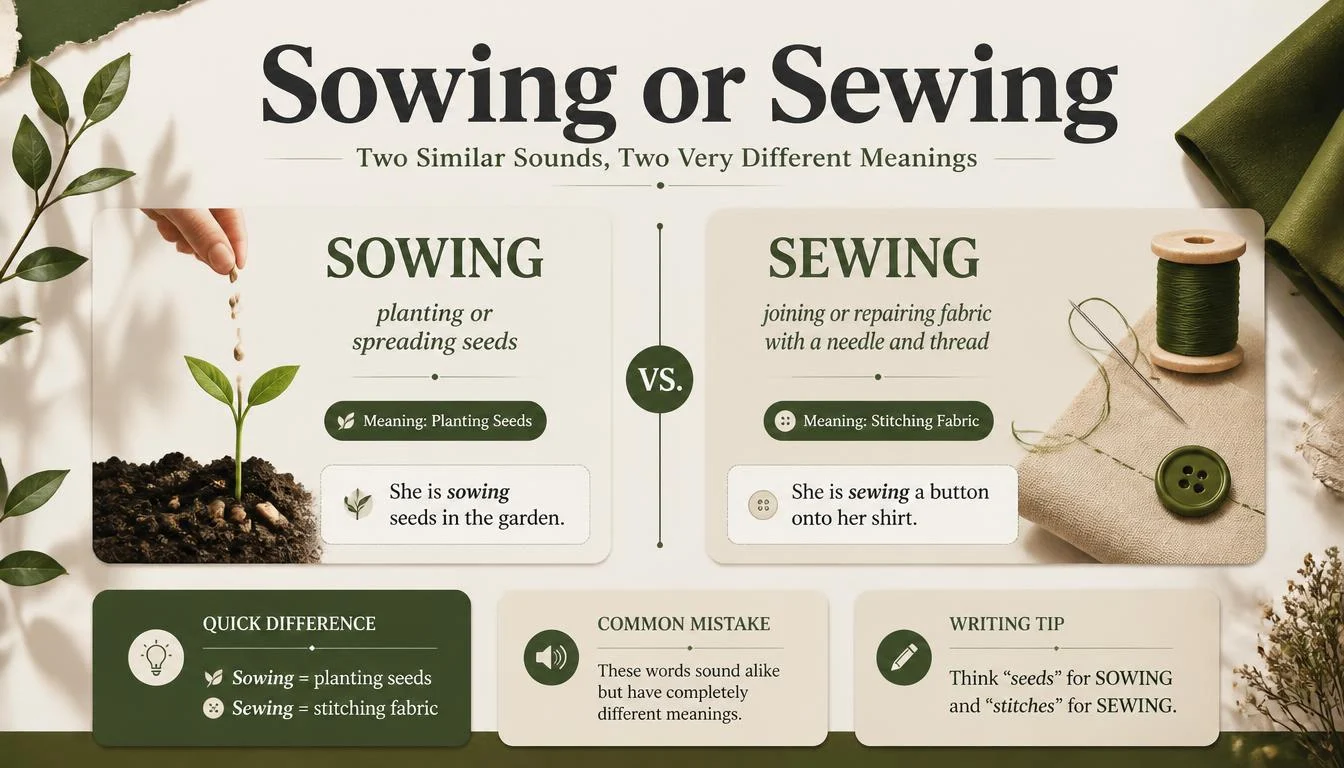
Sowing refers to planting seeds in soil for growth, while sewing involves stitching fabric or materials together using a needle and thread. Though they sound identical in speech, these words have entirely different meanings and applications. Understanding whether you mean sowing or sewing prevents embarrassing mix-ups in writing.
Have you ever written about planting a garden and accidentally told someone you were “sewing seeds”? Or perhaps you meant to describe mending a shirt but wrote about “sowing a button”? This confusion happens more often than you might think, and it’s not limited to English learners.
Sowing or sewing these two words sound exactly alike when spoken, which makes them perfect candidates for spelling confusion. But they belong to completely different worlds: one belongs in the garden, and the other belongs in the tailor’s shop. Using the wrong one doesn’t just create a spelling error; it changes your entire meaning.
This guide will help you understand the difference between sowing and sewing, explain why people mix them up, and give you practical ways to remember which word to use. Whether you’re writing a gardening blog, a fashion article, or just trying to communicate clearly, you’ll leave this guide confident about choosing the right word.
What’s the Difference Between Sowing and Sewing?
The difference comes down to what you’re working with and what tool you’re using.
Sowing means planting seeds. You’re working with soil, seeds, and the earth. When you sow, you scatter or place seeds in the ground so they can grow. The primary tool is your hand or a seed spreader. The result is plants, flowers, vegetables, or crops.
Sewing means stitching fabric. You’re working with cloth, thread, and a needle. When you sew, you use a needle and thread to join pieces of fabric together. The primary tool is a needle (handheld or part of a sewing machine). The result is clothing, curtains, quilts, or repairs.
| Sowing | Sewing | |
|---|---|---|
| Meaning | Planting seeds in soil | Stitching fabric with thread |
| Part of Speech | Verb | Verb |
| Refers To | Agriculture, gardening, farming | Clothing, textiles, crafts |
| Primary Tool | Hands, seed spreader, planter | Needle, thread, sewing machine |
| Typical Context | Farming, gardening, horticulture | Fashion, tailoring, crafts |
| Example | “I am sowing carrots in the garden.” | “I am sewing a dress for the party.” |
| Common Confusion | People confuse this with sewing because of the similar pronunciation. | People confuse this with sowing because of the similar pronunciation. |
While both words function as verbs, their meaning, objects, and tools couldn’t be more different. Sowing connects to the earth and growth, while sewing connects to fabric and creation.
Is This a Grammar, Vocabulary, or Usage Issue?
Understanding whether sowing or sewing is correct involves vocabulary knowledge rather than grammar rules. These words are not interchangeable, and there’s no grammar rule that dictates which one to use you simply must know the meaning of each.
Grammar Classification: Both words are regular verbs. Sowing follows the pattern sow, sowed, sown. Sewing follows sew, sewed, sewn. The grammar is identical, which adds to the confusion.
Vocabulary Difference: The words belong to completely different vocabulary categories. Sowing is agricultural terminology, while sewing belongs to textile and fashion vocabulary.
Usage Difference: You use these words in entirely different situations. You wouldn’t use sowing when discussing dressmaking, and you wouldn’t use sewing when discussing farming.
Are they interchangeable? Absolutely not. Using one in place of the other creates a clear error that readers will notice immediately.
Across Different Contexts
- Formal English: The distinction remains clear. Formal writing demands the correct word without exception.
- Business English: In professional communication, using the wrong word undermines credibility. A landscaping business discussing “sewing” would confuse clients.
- Academic Writing: The correct term matters, especially in agriculture courses, fashion design programs, and textile studies.
- Everyday Conversation: While speaking, the words sound the same, so spelling isn’t an issue. But in written communication texts, emails, social media the distinction becomes critical.
Practical Takeaway: This isn’t a grammar rule you need to memorize. It’s about knowing two different words that happen to sound the same. Remember: seeds get sown, fabric gets sewn.
Sowing: The Complete Guide
Meaning of Sowing
Sowing is the action of planting seeds. When you sow, you place or scatter seeds in the ground so they can grow. This is one of the first steps in gardening, farming, and agriculture. The word comes from the idea of casting or spreading seeds across prepared soil. You’re essentially putting seeds where they can take root and develop into plants.
Pronunciation
Sowing is pronounced exactly like “sewing” /ˈsoʊ.ɪŋ/. The “ow” makes the long “o” sound, similar to how you pronounce “go” or “show.” This identical pronunciation is the primary reason people confuse these two words in writing.
Part of Speech
Sowing is a verb. It’s the present participle of the verb “sow.” The full conjugation is:
- Sow (base form)
- Sows (third person singular)
- Sowing (present participle)
- Sowed (simple past)
- Sown (past participle)
Common Collocations
Agriculture and Gardening:
- Sowing seeds
- Sowing crops
- Sowing fields
- Sowing in rows
- Broadcast sowing
- Direct sowing
Metaphorical Uses:
- Sowing discord (creating trouble)
- Sowing doubt (causing uncertainty)
- Reap what you sow (experience the consequences of your actions)
- Sowing the seeds of something (beginning something that will develop)
Sentence Patterns
Sowing commonly appears in these patterns:
- [Subject] + [is/am/are] + sowing + [object] – “The farmer is sowing wheat.”
- [Subject] + [sowed/has sown] + [object] – “She sowed the pumpkin seeds yesterday.”
- [Subject] + [sow/sows] + [object] + [location] – “We sow tomatoes in the greenhouse.”
Example Sentences
Workplace Example:
“The agriculture team is sowing the new experimental corn variety in the eastern field to test its resistance to drought.”
Academic Example:
“Research shows that sowing cover crops improves soil health by preventing erosion and adding organic matter.”
Technology Example:
“The automated seed drill was sowing the fields at a rate of twenty acres per hour, controlled entirely by GPS.”
Email Example:
“Hi Sarah, we’ve finished sowing the spring vegetables. The lettuce and peas have been sown in the raised beds, and we’ll start the tomatoes next week.”
Daily Conversation Example:
“My grandmother taught me how to sow seeds by hand, making sure each one was spaced perfectly.”
One Common Mistake
Learners often think “sowing” might mean stitching because of the pronunciation. A student might say, “I need to sowing the button on my shirt,” which is incorrect. Remember that sowing never involves needles, thread, or fabric.
Mini Recap
Sowing is about planting seeds in soil. You’ll use this word when discussing gardening, farming, or any situation involving putting seeds into the ground.
Sewing: The Complete Guide
Meaning of Sewing
Sewing is the craft or action of stitching fabric together using a needle and thread. You sew when you’re making clothes, repairing tears, creating quilts, or doing any project that involves joining or repairing textiles. Sewing can be done by hand with a single needle and thread or using a sewing machine for faster, more precise stitching.
Pronunciation
Sewing is pronounced /ˈsoʊ.ɪŋ/ exactly the same as sowing. This homophone pair causes most of the confusion. The spelling is the only clue in writing, which is why this guide exists.
Part of Speech
Sewing is a verb. It’s the present participle of “sew.” The conjugation is:
- Sew (base form)
- Sews (third person singular)
- Sewing (present participle)
- Sewed (simple past)
- Sewn (past participle)
Common Collocations
Fashion and Crafting:
- Sewing machine
- Sewing kit
- Sewing needle
- Sewing thread
- Sewing pattern
- Sewing room
- Hand sewing
- Machine sewing
Common Expressions:
- Sewing clothes
- Sewing a button
- Sewing a hem
- Sewing patches
- Sewing a quilt
- Sewing curtains
Sentence Patterns
Sewing commonly appears in these patterns:
- [Subject] + [is/am/are] + sewing + [object] – “She is sewing a dress.”
- [Subject] + [sewed/has sewn] + [object] – “He sewed the tear in his jacket.”
- [Subject] + [sew/sews] + [object] + [location] – “They sew custom curtains in their workshop.”
Example Sentences
Workplace Example:
“The costume department is sewing twenty period costumes for the upcoming theater production, each requiring hours of hand-stitching.”
Academic Example:
“In textile design courses, students learn that sewing techniques vary significantly between woven and knitted fabrics, affecting both appearance and durability.”
Technology Example:
“The computerized sewing machine adjusts tension and stitch length automatically, reducing the learning curve for beginners.”
Email Example:
“Hi team, I’m sewing the sample garments this week, and I’ll send photos to the client by Friday for their approval.”
Daily Conversation Example:
“I spent the weekend sewing a patchwork quilt from old denim jeans it’s going to be a gift for my niece.”
One Common Mistake
People often write “sewing” when they mean “sowing,” especially in agricultural contexts. A gardening blog might mistakenly say “sewing lettuce seeds” when they mean “sowing lettuce seeds.” Remember that sewing never involves seeds or soil.
Mini Recap
Sewing is about fabric, thread, and needles. You’ll use this word when discussing clothing, textiles, crafts, or any project that involves stitching materials together.
When NOT to Use Each Word
When to Avoid Sowing
1. When You Mean Fabric and Stitching
Don’t use sowing when you’re talking about clothes, buttons, or fabric. Sowing means planting seeds. If you’re repairing a shirt, you’re sewing it.
2. In Fashion or Textile Contexts
Fashion designers sew garments. If you write that a designer is “sowing” a collection, you’re confusing agriculture with haute couture.
3. When Discussing Needles or Thread
Any sentence that includes a needle or thread needs the word “sewing,” not “sowing.” The two activities use completely different tools.
4. In Crafting Situations
Quilting, embroidery, and patching are all forms of sewing. Never use sowing for these activities.
5. In Metaphorical Uses About Creating Problems
“Sowing discord” is correct because you’re scattering discord like seeds. But “sowing” a plan or “sowing” a design would be incorrect.
6. In Business Communication About Textiles
If you work in fashion or upholstery, you always sew. Using “sow” would make you sound unprofessional or confused.
When to Avoid Sewing
1. When You Mean Planting Seeds
Gardening, farming, and agriculture all involve sowing. Never use sewing when discussing seeds or soil.
2. In Agricultural Contexts
Farmers sow crops. If you write that a farmer is “sewing” wheat, readers will imagine the farmer stitching wheat kernels together.
3. When Discussing the Process of Growth
Growth, germination, and plant development come from sowing. Sewing doesn’t produce plants.
4. In Horticultural Writing
Gardeners sow seeds and bulbs. The correct word always relates to putting things in the ground.
5. With Gardening Tools
Seed drills, planters, and hand-seeding are all for sowing. Needles and thread have no place here.
6. In Metaphorical Uses About Beginning Something
“The idea was sown” is correct, as ideas are planted like seeds. “The idea was sewn” suggests someone stitched the idea, which makes no sense.
Common Mistakes Table
| Incorrect Sentence | Correct Sentence | Explanation |
|---|---|---|
| “I’m sewing sunflower seeds in my garden.” | “I’m sowing sunflower seeds in my garden.” | Seeds go in soil, so sowing is correct. |
| “She sowed a new hem on her pants.” | “She sewed a new hem on her pants.” | Fabric and hems require sewing. |
| “The farmer is sewing wheat in the fields.” | “The farmer is sowing wheat in the fields.” | Farming involves sowing seeds, not stitching. |
| “He needs to sowing this button back on.” | “He needs to sew this button back on.” | Buttons require stitching, not planting. |
| “They sowed patches on their jeans.” | “They sewed patches on their jeans.” | Fabric patches get sewn, not sown. |
| “The dressmaker sows custom wedding dresses.” | “The dressmaker sews custom wedding dresses.” | Clothing is sewn, not sown. |
| “I spent the afternoon sowing curtains.” | “I spent the afternoon sewing curtains.” | Curtains are fabric items and require sewing. |
Quick Decision Box
Should You Use Sowing or Sewing?
Use SOWING if:
- You’re planting seeds
- You’re working with soil
- You’re farming or gardening
- You’re spreading something for growth
Use SEWING if:
- You’re stitching fabric
- You’re using a needle and thread
- You’re making or repairing clothes
- You’re working with textiles
Real-World Examples of Sowing and Sewing
Office Communication
At a recent team meeting, our project manager described “sowing the seeds” for a new initiative using the metaphorical meaning correctly. She emphasized how small actions now would lead to bigger results later.
Business Email
“Dear Suppliers, We’re forecasting a busy spring season and need to confirm our sowing schedule for the vegetable crops. Additionally, the design team will be sewing the samples for our new workwear line next month.”
School or University Context
The agricultural science professor took students to the research farm for a hands-on lesson in sowing oats. Meanwhile, students in the fashion design program were sewing their final projects for the annual showcase.
Customer Support Interaction
Customer: “My grandmother’s quilt has a tear. Can you help with sowing it?”
Support: “I believe you mean sewing it. Yes, our repair service can carefully sew your quilt to ensure it’s restored properly.”
Technology Context
AI-powered farming equipment now handles precision sowing, reducing seed waste by thirty percent. In textiles, automated sewing robots are changing how factories produce clothing.
Artificial Intelligence
Modern virtual assistants like Siri and Alexa have learned that when you say “sowing or sewing,” they must clarify your meaning based on context. Voice recognition has adapted, but users still need to be careful about spelling when writing.
Daily Conversation
“I want to start a vegetable garden, but I’m worried I’ll ruin it if I don’t sow the seeds at the right depth. My neighbor who sews clothes offered me some fabric to protect the seedlings, which was kind.”
Sowing and Sewing in Modern Technology
Technology has transformed both sowing and sewing, making the distinction even more important in professional contexts.
Artificial Intelligence
AI language models must understand context to interpret whether a user means sowing or sewing. When you ask, “What’s the best way to start planting?” the AI assumes you mean sowing. If you ask, “What machine do I need for stitching fabric?” it understands sewing.
Virtual Assistants and Voice Search
Voice assistants have improved significantly at distinguishing homophones through context. When someone asks, “How do I learn sowing?” the assistant might ask if you mean gardening or textiles recognizing the common confusion.
Chatbots and Customer Service
E-commerce chatbots need to identify whether customers are asking about gardening supplies or sewing supplies. Mixing these up would direct customers to the wrong products.
Business Software
Agriculture management software tracks sowing dates, seed varieties, and planting depths. Textile design software focuses on sewing patterns, stitches, and fabric types. These systems never confuse the terms because they exist in separate domains.
Technology Job Roles
- Precision Agriculture Specialist: Uses GPS-guided equipment for optimal sowing.
- Textile Technologist: Works with industrial sewing machines for mass production.
Word Origins: Sowing and Sewing
Understanding the origins of these words can help you remember the difference.
Sowing comes from the Old English word “sawan,” which meant to scatter seeds. This root connects to words like “seed” and shows the ancient importance of planting. The word has been used in English for over a thousand years, appearing in texts like the Bible and farming manuals.
Sewing comes from the Old English “siwian,” which meant to stitch. This root relates to words like “suture” (from Latin) and shows the long history of textile work. People have been sewing for thousands of years, initially using needles made from bone and thread from animal sinew or plant fibers.
Both words have evolved, but their core meanings have remained distinct. Knowing the history helps when you’re trying to remember which word to use in your writing.
Expert Insight
As an English language instructor, I’ve encountered hundreds of students struggling with these homophones. The confusion often becomes worse when someone remembers “sowing” sounds like “sewing” and second-guesses themselves.
Here’s what I tell my students: think about the object. Are you touching soil or fabric? That’s the test. If your hands are in the dirt, you’re sowing. If you’re handling cloth and thread, you’re sewing. Create a mental picture. Farming is dirty; fashion is fabric. Once you can see the difference, you’ll never mix them up again.
Also, practice writing sentences out loud. When you say, “I’m sowing seeds,” you can visualize seeds falling into soil. When you say, “I’m sewing a dress,” you can visualize the needle moving through cloth. Visualization reinforces the correct spelling.
Error Prevention Checklist
- □ Use SOWING when you’re planting seeds in soil or referring to agriculture and gardening.
- □ Use SEWING when you’re working with fabric, thread, needles, or making/repairing clothes.
- □ Never confuse them when writing about fashion, crafts, farming, or gardening.
- □ Quick memory tip: Seeds = Soil = Sowing. Fabric = Thread = Sewing.
Related Grammar Confusions Worth Learning
If understanding the difference between sowing and sewing has helped you, consider exploring these other grammar topics:
- Affect vs. Effect – Understanding the verb-noun distinction improves professional writing.
- Principle vs. Principal – A commonly confused homophone pair that trips up many writers.
- Stationary vs. Stationery – Another spelling distinction that matters in business contexts.
- Complement vs. Compliment – Using the wrong one changes your meaning entirely.
- Desert vs. Dessert – A classic memory challenge that’s worth mastering.
- Advice vs. Advise – Understanding the noun-verb difference prevents common errors.
- Practice vs. Practise – Important distinction in British English that confuses many.
- Licence vs. License – Another British English noun-verb pair worth knowing.
- Breath vs. Breathe – A subtle but important difference in spelling and pronunciation.
- Lose vs. Loose – A common confusion that affects writing clarity.
FAQs
Is sowing the same as planting?
Sowing specifically refers to scattering or placing seeds, while planting can include putting seedlings, bulbs, or whole plants into the ground. Sowing is a type of planting, but not all planting is sowing.
Why do people confuse sowing and sewing?
The words are perfect homophones, meaning they sound identical when spoken. This pronunciation similarity leads to spelling confusion in writing. People hear the word and must guess which spelling fits the context.
Can I use sowing and sewing interchangeably in any situation?
Absolutely not. They have different meanings and cannot be swapped. One refers to planting seeds, the other to stitching fabric. They are not synonyms.
Which one is more common in everyday language?
Sewing tends to appear more frequently in everyday conversation because it relates to clothing, repairs, and common household activities. However, gardeners and farmers use sowing regularly.
Is “sowed” the same as “sewed”?
No. “Sowed” is the past tense of sow (planting seeds). “Sewed” is the past tense of sew (stitching fabric). They sound identical but have different spellings and meanings.
What if I’m using a metaphor which word do I choose?
For metaphors, consider the underlying meaning. “Sowing the seeds of change” is correct because you’re scattering ideas like seeds. “Sewing the seeds of change” would be incorrect because you can’t stitch an idea. Always match the metaphor to the original meaning.
How can I remember the difference?
Create a simple reminder: “Garden starts with G and Soil starts with S so SOWING uses Soil.” “Fabric starts with F and Thread starts with T so SEWING uses Thread.” Associating the word with its primary material helps cement the distinction.
Conclusion
The difference between sowing and sewing is simple once you understand it. Sowing means planting seeds in soil it’s about farming, gardening, and growth from the earth. Sewing means stitching fabric with thread it’s about clothing, textiles, and making things from cloth. They sound the same, but they live in completely different worlds.
The practical rule to remember: seeds get sown, fabric gets sewn. If you’re touching dirt and planting seeds, you’re sowing. If you’re holding a needle and thread, you’re sewing. This one memorable rule will prevent you from ever confusing these words again.
Choosing the correct word whether you mean sowing or sewing isn’t just about correct spelling. It’s about communicating clearly and demonstrating your understanding of language. In professional writing, academic work, or everyday communication, using the right word builds credibility and prevents confusion.
Read More Related Articles:
- Losing vs Loosing | How One Extra “O” Changes the Entire Meaning In 2026
- Successfully or Succesfully | Easy Trick to Remember the Correct Spelling Forever In 2026
- Usage vs Useage | Stop Making This Spelling Mistake in Your Writing In 2026

Lucas Mitchell is a content writer at synoseek.com. He writes simple, thoughtful pieces that focus on everyday ideas, observations and general knowledge topics. His work is shaped by a calm, realistic tone that keeps the reader engaged without overstatement.