Quick Answer
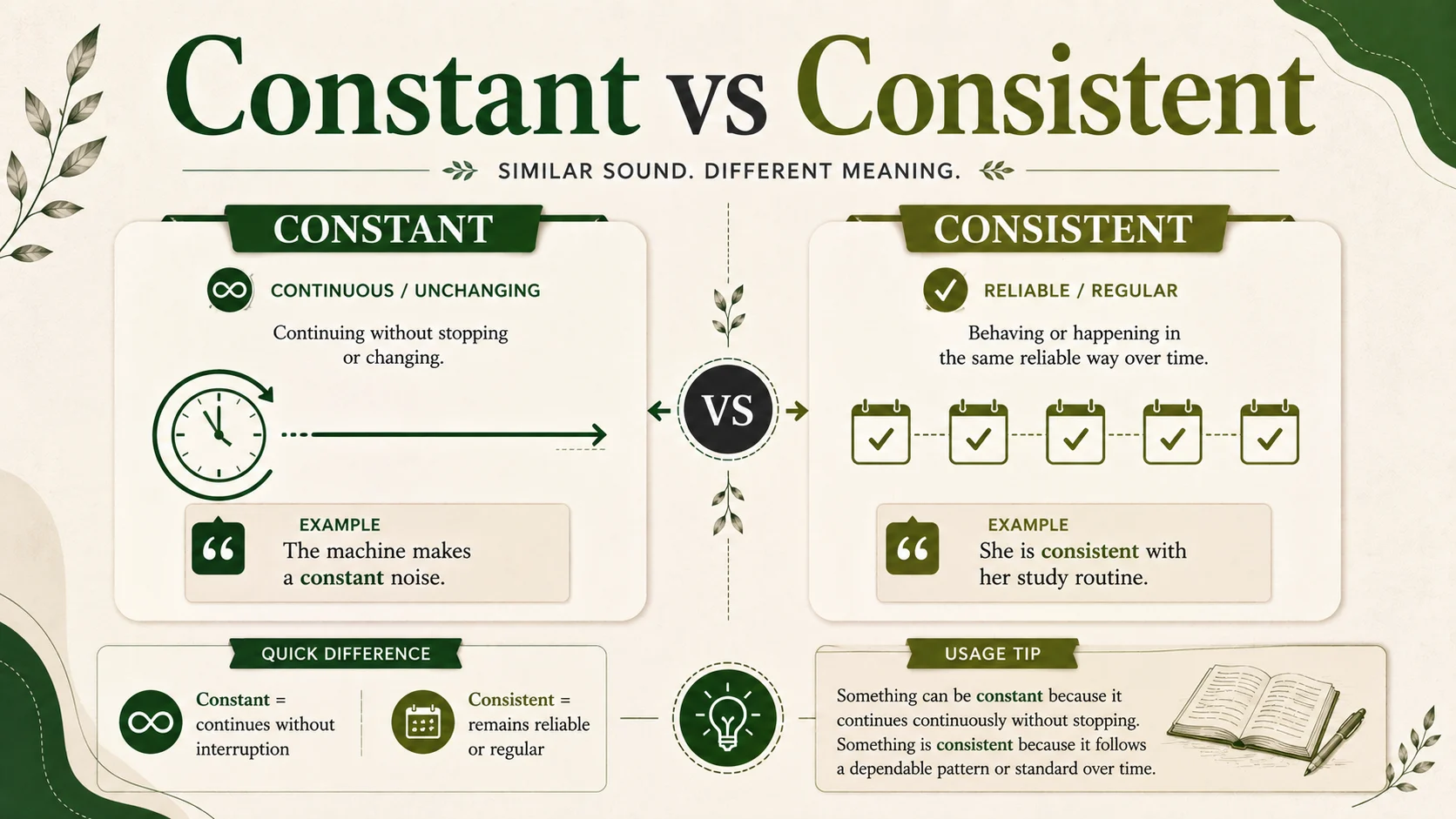
The difference between constant and consistent lies in frequency versus reliability. Constant means something occurs continuously or repeatedly without stopping, while consistent means something happens regularly in the same dependable way each time. Understanding this distinction prevents common communication errors in professional and academic writing.
Have you ever described someone’s work as “constant” when you really meant “consistent”? Or praised a colleague’s “constant effort” only to realize later that “consistent effort” better captured what you wanted to say? You’re not alone. Even advanced English speakers regularly mix up these two words, and the consequences can range from mild confusion to entirely misrepresenting your intended meaning.
The confusion is understandable. Both words describe patterns of behavior or occurrence, and they often appear in similar contexts performance reviews, project updates, and daily conversations. But using “constant” when you mean “consistent” can make you sound either overly dramatic or professionally imprecise. A “constant headache” suggests something very different from a “consistent headache,” just as a “constant employee” means something entirely different from a “consistent employee.
This guide will clear up the confusion once and for all. You’ll learn exactly when to use each word, why they aren’t interchangeable, and how mastering this distinction can instantly improve your professional communication.
What’s the Difference Between Constant and Consistent?
At their core, constant and consistent differ in a fundamental way: constant emphasizes uninterrupted continuation, while consistent emphasizes dependable regularity and uniformity.
A constant condition is always there it never stops or changes. The ticking of a clock is constant; it continues without interruption. Pain that never goes away is constant. Rain that falls all day without stopping is constant. The key idea is continuity.
A consistent condition happens repeatedly in the same reliable way, but it can stop and start. A consistent employee arrives at 8:30 AM every day there’s a gap between arrivals (nighttime), but the pattern remains steady. The key idea is reliability or uniformity across repeated instances.
Let’s look at how they compare across key dimensions:
| Aspect | Constant | Consistent |
|---|---|---|
| Meaning | Continuous, never stopping | Regular, dependable, uniform |
| Part of Speech | Adjective | Adjective |
| Refers To | Uninterrupted duration | Reliable repetition |
| Typical Usage | Describing ongoing states, continuous actions | Describing patterns, reliability, adherence to standards |
| Example | “The machine runs constantly.” | “The team produces consistent results.” |
| Common Confusion | Using it for dependable repetition | Using it for continuous occurrence |
Think of it this way: constant is about time without breaks, while consistent is about sameness across instances. A river flows constantly (without stopping), but it flows consistently in the same channel (following the same path each time).
Is This a Grammar, Vocabulary, or Usage Issue?
Constant vs consistent is primarily a vocabulary and usage issue rather than a strict grammar rule. Both words are adjectives, and both follow standard grammatical patterns. The challenge lies in choosing the correct word based on meaning and context.
From a grammar perspective, both words function identically: they modify nouns and can be used attributively (“constant noise,” “consistent effort”) or predicatively (“the noise was constant,” “the effort was consistent”). Neither word has unusual grammatical rules or irregular forms.
The vocabulary distinction matters because these words belong to different semantic families. “Constant” relates to continuity and duration it shares roots with words like “continue” and “continuous.” “Consistent” relates to agreement and uniformity it connects to words like “consist” and “consistency.”
In usage terms, the words serve different purposes in different contexts:
- Formal English: Both appear frequently. “Constant” often describes states or conditions; “consistent” often describes processes, results, or behaviors.
- Business English: “Consistent” is more common when discussing performance, quality, and reliability. “Constant” appears when discussing ongoing issues or continuous improvement.
- Academic Writing: “Consistent” is preferred for describing methodological reliability and result patterns. “Constant” appears in scientific contexts to describe unchanging variables or conditions.
- Everyday Conversation: Both are common, but misuse often goes uncorrected, leading to subtle misunderstandings.
The Bottom Line: While neither word is grammatically incorrect in each other’s place, choosing the wrong one creates semantic errors that can confuse your audience or make your writing seem imprecise.
Understanding “Constant” in Depth
What Does “Constant” Mean?
Constant means occurring continuously over a period of time without interruption, or remaining the same and unchanging. Something constant doesn’t stop, pause, or vary.
Pronunciation
/KON-stənt/ (American English)
/KON-stuhnt/ (British English)
Part of Speech
Adjective (primarily). Can also be used as a noun meaning something that remains unchanged.
Common Collocations
- Constant reminder
- Constant attention
- Constant pressure
- Constant noise
- Constant companion
- Constant worry
- Constant movement
- Constant improvement
Typical Sentence Patterns
- [Subject] + [be verb] + constant (The traffic noise was constant.)
- [Subject] + requires/demands/needs + constant + [noun] (The baby requires constant attention.)
- There is + constant + [noun] (There is constant pressure to perform.)
Workplace Example
“The background noise from the construction site was constant throughout the day, making it difficult for employees to concentrate during client calls.”
Academic Example
“The experiment required constant monitoring of temperature levels to ensure the chemical reaction proceeded as expected.”
Technology Example
“The server receives a constant stream of data from thousands of connected devices, requiring robust processing capacity.”
Email Example
“I appreciate your constant efforts to keep this project moving forward, even when faced with unexpected obstacles.”
Daily Conversation Example
“My neighbor’s dog has been barking constantly all morning I can’t get any work done.”
One Learner Mistake
Many learners use “constant” to describe reliable performance: “She is a constant worker.” This should be “consistent worker” unless you mean she never stops working (which would be unusual for a human).
Mini Recap
Constant emphasizes that something never stops or changes. It’s about duration and continuity. When you need to communicate that an action, state, or condition continues without interruption, choose constant.
Understanding “Consistent” in Depth
What Does “Consistent” Mean?
Consistent means acting or happening in the same way over time, especially so as to be fair, accurate, or reliable. Something consistent may stop and start, but each occurrence matches previous patterns.
Pronunciation
/kən-SIS-tənt/ (American English)
/kən-SIS-tuhnt/ (British English)
Part of Speech
Adjective. Also used as a noun in specialized contexts (consistency).
Common Collocations
- Consistent effort
- Consistent results
- Consistent performance
- Consistent quality
- Consistent approach
- Consistent message
- Consistent improvement
- Consistent reliability
Typical Sentence Patterns
- [Subject] + [be verb] + consistent (The company’s growth has been consistent.)
- [Subject] + remains/stays + consistent (Her performance remains consistent.)
- [Subject] + is consistent with + [noun phrase] (The findings are consistent with earlier studies.)
Workplace Example
“The marketing team’s consistent approach to social media has resulted in steady follower growth and improved engagement metrics.”
Academic Example
“The study’s results were consistent across all demographic groups, suggesting the intervention has broad applicability.”
Technology Example
“We need to ensure our user interface provides a consistent experience across all devices and platforms.”
Email Example
“Thank you for your consistent attention to quality it’s made a noticeable difference in our output.”
Daily Conversation Example
“My morning routine is consistent coffee, brief exercise, then shower it helps me start the day focused.”
One Learner Mistake
A common error is using “consistent” to mean something never stops: “The rain was consistent all day.” Unless the rain had regular patterns (stopping and starting with the same frequency), “constant” is the correct choice.
Mini Recap
Consistent emphasizes reliability and sameness across repeated instances. It’s about pattern and dependability. When you need to communicate that something occurs regularly in the same way even if it stops and starts choose consistent.
When NOT to Use Each Word
Many writers choose the wrong word because they confuse continuity with regularity. Here are the most common mistakes:
Using “Constant” When You Mean “Consistent”
Mistake #1: Describing reliable performance
Incorrect: “He provides constant quality work.”
Correct: “He provides consistent quality work.”
Why: Quality work has breaks between projects. Constant” would mean he never stops producing work.
Mistake #2: Describing dependable behavior
Incorrect: “She is constantly reliable.”
Correct: “She is consistently reliable.”
Why: Reliability requires repeated instances, not continuous action.
Mistake #3: Describing regular patterns
Incorrect: “The bus schedule is constant.”
Correct: “The bus schedule is consistent.”
Why: Schedules have gaps between departures. They’re regular, not continuous.
Using “Consistent” When You Mean “Constant”
Mistake #4: Describing something that never stops
Incorrect: “The alarm has been consistent for two hours.”
Correct: “The alarm has been constant for two hours.”
Why: An alarm ringing without stopping is continuous, not merely regular.
Mistake #5: Describing ongoing conditions
Incorrect: “She lives with consistent pain.”
Correct: “She lives with constant pain.”
Why: Pain that never subsides is continuous.
Mistake #6: Describing unchanging states
Incorrect: “The temperature is consistent at 98.6°F.”
Correct: “The temperature is constant at 98.6°F.”
Why: A stable, unchanging temperature is continuous, not patterned.
Common Mistakes Comparison Table
| Correct Sentence | Incorrect Sentence | Explanation |
|---|---|---|
| “The team delivers consistent results.” | “The team delivers constant results.” | Results happen in cycles, not continuously. |
| “The noise from the highway was constant.” | “The noise from the highway was consistent.” | The noise continues without breaks. |
| “She maintains a consistent schedule.” | “She maintains a constant schedule.” | Schedules have breaks between activities. |
| “The patient requires constant monitoring.” | “The patient requires consistent monitoring.” | Monitoring must happen continuously. |
| “Her work shows consistent improvement.” | “Her work shows constant improvement.” | Improvement happens in increments over time. |
| “The drill produces constant vibration.” | “The drill produces consistent vibration.” | Vibration never stops while operating. |
Quick Decision Guide
If you mean the action, state, or condition continues without stopping → Choose CONSTANT
- The noise is constant.
- She needs constant supervision.
- There is constant pressure.
If you mean the action, state, or condition happens regularly and reliably in the same way → Choose CONSISTENT
- He is a consistent performer.
- The quality remains consistent.
- We need consistent messaging.
Real-World Examples: Constant vs Consistent in Action
Office Communication
Constant: “The open office environment produces constant background chatter.”
Consistent: “Our team’s meeting attendance has been consistent this quarter.”
Business Email
Constant: “Thank you for your constant vigilance regarding security protocols.”
Consistent: “Your consistent attention to detail has significantly improved our documentation.”
School or University
Constant: “The student faced constant distraction from nearby construction.”
Consistent: “Her consistent study habits led to excellent exam results.”
Customer Support
Constant: “We receive constant inquiries about this feature.”
Consistent: “We provide consistent response times to all customer queries.”
Technology
Constant: “The system requires constant bandwidth to stream video.”
Consistent: “We need consistent performance across all browsers.”
Artificial Intelligence
Constant: “The AI model processes a constant data stream from IoT devices.”
Consistent: “The model produces consistent predictions given the same inputs.”
Daily Conversation
Constant: “My phone has been buzzing constantly since the announcement.”
Consistent: “I try to be consistent with my exercise routine.”
Constant vs Consistent in Modern Technology
Technology has given both words new contexts that reveal their distinct meanings clearly.
In Artificial Intelligence, a model might receive a constant stream of training data the data flows continuously. That same model, once trained, might deliver consistent responses each query receives a reliable, predictable answer. The constant input enables the consistent output.
For Voice Assistants like Siri or Alexa, they require constant internet connectivity to process queries. But they need consistent voice recognition across different users and environments to be useful. One is about continuous necessity; the other about reliable function.
In Software Development, a system might need constant uptime (never going offline) while delivering consistent performance (the same speed and response quality regardless of user load). A service can be consistently fast without being constantly available, and vice versa.
Business Intelligence Tools often track both concepts: constant data streams flow into dashboards, providing real-time insights, while consistent data quality ensures decisions are based on reliable information.
Expert Insight
Here’s what language educators want you to remember: The choice between “constant” and “consistent” often determines whether you sound like you’re exaggerating or whether you sound professional and precise.
Many of my students who use these words interchangeably don’t realize they’re sending unintended messages. When you say a colleague provides “constant support,” you’re implying they never stop working which might sound like a criticism. When you say they provide “consistent support,” you’re praising their reliability which is usually what you meant.
The practical takeaway is this: before using either word, ask yourself one question: “Does this activity or condition have breaks or gaps?” If the answer is yes, you likely want “consistent.” If the answer is no, you likely want “constant.” It’s that simple, and mastering this distinction will instantly improve your professional communication.
Error Prevention Checklist
Always use CONSTANT when:
- The action or state has no interruption
- Time passes without the condition changing
- You need to emphasize continuity or unbroken duration
- The situation continues indefinitely without stopping
Always use CONSISTENT when:
- The action happens in regular, reliable patterns
- There are gaps between occurrences
- You need to emphasize dependability or uniformity
- You’re describing something that follows established standards
Never confuse them if:
- You’re describing performance (almost always “consistent”)
- You’re describing noise or pain (almost always “constant”)
- You’re unsure, and the word “steady” might work for either meaning
Quick Memory Tip:
Constant = Count-on-tinuous (it never stops)
Consistent = Consistently-reliable (it’s always the same pattern)
Related Grammar Confusions
- Continuous vs Continual – Similar to constant vs consistent: continuous means never stopping; continual means recurring regularly.
- Persistent vs Consistent – Persistent means stubbornly continuing; consistent means reliably the same.
- Regular vs Constant – Regular happens at set intervals; constant never stops.
- Stable vs Consistent – Stable doesn’t change; consistent follows a reliable pattern.
- Uniform vs Constant – Uniform means all parts are the same; constant means unchanging over time.
- Steady vs Continuous – Steady means even and regular; continuous means unbroken.
- Unwavering vs Consistent – Unwavering means not changing or weakening; consistent means reliable over time.
- Reliable vs Consistent – Reliable means can be depended on; consistent means same each time.
- Fixed vs Constant – Fixed means unchanging or set; constant means continuous.
- Perpetual vs Persistent – Perpetual means never ending; persistent means continuing despite obstacles.
FAQs
Is “consistent” the same as “constant”?
No. “Consistent” means happening regularly in the same reliable way, while “constant” means continuing without stopping. A consistent worker arrives on time each day (with gaps between days); a constant worker would never leave work (which is unrealistic). They serve different purposes in communication.
Can something be both constant and consistent?
Yes. A condition can be both constant and consistent if it never stops and also follows a regular pattern. For example, the ticking of a clock is constant (continuous) and consistent (regular in its rhythm). But many things are one without being the other noise can be constant but not consistent in volume.
Which word is better for professional writing?
“Consistent” is more commonly used in professional contexts when describing performance, quality, results, and reliability. “Constant” appears more often when discussing ongoing conditions, continuous requirements, or unbroken states. Choose based on meaning, not professional preference.
What is the noun form of consistent?
The noun form is “consistency.” For example: “Her consistency has earned her a promotion.” The noun form of “constant” is also “constant” (in mathematics) or “constancy” (in emotional or philosophical contexts).
Is “consistently” an adverb?
Yes. “Consistently” is the adverb form. Example: “She consistently outperforms her targets.” The adverb form of “constant” is “constantly.” Example: “The machine runs constantly.”
Can I use “constant” to describe someone’s character?
Yes, but carefully. “A constant friend” suggests unwavering loyalty (never changing). “A consistent friend” suggests reliable support (always there when needed). Both are positive but emphasize different qualities.
Conclusion
The difference between constant and consistent comes down to one essential distinction: continuity versus reliability. Constant emphasizes that something never stops or changes it’s about unbroken duration and steady presence. Consistent emphasizes that something happens in the same reliable way each time it’s about dependable patterns and predictable results.
When you choose between these words, think about what you’re really trying to communicate. Are you describing an ongoing state that continues without interruption? Choose “constant.” Are you describing reliable performance or regular patterns? Choose “consistent.”
The practical rule to remember: if your subject has breaks or gaps, use “consistent.” If it has no breaks, use “constant.” This simple test will help you avoid the most common mistakes and communicate with greater precision.
Mastering this distinction not only improves your vocabulary it makes your writing more professional, your speech more accurate, and your communication more effective.