Quick Answer
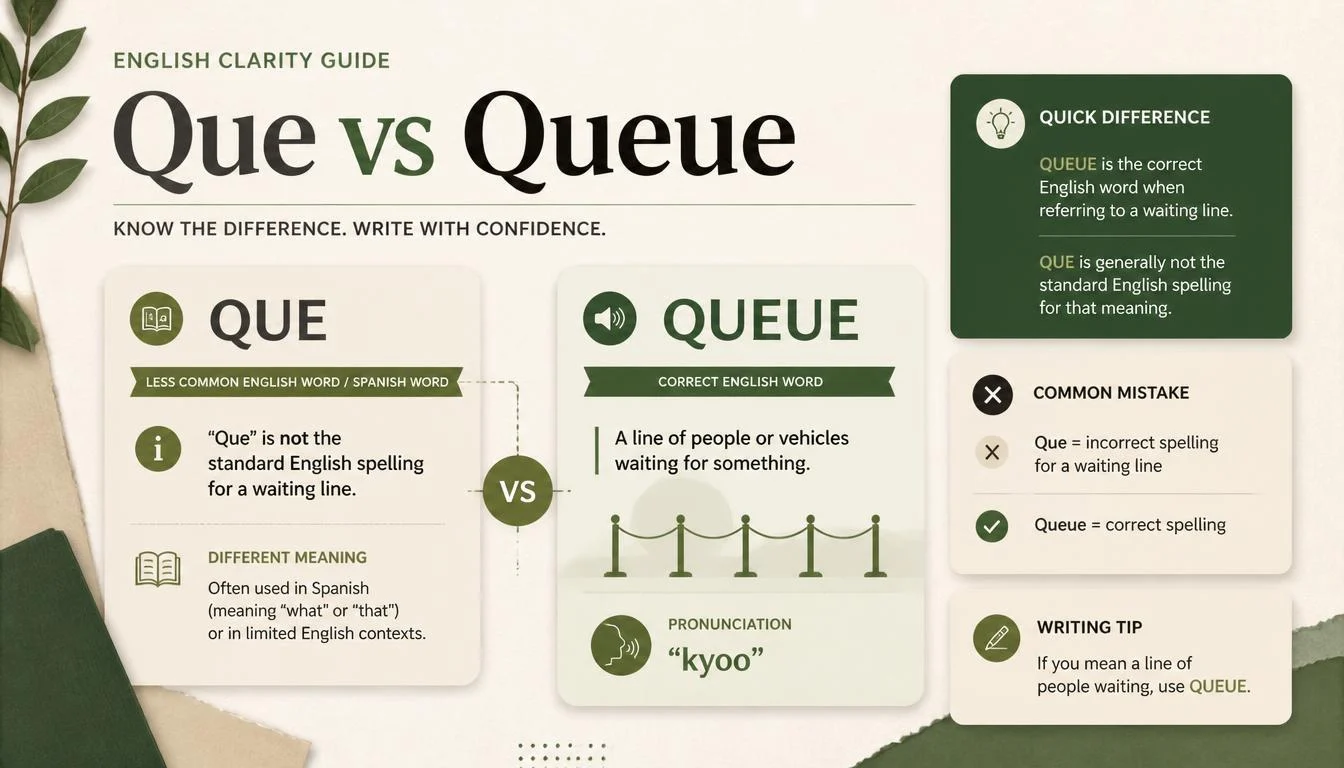
Queue is the correct English word for a waiting line or a sequence, both in everyday speech and in computing. Que is not a standard English word on its own it’s either a misspelling of queue, a shortened slang form, or part of another word like “cue.” If you’re writing formally, always choose queue.
You’re typing an email, and you want to say “please add this task to the list.” Your fingers type “que,” but something feels off. Is that even a real word? You’re not alone. This mix-up happens constantly, especially because “que” shows up in Spanish, in French loanwords, and in casual internet slang, which makes it feel more legitimate in English than it actually is.
Here’s the core issue: queue is a five-letter word borrowed from French, and it refers to a line of people, vehicles, or data waiting for their turn. Que, on the other hand, isn’t a recognized standalone word in standard English dictionaries. People often type it by accident, thinking it’s a shortcut, or they confuse it with the similar-sounding word “cue,” which has an entirely different meaning.
Getting this wrong isn’t just a spelling slip. In business writing, technical documentation, or academic work, using “que” instead of “queue” can make your writing look careless, even if your grammar is otherwise solid. By the end of this guide, you’ll know exactly when to use queue, why que causes so much confusion, how the word “cue” fits into this picture, and how professionals, developers, and everyday writers use these terms correctly.
Que vs Queue: What’s the Difference?
The direct answer is this: queue is the real English word, and que is almost always a mistake, an abbreviation, or a word borrowed from another language.
Queue functions as both a noun and a verb. As a noun, it describes a line of people or objects waiting in order think of people standing outside a coffee shop or emails stacking up in an inbox. As a verb, it means to line up or to arrange something in a sequence, as in “please queue the files for processing.
Que does not carry this meaning in English. It shows up in a few specific contexts: as a phonetic shorthand some people use casually online, as a fragment of Spanish words like “qué” (meaning “what”) or “porque” (meaning “because”), and sometimes as an accidental typo when someone drops letters while typing quickly. None of these uses make que an acceptable substitute for queue in professional or academic writing.
| Feature | Que | Queue |
|---|---|---|
| Meaning | Not a standard English word; often a typo or slang | A line of people, objects, or data waiting in order |
| Part of Speech | None (in standard English) | Noun and verb |
| Refers To | Nothing specific in English | A waiting line or sequence |
| Typical Usage | Casual texting, foreign language fragments | Formal writing, technical documentation, everyday speech |
| Example | “Get in que” (incorrect) | “Get in queue” (correct) |
| Common Confusion | Mistaken for a valid shortened spelling of queue, or confused with “cue” | Sometimes misspelled as “que” or confused with “cue” |
So here’s the recap: queue is the only version you’ll find in Oxford Dictionary, Cambridge Dictionary, or Merriam-Webster as a word meaning “a waiting line.” Que simply doesn’t appear as an English entry with that meaning. If you’re ever unsure while writing, picture people standing in a physical line that image should trigger the word queue, complete with all five letters.
Is Que vs Queue a Grammar, Vocabulary, or Usage Issue?
This is primarily a vocabulary and spelling issue, not a grammar issue in the traditional sense. There’s no rule of sentence structure at play here the problem is that “que” simply isn’t a word with an accepted meaning in standard English, while “queue” is.
That said, there’s a usage layer worth understanding. In formal English, business English, and academic writing, only queue is acceptable. You’ll never see “que” used correctly in a research paper, a corporate memo, or a style guide like APA or the Chicago Manual of Style. In everyday conversation and informal texting, some people do type “que” as a quick shorthand, similar to how people write “u” for “you.” This doesn’t make it correct it just means the mistake is common enough that you’ll encounter it in casual settings.
The two words are not interchangeable in any formal context. If you’re a student, a professional writer, or someone preparing content for publication, queue is the only acceptable spelling. The practical takeaway here is simple: treat “que” as a spelling error to catch and correct, not as a legitimate stylistic choice, unless you’re specifically writing in Spanish or another language where “que” has its own valid meaning.
Understanding “Queue”
Queue means a line of people, vehicles, or items arranged in order, waiting for their turn. It also functions as a verb meaning to form or join such a line, or to arrange items in sequence for processing.
Pronunciation: Queue is pronounced exactly like the letter “Q” /kjuː/. This is one of the quirks of English spelling that trips people up, since none of the extra letters (“ueue”) change how the word sounds.
Part of speech: Noun and verb.
Common collocations: “join the queue,” “form a queue,” “jump the queue,” “queue up,” “in the queue,” “print queue,” “waiting queue.”
Typical sentence patterns: Queue often appears after a preposition (“in the queue,” “at the back of the queue”) or as part of a phrasal verb (“queue up”).
Workplace example: “Your request has been added to the support queue and will be reviewed within 24 hours.”
Academic example: “The professor asked students to queue outside the lecture hall until the previous class had finished.”
Technology example: “The print queue is backed up, so your document might take a few minutes to come out.”
Email example: “I’ve queued your invoice for approval it should go through by end of day.”
Daily conversation example: “There’s already a huge queue outside the bakery this morning.”
One learner mistake: Non-native speakers sometimes drop letters and write “que” or “queu,” especially because the word’s spelling doesn’t match its short pronunciation. Remembering that queue sounds like just one letter but is spelled with five can help lock in the correct form.
Mini recap: Queue is the real word for a waiting line, pronounced like the letter Q, and it works as both a noun and a verb in formal and informal English alike.
Understanding “Que”
“Que” is not a standalone English word with an official dictionary meaning related to lines, waiting, or sequences. In English, it most often appears as a misspelling of “queue,” a word borrowed from French. It can also appear as a word or fragment from another language, such as Spanish or French, or as informal internet shorthand.
Meaning in Context
In Spanish, “qué” with an accent means “what,” while “que” without an accent can mean “that” or “which.” For example, creo que sí means “I think so.” These are legitimate Spanish words, but their meanings do not make “que” a standard English word for a waiting line.
Pronunciation
When people mistakenly write “que” instead of queue in English, they generally pronounce it like “queue” or the letter Q. In Spanish, “que” is pronounced more like “keh.” The difference in pronunciation can help distinguish the two uses.
Part of Speech
In standard English, “que” has no established part of speech when it is used as a supposed alternative to queue. In Spanish, however, que can function as a conjunction or pronoun depending on the sentence.
Common Collocations
In casual English texting, you may occasionally see incorrect phrases such as “join the que” or “long que.” These are usually misspellings of “join the queue” and “long queue.” In careful English writing, always use queue.
Typical Sentence Patterns
The misspelling “que” commonly appears in places where queue would normally be used. Common examples include phrases with “long,” “join,” “in,” and “up.”
Workplace Example
Incorrect: “Your ticket has been added to the que.”
Correct: “Your ticket has been added to the queue.”
Technology Example
Incorrect: “Check your download que for progress.”
Correct: “Check your download queue for progress.”
Email Example
Incorrect: “I’ll que up your request for review.”
Correct: “I’ll queue up your request for review.”
Daily Conversation Example
Someone might text, “The que is so long today,” when they mean “The queue is so long today.” Although the intended meaning is usually clear, que is not the correct English spelling.
One Common Learner Mistake
English learners sometimes assume “que” is an informal shortened form of “queue,” similar to how photo is shortened from photograph. However, “que” is not an officially recognized abbreviation for queue. In standard English, the full spelling should be used.
Mini Recap
“Que” is not a standard English word meaning a line or sequence. When it appears in English in that sense, it is usually a misspelling of “queue” or informal shorthand. In Spanish and other languages, que has legitimate uses, but those meanings are separate from standard English.
When Not to Use Each Word
1. Never use “que” in formal writing. Whether it’s a business report, a college essay, or a professional email, “que” has no place there. Always write queue in full.
2. Don’t use “que” thinking it saves time. Some writers assume shorter is better, but queue isn’t long enough to justify shortening, and there’s no accepted abbreviation for it anyway.
3. Avoid confusing “que” with “cue.” Cue is a completely different word meaning a signal or prompt, as in “that’s your cue to speak.” If you meant “signal,” you need cue, not que and not queue.
4. Don’t rely on autocorrect to catch this. Many spell-checkers won’t flag “que” as an error because it’s a valid word fragment in other contexts (like part of a longer word or a proper noun), so the mistake can slip through unnoticed.
5. Avoid using “que” in technical documentation. In software development, terms like “message queue” or “print queue” are standardized. Writing “que” in code comments, documentation, or user interfaces looks unprofessional and can confuse international readers.
6. Don’t use “que” when writing for a global audience. Since que carries a real meaning in Spanish, using it incorrectly in English content read by bilingual audiences can create genuine confusion, not just an appearance of sloppiness.
7. Never substitute “que” in customer-facing content. Support tickets, chatbot responses, and website copy should always use queue, since customers may screenshot or quote your text, and errors here directly affect brand credibility.
8. Don’t assume que is “just texting shorthand” that’s fine everywhere. What flies in a casual text to a friend won’t fly in a resume, a cover letter, or a client-facing report. Context always matters.
Common Mistakes Table
| Correct Sentence | Incorrect Sentence | Explanation |
|---|---|---|
| “There’s a long queue at the ticket counter.” | “There’s a long que at the ticket counter.” | Queue is the correct spelling for a waiting line; que is not a recognized English word here. |
| “I’ve queued the report for your review.” | “I’ve qued the report for your review.” | The verb form is “queued,” not “qued,” which isn’t a standard spelling at all. |
| “Please stand in the queue until called.” | “Please stand in the cue until called.” | This confuses queue (a line) with cue (a signal), which have entirely different meanings. |
| “The download is next in the queue.” | “The download is next in the que.” | Even in casual tech contexts, queue is the standard, correctly spelled term. |
| “Add your name to the waiting queue.” | “Add your name to the waiting que.” | Que is not an accepted shorthand for queue in professional or academic English. |
Quick Decision Box
- If you mean a line of people, vehicles, or data waiting for their turn, use queue.
- If you’re writing in Spanish and mean “what” or “that,” use qué or que with correct Spanish spelling and accents.
- If you mean a signal or prompt, like an actor’s line cue, use cue.
When in doubt in English writing, default to queue it’s almost always the word you’re reaching for.
Real World Examples
Office communication: “Can you check the print queue? My document has been sitting there for ten minutes.” This is a classic workplace scenario where “que” often sneaks in by mistake, especially in quick internal messages.
Business email: “Your refund request has been added to our processing queue and will be completed within 3-5 business days.” Customer service teams rely heavily on this exact phrase, and getting it wrong undermines the professionalism of the message.
School or university: “Students should queue outside Room 204 before the exam begins.” Academic instructions often use queue to describe orderly lines, particularly in exam halls or registration events.
Customer support: “You are currently third in the queue. Estimated wait time: 6 minutes.” This phrase appears constantly in call center systems and live chat tools, making correct spelling essential for brand consistency.
Technology: “The job queue processes tasks in the order they were received.” Developers and IT professionals use this term daily when discussing how systems handle multiple requests.
Artificial Intelligence: “The AI model processes prompts from a queue, handling one request at a time to manage server load.” As AI tools become more common, understanding queue-related terminology matters more than ever for anyone working with these systems.
Daily conversation: “I hate waiting in queue at the grocery store on weekends.” This everyday complaint is one of the most natural places you’ll hear or use the word queue.
Que and Queue in Modern Technology
The word queue shows up constantly in modern technology, often more than in everyday spoken English. In artificial intelligence systems, a “queue” refers to the list of requests or prompts waiting to be processed by a model, especially during high-traffic periods when a server can’t handle every request instantly.
Virtual assistants and voice assistants also rely on queuing systems behind the scenes, even if users never see them directly. When you ask a smart speaker to play a song, that request often enters a processing queue before the assistant responds, particularly if multiple commands are given at once.
Chatbots use message queues to manage conversations, ensuring that responses are sent in the correct order even when a system is handling thousands of users simultaneously. Software engineers specifically use terms like “task queue,” “job queue,” and “message queue” to describe these background processes.
Business tools like customer support platforms, project management software, and email marketing systems almost always include a “queue” feature a scheduling or waiting list where tasks sit until they’re ready to be executed. In none of these technical contexts does “que” ever appear as a legitimate variant; the correct spelling remains consistent across programming documentation, technical writing, and user interfaces worldwide.
Word Origin
Queue traces back to the French word “queue,” which itself came from the Latin “cauda,” meaning “tail.” The original French meaning referred literally to a tail, and over time, the word evolved in English to describe a line of people or things extending like a tail behind a starting point. This origin explains the unusual spelling English borrowed the word directly from French rather than adapting its spelling to match English pronunciation patterns, which is why it looks so different from how it sounds.
“Que,” by contrast, doesn’t have an independent origin story in English because it was never adopted as a standalone word. Its appearance in English writing is almost always a byproduct of misspelling queue or borrowing fragments from Spanish or French without full context.
Expert Insight
As a language instructor, I always tell students to picture the actual French root of the word: queue means “tail,” like the tail of a line stretching out behind the first person. That mental image helps explain why the word has so many extra letters even though it’s pronounced like a single letter. Once you connect the spelling to that “tail” concept, the five-letter version starts to feel far more natural, and “que” starts to feel like the incomplete version it actually is. This trick works especially well with visual learners who struggle with English’s inconsistent spelling-to-sound relationships.
Error Prevention Checklist
- Always use queue when referring to a line of people, vehicles, or a sequence of tasks.
- Always use cue when referring to a signal, prompt, or hint (like a stage cue).
- Never confuse them if you remember: queue = line (tail), cue = signal (hint).
- Quick memory tip: Queue has extra letters like a “tail” trailing behind, just like its French origin suggests.
Related Grammar Confusions
Cue vs Queue: These two words sound nearly identical but mean completely different things, making them one of the most common homophone mix-ups in English.
Effect vs Affect: Understanding the difference between this noun and verb pair can dramatically improve clarity in both academic and professional writing.
Their vs There vs They’re: This classic trio trips up even experienced writers, especially in fast typing situations like emails and social media.
Its vs It’s: A single apostrophe changes the meaning entirely, and this mistake appears constantly even in published content.
Complement vs Compliment: These words look similar but carry very different meanings, one about completion and the other about praise.
Discreet vs Discrete: Both words are spelled similarly but serve entirely different purposes, one about privacy and the other about separateness.
Principal vs Principle: A common source of confusion in academic writing, especially in school-related or ethical contexts.
Stationary vs Stationery: One describes something that doesn’t move, while the other refers to paper products, and mixing them up is surprisingly common.
Loose vs Lose: A frequent typing error that changes meaning significantly depending on which spelling you choose.
Whose vs Who’s: Similar to its/it’s, this pair depends entirely on whether you’re using a contraction or a possessive form.
FAQs
Is “que” ever correct in English?
No. “Que” is not a standard English word with an independent meaning. It can appear correctly in other languages, such as Spanish or French, but using “que” as a shortened form of queue is not standard English.
Why is “queue” spelled with so many extra letters?
“Queue” comes from French and originally referred to a “tail.” English borrowed the word while retaining its unusual spelling. Although it contains several letters, queue is pronounced as a single syllable, which makes its spelling particularly memorable.
What’s the difference between “queue” and “cue”?
“Queue” refers to a line of people or things waiting or arranged in sequence. “Cue” means a signal, prompt, or indication that something should happen. They are pronounced alike but have completely different meanings.
Can “que” be used as an abbreviation for “queue”?
No. “Que” is not a standard abbreviation for queue. Using it as a shortcut may be understood in informal messages, but it should be avoided in formal, academic, and professional writing.
Is “queue” used differently in British and American English?
The word “queue” has essentially the same meaning in both British and American English. It refers to a line or sequence of people or things. The verb “queue” is also standard in both varieties, although Americans often use “line” and “line up” instead.
How can I remember that “queue” is spelled correctly?
A useful trick is to remember that a queue is like a tail because people or things line up behind one another. You can also remember that queue contains several silent letters but is pronounced as one syllable: Q + U + E + U + E.
Conclusion
The bottom line is straightforward: queue is the only correct English word for describing a line of people, vehicles, or tasks waiting their turn, while “que” is a misspelling, a fragment from another language, or informal shorthand that doesn’t belong in careful writing. Understanding the French origin of queue, meaning “tail,” makes the unusual spelling much easier to remember and helps explain why it looks so different from how it sounds.
Next time you’re tempted to type “que” in an email, a report, or a piece of code, pause for a second and picture that trailing tail of people standing in line. That simple mental image is often enough to guide you toward the correct, complete spelling queue, every single time.
Read More Related Articles:
- Losing vs Loosing | How One Extra “O” Changes the Entire Meaning In 2026
- Successfully or Succesfully | Easy Trick to Remember the Correct Spelling Forever In 2026
- Usage vs Useage | Stop Making This Spelling Mistake in Your Writing In 2026

Lucas Mitchell is a content writer at synoseek.com. He writes simple, thoughtful pieces that focus on everyday ideas, observations and general knowledge topics. His work is shaped by a calm, realistic tone that keeps the reader engaged without overstatement.
1 thought on “Que vs Queue | Quick Guide to the Right Word In 2026”