Quick Answer
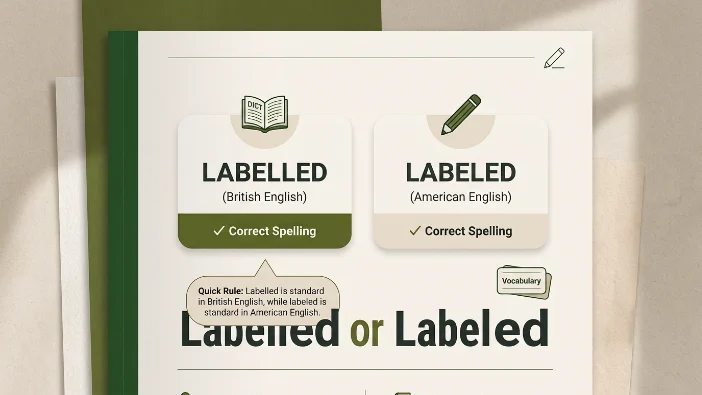
Both spellings are correct. Labeled or labeled depends on which English you’re writing: labeled is the American spelling, while labelled is the British spelling. Neither version is grammatically wrong, but using the wrong one for your audience can make your writing look inconsistent or unpolished.
Wondering whether Labelled or Labeled is the correct spelling? Both forms are correct, but the preferred spelling depends on whether you are using British or American English.
Labelled is the standard British spelling, while labeled is preferred in American English. Understanding this small spelling difference can help you keep your writing consistent and accurate.
Why This Word Trips People Up
You’re filling out a form, writing an email, or finishing a school assignment, and suddenly you stop mid-sentence. Is it one L or two? Spellcheck flags one version, your coworker uses the other, and now you’re not sure which one is actually right.
Here’s the thing: you’re not making a mistake by wondering. The word label follows a spelling rule that changes depending on which side of the Atlantic you’re writing for. American English and British English don’t just differ in vocabulary words like “elevator” versus “lift” they also differ in how certain verbs get their endings when you add -ed or -ing.
Labeled and labelled are a perfect example of this split. Once you understand the pattern behind it, you’ll never second-guess yourself again, and you’ll also start noticing the same rule apply to dozens of other everyday words.
By the end of this guide, you’ll know exactly which spelling to use, why the rule exists, and how to stay consistent whether you’re writing for a US audience, a UK audience, or switching between both.
Labeled or Labelled: What’s the Real Difference?
The difference comes down to regional spelling conventions, not meaning. Both words describe the exact same action attaching a label or identifying something but American English drops the second L while British English keeps it.
Here’s a quick breakdown of how the two versions compare:
| Feature | Labeled | Labelled |
|---|---|---|
| Region | American English | British English (also used in Australia, Canada, and much of the Commonwealth) |
| Consonant Doubling | No doubling | Doubles the final L |
| Part of Speech | Past tense / past participle of “label” | Past tense / past participle of “label” |
| Meaning | Identical | Identical |
| Common Usage | US publications, US software, US education | UK publications, Australian and NZ writing, most Commonwealth countries |
| Example | The jar was labeled correctly. | The jar was labelled correctly. |
Notice that nothing changes about the meaning, pronunciation, or grammatical function. The only variable is geography. If you’re writing a resume for a company in New York, use labeled. If you’re submitting an essay to a university in London, use labelled. It really is that simple once you know your audience.
Is Labeled a Grammar Issue or a Spelling Issue?
This is purely a spelling issue, not a grammar issue. Both labeled and labelled function identically in a sentence they’re both the past tense and past participle forms of the verb “label.” Neither one breaks any grammatical rule.
The confusion exists because of a quirk in English spelling conventions rather than anything related to sentence structure. In American English, when a word ends in a single vowel followed by a single consonant, that final consonant usually doesn’t double before adding -ed or -ing, especially if the stress falls on the first syllable (like LA-bel). British English, on the other hand, tends to double the final consonant regardless of where the stress falls, as long as the word ends in a single vowel plus a single consonant.
This same pattern shows up in similar word pairs:
- Traveled (US) vs. Travelled (UK)
- Canceled (US) vs. Cancelled (UK)
- Modeled (US) vs. Modelled (UK)
- Fueled (US) vs. Fuelled (UK)
In formal writing whether that’s business English, academic papers, or professional emails the expectation is consistency. Style guides in the US, including the Chicago Manual of Style, favor the single-L version. Meanwhile, the Oxford Dictionary and most UK-based editorial standards favor the double-L version.
Practical takeaway: Pick one spelling system based on your audience or your organization’s house style, and stick with it throughout the entire document. Mixing labeled and labelled in the same piece of writing is the real mistake, not choosing one over the other.
Labeled: The American English Standard
Meaning and Usage
Labeled means something has been marked, tagged, or identified with a label whether that’s a physical tag on a product or a figurative description applied to a person, idea, or situation.
Part of speech: Verb (past tense and past participle of “label”)
Common collocations: clearly labeled, mislabeled, labeled as, properly labeled, correctly labeled, labeled accordingly
Real Examples
Workplace: The shipping team labeled every box before it left the warehouse.
Academic: The diagram was labeled with the names of each cell structure.
Technology: The app labeled each notification by priority level.
Email: Please make sure the attached files are labeled with today’s date.
Daily conversation: I labeled the leftovers so nobody throws them out by mistake.
Common Learner Mistake
Many non-native English speakers write “labelled” out of habit, especially if they learned British English in school, and then get confused when American software or spellcheck tools flag it as incorrect. The fix is simple: check which regional dialect your document, employer, or publication requires before you start writing.
Mini Recap
Labeled is the go-to spelling for American businesses, US-based publications, and any writing intended for a US audience. It follows the standard American rule of not doubling the final consonant.
Labelled: The British English Standard
Meaning and Usage
Labelled carries the exact same meaning as labeled. There’s no difference in definition, pronunciation, or grammatical role only the spelling changes.
Part of speech: Verb (past tense and past participle of “label”)
Common collocations: clearly labelled, mislabelled, labelled as, properly labelled, correctly labelled
Real Examples
Workplace: The samples were labelled and sent to the lab for testing.
Academic: Students labelled the parts of the plant during the biology lesson.
Technology: The software labelled each error with a red warning icon.
Email: Kindly ensure the folders are labelled before the meeting on Friday.
Daily conversation: She labelled the spice jars so the kitchen would stay organized.
Common Learner Mistake
Writers based in the UK, Australia, Canada, or other Commonwealth countries sometimes switch to “labeled” without realizing it, particularly when reading American content online or using US-based writing tools with default settings. Double-check your spellcheck language setting if this keeps happening.
Mini Recap
Labelled is the standard spelling across the UK, Australia, New Zealand, and most Commonwealth nations. It follows the British rule of doubling the final consonant before adding -ed.
When Writers Choose the Wrong Version
Even experienced writers slip up here. Below are the most common situations where people pick the wrong spelling, along with how to avoid repeating the mistake.
1. Writing for an international audience without picking a standard. When you’re not sure who’s reading your content, it’s easy to switch spellings halfway through. Decide on one dialect before you start writing, not after.
2. Relying on default spellcheck settings. Many word processors default to American English, which silently “corrects” labelled to labeled even for UK writers. Always check your language settings first.
3. Switching between US and UK sources during research. If you’re referencing both American and British articles while writing, spelling can bleed over without you noticing. Read through your final draft specifically checking for consistency.
4. Working with international teams. A US-based writer editing a UK-based document (or vice versa) often introduces the wrong spelling accidentally. Agree on a house style before collaborating.
5. Using outdated textbooks or guides. Some older learning materials mix American and British conventions without explanation, which confuses students learning English as a second language.
6. Copying and pasting from multiple sources. Content pulled from different websites often carries inconsistent spelling that goes unnoticed during editing.
7. Assuming one version is “more correct.” Neither spelling outranks the other. This isn’t like a genuine grammar error it’s a regional choice, and treating one as superior only creates unnecessary confusion.
8. Forgetting brand or publication style guides. Many companies specify American or British English in their style guide, and skipping that check leads to inconsistent published content.
Common Mistakes Table
| Correct Sentence | Incorrect Sentence | Explanation |
|---|---|---|
| The product was labeled for the US market. | The product was labelled for the US market, then switched to “labeled” halfway through the same document. | Mixing both spellings in one piece of writing looks careless, even though each spelling is individually correct. |
| She labelled the folders using British spelling conventions for her UK client. | She labeled the folders using British spelling conventions for her UK client. | If the context specifies British English, the American spelling breaks consistency. |
| The ingredients were clearly labeled in English. | The ingredients was labeled in English. | This is a subject-verb agreement error, unrelated to the spelling debate but often confused with it. |
Quick Decision Box
If you’re writing for a US audience, US company, or American publication, use labeled.
If you’re writing for a UK, Australian, Canadian, or Commonwealth audience, use labelled.
If you’re not sure, check your organization’s style guide or match the spelling used elsewhere in the document.
Labeled and Labelled in Real-World Situations
Office communication: A manager reviewing inventory might write, “Every pallet needs to be labeled before it ships tomorrow,” if working for a US company, or “labelled” if working for a UK branch of the same business.
Business email: A project coordinator sending files to an international team might specify, “Please make sure all documents are labeled according to our US style guide” to avoid confusion among contributors from different countries.
School or university: A biology teacher grading a diagram might mark down a British student for writing “labeled” only if the school specifically requires British English spelling for exams like GCSEs or A-levels.
Customer support: A support agent troubleshooting a shipping issue might type, “Your package was labeled with the wrong address,” using whichever spelling matches the company’s regional headquarters.
Technology: Developers building software often have to choose one spelling for consistency across the user interface, error messages, and documentation, especially if the product serves a global audience.
Artificial Intelligence: AI systems trained on labeled datasets a term used heavily in machine learning almost always default to American spelling because most technical documentation in this field originates from US-based companies and research institutions.
Daily conversation: Something as small as labeling moving boxes before a house move can spark this exact spelling debate between friends or family members from different English-speaking countries.
Labeled vs. Labelled in Modern Technology
Technology has actually made this spelling difference more visible than ever. In machine learning and artificial intelligence, the term “labeled data” refers to information that’s been tagged with identifying information so an algorithm can learn from it. Because most major AI research comes out of American companies and universities, “labeled” is overwhelmingly the standard spelling in technical and academic papers about AI.
Virtual assistants and voice assistants, most of which were developed by American companies, also default to American spelling conventions in their documentation and user interfaces. If you ask a voice assistant to spell-check a document, it typically defaults to American English unless you’ve specifically changed the regional language setting.
Software companies building products for global markets often localize their spelling based on the user’s detected region so a UK user might see “labelled” throughout an app’s interface while a US user sees “labeled” in the exact same feature. This is a deliberate design choice, not an inconsistency, and it reflects how seriously companies take regional spelling preferences.
Where the Word Comes From
The word “label” traces back to Old French, where “label” or “lambel” originally referred to a strip or band of cloth, often used decoratively. It entered English in the 14th century and gradually shifted toward its modern meaning: a tag or marker used to identify something.
The spelling split between labeled and labelled didn’t emerge until spelling reforms took hold in the 19th century, largely influenced by American lexicographer Noah Webster. Webster intentionally simplified many British spelling conventions to create a distinct American standard, which is why so many words colour versus color, travelling versus traveling, labelled versus labeled diverged along the same lines.
Expert Insight
As a language instructor, I always tell students not to think of labeled and labelled as a right-versus-wrong situation. Think of it more like choosing between two dialects of the same language, similar to choosing “soccer” versus “football.” The word itself isn’t the problem inconsistency is. Once you commit to one spelling system in a piece of writing, your job is just to stay consistent from the first word to the last.
Error Prevention Checklist
- Always use labeled when writing for American audiences, US companies, or US-based publications.
- Always use labelled when writing for UK, Australian, Canadian, or Commonwealth audiences.
- Never confuse them if you remember this: American English simplifies, British English doubles.
- Quick memory tip: “Labelled” has an extra L, just like “British English” often adds extra letters compared to American English (colour vs. color, travelling vs. traveling).
Related Grammar Confusions Worth Learning
- Traveled vs. Travelled follows the exact same American versus British doubling rule.
- Canceled vs. Cancelled one of the most commonly searched spelling debates online.
- Modeled vs. Modelled frequently confused in fashion, design, and academic writing.
- Color vs. Colour a foundational example of American versus British spelling differences.
- Organize vs. Organise shows the -ize versus -ise pattern common in British English.
- Practice vs. Practise a noun versus verb distinction that’s unique to British English.
- Realize vs. Realise another -ize versus -ise example that trips up many writers.
- Center vs. Centre demonstrates the -er versus -re ending pattern.
- Analyze vs. Analyse commonly confused in academic and scientific writing.
- Defense vs. Defence shows the -se versus -ce pattern found in British spelling.
FAQs
Is “labeled” or “labelled” more correct?
Neither spelling is inherently more correct. Labeled is the standard American English form, while labelled is preferred in British English. Choose the spelling that matches your audience and keep it consistent throughout your writing.
Which spelling does Microsoft Word use by default?
Microsoft Word typically uses the English variant selected in your language settings. With English (US) enabled, it generally prefers labeled, while English (UK) settings typically recognize labelled as the standard form.
Do Canadians use “labeled” or “labelled”?
Canadian English commonly uses labelled, following the British spelling pattern in many cases. However, usage can vary by publication, industry, and individual preference.
Is “labeling” or “labelling” correct for the -ing form?
Both are correct regional spellings. American English generally uses labeling with one l, while British English uses labelling with two ls. The same regional distinction applies to labeled and labelled.
Why does British English double the consonant while American English doesn’t?
The difference comes from historical spelling conventions and American spelling reforms associated with Noah Webster. American English simplified some British spellings, while British English retained the traditional doubled consonant in words such as labelled.
Can I use both spellings in the same document?
It’s best not to mix them. Although labeled and labelled are both correct, switching between regional spellings can make your writing appear inconsistent. Choose one form based on your audience and use it consistently.
Conclusion
At the end of the day, labeled and labelled mean exactly the same thing the only real difference is which side of the English-speaking world you’re writing for. American English drops the second L, while British English keeps it, and that single letter is the whole story behind this spelling debate.
The rule to remember is simple: match your spelling to your audience, and once you’ve picked a version, stay consistent from start to finish. Get that right, and you’ll never second-guess yourself over labeled or labelled again.
Read More Related Articles:
- Losing vs Loosing | How One Extra “O” Changes the Entire Meaning In 2026
- Successfully or Succesfully | Easy Trick to Remember the Correct Spelling Forever In 2026
- Usage vs Useage | Stop Making This Spelling Mistake in Your Writing In 2026

Lucas Mitchell is a content writer at synoseek.com. He writes simple, thoughtful pieces that focus on everyday ideas, observations and general knowledge topics. His work is shaped by a calm, realistic tone that keeps the reader engaged without overstatement.
1 thought on “Labelled or Labeled | Quick Guide to the Right Spelling In 2026”