Quick Answer
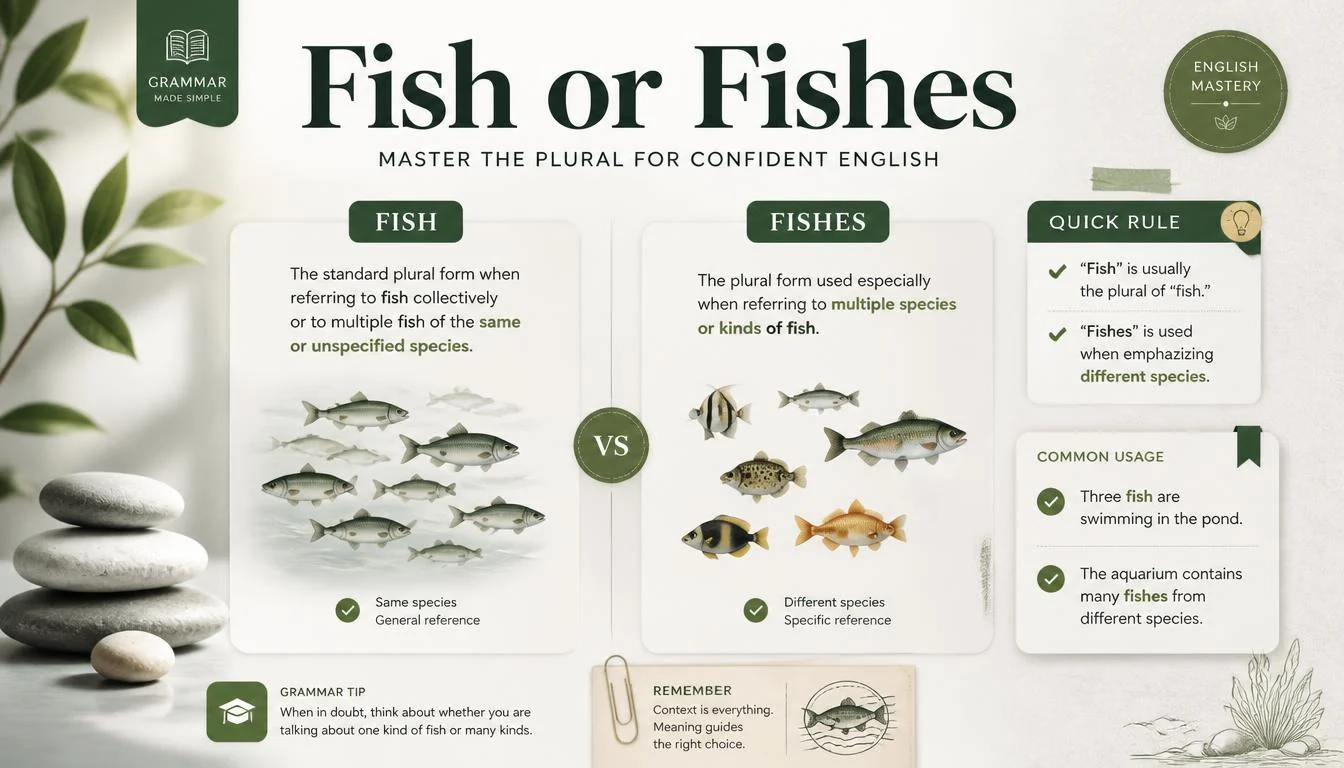
Use fish when referring to multiple individuals of the same species (e.g., “three goldfish”) or as a collective noun for all fish as a group. Use fishes when referring to multiple species of fish (e.g., “the aquarium contains several different fishes”). In everyday conversation, fish is almost always the correct choice .
If you have ever paused mid-sentence wondering whether to say “look at all those fish” or “look at all those fishes,” you are not alone. This is one of those quirky English grammar questions that even native speakers occasionally stumble over. The confusion is understandable: most plural nouns simply add an “s,” so why would “fish” be any different?
The short answer is that both words are grammatically correct, but they are used in different contexts. Understanding the distinction between “fish” and “fishes” will make your writing more precise and help you sound more confident, especially in academic or professional settings. This guide will walk you through the simple rule that governs this usage, provide plenty of examples, and even cover a few surprising exceptions to keep you on your toes .
What’s the Difference Between “Fish” and “Fishes”?
The core difference between these two words boils down to one thing: species. Both “fish” and “fishes” are plural forms of the singular noun “fish,” but they are not interchangeable in all contexts .
Meaning and Part of Speech
As a noun, a “fish” is a vertebrate animal that lives in water, breathes through gills, and typically has fins and scales . The word “fish” can also function as a verb, meaning to catch fish or to search for something .
| Feature | Fish | Fishes |
|---|---|---|
| Meaning | One or more fish of the same species; a collective group. | Two or more fish of different species. |
| Part of Speech | Noun (singular and plural) & Verb | Noun (plural) & Verb (3rd person singular) |
| Refers To | A single animal, a group of the same kind, or fish as a general concept. | Multiple species of fish in a specific group. |
| Typical Usage | Everyday conversation, general writing, and most non-scientific contexts. | Scientific writing, biology, conservation, and when emphasizing variety. |
| Example | “The school of fish swam together.” | “The exhibit features many fishes of the Amazon.” |
| Common Confusion | Thinking “fish” is always singular and “fishes” is always the correct plural. | Using “fishes” in everyday conversation where it would sound unnatural. |
Is “Fish” Singular or Plural?
This is the most common point of confusion. The word “fish” itself does double duty. It serves as both the singular form (for one individual) and the plural form (for multiple individuals). This is similar to words like “sheep” or “deer,” where the singular and plural are the same .
Is “Fish” vs. “Fishes” a Grammar, Vocabulary, or Usage Issue?
This question touches on all three areas, but it is primarily a usage issue .
- Grammar: Grammatically, both are accepted plural forms of the same noun.
- Vocabulary: Both words are part of the English vocabulary, but one (“fish”) is far more common.
- Usage: The distinction is about how and when to use each word correctly. It is a stylistic and contextual choice rather than a fundamental rule of grammar.
Neither word is more “correct” than the other in all situations. The correct choice depends entirely on what you are trying to communicate. However, in business English and everyday conversation, “fish” is the default plural. In academic writing, especially in biology, the stricter distinction is often preferred .
A Complete Guide to “Fish”
Meaning and Usage
As a noun, “fish” is your go-to word for almost every situation.
- One fish: “I have a pet fish.”
- Multiple fish of the same kind: “We saw three tropical fish in the tank.”
- A collective group: “Fish live in both saltwater and freshwater.”
- Fish as food: “We are having fish for dinner tonight.” (Here, it is often treated as an uncountable noun like “water” or “rice”) .
Common Collocations
- School of fish: A large group swimming together.
- Fish and chips: The classic British dish.
- Go fishing: The activity of catching fish.
- Fish tank / bowl: An aquarium.
Natural Examples in Context
Workplace Example:
“After the company retreat, a group of us went fishing. We caught about ten fish and released them all.”
Academic Example:
“The study examined the migratory patterns of this particular fish in the Atlantic Ocean.” (Focusing on one species).
Technology Example:
“The new sonar technology allows us to track individual fish in the river system.”
Email Example:
“Thanks for sending over the report. I’ll take a look at it and have some feedback for you by tomorrow. This is the first time I’ve seen the data on fish populations in that area.”
Daily Conversation:
“My son is obsessed with his new fish. He looks at it for hours.”
One Common Learner Mistake
A common mistake is to always add an “s” to make the plural, resulting in an unnatural sounding “fishes” in simple sentences. For instance, saying “I have three fishes” when you have three goldfish. The correct sentence is “I have three fish.”
Mini Recap
- Use fish for one or more individuals of the same species.
- Use fish for the group as a whole.
- Use fish as food.
- Remember: “fish” is both singular and plural.
A Complete Guide to “Fishes”
Meaning and Usage
“Fishes” is a specialized plural form. Its primary use is to highlight biological diversity—specifically, different species . You will most often encounter it in the work of biologists, marine ecologists, and conservationists.
Pronunciation
It is pronounced as two syllables: FISH-iz.
Common Collocations
- Many species of fishes: A direct way to emphasize variety.
- Freshwater / marine fishes: Used in classification and ecology.
Natural Examples in Context
Workplace Example:
“The client’s new aquarium installation will need to house many fascinating fishes, including discus, angelfish, and neon tetras.”
Academic Example:
“The biodiversity of these ancient fishes is essential to understanding evolutionary history” .
Technology Example:
“Our AI model is trained to identify different fishes in underwater images, helping to monitor reef health.”
Email Example:
“In the attached paper, I have outlined the different types of fishes we observed at the coral reef site. The data is organized by species.”
Daily Conversation:
“You wouldn’t believe it! The snorkeling guide pointed out all the different fishes—parrotfish, damselfish, and even a couple of moray eels!”
One Common Learner Mistake
The mistake is using “fishes” incorrectly in a context that is not about species. For instance, saying “I went to the market and bought several fishes for the restaurant” is incorrect. Unless you are specifying that you bought multiple species (like salmon and cod and tuna), you should say “I bought several fish.”
Mini Recap
- Use fishes when specifically referring to more than one species.
- Its use is mostly restricted to scientific and formal academic contexts.
- When in doubt, “fish” is almost always the safer choice .
When Not to Use Each Word
Situations Where “Fish” is Always Correct
- When referring to a single animal: “I saw a fish jump out of the water.” Using “fishes” here would be a clear mistake.
- When talking about food: “I prefer fish to meat.” “Fishes” is never used to describe food in this way.
- When talking about a group of fish of the same kind: “There are a lot of fish in this lake.”
- In idioms: “There are plenty of other fish in the sea.” This phrase is used to comfort someone who has lost a romantic partner, implying they will find another.
Situations Where “Fishes” Might Be Necessary
- When emphasizing different species: “This region is home to over 200 different fishes.”
- In scientific writing: The word “fishes” is a standard term in taxonomy and ichthyology (the study of fish) .
- In certain idioms: You might hear the phrase “Loaves and fishes” in a religious context, or “sleep with the fishes” in the context of a mafia movie. These are fixed expressions where “fishes” is the standard wording .
Common Mistakes Table
| Correct Sentence | Incorrect Sentence | Explanation |
|---|---|---|
| I bought three goldfish. | I bought three goldfishes. | Since all the fish are the same species (goldfish), the correct plural is “fish.” |
| The study examines 10 fish species. | The study examines 10 fishes species. | “Fishes” is not an adjective. Use it only as a plural noun. |
| We are having fish for dinner. | We are having fishes for dinner. | “Fishes” is not used to describe fish as a food. |
| The diver saw a school of fish. | The diver saw a school of fishes. | A “school” typically consists of fish of the same species. |
| The aquarium has many fishes. | The aquarium has many fish of different types. | This is a rare exception where “fishes” would be accepted to emphasize variety. |
Decision Box
- If you mean one animal, use fish.
- If you mean multiple animals of the same kind, use fish.
- If you mean fish as food, use fish.
- If you mean multiple different types or species of fish, use fishes.
Real-World Examples of Correct Usage
Office Communication
“The head of the science department requested a report on the freshwater fish in the state’s rivers. We’ll focus on identifying which species of fishes are endangered.”
Business Email
“Subject: Proposal for Aquarium Partnership. We are proposing an exhibit that showcases the diversity of marine fishes found in the Pacific Northwest.”
School or University
Professor: “Good morning. Today we will be discussing the various families of fishes that developed during the Devonian period.”
Student: “Did you say fishes?”
Professor: “Yes. I’m referring specifically to the many distinct groups that evolved.”
Customer Support
“We can certainly help you choose the right food for your fish. Can you please tell me what types of fishes you have in your tank?”
Technology
“The new camera system has a feature that can count the number of individual fish in a school, and even categorize different fishes based on shape and color.”
Daily Conversation
“We went to the aquarium yesterday. It was amazing to see the jellyfish and all the colorful fishes from the Great Barrier Reef.”
“Fish” and “Fishes” in Modern Technology
With the rise of conversational AI and smart devices, precise language is more important than ever . While these distinctions matter less to a voice assistant like Siri or Alexa (they are designed to understand natural language), they are critical in technical fields.
For instance, in software designed for marine biology, the distinction between “fish” and “fishes” is semantically important. A database query for “fish populations” might return a count of individuals, whereas a query for “fishes” might be designed to return a list of different species. As a content creator or business writer, understanding this nuance will help you optimize your content for voice search and ensure it is interpreted correctly by AI systems.
Word Origin
The word “fish” comes from the Old English word “fisc,” which has Germanic roots. For centuries, “fish” and “fishes” were used interchangeably for the plural. Over time, “fish” became the dominant form in the English language .
Expert Insight
The confusion is natural, because “fish” doesn’t follow the usual English rule of adding an “s” or “es” to make a plural. To decide which word to use, I often suggest my students visualize the scenario. Are they looking at a bowl of identical guppies? Then they are looking at “fish.” Are they looking at a reef that houses clownfish, angelfish, and parrotfish? Then they are looking at “fishes.” The distinction is not just about grammar; it is about paying attention to the world around you.
Error Prevention Checklist
- □ Always use “fish” when: You are talking about one fish.
- □ Always use “fish” when: You are talking about a group of the same kind.
- □ Always use “fish” when: You are referring to the animal as a food source.
- □ Never confuse them if: You are unsure. Just use “fish”—it is correct 90% of the time .
- □ Quick memory tip: “One fish, two fish, same kind, use fish.” “Different fishes, different species, use fishes.”
Related Grammar Confusions
- Effect vs. Affect: A classic pair of easily confused words.
- Principal vs. Principle: This pair often trips up students.
- It’s vs. Its: A common punctuation error with a simple rule.
- Your vs. You’re: One of the most common errors in English writing.
- Loose vs. Lose: Another pair that is frequently misspelled.
- Accept vs. Except: These words sound similar but have opposite meanings.
- Who vs. Whom: A grammar rule that many native speakers avoid.
- That vs. Which: This distinction can determine whether a sentence is grammatically correct or not.
- Comprise vs. Compose: A more advanced grammar point that is worth learning.
FAQs
What is the difference between “fish” and “fishes”?
“Fish” is the standard plural for one or more fish of the same kind. “Fishes” is a specialized plural used in biology to refer to multiple different species of fish .
Is “fishes” grammatically correct?
Yes, “fishes” is grammatically correct. However, its use is limited mostly to scientific or academic contexts when discussing biodiversity and species variation.
When should I use “fishes”?
Use “fishes” when you want to emphasize that you are talking about more than one type or species of fish. For example, “The reef contains many different fishes, including tangs and butterflyfish.”
What is the plural of “fish”?
The most common plural of “fish” is simply “fish.” It is an irregular plural that is the same as the singular form .
Is “fish” singular or plural?
“Fish” is used for both singular and plural contexts. You would say “one fish” and “two fish” .
Conclusion
The distinction between “fish” and “fishes” is a perfect example of how English is a language of nuance and context. At its core, the rule is straightforward: “fish” is your standard everyday plural, while “fishes” is the specialized term used when you are talking about different species.
Mastering this difference is a sign of a careful and attentive writer. It demonstrates an understanding of the subject matter and an ability to communicate with precision. The next time you’re writing, remember this simple rule, and you’ll be sure to choose the right word. When you are in doubt, just remember the golden rule: “fish” is almost always the safest choice.
Read More Related Articles:
- Lended or Lent | Easy Way to Remember the Difference In 2026
- Addition vs Edition | Key Difference You Need to Know In 2026
- Nosy or Nosey | Simple Guide to Getting the Spelling Right In 2026

Caleb Dawson is a content writer at synoseek.com, where he works on simple, reader-focused articles across a range of everyday topics. His writing style is practical and grounded, aiming to present information in a clear and relatable way without unnecessary complexity.
2 thoughts on “Fish or Fishes | Right Choice for Every Context In 2026”