Quick Answer
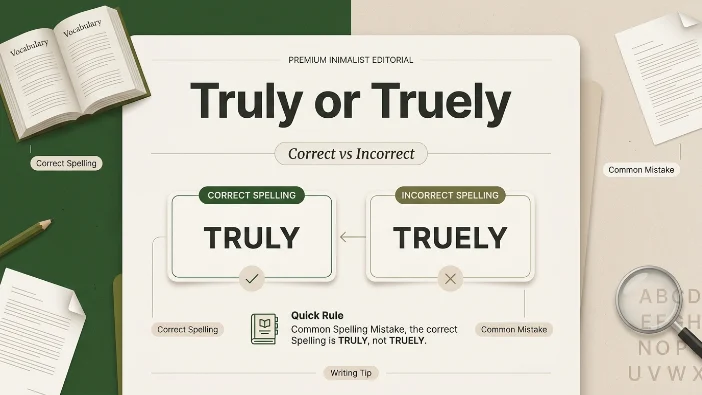
The correct spelling is truly. “Truely” is a common misspelling and should never be used in professional writing, academic work, or everyday communication. The word means “in a truthful manner” or “genuinely” and follows an unusual spelling rule where the silent “e” is dropped before adding “-ly.
You’re drafting an important email. You want to express sincere appreciation, so you type “I am truely grateful” and hit send. Later, you spot the red underline or worse, a colleague points out the error. That small spelling mistake undermines your credibility in seconds.
The confusion between “truly” and “truely” plagues even experienced writers. Despite the word’s straightforward meaning, its unusual spelling trips up professionals, students, and native English speakers alike. The rule seems inconsistent: we keep the “e” in “nice” to make “nicely,” but drop it completely in “true” to make “truly.” This irregularity is precisely why so many people second-guess themselves.
This guide explains everything you need to know about using “truly” correctly. You’ll learn why “truely” is always incorrect, discover memory tricks to prevent future mistakes, and see how professionals use this word effectively in real-world contexts. By the end, you’ll never hesitate when choosing between these two spellings again.
What’s the Difference Between Truly and Truely?
The difference is simple: one is correct, and the other is a spelling error. Truly is the only correct spelling for the adverb meaning “in a truthful way,” “genuinely,” or “sincerely.” Truely is a misspelling that appears because writers incorrectly assume you keep the silent “e” when adding “-ly” to “true.
| Aspect | Truly | Truely |
|---|---|---|
| Meaning | Genuinely, sincerely, truthfully | No meaning (incorrect spelling) |
| Part of Speech | Adverb | Not applicable |
| Refers To | Manner, degree, or sincerity | Not applicable |
| Typical Usage | Expressing sincerity, confirming accuracy, emphasizing truth | Never used |
| Example | “She was truly sorry for the mistake.” | ❌ Incorrect |
| Common Confusion | Writers add the “e” from “true” before “-ly” | Always a spelling error |
Truly functions as an adverb that modifies verbs, adjectives, or other adverbs. It appears in countless professional, academic, and everyday contexts. The word is particularly valuable in business writing where sincerity and precision matter.
Truely, by contrast, appears in no standard dictionary. Major authorities like Merriam-Webster, Oxford, and Cambridge list only “truly” as the correct form. If you use “truely,” careful readers will notice immediately.
The confusion stems from the typical rule for adding “-ly” to adjectives ending in “e.” Words like “nice” become “nicely,” “polite” become “politely,” and “complete” become “completely.” This regular pattern makes writers expect “true” to become “truely.” However, English has many exceptions, and this is one of the most common.
Is Truly a Grammar, Vocabulary, or Usage Issue?
This question touches on spelling, usage, and vocabulary simultaneously, but the core issue is primarily spelling with significant implications for vocabulary and usage.
Classification
Spelling Issue: The most straightforward classification is spelling. “Truly” follows an unusual spelling pattern where the silent “e” from “true” disappears completely. This irregular spelling causes most of the confusion.
Vocabulary Issue: Understanding “truly” as a vocabulary term means knowing its precise meaning and appropriate contexts. The word has multiple uses: expressing sincerity (“I truly appreciate your help”), indicating accuracy (“Is that truly the case?”), emphasizing genuineness (“a truly remarkable achievement”), and confirming truth (“He spoke truly”).
Usage Issue: Using “truly” correctly involves knowing when to deploy it in formal versus informal settings, understanding its role in business and academic writing, and recognizing that modern usage sometimes treats it as an intensifier rather than strictly meaning “truthfully.
Are They Interchangeable?
No, because “truely” is not a word. Writers sometimes use “truely” thinking it’s correct, but no standard English grammar system recognizes it. There is no context where “truely” would be acceptable.
Formality Across Contexts
| Context | Usage Recommendation |
|---|---|
| Formal English | “Truly” is formal and appropriate for academic papers, official documents, and professional correspondence. |
| Business English | Standard and widely used in professional communication, especially in phrases like “truly appreciate,” “truly committed,” and “truly sorry.” |
| Academic Writing | Acceptable but should be used sparingly; academic style often prefers more precise terms. |
| Everyday Conversation | Common and natural in spoken English, often as an intensifier (“I’m truly excited”). |
Practical Takeaway
“Truly” is a versatile adverb acceptable across all English registers. The only real issue is spelling remember to drop the “e” from “true” before adding “-ly.” Once you master this exception, you’ll avoid one of English’s most common spelling traps.
Truly: Complete Usage Guide
Meaning and Pronunciation
Truly (pronounced /ˈtruːli/) functions as an adverb with three primary meanings:
- In a truthful or sincere manner: “She spoke truly about her intentions.”
- Genuinely or really: “The museum was truly impressive.”
- Undoubtedly or certainly: “A truly unique opportunity.”
Part of Speech
Adverb it modifies verbs, adjectives, and other adverbs.
Common Collocations
- Truly appreciate
- Truly believe
- Truly remarkable
- Truly sorry
- Truly grateful
- Truly unique
- Truly committed
- Truly understand
- Truly wonderful
- Truly exceptional
Typical Sentence Patterns
Pattern 1: Truly + Verb
- “I truly believe we can achieve this goal.”
- “She truly understands the complexity of the situation.”
Pattern 2: Truly + Adjective
- “The performance was truly outstanding.”
- “This is a truly significant discovery.”
Pattern 3: Truly + Comparative
- “He worked truly harder than anyone else.”
Pattern 4: Be + Truly + Past Participle
- “We are truly honored to host you.”
- “I am truly grateful for your support.”
Workplace Example
“The board is truly committed to implementing these changes, and we genuinely appreciate the team’s extraordinary efforts throughout this transition.”
Academic Example
“The findings represent a truly novel contribution to the field of cognitive neuroscience, challenging assumptions that have persisted for decades.”
Technology Example
“Machine learning algorithms have become truly sophisticated, enabling applications that seemed impossible just five years ago.”
Email Example
“Dear Ms. Chen,
I am truly sorry for the confusion regarding the project timeline. We are working diligently to resolve the issues and will provide an updated schedule by Friday.”
Daily Conversation Example
“That’s truly the best pizza I’ve ever had. I’m not exaggerating it’s incredible.”
Learner Mistake
Incorrect: “I am truely thankful for your help.”
Correct: “I am truly thankful for your help.”
Why it happens: Writers mistakenly keep the “e” from “true” when adding “-ly,” applying the more common pattern seen in words like “definitely” (from “definite”) or “politely” (from “polite”).
Mini Recap
Remember that “truly” follows a unique spelling rule. Drop the “e” from “true” and add “-ly.” This irregularity is the sole reason for the widespread confusion with “truely.” Practice writing “truly” several times to build muscle memory.
Truely: Why This Spelling Is Always Incorrect
Meaning and Pronunciation
Truely has no meaning. It is a misspelling of “truly” that occurs when writers incorrectly assume the “e” from “true” carries over. Dictionaries do not recognize “truely” as a word.
Why the Mistake Happens
The error stems from a logical but incorrect application of spelling rules. Most adjectives ending in silent “e” keep that “e” when adding “-ly”:
- nice → nicely
- polite → politely
- definite → definitely
- fortunate → fortunately
- complete → completely
“True” breaks this pattern. Instead of becoming “truely,” the silent “e” drops away entirely. This exception makes English less predictable but also creates one of the most common spelling errors in the language.
What Happens If You Use It
Using “truely” communicates one thing clearly: you haven’t mastered this basic spelling rule. In professional contexts, spelling errors like this can:
- Undermine your credibility
- Distract from your message
- Suggest carelessness or lack of attention to detail
- Lead readers to question your expertise
Learner Mistake
Incorrect: “I found the presentation truely inspiring.”
Correct: “I found the presentation truly inspiring.”
Why it happens: The writer hears the “e” sound in “true” and assumes it must appear in the derived adverb. This phonetic reasoning leads many learners astray.
Memory Aid
Remember this simple rule: “True” loses its “e” to become “truly.” Think of it as “true” donating its “e” to nowhere it simply disappears when you add “-ly.
When Not to Use “Truely”
Since “truely” is never correct, this section covers six situations where writers commonly choose the wrong form and what to use instead.
1. Professional Email Openings
The Mistake: “I am truely grateful for this opportunity.”
Why It Happens: Writers rush through email greetings and rely on autocorrect, which may not flag “truely” if they’ve accidentally added it to their dictionary.
The Fix: Always use “truly” in professional correspondence. “I am truly grateful for this opportunity” conveys sincerity correctly.
2. Academic Writing
The Mistake: “The experiment’s results were truely groundbreaking.”
Why It Happens: Students often confuse the spelling when writing quickly under pressure.
The Fix: Use “truly” or consider alternatives like “genuinely” or “remarkably” to vary your vocabulary.
3. Job Applications and Cover Letters
The Mistake: “I am truely passionate about this position.”
Why It Happens: Candidates want to sound sincere but focus on content rather than spelling details.
The Fix: “I am truly passionate about this position” demonstrates both sincerity and attention to detail.
4. Professional Social Media
The Mistake: “I’m truely honored to work with this team.”
Why It Happens: Social media encourages quick posting without careful proofreading.
The Fix: Take an extra moment to verify “truly” before posting. Your professional reputation matters.
5. Client Communication
The Mistake: “We are truely sorry for any inconvenience.”
Why It Happens: Even experienced professionals rush when drafting apologies or sensitive messages.
The Fix: “We are truly sorry” shows you care enough to write correctly.
6. Formal Thank-You Notes
The Mistake: “Thank you truely for your kindness.”
Why It Happens: Handwritten notes or quick thank-you emails often lack careful proofreading.
The Fix: “Thank you truly” or “Truly, thank you” are both correct and elegant.
Memory Tip
If you’re unsure about spelling, substitute “really” or “genuinely” in your sentence. If either fits the meaning, you need “truly.” This substitution test helps confirm your choice without relying on spelling rules.
Common Mistakes: Truly vs. Truely
| Correct Sentence | Incorrect Sentence | Explanation |
|---|---|---|
| “I truly appreciate your feedback.” | “I truely appreciate your feedback.” | The adverb form of “true” drops the silent “e” before adding “-ly.” |
| “This is truly an exceptional achievement.” | “This is truely an exceptional achievement.” | Writers mistakenly apply the pattern from “nicely” (nice→nicely) to “true.” |
| “She spoke truly about the company’s mission.” | “She spoke truely about the company’s mission.” | The correct spelling has only one “e” in the final word. |
| “We are truly honored to be here.” | “We are truely honored to be here.” | “Truly” functions as an adverb modifying the adjective “honored.” |
| “His dedication is truly inspiring.” | “His dedication is truely inspiring.” | The spelling error distracts readers from the genuine compliment. |
| “A truly transformative experience.” | “A truely transformative experience.” | Even in short phrases, the misspelling stands out to careful readers. |
Decision Box
Need to express sincerity, genuineness, or truth?
→ Use Truly
Trying to spell the adverb form of “true”?
→ Use Truly (drop the “e”)
Wondering if “truely” is acceptable anywhere?
→ No. Never. It’s always incorrect.
Unsure if you’re spelling it right?
→ Think: “True” loses its “e” to become “truly.”
Real-World Examples of Truly in Action
Office Communication
“After reviewing the quarterly results, I’m truly impressed by the sales team’s performance. Their dedication has made a remarkable difference.”
Business Email
“Dear Dr. Morrison,
We are truly grateful for your continued partnership. The insights you’ve shared have been invaluable to our development process. We look forward to collaborating on future initiatives.”
University Setting
“The professor’s feedback was truly constructive. Her detailed comments helped me understand where my argument needed strengthening and how to refine my research approach.”
Customer Support
“We are truly sorry for the shipping delay. Our team is working around the clock to ensure your order arrives by Wednesday at the latest.”
Technology Context
“AI has become truly integrated into everyday tools. From email sorting to voice recognition, machine learning capabilities have transformed how we interact with devices.”
Artificial Intelligence
“The latest language models demonstrate truly remarkable reasoning capabilities. They can analyze complex problems and generate nuanced responses that feel increasingly human-like.”
Daily Conversation
“Truly? I had no idea you’d been working on that project for months. Your presentation was flawless.”
Truly in Modern Technology
The word “truly” appears frequently in technology contexts, often to emphasize the genuine nature of innovations or capabilities.
Artificial Intelligence
When discussing AI, “truly” often signals that a system has achieved authentic intelligence or capability, not merely simulated it. “This model truly understands context” suggests the AI has moved beyond pattern matching to genuine comprehension.
Virtual Assistants
Products like Siri, Alexa, and Google Assistant are described as “truly helpful” when they go beyond basic commands to understand user intent. The word suggests genuine assistance rather than simple automation.
Voice Assistants
“Truly hands-free operation” indicates that voice commands are reliable enough to replace physical interaction entirely. The word emphasizes the system’s reliability and natural interaction.
Chatbots
Companies describe advanced chatbots as “truly conversational” when they can maintain coherent, context-aware discussions without falling back on scripted responses.
Software
“Truly intuitive software” suggests the user interface requires minimal learning and feels natural to use.
Business Tools
Enterprise products are “truly scalable” when they can handle growth without performance degradation or architectural changes.
The Technology Takeaway
In tech, “truly” often serves as a benchmark marker. It suggests a product or system has achieved a meaningful milestone beyond superficial or limited capabilities. When you see “truly” in technology marketing, it typically signals genuine innovation rather than incremental improvement.
Word Origin: Where Did Truly Come From?
Etymology
Truly entered English from Old English “triewe” or “treowe,” meaning “faithful, trustworthy, or honest.” The word has deep Germanic roots, with related forms appearing in:
- Old Saxon “triuwi” (faithful)
- Old High German “triuwi” (trustworthy)
- Old Norse “tryggr” (true, reliable)
- Proto-Germanic “trewwjaz” (having faith or trust)
The Historical Spelling Development
In early Middle English, the word appeared as “treuli” and “treowlice,” reflecting its Old English origins. Over time, pronunciation and spelling simplified to “truli” and eventually “truly.” The silent “e” from “true” disappeared entirely in the adverb form, a pattern that became fixed by the 15th century.
Why It Matters
Understanding the word’s history provides a memory hook. Truly” comes from words meaning “faithful” and “trustworthy.” Its spelling reflects centuries of linguistic evolution, not a random exception designed to frustrate learners.
The irregularity exists because English spelling often preserves historical forms while pronunciation shifts. The silent “e” in “true” represents a historical pronunciation that no longer exists, and when English shortened the adverb, the extra “e” simply faded away.
Expert Insight
The confusion between “truly” and “truely” presents a perfect teaching moment about English spelling patterns. What makes this particular error so persistent isn’t the word itself it’s the assumption that English follows consistent rules.
Most learners encounter “nicely,” “politely,” and “definitely” before they learn “truly.” These examples create a mental pattern: adjective ending in “e” plus “-ly” equals keeping that “e.” When students apply this pattern to “true,” they naturally produce “truely.”
The solution lies not in memorizing a list of exceptions but in recognizing that English spelling operates differently from other languages. It preserves historical forms, reflects pronunciation changes, and tolerates inconsistency. “Truly” is one of hundreds of words where the spelling defies a general pattern.
For writers, the practical strategy is verification. If you’re unsure about any adverb’s spelling, check a dictionary or use a reliable spelling checker. Building this habit is more valuable than memorizing every exception. The best writers aren’t those who know every rule but those who verify what they’re uncertain about.
Error Prevention Checklist
Always use “truly” when:
- Expressing sincere appreciation or gratitude
- Emphasizing the genuine nature of something
- Confirming that a statement is accurate or honest
- Describing an exceptional or remarkable quality
- Writing in any professional or academic context
Never use “truely”:
- In professional correspondence
- In academic papers
- In business writing
- In everyday communication
- Anywhere it’s always incorrect
Quick Memory Tip:
- “True” drops its “e” to become “truly.”
- Visualize the “e” falling away before you add “-ly.”
- If you’re tempted to write “truely,” mentally substitute “really.” If “really” works, you need “truly.”
- Practice writing “truly” correctly five times to build muscle memory.
Related Grammar Confusions
Learning about “truly” often leads to questions about other commonly confused or misspelled words. These related topics help you build broader language skills.
- Definitely vs. Defiantly – One is about certainty, the other about resistance. Don’t confuse these common spelling missteps.
- Separate vs. Seperate – This spelling confusion rivals “truely” in frequency and importance.
- Affect vs. Effect – The classic grammar confusion that every writer should master for professional communication.
- Then vs. Than – One relates to time, the other to comparison; mixing them changes sentence meaning entirely.
- Its vs. It’s – The apostrophe difference that tripped up many professionals in formal writing contexts.
- Your vs. You’re – A common error that suggests carelessness in professional communication.
- There vs. Their vs. They’re – The triple threat of English grammar that deserves careful attention.
- Accept vs. Except – One means “receive,” the other means “excluding,” and the difference matters.
- Principle vs. Principal – Confusing the standard rule with the person in charge can embarrass any professional.
- Stationary vs. Stationery – The spelling difference reflects distinct meanings: motionless versus writing supplies.
Each of these topics represents another opportunity to strengthen your professional writing skills. Master them progressively, and your written communication will become measurably more effective.
FAQs
Is “truely” ever correct in British English?
No. “Truly” is the standard spelling in British, American, Australian, and Canadian English. The misspelling “truely” is not accepted as an alternative form in standard English. If you are writing in any major English variety, truly is the correct choice.
Why do so many people spell it “truely”?
The confusion comes from a common spelling pattern. Many adjectives ending in a silent e keep that letter when ly is added, as in nice → nicely. Writers often assume true follows the same pattern. However, true → truly is an exception because the final e is dropped.
What’s the easiest way to remember the correct spelling?
Use a simple rule: true loses its e before becoming truly. Think of the transformation as true → truly. If you remember that the final e disappears, you’re much less likely to write truely by mistake.
Can I use “truly” in formal academic writing?
Yes. “Truly” is perfectly acceptable in academic writing, although it should have a clear purpose. It can emphasize sincerity, authenticity, or the strength of a statement. In highly formal academic work, a more precise adverb may sometimes be preferable, so avoid using truly merely to add emphasis.
What are some words similar to “truly”?
Depending on the context, alternatives include genuinely, sincerely, honestly, really, actually, authentically, and indeed. These words aren’t exact substitutes in every sentence. For example, genuinely often emphasizes authenticity, while sincerely is more closely associated with feelings or intentions.
Is “truly” used differently in American and British English?
The spelling is the same in both varieties, and its core meaning does not change. “Truly” can express sincerity, emphasize a quality, or confirm that something is genuine. Its frequency may vary by context and writing style, but there is no British or American spelling variant.
How can I tell whether I’m using “truly” correctly?
Look at what “truly” is doing in the sentence. If it emphasizes sincerity, genuineness, or the truth of a statement, it is likely appropriate. You can also try replacing it with genuinely or really to see whether the sentence still makes sense. Most importantly, remember the spelling: truly, not truely.
Does “truly” only relate to truth?
No. Although the word is closely connected with truth and accuracy, modern English uses “truly” in several ways. It can express sincerity, as in “I’m truly sorry,” emphasize a quality, as in “a truly remarkable achievement,” or confirm something, as in “She truly understood the situation.”
Conclusion
The distinction between “truly” and “truely” is straightforward: one is correct, the other is always a misspelling. Truly is the only acceptable form for expressing sincerity, genuineness, or truthfulness in any professional, academic, or casual context.
Remember that “true” drops its “e” to become “truly.” This simple rule prevents the spelling error that plagues so many writers. The word’s unusual spelling reflects its long history in English, not a random exception designed to confuse.
Next time you write “I am truly grateful,” “this is truly remarkable,” or “he spoke truly,” you can proceed with confidence. Your readers will notice your attention to detail, and your professional credibility will remain intact.
The best writers verify what they’re uncertain about. If you ever hesitate between “truly” and “truely,” pause, check the spelling, and remember: the “e” disappears. This small habit will make you a more careful and trusted communicator.
8 thoughts on “Truly or Truely | Simple Guide to Getting It Right In 2026”