Quick Answer:
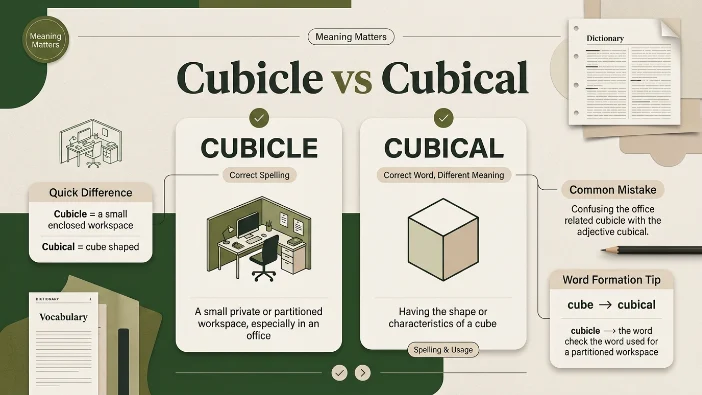
In the cubicle vs cubical comparison, a cubicle is a noun that means a small, partly enclosed workspace, while cubical is an adjective that describes something shaped like a cube. They sound almost identical, but one names a place and the other describes a shape. Mixing them up is a common spelling slip, not a grammar error.
The difference between cubicle vs cubical can be confusing because both words look and sound similar. However, they have different meanings and grammatical uses. Cubicle is usually a small enclosed workspace or compartment, while cubical is an adjective meaning cube-shaped or relating to a cube.
Understanding cubicle vs cubical can help you avoid common spelling and word-choice mistakes in professional and everyday English. In this guide, we’ll explain their meanings, pronunciation, examples, and the easiest way to remember which word to use.
Why People Keep Mixing Up These Two Words
If you’ve ever typed “cubical desk” instead of “cubicle desk” and had spellcheck leave it alone, you’re not imagining things. These two words are spelled so closely that even careful writers glance right past the mistake. One extra or missing letter is the only thing separating a workspace from a geometric shape, and that tiny difference rarely gets flagged because both words are technically correct English just correct for different situations.
The confusion isn’t really about grammar. It’s about spelling and meaning colliding at the same time. Cubicle refers to the small partitioned space where an office worker sits, typically boxed in by low walls on three sides. Cubical, on the other hand, describes anything shaped like a cube six equal square sides, like a die or a block of ice. Once you separate the noun from the adjective, the confusion mostly disappears.
Getting this wrong matters more than people assume, especially in professional writing. A resume that mentions working in a “cubical” instead of a “cubicle” reads as a typo to any hiring manager who notices it. In technical or architectural writing, describing a room as “cubicle” when you mean “cube-shaped” changes the meaning entirely. This guide breaks down exactly how to tell them apart, when each word fits, and how to stop second-guessing yourself every time you type one of them.
Cubicle vs Cubical: What’s the Difference?
The core difference is simple: cubicle is a noun naming a small enclosed workspace, and cubical is an adjective describing a cube-like shape.
A cubicle is something you sit in. A cubical shape is something you look at and describe. That’s the entire distinction in practical terms, but the details matter when you’re trying to use either word confidently in writing.
Cubicle comes from a tradition of describing small, boxed-off spaces originally bedrooms or sleeping areas, later expanded to office workstations divided by low partition walls. It’s a physical location, always a noun, and it always refers to a space a person can occupy.
Cubical is built from the same root as “cube” and functions strictly as an adjective. It describes the geometry of an object six square faces of equal size the same way “spherical” describes a ball-shaped object or “circular” describes something round.
| Feature | Meaning | Part of Speech | Refers To | Typical Usage | Example |
|---|---|---|---|---|---|
| Cubicle | Small, partly enclosed workspace | Noun | A physical space or booth | Offices, exam halls, changing rooms | “She works in the third cubicle from the window.” |
| Cubical | Shaped like a cube | Adjective | A geometric shape or form | Architecture, math, design, science | “The storage unit had a cubical design.” |
Once you see them side by side, the pattern is easy to remember: if you can replace the word with “box” or “workstation,” you want cubicle. If you can replace it with “cube-shaped,” you want cubical. That mental swap works almost every time and takes the guesswork out of typing either word under deadline pressure.
Is Cubicle vs Cubical a Grammar, Vocabulary, or Usage Issue?
This is primarily a vocabulary issue, not a grammar rule you need to memorize. Both words are spelled correctly and both exist in standard English, so there’s no rule being broken when someone uses one instead of the other just a meaning mismatch.
From a grammar standpoint, the two words don’t even function the same way in a sentence. Cubicle behaves like any countable noun: it takes an article (“a cubicle”), a plural form (“cubicles”), and can be modified by adjectives (“a cramped cubicle”). Cubical behaves like a standard adjective: it sits before a noun (“a cubical shape”) or after a linking verb (“the box is cubical”) and never takes a plural form.
They are not interchangeable in formal English, business writing, or academic contexts. Using “cubical” where you mean “cubicle” isn’t a style choice it changes the sentence’s meaning or makes it grammatically odd, since an adjective can’t occupy the noun slot a sentence needs.
In everyday conversation, people sometimes let the mix-up slide because context makes the intended meaning obvious. But in writing emails, reports, resumes, technical documents the wrong word choice stands out and can make the writer look careless, even when the rest of the writing is strong.
Practical takeaway: If you’re describing a place someone works or sits, you need the noun cubicle. If you’re describing the shape of an object, you need the adjective cubical. There’s no in-between usage where both work equally well.
Cubicle: Full Word Guide
Meaning: A small, partly enclosed area, especially one separated from a larger room by partition walls most commonly used for office workstations, but also for changing rooms, voting booths, and exam seating.
Pronunciation: KYOO-bih-kul (stress on the first syllable).
Part of speech: Noun (countable). Plural form: cubicles.
Common collocations: office cubicle, cramped cubicle, corner cubicle, cubicle wall, cubicle partition, cubicle farm, changing cubicle, exam cubicle.
Typical sentence patterns: “in a cubicle,” “my cubicle,” “the cubicle next to mine,” “a row of cubicles.”
Workplace example: “IT moved my monitor setup to a new cubicle closer to the break room.”
Academic example: “The testing center assigned each student a private cubicle to prevent cheating during the exam.”
Technology example: “The company replaced the old cubicle layout with an open-plan office and shared standing desks.”
Email example: “Quick note I’ve moved to cubicle 14B, so please update the office directory.”
Daily conversation example: “I can hear everything from the cubicle next to mine; the walls barely block any sound.”
One learner mistake: Non-native speakers sometimes write “cubical” when describing their workspace, likely because the two words sound nearly identical when spoken quickly. Reading the sentence aloud and asking “am I describing a place or a shape?” usually catches the error immediately.
Mini recap: Cubicle is always a noun, always a place, and always something a person can physically enter or sit inside.
Cubical: Full Word Guide
Meaning: Shaped like a cube; having six equal square sides. Used to describe the geometry or form of an object.
Pronunciation: KYOO-bih-kul (identical pronunciation to cubicle, which is exactly why the spelling confusion happens so often).
Part of speech: Adjective. No plural form, since adjectives don’t inflect for number in English.
Common collocations: cubical shape, cubical structure, cubical volume, cubical design, cubical block, cubical container.
Typical sentence patterns: “a cubical object,” “the shape is cubical,” “cubical in form.”
Workplace example: “The warehouse team measured the cubical volume of each shipping crate before loading the truck.”
Academic example: “In the geometry unit, students calculated the surface area of a cubical solid using side-length measurements.”
Technology example: “The new modular server rack uses a cubical frame that stacks neatly with other units.”
Email example: “The vendor confirmed the packaging will be cubical rather than rectangular, which should simplify our storage calculations.”
Daily conversation example: “That ice sculpture started out as a cubical block before the artist carved the details.”
One learner mistake: Writers sometimes drop cubical entirely and default to “cube-shaped” because they’re unsure whether the adjective form is even correct. It is correct cubical is standard, dictionary-recognized English, just less common in casual speech than in technical or architectural writing.
Mini recap: Cubical never refers to a place. It only ever describes shape.
When Not to Use Each Word
Don’t use cubical to describe your desk or workspace. This is the single most frequent mistake. Your office space is a cubicle, never cubical, no matter how boxy it looks.
Don’t use cubicle to describe a geometric shape. If you’re talking about a die, a cube-shaped box, or a square building block, the correct word is cubical, not cubicle.
Don’t rely on spellcheck to catch this error. Both words are spelled correctly in isolation, so most spelling tools won’t flag a misused word only grammar-aware tools that understand context will catch it, and even those miss it sometimes.
Don’t assume the words are regional variants of each other. Some learners assume cubical is a British spelling and cubicle is American, similar to “colour” versus “color.” That’s not the case here both spellings are standard everywhere, and the difference is purely meaning-based, not regional.
Don’t use cubical as a noun, even informally. You’ll sometimes see “working in a cubical” in casual writing or social media, but this is a widespread error, not an accepted informal usage. Formal and professional writing should always use cubicle for the noun form.
Don’t confuse either word with “cubicle-shaped” as a compound term. Some writers try to combine the two, writing things like “a cubicle-shaped box,” when the correct and more concise term is simply cubical.
Don’t switch between the two mid-document. If you use cubicle to describe an office space early in a document, don’t accidentally slip into cubical later when referring to the same thing consistency signals careful editing.
Don’t forget the plural rule. Cubicles is correct for multiple workspaces; cubicals is not a standard English word, since adjectives like cubical don’t take a plural form.
Common Mistakes Table
| Correct Sentence | Incorrect Sentence | Explanation |
|---|---|---|
| “I work in the cubicle next to the printer.” | “I work in the cubical next to the printer.” | A workspace is a noun, so it needs cubicle, not the adjective cubical. |
| “The container has a cubical shape.” | “The container has a cubicle shape.” | Describing shape requires the adjective cubical. |
| “Our office has forty cubicles.” | “Our office has forty cubicals.” | Cubical is an adjective and doesn’t take a plural form. |
| “The box is roughly cubical in form.” | “The box is roughly cubicle in form.” | Describing form or geometry always calls for cubical. |
| “She decorated her cubicle with photos.” | “She decorated her cubical with photos.” | A decorated space is a noun usage, which means cubicle is correct. |
Quick Decision Box
If you mean the workspace or booth, use Cubicle.
If you mean cube-shaped, use Cubical.
Ask yourself: “Am I naming a place, or describing a shape?” That single question resolves almost every case in under ten seconds.
Real-World Examples
Office communication: A team lead sends a message saying, “Facilities is reassigning cubicles next week, so expect some shuffling near the west wing.
Business email: A supplier writes, “Our new packaging line produces cubical containers, which should reduce wasted space during freight shipping.”
School or university: A professor announces, “Each student will complete the final exam in an individual cubicle to minimize distractions.”
Customer support: A support agent explains, “The product ships in a cubical box measuring twelve inches on each side.”
Technology: A product description reads, “This modular shelving unit features a cubical frame that connects to additional units for custom configurations.”
Artificial Intelligence: A UX writer drafts help-center copy explaining that an AI assistant’s “workspace” metaphor in a productivity app is sometimes visually represented as a small cubicle icon to suggest a personal, private work area.
Daily conversation: A friend complains, “My new cubicle barely fits my monitor and a coffee mug there’s zero personal space.”
Cubicle and Cubical in Modern Technology
Cubicle shows up in tech contexts mostly as a metaphor or design reference. Software companies building virtual office tools or remote-collaboration platforms sometimes use “cubicle” imagery to represent an individual’s digital workspace, giving remote employees a familiar visual anchor even when they’re working from home. Virtual assistants and productivity apps occasionally use the term loosely when describing a user’s dedicated dashboard or personal work area, borrowing the everyday office association.
Cubical appears more often in technical and hardware contexts. Server racks, modular data-center units, and 3D-printed components are frequently described by their cubical dimensions, since manufacturers need to communicate exact shape and volume. In software that models physical objects CAD tools, architectural design programs, or 3D modeling applications cubical is the standard term for describing cube-shaped elements within a design.
Voice assistants and chatbots rarely need either word directly, but when users ask about office furniture, storage dimensions, or shipping container shapes, getting the distinction right in written responses avoids the kind of small, credibility-damaging error that stands out in professional or technical content.
Word Origin
Both words trace back to the Latin cubus, meaning “cube,” which itself came from the Greek kybos. Cubical stayed closer to that root, developing directly as an adjective describing cube-like shape. Cubicle took a slightly different path it entered English through Latin cubiculum, meaning “bedroom” or “sleeping chamber,” a word built from cubare, “to lie down.” Over centuries, cubicle shifted from describing a small sleeping room to describing any small, partitioned space, eventually landing on its modern meaning as an office workstation in the twentieth century, when open offices began adopting partition-wall designs.
Expert Insight
When I’m teaching this pair to students, I tell them to stop thinking of it as a grammar problem and start thinking of it as a spelling trap with two completely different jobs attached. Cubicle names something; cubical describes something. Once a learner locks in that noun-versus-adjective distinction, the words practically sort themselves the mistake almost always comes from typing on autopilot, not from a genuine misunderstanding of meaning.
Error Prevention Checklist
- Always use Cubicle when naming a workspace, booth, or small enclosed room.
- Always use Cubical when describing a cube-like shape or geometric form.
- Never confuse them if you remember: cubicle = place, cubical = shape.
- Quick memory tip: “cubicle = a place,” since both words end in a sound tied to their meaning cle for a physical space, cal for a shape-describing adjective.
Related Grammar Confusions
- Affect vs Effect one of the most common verb-versus-noun mix-ups in English writing.
- Stationary vs Stationery a spelling trap almost identical in structure to cubicle vs cubical.
- Principal vs Principle another pair separated by a single letter and a big meaning shift.
- Complement vs Compliment easy to confuse in professional emails and reviews.
- Discreet vs Discrete often mixed up in formal and technical writing.
- Elicit vs Illicit a pair where one wrong letter changes the entire meaning of a sentence.
- Farther vs Further useful for writers who want precise distance versus abstract usage.
- Council vs Counsel common in legal, governmental, and academic writing.
- Adverse vs Averse frequently confused in business and formal correspondence.
- Historic vs Historical a subtle distinction that trips up even advanced English learners.
FAQs
Is “cubical” a real word?
Yes. Cubical is a standard English adjective meaning “shaped like a cube” or “relating to a cube.” It is commonly used in technical, mathematical, architectural, and academic contexts.
Can “cubicle” be used as an adjective?
Generally, no. Cubicle is primarily a noun referring to a small enclosed or partitioned space. When it modifies another noun, cubicle-style is often more natural, as in “a cubicle-style workspace.”
Why do “cubicle” and “cubical” sound so similar?
The two words have very similar pronunciations, which makes them easy to confuse in speech. Their meanings, however, are different. Cubicle refers to a small space, while cubical describes something shaped like a cube.
Is “cubical” British English and “cubicle” American English?
No. This is not a British versus American spelling difference. Both words are used in British and American English. The distinction is based on meaning and grammatical function, not region.
What’s an easy way to remember the difference?
Think “cubicle = place” and “cubical = shape.” A cubicle is a small space or enclosure, while something cubical has the form of a cube. This simple association can help you choose the right word quickly.
Does spellcheck catch “cubicle” and “cubical” mistakes?
Usually not. Both cubicle and cubical are correctly spelled English words, so basic spellcheckers may not recognize that you’ve used the wrong one for the context. Careful proofreading is still important.
Conclusion
The difference between cubicle and cubical comes down to one clear rule: cubicle names a place, and cubical describes a shape. One is a noun you can walk into; the other is an adjective you use to describe geometry. Once that distinction clicks, the confusion that trips up so many writers disappears almost instantly.
Next time you’re unsure which word to type, ask yourself whether you’re talking about a workspace or a shape. If it’s a place, reach for cubicle. If it’s a form, reach for cubical. That one habit will keep this common mix-up out of your writing for good.
1 thought on “Cubicle vs Cubical | Usage Rules Every Writer Should Know In 2026”