Quick Answer
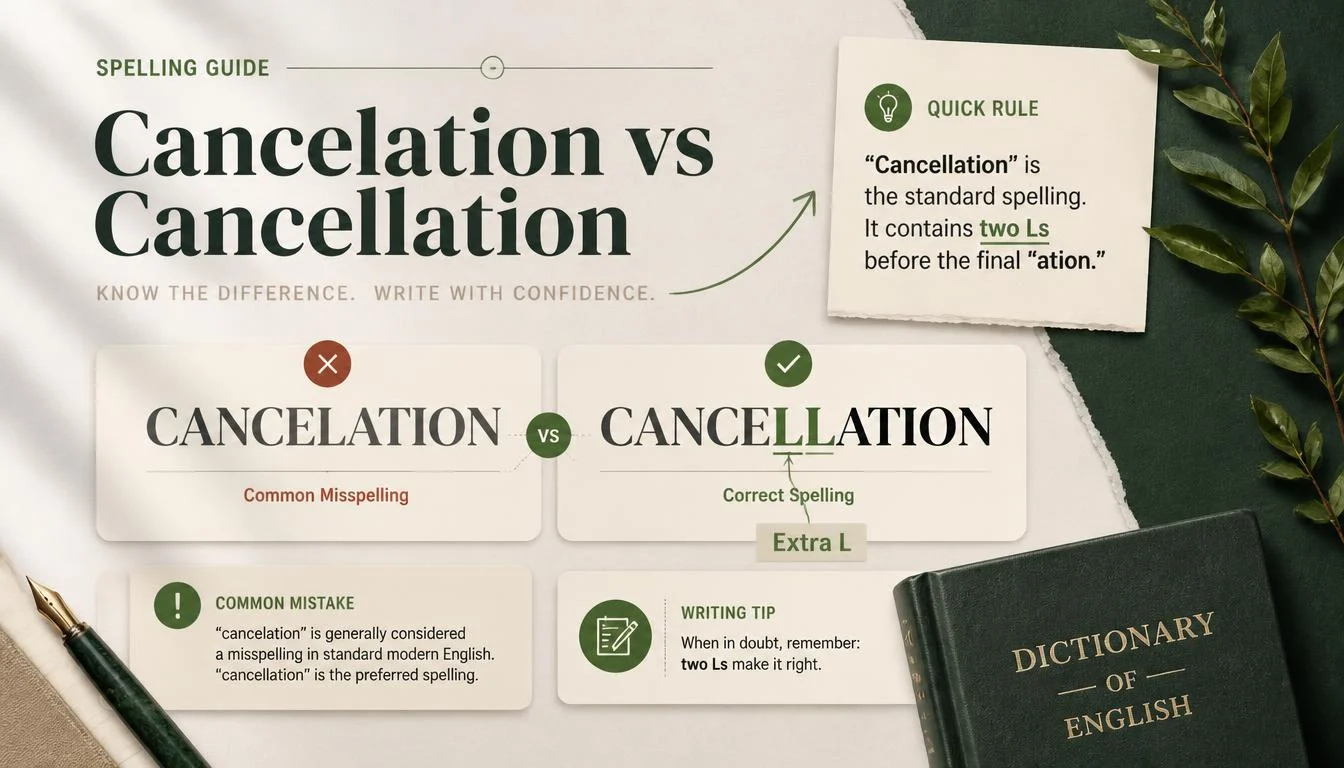
Cancellation (with two L’s) is the correct and standard spelling in both American and British English. Cancelation (one L) is a rare variant that shows up occasionally in American writing, but it isn’t preferred by dictionaries or style guides. If you’re choosing between cancelation vs cancellation for anything you plan to publish, go with the double-L version every time.
If you’re unsure about Cancelation vs Cancellation, you’re not alone. Both spellings appear in English, but they are not equally common or accepted in every context. Understanding the difference can help you choose the correct spelling for emails, articles, and professional documents.
In this guide, we’ll explain whether cancelation or cancellation is the preferred spelling, how each form is used, and which version you should use in everyday and formal writing. You’ll also find simple examples to make the distinction easy to remember.
Why This Word Trips Up So Many Writers
You’re proofreading an email about a flight cancellation, or maybe you’re writing a policy page for your business, and suddenly you stop. One L or two? Your fingers hover over the keyboard because both versions look vaguely familiar, and neither one looks obviously wrong.
Here’s where the confusion actually comes from. English has a habit of dropping a letter here and there when words cross the Atlantic. Americans write “canceled” and “traveled” with one L, while British writers use “cancelled” and “travelled” with two. So it seems logical to assume the noun form follows the same pattern one L for American English, two for British English. That assumption is wrong, and it’s the exact reason this mix-up happens so often.
Getting this right matters more than it might seem. A misspelled word on a cancellation policy, a customer service reply, or a resume can quietly undercut how professional your writing looks, even when everything else about the message is solid. By the end of this guide, you’ll know exactly which spelling to use, why the “one L for American English” rule doesn’t apply here, and how to remember it permanently.
Cancelation vs Cancellation: What’s the Difference?
The core difference isn’t about meaning at all both spellings refer to the exact same thing, which is the act of calling something off or making it void. The real difference is about which spelling is considered standard.
Cancellation, with two L’s, is the form you’ll find as the main entry in Merriam-Webster, Oxford, and Cambridge dictionaries. It’s the spelling used in professional writing, journalism, legal documents, and everyday communication across the United States, the United Kingdom, Canada, and Australia. Cancelation, with a single L, does appear in some American dictionaries as a secondary or “less common” variant, but it’s not the spelling that style guides, editors, or businesses typically recommend.
| Feature | Cancellation | Cancelation |
|---|---|---|
| Meaning | Act of calling something off | Same meaning, rare variant |
| Part of Speech | Noun | Noun |
| Refers To | Ending, voiding, or calling off an event, order, or agreement | Same |
| Typical Usage | Standard in US and UK English, formal and informal writing | Occasional, non-standard, mostly seen in casual American writing |
| Example | “The airline sent a cancellation notice.” | “The airline sent a cancelation notice.” (less recommended) |
| Common Confusion | Assumed to be the British spelling | Assumed to be the “correct” American spelling |
So here’s the short recap: this isn’t really a case of two equally valid regional spellings, like “color” and “colour.” It’s closer to a widely accepted standard spelling and a much less common alternate form. If you want your writing to look polished and error-free, cancellation is the safer, smarter, and more recognized choice in nearly every context.
Is This a Grammar, Vocabulary, or Spelling Issue?
This is purely a spelling issue, not a grammar or vocabulary problem. Both forms are nouns, both come from the verb “cancel,” and both carry the exact same definition. Nothing about sentence structure, tense, or word choice changes depending on which spelling you pick.
Where people get confused is by borrowing a rule that applies somewhere else. American English does drop the second L in words like “canceled,” “canceling,” and “traveler.” British English keeps it, giving us “cancelled,” “cancelling,” and “traveller.” That rule is real but it only applies to the verb forms of “cancel,” not to the noun “cancellation.”
The noun cancellation keeps its double L in both American and British English because of how the word was originally built from Latin, through French, long before American and British spelling norms diverged. In formal English, business English, and academic writing, cancellation is the expected spelling without exception. In everyday conversation and casual writing, you’ll occasionally see cancelation, but it still tends to read as a small error rather than a stylistic choice.
The practical takeaway: memorize cancellation as the one spelling that doesn’t follow the “American English drops a letter” pattern, and you’ll never second-guess it again.
Cancellation: The Complete Guide
Meaning: The noun cancellation refers to the act of stopping, ending, or voiding something that was previously planned, scheduled, or agreed upon an event, a subscription, a flight, a contract, or an order.
Pronunciation: kan-suh-LAY-shun, with the stress falling on the third syllable.
Part of Speech: Noun.
Common Collocations: flight cancellation, order cancellation, cancellation policy, cancellation fee, subscription cancellation, last-minute cancellation, cancellation notice, cancellation rate.
Typical Sentence Patterns: “There was a cancellation of the meeting.” / “Please review our cancellation policy before booking.” / “The store processed the cancellation within 24 hours.”
Here’s how it shows up in real situations:
- Workplace example: “HR sent out a company-wide email about the cancellation of Friday’s team-building event due to the weather.”
- Academic example: “The professor announced the cancellation of the midterm exam after the university closed for the storm.”
- Technology example: “The app now lets users request a subscription cancellation directly from the settings menu, without calling support.”
- Email example: “I’m writing to confirm the cancellation of order #48213, which was processed this morning.”
- Daily conversation example: “Ugh, another cancellation my dentist appointment got pushed to next month.”
One Learner Mistake: Non-native speakers often drop one of the L’s because they’re mentally applying the American “canceled” rule to this word too. It’s an understandable mistake, but cancellation always keeps both L’s, no matter which side of the Atlantic you’re writing for.
Mini Recap: Cancellation is the correct, standard spelling for the noun in all forms of English, used in formal writing, business communication, and everyday speech alike.
Cancelation: What You Need to Know
Meaning: Cancelation carries the identical definition as cancellation it describes the act of calling something off. There’s no separate meaning attached to this spelling; it’s purely a variant form.
Pronunciation: Identical to cancellation kan-suh-LAY-shun.
Part of Speech: Noun.
Common Collocations: You’ll occasionally spot it in phrases like appointment cancelation or reservation cancelation, almost always in informal American writing rather than published or edited material.
Typical Sentence Patterns: “I need to request a cancelation.” / “The cancelation went through fine.”
Realistic contexts where you might still encounter it:
- Workplace example: A quick internal Slack message might read, “Heads up, there’s a cancelation on the calendar for 3pm” casual, unedited, and unlikely to appear in a formal memo.
- Academic example: Rarely used in academic writing, since style guides like APA and Chicago consistently favor cancellation.
- Technology example: Some older or less carefully edited software interfaces use cancelation in error messages or menus, though most modern platforms have standardized on cancellation.
- Email example: You might see it in a hastily typed customer message: “just wanted to confirm the cancelation,” but a professionally written business reply would use cancellation.
- Daily conversation example: In texting or casual chat, spelling often gets simplified, and cancelation slips through without much scrutiny.
One Learner Mistake: Some learners assume cancelation is the “modern” or “simplified” spelling and start using it in formal documents, resumes, or emails. That assumption can quietly make writing look less polished to an editor, teacher, or hiring manager.
Mini Recap: Cancelation isn’t wrong in the sense of being nonexistent, but it’s the less accepted, less professional choice. When in doubt, default to cancellation.
When Not to Use Each Spelling
1. Don’t use cancelation in business documents. Contracts, policies, and official notices should always use cancellation. Using the single-L version can make a document look inconsistent or unedited.
2. Don’t use cancelation in academic papers. Both APA and Chicago style manuals favor cancellation. Professors and editors will likely flag cancelation as an error.
3. Don’t assume cancelation is the British spelling. This is one of the most common mix-ups. British English uses cancellation too the “double the L” pattern for American verb forms doesn’t extend to this noun.
4. Don’t use cancelation in resumes or cover letters. Hiring managers often treat spelling inconsistencies as a signal of carelessness, even when the meaning is perfectly clear.
5. Don’t switch spellings mid-document. If you accidentally use cancelation once and cancellation elsewhere, it reads as an inconsistency rather than a stylistic choice. Pick one cancellation and stick with it throughout.
6. Don’t rely on spell-check alone. Some spell-checkers accept cancelation as a valid word since it does technically exist in some dictionaries, so it won’t always get flagged as an error.
7. Don’t use cancelation in customer-facing communication. Whether it’s a chatbot script, an automated email, or a support ticket response, cancellation keeps your brand voice looking consistent and professional.
8. Don’t assume regional spelling differences apply here. Unlike “color/colour” or “organize/organise,” this isn’t a US vs UK split. It’s simply standard vs. non-standard.
Common Mistakes in Real Sentences
| Correct Sentence | Incorrect Sentence | Explanation |
|---|---|---|
| “Please confirm the cancellation of my subscription.” | “Please confirm the cancelation of my subscription.” | Cancellation is standard in customer service writing. |
| “The cancellation fee is $25.” | “The cancelation fee is $25.” | Business and legal writing should use the double-L form. |
| “We regret to announce the cancellation of tonight’s show.” | “We regret to announce the cancelation of tonight’s show.” | Public announcements read as more polished with cancellation. |
| “Her flight cancellation caused a chain reaction of delays.” | “Her flight cancelation caused a chain reaction of delays.” | Travel and airline industries consistently use cancellation. |
| “The cancellation policy is listed on our website.” | “The cancelation policy is listed on our website.” | Policy documents should always use the standard spelling. |
Quick Decision Box
If you’re writing anything formal, professional, academic, or customer-facing use cancellation.
If you’re texting a friend casually and it slips out as cancelation it won’t cause a misunderstanding, but it’s still not the recommended spelling.
Rule of thumb: When in doubt, add the second L. Cancellation is right almost 100% of the time.
Real World Examples
Office communication: A manager emails the team: “This is a reminder that the cancellation of Thursday’s meeting has been finalized please adjust your calendars.”
Business email: A customer service rep writes: “Your cancellation request has been processed, and you will receive a confirmation email within 24 hours.
School or university: A university website posts: “Due to severe weather, the cancellation of all evening classes is now in effect.”
Customer support: A support chat message reads: “I understand you’d like to proceed with the cancellation of your order. Let me walk you through the next steps.”
Technology: A software update note states: “We’ve simplified the cancellation flow so users can cancel their plan in under 30 seconds.”
Artificial Intelligence: An AI-powered scheduling assistant might generate a message like: “I’ve detected a scheduling conflict and recommend cancellation of the 2pm call.”
Daily conversation: “Did you hear about the cancellation of the concert? Everyone’s asking for refunds.”
Cancellation in Modern Technology
Modern software and AI tools deal with cancellations constantly, from subscription management to appointment scheduling, and the spelling choice matters more than people expect in this space.
Virtual assistants and chatbots the kind built into banking apps, streaming services, and airlines almost universally use cancellation in their scripted responses and confirmation messages. This consistency matters because these tools often serve global audiences, and cancellation reads as correct and professional regardless of whether the user is in New York, London, or Sydney.
AI writing tools and grammar checkers, including many built into email clients and document editors, will typically flag cancelation as a less-preferred spelling or suggest cancellation as the correction. Voice assistants like the ones on smartphones will recognize both spellings when transcribing speech, but when generating written confirmations, they default to cancellation as well.
For businesses building automated systems order management platforms, appointment booking software, or customer service bots standardizing on cancellation across every template, notification, and interface label helps maintain a consistent, professional brand voice at scale.
A Quick Look at Word Origin
Cancellation traces back to the Latin word “cancellare,” meaning to cross out or make void, which itself comes from “cancelli,” referring to a lattice or crossed bars picture someone drawing an X-shaped mark over a document to invalidate it. The word moved through French before settling into English with its double-L spelling intact.
This history explains why cancellation doesn’t follow the same simplification pattern as “canceled” or “traveled.” Those verb forms picked up their American spelling simplification much later, during 19th-century efforts (largely driven by Noah Webster) to streamline American spelling. The noun cancellation, however, had already been borrowed directly from its Latin and French roots with the double L, and that spelling stuck on both sides of the Atlantic.
Expert Insight
Here’s a memory trick that tends to work well with students: think of the double L in cancellation as mirroring the double L in “parallel” or “syllable” words that also came into English through Latin and French with their doubled consonants preserved. If a word feels like it has “old” roots, there’s a decent chance the extra letter has stuck around regardless of which side of the ocean you’re writing from. Cancellation is one of those words that simply never got the simplification treatment that “canceled” and “traveled” did, and once you see that pattern, the spelling stops feeling random.
Error Prevention Checklist
- Always use cancellation in professional emails, contracts, policies, and academic writing.
- Always use cancellation when writing for a global or mixed US/UK audience.
- Never confuse this word with “canceled” or “traveled” those verb forms do drop the extra letter in American English, but cancellation does not.
- Quick memory tip: If you can imagine a British person and an American person both writing the word the exact same way, that’s cancellation.
Related Grammar Confusions Worth Learning
- Canceled vs Cancelled This is the actual US vs UK spelling split that people often confuse with cancellation.
- Traveled vs Travelled Follows the same American-drops-a-letter pattern as canceled.
- Fulfil vs Fulfill Another word where American and British spelling genuinely diverge.
- License vs Licence British English separates the noun and verb spelling; American English doesn’t.
- Judgment vs Judgement A classic case of one letter making writers pause mid-sentence.
- Practice vs Practise British English treats these as different parts of speech; American English uses “practice” for both.
- Gray vs Grey A true regional spelling variant, unlike cancelation vs cancellation.
- Enrollment vs Enrolment Mirrors the same double-letter confusion seen in cancellation.
- Installment vs Instalment Another word where the letter count shifts depending on region.
- Advisor vs Adviser Not a US/UK split, but a widely debated “which one is correct” spelling question.
FAQs
Is cancelation a real word? Yes, cancelation technically appears in some dictionaries as a variant spelling, but it’s rarely recommended. Cancellation is the standard, widely accepted spelling used in formal and professional writing across English-speaking countries.
Is cancellation British or American spelling? Neither, exclusively cancellation is used in both British and American English. Unlike words such as “colour” or “cancelled,” the noun cancellation keeps its double L regardless of which country you’re writing in.
Why does canceled have one L but cancellation has two? Canceled is a verb form that follows American spelling simplification rules, while cancellation is a noun that kept its original Latin-derived double-L spelling. They followed different historical paths, even though they share the same root word.
Which spelling should I use on a resume? Always use cancellation. It’s the standard, professional spelling, and using cancelation could come across as a small but noticeable error to a hiring manager or recruiter.
Do spell-checkers flag cancelation as wrong? Not always. Because cancelation exists as a minor variant in some dictionaries, certain spell-checkers won’t flag it, which is part of why the mistake spreads so easily in casual writing.
Does British English ever use cancelation? It’s extremely rare. British English almost universally uses cancellation, and cancelation is more commonly (though still infrequently) seen in American informal writing.
Conclusion
The difference between cancelation and cancellation comes down to one simple fact: cancellation is the correct, standard spelling used across American, British, and international English, while cancelation is a rare variant that most style guides and dictionaries don’t recommend. This isn’t a regional spelling split like “color” versus “colour” it’s closer to a widely accepted standard versus an occasional shortcut.
Next time you’re typing up an email, a policy, or a quick text and your fingers hesitate over that second L, remember the simple rule: cancellation almost always keeps both L’s, in every context, everywhere. Add the extra letter, and you’ll be right nearly every time.
Read More Related Articles:
- Totaling or Totalling | American vs British English In 2026
- Hoodie or Hoody | Easy Way to Remember the Difference In 2026
- Truly or Truely | Simple Guide to Getting It Right In 2026

Lucas Mitchell is a content writer at synoseek.com. He writes simple, thoughtful pieces that focus on everyday ideas, observations and general knowledge topics. His work is shaped by a calm, realistic tone that keeps the reader engaged without overstatement.