Quick Answer
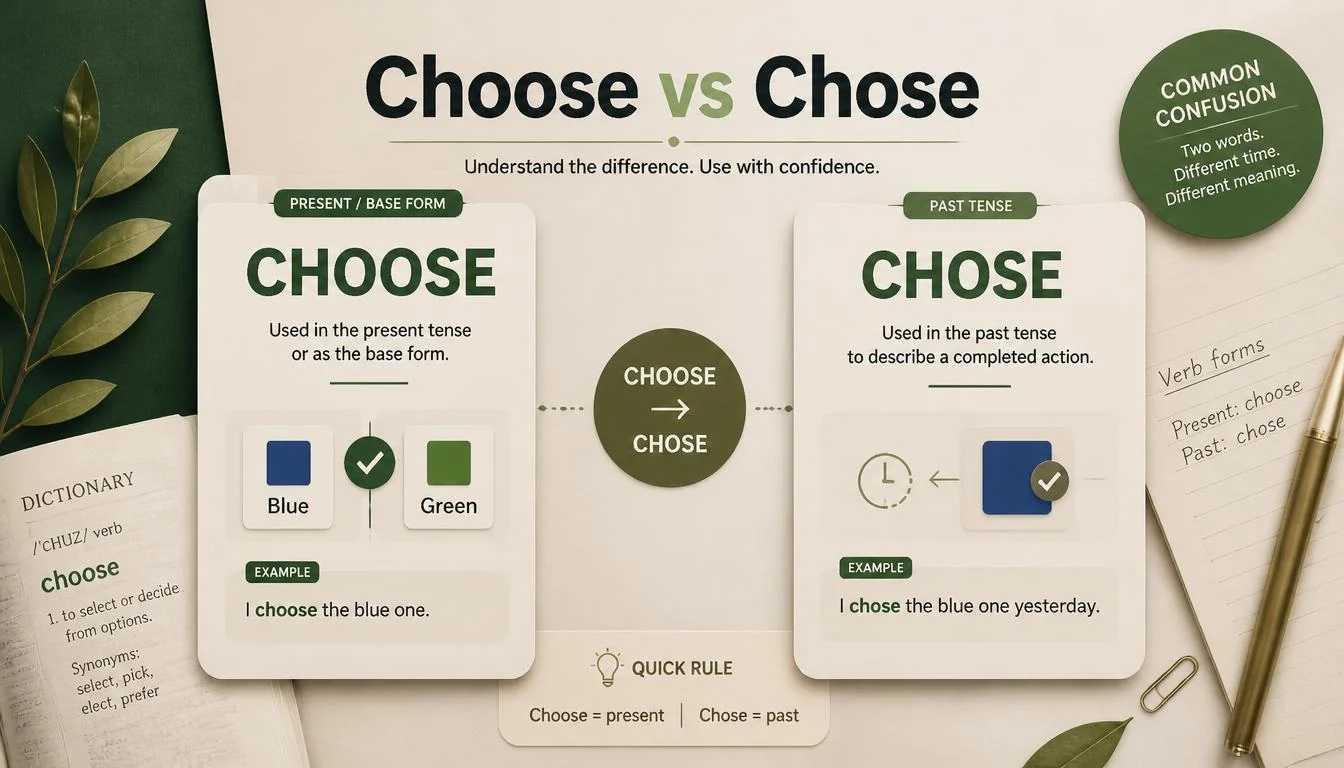
Choose is the present tense verb meaning to pick or decide between options, while chose is its past tense form describing a decision already made. Use choose for something happening now or in the future (“I choose the blue one”), and chose for a completed action (“I chose the blue one yesterday”). The spelling and sound change entirely between the two.
Confused about Choose vs Chose? These two words look and sound similar, but they are used for different points in time. Understanding the difference can help you avoid common grammar mistakes in everyday writing.
The key is to remember that “choose” is used for the present or future, while “chose” is the past tense of “choose.” In this guide, we’ll explain their meanings, usage, pronunciation, and examples in simple terms.
Choose vs Chose: What’s the Difference?
The core difference comes down to timing: choose describes a present or future action, and chose describes something that already happened. Both words come from the same irregular verb, “to choose,” but English speakers rely on context and tense to know which form belongs where.
Choose is used when someone is currently selecting something, planning to select something, or describing a habitual choice. Chose is strictly reserved for actions that are finished. There’s no such thing as “I will chose” or “I am chosing” those combinations don’t exist in standard English, no matter how natural they might sound in the moment.
| Meaning | Part of Speech | Refers To | Typical Usage | Example | Common Confusion |
|---|---|---|---|---|---|
| To select or decide | Verb (present tense) | Current or future action | Everyday decisions, instructions, plans | “Please choose a seat.” | Used incorrectly for past events |
| Selected or decided | Verb (past tense) | Completed action | Storytelling, reports, past events | “She chose the window seat.” | Used incorrectly for present or future actions |
Once you see them side by side, the pattern becomes easier to internalize. Choose sits in the present, ready for action. Chose belongs to the past, already settled. If you can ask yourself “has this decision already happened?” you’ll almost always land on the right word.
Is Choose vs Chose a Grammar, Vocabulary, or Usage Issue?
This is a grammar issue, specifically an issue of verb tense, not a vocabulary or spelling problem in the traditional sense. Choose and chose share the exact same meaning; they only differ in when the action takes place.
Because choose is an irregular verb, it doesn’t follow the predictable “-ed” pattern that regular verbs use. Irregular verbs like choose, know, and speak change their spelling entirely between tenses, which is precisely why learners often try to “regularize” them by mistake, producing errors like “choosed” or “chose” in the wrong slot.
The two words are never interchangeable. In formal English, academic writing, and business communication, tense accuracy carries real weight because it signals precision and attention to detail. In everyday conversation, a slip might go unnoticed, but in written form emails, reports, essays the error stands out immediately to a careful reader.
Practical takeaway: if you’re describing something happening today, this week, or as a general habit, reach for choose. If you’re recounting something that already happened, chose is the only correct option.
Choose: Meaning, Usage, and Examples
Meaning: Choose means to select one option from a group of possibilities, either now or in the near future.
Pronunciation: Choose rhymes with “shoes” the “oo” sound is long and drawn out.
Part of speech: Verb, present tense (base form).
Common collocations: choose wisely, choose carefully, choose between, choose a career, choose an option, choose to ignore, free to choose.
Typical sentence patterns: “I choose to + verb,” “choose between X and Y,” “you should choose,” “we need to choose.”
Here’s how choose shows up across different real-life situations:
- Workplace example: “Before the meeting starts, choose one representative to present the quarterly numbers.”
- Academic example: “Students must choose a thesis topic by the end of the semester.”
- Technology example: “Users can choose their preferred language from the settings menu.”
- Email example: “Please choose a time that works best for your schedule, and I’ll send a calendar invite.”
- Daily conversation example: “I can never choose what to eat when the menu has too many options.”
One learner mistake: Many non-native speakers write “choosed” instead of “chose” when trying to form the past tense, applying the regular “-ed” rule to an irregular verb. This is one of the most common errors in English language learning, and it happens because choose looks like it should follow the standard pattern.
Mini recap: Choose is your go-to word for anything happening now, planned for later, or repeated as a habit. If the decision hasn’t been finalized yet, choose is almost always correct.
Chose: Meaning, Usage, and Examples
Meaning: Chose is the simple past tense of choose, describing a selection that has already been made.
Pronunciation: Chose rhymes with “rose” a short, single-syllable word with a long “o” sound.
Part of speech: Verb, past tense.
Common collocations: chose to leave, chose wisely, finally chose, chose between, chose not to.
Typical sentence patterns: “I chose + noun,” “he, she chose to + verb,” “they chose between X and Y.”
Real-world examples make the past tense usage clearer:
- Workplace example: “The hiring committee chose a candidate with strong analytical skills over one with more years of experience.”
- Academic example: “The researcher chose a qualitative approach for her dissertation instead of a quantitative one.”
- Technology example: “Early smartphone designers chose touchscreens over physical keyboards, which changed the entire industry.”
- Email example: “Thank you for the proposal. After reviewing all three options, we chose the second package.”
- Daily conversation example: “I chose the aisle seat so I wouldn’t have to climb over anyone.”
One learner mistake: Writers sometimes use chose where choose belongs, especially in sentences with “will,” “should,” or “let’s,” which always require a present or base form: “Let’s chose a restaurant” should be “Let’s choose a restaurant.”
Mini recap: Chose only belongs in sentences about the past. If you’re telling a story, summarizing a decision that already happened, or describing history, chose is the word you need.
When Not to Use Each Word
Even confident writers slip up in specific, predictable situations. Here are the most common traps:
1. After “will,” “would,” or “should.” These modal verbs always pair with the base form, choose never chose. “I would choose the red one” is correct; “I would chose the red one” is not.
2. In present tense storytelling. Some writers narrate in present tense for stylistic effect (“She walks into the room and chooses the corner table”). In this style, choose (or chooses) is correct throughout, and chose would break the tense consistency.
3. Right after “to.” The infinitive form always uses choose. “I want to choose my own path” is correct. “I want to chose my own path” is a common error, especially among learners translating directly from languages where tense markers work differently.
4. In the present perfect tense. This tense uses “have” or “has” plus the past participle, which is “chosen,” not “chose.” So “I have chosen this option” is correct, while “I have chose this option” is incorrect.
5. When describing habits or routines. Habitual actions use choose, even if the habit started in the past and continues today. “Every morning, she chooses her outfit the night before” stays in present tense because it’s an ongoing pattern.
6. In instructions or commands. Directions and instructions almost always use choose, since they’re guiding someone through a present or future action. “Choose your payment method to continue” is standard on nearly every checkout page online.
7. When referring to a completed election or decision. Historical or finished events call for chose. “Voters chose their new mayor in November” is correct; using choose here would incorrectly suggest the event is ongoing.
8. In conditional sentences about the past. “If I had known, I would have chosen differently” uses “chosen,” not “chose,” because it follows “would have.”
Common Mistakes Table
| Correct Sentence | Incorrect Sentence | Explanation |
|---|---|---|
| “I chose the wrong flight yesterday.” | “I choose the wrong flight yesterday.” | Past action needs past tense. |
| “Please choose an option from the list.” | “Please chose an option from the list.” | Instructions use present tense. |
| “She has chosen a new career path.” | “She has chose a new career path.” | Present perfect requires “chosen,” not “chose.” |
| “They will choose a winner tomorrow.” | “They will chose a winner tomorrow.” | Future tense pairs with the base form. |
| “We chose this hotel because of the reviews.” | “We choosed this hotel because of the reviews.” | “Choosed” is not a real word. |
Decision Box
If the action is happening now, will happen later, or repeats regularly, use Choose. If the action already happened and is finished, use Chose. Still unsure? Ask yourself: “Did this happen already?” Yes means chose. No means choose.
Choose or Chose in Real World Situations
Office communication: A manager writing a team update might say, “Let’s choose a date for the offsite before Friday,” keeping the decision open and future-focused.
Business email: A client confirming a decision could write, “We chose your agency after comparing three proposals,” clearly marking the choice as final.
School or university: A professor assigning work might instruct, “Choose a novel from the reading list and submit your analysis by next week.”
Customer support: A support agent might explain, “Once you choose a refund method, the process usually takes three to five business days.”
Technology: A product review could note, “Developers chose an open-source framework for the app’s backend, which sped up development significantly.”
Artificial Intelligence: A tech article might state, “Engineers chose a smaller model architecture to reduce response times without sacrificing accuracy.”
Daily conversation: Between friends, someone might casually mention, “I chose the wrong day to walk to work it started pouring halfway there.”
Choose vs Chose in Modern Technology
Technology writing leans heavily on choose, since so much of it involves instructions and live decision-making. Interfaces are full of phrases like “choose a plan,” “choose your notification settings,” or “choose a payment option,” all guiding the user through an action they’re about to take.
Virtual assistants and voice assistants also rely on choose in their prompts: “Which reminder would you like to choose?” or “Choose a time for your alarm.” Since these interactions happen in real time, present tense fits naturally.
Chose appears more often in technology journalism and case studies, where writers describe decisions companies have already made. A headline might read, “Why This Startup Chose a Remote-First Model,” summarizing a past business decision rather than an ongoing one. Chatbots and AI systems occasionally generate this exact confusion in their own output, which is part of why understanding the distinction matters even more as more writing gets AI-assisted.
Word Origin
Choose traces back to the Old English word “cēosan,” which already carried the meaning of selecting or deciding between options. Over centuries, English speakers shortened and adjusted the spelling, but the core meaning barely changed. Chose developed as the natural past tense form through the same irregular verb pattern, alongside related forms like “chosen” for the present perfect and past participle uses. This irregularity is a leftover from Old English grammar rules that modern English simplified for most verbs but preserved for a smaller group, including choose.
Expert Insight
Here’s a trick that tends to stick with students faster than any grammar rule: say the sentence out loud and listen for the vowel sound. Choose has that long, buzzing “oo” sound, almost like you’re saying “shoes.” Chose has a short, rounded “oh” sound, like “rose” or “nose.” If you can hum the sentence and hear which sound fits, you’ll usually catch the right tense before you even think about the grammar behind it. Many learners rely too heavily on visual memory, which is exactly why these two words trip people up they look similar on the page but sound nothing alike.
Error Prevention Checklist
- Always use Choose when describing something happening now, in the future, or as a routine.
- Always use Chose when describing something that has already happened and is finished.
- Never confuse them if you remember: choose = present, chose = past, chosen = present perfect.
- Quick memory tip: “Choose” has two O’s, just like two options waiting to be picked. “Chose” has one O, just like one decision already made.
Related Grammar Confusions
- Lose vs Loose: One is a verb about losing something, the other describes something not tight a classic spelling mix-up.
- Effect vs Affect: Understanding which one is the noun and which is the verb clears up one of the most common writing errors.
- Then vs Than: Confusing these two changes the entire meaning of a comparison versus a sequence of events.
- Its vs It’s: A tiny apostrophe changes possession into a contraction, and it trips up even experienced writers.
- Advice vs Advise: One is something you give, the other is something you do, and the spelling difference matters.
- Farther vs Further: Physical distance versus figurative distance is a subtle but useful distinction for precise writing.
- Complement vs Compliment: These words sound identical but mean completely different things in a sentence.
- Chosen vs Chose: Since both come from the same verb, knowing when to use the past participle instead of the simple past avoids another common slip.
- Lay vs Lie: Another irregular verb pair that confuses even confident English speakers.
- Accept vs Except: One word means to receive, the other means to exclude, and mixing them up changes meaning entirely.
FAQs
Is “Chose” Ever Used With “Have”?
No. The present perfect tense requires “chosen,” not “chose.” The correct form is “I have chosen,” never “I have chose.” This is a common error, even among fluent English speakers.
Why Isn’t the Past Tense of Choose Just “Choosed”?
Choose is an irregular verb, so it does not follow the standard “-ed” pattern used by regular verbs. Its past tense form is “chose.” The spelling “choosed” is not considered correct in standard English.
Can “Choose” Be Used in the Past Tense at All?
No. “Choose” is the present tense form. For a completed action, use “chose” for the simple past or “chosen” when the sentence requires a past participle.
Do Choose and Chose Have Different Pronunciations?
Yes. Choose has a long “oo” sound, while chose has a long “o” sound. Chose rhymes with words such as “rose” and “nose.” Knowing this difference can help you identify the correct form when speaking.
Is It Correct to Say “I Chose To” or “I Choose To”?
Both can be correct depending on the timing of the decision. “I choose to help” describes a current or ongoing choice. “I chose to help” describes a decision that was made in the past.
What’s the Difference Between “Chose” and “Chosen”?
Chose is the simple past form and can be used on its own, as in “She chose the book.” Chosen is the past participle and usually appears with a helping verb such as “has,” “have,” or “was,” as in “She has chosen the book” or “The book was chosen.”
Conclusion
The difference between choose and chose comes down to one simple question: has the decision already happened? Choose belongs to the present and future, guiding actions that are still unfolding. Chose belongs to the past, marking decisions that are already settled and done.
Once that timing rule clicks, the confusion tends to disappear for good. The next time your cursor hesitates over one of these words, just picture the vowel sound the long “oo” of choose for something happening now, or the short “oh” of chose for something already finished and you’ll pick the right word almost automatically.
Read More Related Articles:
- Totaling or Totalling | American vs British English In 2026
- Hoodie or Hoody | Easy Way to Remember the Difference In 2026
- Truly or Truely | Simple Guide to Getting It Right In 2026

Lucas Mitchell is a content writer at synoseek.com. He writes simple, thoughtful pieces that focus on everyday ideas, observations and general knowledge topics. His work is shaped by a calm, realistic tone that keeps the reader engaged without overstatement.
4 thoughts on “Choose vs Chose | Simple Rule That Ends the Confusion for Good In 2026”