Quick Answer
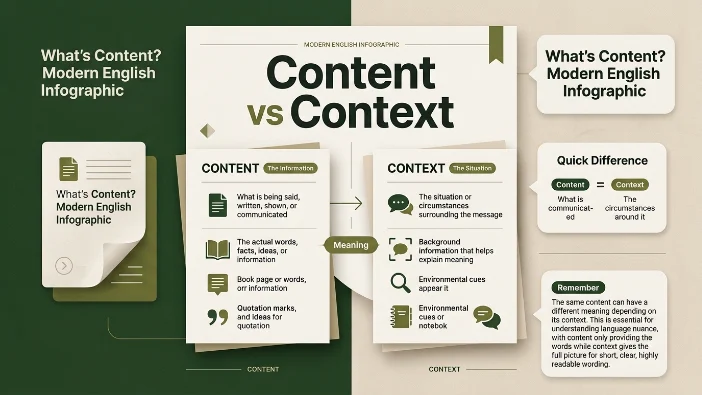
Content vs context confusion usually happens because both words sound related but describe completely different things. Content is the actual material words, images, data, or information that makes up a piece of communication. Context is the surrounding circumstances that give that material meaning. Without context, content can easily be misread.
You’ve probably typed a message, hit send, and then watched someone misread it completely. The words were fine. The content was accurate. But something around it the tone, the timing, the situation got lost, and the message landed wrong. That gap is exactly where the confusion between content and context begins.
Content refers to what is actually said, written, shown, or shared. It’s the substance itself an article, a photo, a paragraph in a contract, a line in an email. Context, on the other hand, is everything surrounding that material that helps a reader or listener understand what it actually means. A sentence pulled out of a report is content. The reason that sentence was written, who it was written for, and what happened right before it that’s context.
People mix these two words up because both feel connected to “meaning.” But content answers the question what is being communicated, while context answers the question why does it mean what it means. Get them confused, and you risk writing instructions that make sense to you but not to your reader, or building a marketing plan that ignores the situation your audience is actually in.
By the end of this guide, you’ll know exactly when to use each word, how professionals apply them in writing, business, and technology, and how to stop mixing them up for good.
Content vs Context: What’s the Difference?
Content is the material itself; context is the situation that explains what that material means. That’s the whole difference in one sentence, but the details matter just as much.
Content is a noun that refers to something tangible or communicable text, video, audio, data, ideas, or physical substance packed inside something. When someone says “the content of this email is confusing,” they mean the actual wording and information inside it is unclear.
Context is also a noun, but it points outward rather than inward. It refers to the conditions, background, or circumstances surrounding a piece of content. Context includes things like who is speaking, when something was said, what happened right before it, and what the audience already knows.
| Meaning | Part of Speech | Refers To | Typical Usage | Example | Common Confusion |
|---|---|---|---|---|---|
| The material or substance inside something | Noun | Words, data, media, ideas | “Read the content of the report” | The blog post had useful content on budgeting | Used when people actually mean “the situation |
| The circumstances that give meaning to content | Noun | Surrounding conditions, background | “Without context, the quote sounds harsh” | The joke made sense once you knew the context | Used when people actually mean “the material itself |
Here’s a short recap before moving on. Content is what’s inside the box. Context is the room the box is sitting in, along with everything that explains why the box is there in the first place. You can have great content and still confuse people if you strip away the context. And you can understand the context perfectly while still needing solid content to make it useful. They work as a pair, not as substitutes for each other.
Is Content vs Context a Grammar, Vocabulary, or Usage Issue?
This isn’t really a grammar problem both words follow standard noun rules, and neither changes form in confusing ways. It’s a vocabulary and usage issue instead. People know both words individually but struggle to pick the right one depending on the situation being described.
Content and context are not interchangeable in any register of English. In business writing, content usually refers to deliverables blog posts, reports, presentations, product descriptions. Context shows up when explaining background, such as market conditions or a client’s history with a project. In academic writing, content refers to the actual argument or data in a paper, while context refers to the historical, social, or theoretical background that shapes how that argument should be read.
In everyday conversation, the line blurs a little less than people expect. If a friend says “you’re taking that out of context,” they mean you’ve focused on the words (the content) while ignoring the situation that explains them. That phrase alone is one of the clearest real-world illustrations of the difference.
Practical takeaway: if you’re describing the actual material, use content. If you’re describing the background that explains that material, use context. There’s rarely a gray area once you ask yourself which question you’re answering.
Understanding Content
Meaning
Content refers to the information, ideas, or material contained within a form of communication. It can be written, spoken, visual, or digital.
Part of Speech
Content functions primarily as a noun. It can occasionally act as an adjective, as in “she felt content,” but that’s a completely unrelated word with a different pronunciation and meaning worth noting separately so learners don’t confuse the two.
Pronunciation Note
As a noun meaning “material or substance,” content is pronounced with stress on the first syllable: CON-tent. As an adjective meaning “satisfied,” it’s pronounced with stress on the second syllable: con-TENT. This distinction trips up even confident English speakers.
Common Collocations
- Content strategy
- Content marketing
- Written content
- Video content
- Content creator
- Course content
- Content management system
Typical Sentence Patterns
Content usually appears after words like “the,” “this,” or “our,” and is often followed by a description of type or quality: “the content of the presentation,” “our video content,” “high-quality written content.”
Workplace Example
“Can you review the content before we publish it? I want to make sure the facts are accurate.”
Academic Example
“The professor said the content of the thesis was strong, but the structure needed work.”
Technology Example
“The app recommends content based on what you’ve watched before.”
Email Example
“Attached is the content for next week’s newsletter. Let me know if any section needs trimming.
Daily Conversation Example
“I loved the content of that podcast episode so much useful advice packed in.”
One Learner Mistake
Non-native speakers sometimes use “contents” when they mean the general subject matter, when “content” (singular) is usually correct in that sense. “Contents” typically refers to a literal list, like a table of contents or the items inside a box.
Mini Recap
Content is the actual material the words, images, or information someone creates or shares. It’s what you’d point to if someone asked, “what does this say?”
Understanding Context
Meaning
Context refers to the circumstances, background information, or setting that helps explain the meaning of something. It answers “why” and “under what conditions,” not “what.”
Part of Speech
Context is a noun. It’s frequently paired with prepositions like “in” and “within,” as in “in this context” or “within the context of the meeting.”
Pronunciation Note
Context is pronounced CON-text, with stress on the first syllable. There’s no alternate pronunciation to worry about here, unlike content.
Common Collocations
- Historical context
- Cultural context
- In context
- Out of context
- Provide context
- Lack of context
- Contextual information
Typical Sentence Patterns
Context often follows verbs like “provide,” “lack,” “lose,” or “understand”: “provide more context,” “we lost the context,” “without proper context.”
Workplace Example
“Before you send that feedback, give the client some context. They don’t know we changed the timeline.”
Academic Example
“Understanding the historical context of the novel changes how you interpret the main character’s choices.”
Technology Example
“The chatbot struggled because it lost context halfway through the conversation.”
Email Example
“Just to give you some context, this request came directly from the client after our call yesterday.”
Daily Conversation Example
“That comment sounds rude without context, but honestly, it was a joke between old friends.”
One Learner Mistake
Learners sometimes say “context” when they mean “situation” in a very general sense, without connecting it to any specific piece of communication. Context works best when it’s explaining something specific a quote, a decision, a message rather than describing life in general.
Mini Recap
Context is the background that shapes meaning. It’s what you’d explain if someone asked, “why does this matter, or why was this said?”
When Not to Use Content or Context
Mistake 1: Using “content” to describe a general situation. People sometimes say “the content of the meeting was tense” when they actually mean the atmosphere or circumstances were tense. That’s context, not content. Content would refer to what was actually discussed, not how it felt.
Mistake 2: Using “context” to describe the actual material itself. Saying “send me the context of the report” when you want the actual document is incorrect. You want the content. Context would be an explanation of why the report exists or what led to it.
Mistake 3: Treating them as synonyms in formal writing. Academic and business writing often penalizes vague word choice. If a sentence could mean either word, a reader has to guess, which weakens clarity and credibility.
Mistake 4: Using “context” when you mean “background information” in a shallow, filler way. Context should add real explanatory value. Adding a vague sentence like “in this context, things were different” without specifics doesn’t actually help the reader.
Mistake 5: Forgetting that content needs context to be persuasive. Marketers sometimes publish strong content without explaining the context behind it why it matters right now, why the audience should care. This weakens otherwise good writing.
Mistake 6: Confusing “context” with “excuse.” Providing context isn’t the same as justifying a mistake. Saying “that’s just the context” to dismiss an error blurs an honest explanation with an excuse, and readers usually notice the difference.
Mistake 7: Overusing “content” as a vague catch-all term. In digital marketing, “content” sometimes gets used so broadly that it loses meaning “we need more content” without specifying what kind, or for what purpose.
Mistake 8: Ignoring cultural context when translating or adapting content. Writers sometimes translate content word-for-word without adjusting for cultural context, which can make even accurate translations feel awkward or confusing.
Common Mistakes Table
| Correct Sentence | Incorrect Sentence | Explanation |
|---|---|---|
| The context of her decision made the choice easier to understand. | The content of her decision made the choice easier to understand. | The sentence is explaining background reasoning, not material, so context is correct. |
| Please review the content before we publish the article. | Please review the context before we publish the article. | The request is about the actual written material, so content is correct. |
| Without more context, the email sounded harsh. | Without more content, the email sounded harsh. | The tone confusion comes from missing background, not missing text. |
| The website needs fresh content this month. | The website needs fresh context this month. | Websites need new material, not new circumstances. |
| His comment was taken out of context. | His comment was taken out of content. | This is a fixed expression referring to missing background, always using context. |
Quick Decision Box
If you’re talking about the actual words, data, or material use Content.
If you’re talking about the background, situation, or circumstances that explain that material use Context.
Content and Context in Real Situations
Office Communication: A manager forwards an email and writes, “Here’s the context this client has been unhappy since March.” The forwarded message itself is the content; the manager’s note is the context.
Business Email: A marketing team sends a newsletter draft for approval. The subject line reads “Content review needed by Friday,” referring to the actual written copy inside the newsletter.
School or University: A professor tells students, “Don’t just memorize the content of the textbook understand the historical context behind these events.” This shows both words working together in one sentence, each doing a different job.
Customer Support: A support agent writes internal notes saying, “For context, the customer already tried resetting their password twice before contacting us.” That note prevents the next agent from repeating advice that’s already failed.
Technology: A product manager reviewing an app update says, “The content library grew, but users still complain the recommendations lack context.” This is one of the clearest modern examples plenty of material exists, but the system doesn’t understand the situation well enough to use it wisely.
Artificial Intelligence: An AI tool might generate accurate content but still miss the point if it doesn’t understand the context of the request. A chatbot might answer a question correctly in isolation while completely misunderstanding what the user actually needed based on the earlier conversation.
Daily Conversation: A friend texts, “That message came off harsh, not sure that’s what you meant.” The reply, “Yeah, no context long day,” is a quick, natural way English speakers already separate these two ideas without even thinking about grammar rules.
Content vs Context in Modern Technology
Modern software depends heavily on getting this distinction right. Content refers to whatever material a system stores, generates, or displays text, images, videos, code, or data. Context refers to the situational information a system uses to decide how that content should be interpreted or delivered.
Virtual assistants and voice assistants rely on context constantly. When someone asks, “what’s the weather like tomorrow,” the assistant needs contextual information the user’s location, time zone, and previous questions to generate useful content in response. Without context, even accurate content can feel oddly disconnected from what a person actually needs.
Chatbots highlight this difference especially well. A chatbot might have access to enormous amounts of content documentation, FAQs, product details yet still give unhelpful answers if it loses context partway through a conversation. That’s why “context window” has become a common technical term; it literally refers to how much surrounding conversation a system can remember and use while generating a response.
Business software follows the same pattern. A content management system stores and organizes material like blog posts or product pages. Meanwhile, contextual data user behavior, browsing history, location often determines which content actually gets shown to a specific visitor. Neither piece works well without the other.
Word Origin
Content comes from the Latin word contentum, related to continere, meaning “to contain.” That root explains why content refers to what’s held inside something a document, a video, a conversation.
Context comes from the Latin contextus, meaning “a joining together” or “connection,” from contexere, “to weave together.” That origin fits perfectly with how context works today it weaves surrounding details together to shape meaning.
Expert Insight
As a language instructor, I usually tell students to picture content as the letter itself and context as the envelope it arrives in, along with the stamp, the handwriting, and who sent it. You can read the letter without any of that extra information, but you’ll understand it far better with it. Whenever a sentence feels unclear, ask whether the missing piece is the actual material or the situation surrounding it. That one question solves this confusion almost every time.
Error Prevention Checklist
- Always use content when referring to the actual material text, images, data, or ideas.
- Always use context when referring to background, circumstances, or surrounding information.
- Never confuse them if you remember: content is inside, context is around.
- Quick memory tip: Con-TENT stays contained inside something; con-TEXT connects a text to its surroundings.
Related Grammar Confusions
- Affect vs Effect one of the most common grammar mix-ups in everyday writing, since both relate to change but function differently.
- Fewer vs Less useful for writers who want to sound polished in both casual and formal English.
- Complement vs Compliment a classic spelling confusion that changes meaning entirely.
- Its vs It’s small but powerful, since this mistake shows up constantly even in professional writing.
- Then vs Than easy to mix up when typing quickly, but the meanings are completely different.
- Assure vs Ensure vs Insure three similar-sounding words with three distinct professional uses.
- Farther vs Further helpful for writers who want precision in physical versus abstract distance.
- Data vs Information closely related to content vs context, since both pairs deal with raw material versus meaning.
- Explicit vs Implicit useful for understanding how meaning is stated directly versus implied through context.
- Subjective vs Objective another pair that ties directly into how content is interpreted differently depending on perspective.
FAQs
Is content the same as information?
Not exactly. Content refers to the material being presented, such as text, images, videos, or audio, while information generally refers to facts, details, or knowledge. Content can contain information, but the two terms are not always interchangeable.
Can something have content but no context?
Yes. A statement, image, or quote can have clear content while lacking context. Without information about the surrounding circumstances, readers may misunderstand what the content means or why it was presented.
Why does context matter in writing?
Context helps readers understand the intended meaning, tone, and purpose of content. Without enough context, even accurate information can be interpreted incorrectly because readers may rely on their own assumptions.
Is “context” always necessary in a sentence?
No. Many sentences are understandable without additional context. However, context becomes important when the meaning depends on factors such as previous statements, circumstances, timing, or the speaker’s intention.
What is the difference between context and background?
The two terms are related but not identical. Background usually refers to broader history, facts, or circumstances that help explain a subject. Context focuses more specifically on the circumstances surrounding a particular statement, event, or piece of content.
Do “content” and “context” ever mean the same thing?
No. In standard English, content and context describe different aspects of communication. Content is the material or message itself, while context provides the surrounding circumstances that help explain and interpret it.
Conclusion
Content and context aren’t competing words they’re teammates. Content is the material you create or share, and context is what makes that material land the way you intended. Mixing them up doesn’t just cause a small grammar slip; it can genuinely change how a message gets understood, whether you’re writing a business email, building a chatbot, or just texting a friend.
If you remember one rule going forward, make it this one: content is what’s inside, context is what’s around it. Ask yourself which one you’re actually describing before you write the sentence, and the right word will almost always follow naturally.
1 thought on “Content vs Context | Easy Way to Understand Both Terms In 2026”