Quick Answer
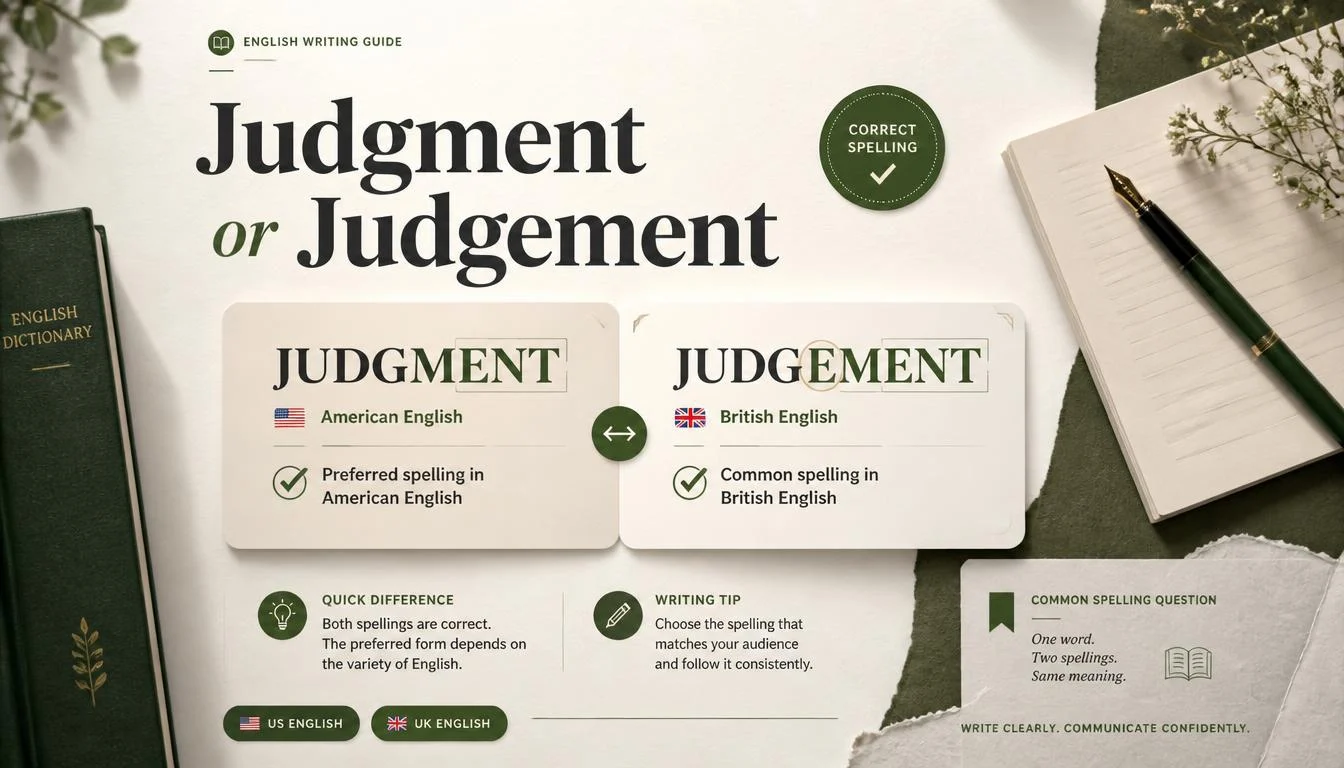
The spelling difference between judgment and judgement is a matter of regional convention, not meaning. Judgment is the standard spelling in American English and is also preferred in British legal contexts. Judgement is the standard spelling in British English for general use. Both words mean the same thing: the act of forming an opinion or a decision.
You are writing an important email, and suddenly your brain freezes. Is it “I’ll reserve judgment” or “I’ll reserve judgement”? You stare at the screen, type it both ways, and still aren’t sure which one looks right. This tiny spelling decision trips up native speakers and learners alike, causing unnecessary hesitation in both professional and casual writing.
The confusion between judgment and judgement is one of the most common spelling dilemmas in English. While the meaning remains identical, the spelling rules change depending on your audience and context. Choosing the wrong variant can make your writing appear inconsistent or out of touch with expected conventions.
This guide clarifies everything you need to know about using judgment and judgement correctly, so you can write with confidence in any situation.
Judgment or Judgement: What’s the Difference?
The core difference between judgment and judgement is purely orthographic it is a matter of spelling, not meaning or usage.
Both forms function as nouns with the same definitions:
- The ability to make considered decisions or form sensible opinions
- An official decision given by a court or legal body
- An opinion or conclusion formed after careful thought
The spelling variation arises from regional conventions rather than any grammatical distinction.
In short, judgment is the dominant form in American English and legal writing everywhere. Judgement is the preferred British English spelling outside legal contexts . No one will misunderstand your meaning regardless of which spelling you choose, but using the wrong form for your audience can make your writing appear unpolished.
Is This a Grammar, Vocabulary, or Usage Issue?
This question is actually a spelling and usage distinction rather than a grammar rule. Both words function as nouns and follow the same grammatical rules they can be countable (“a judgment”) or uncountable (“good judgment”).
Key points to understand:
Grammar Classification: This is a spelling variation issue, not a grammatical error. Both forms are grammatically identical.
Vocabulary Difference: There is no vocabulary difference. Both words share the exact same definition and all related meanings .
Usage Difference: The usage difference is regional and contextual, not semantic. Writers choose one spelling over the other based on their intended audience or the conventions of their field.
Interchangeability: The words are fully interchangeable in meaning, but they are not interchangeable in all contexts. For example, you would not use judgement in an American legal brief or judgment in a British newspaper article that follows conventional UK spelling rules.
Formal and Business English: In American English, judgment is the only acceptable spelling. In British English, judgement is standard for general writing, but judgment is required in legal contexts. British academic writing tends to follow the general standard of judgement, though some institutions may have specific preferences.
Everyday Conversation: In informal writing and conversation, either spelling is acceptable depending on your location. British and Australian English speakers frequently use judgement without issue. American speakers overwhelmingly use judgment so much so that judgement is likely to be marked as an error by spell-checkers and considered a mistake .
Practical Takeaway: Know your audience. If you are writing for an American publication or legal setting anywhere, always use judgment. For British general audiences, judgement is the safe and standard choice.
Using “Judgment” (American English Standard)
In the United States, judgment is not merely the preferred spelling it is practically the only spelling . Merriam-Webster records judgment as the standard American form, and American style guides universally recommend it.
Pronunciation: JUJ-munt (the “g” is pronounced as a “j” sound, and the middle “e” is silent regardless of spelling).
Part of Speech: Noun
Common Collocations:
- Good judgment
- Poor judgment
- Sound judgment
- Judgment call
- Judgment day
- Pass judgment on
- Reserve judgment
Typical Sentence Patterns:
- “It requires good judgment to…” (ability)
- “The court issued a judgment…” (legal decision)
- “In my judgment, the plan will…” (opinion)
Natural Workplace Example:
“We need to use our best judgment when handling this client complaint. The manual doesn’t cover every possible scenario.”
Academic Example:
“Researchers must exercise judgment when interpreting statistical data to avoid drawing incorrect conclusions.”
Technology Example:
“The cybersecurity team used their professional judgment to determine whether the alert represented a genuine threat.”
Email Example:
“Given your experience in this area, I trust your judgment on which vendor to select. Please proceed with your recommendation.”
Daily Conversation Example:
“Making good financial decisions requires judgment and a clear understanding of your long-term goals.”
One Learner Mistake: A common error is adding the “e” by analogy with other words like acknowledgement. In American English, this is incorrect and will be marked as a spelling error.
Mini Recap: Judgment (without the “e”) is the standard spelling in American English for all contexts. Use it for any American audience, any legal document, and any formal writing in the United States.
Using “Judgement” (British English Standard)
In British English, judgement is the standard spelling for general use. The Oxford English Dictionary historically preferred this spelling, and it remains the recommended form in the UK outside of legal writing .
Pronunciation: JUJ-munt (identical to judgment)
Part of Speech: Noun
Common Collocations:
- Good judgement
- Sound judgement
- Poor judgement
- Pass judgement on
- Harsh judgement
- Exercise judgement
Typical Sentence Patterns:
- “I trust her judgement when it comes to…” (ability)
- “The judgement of the committee was…” (opinion)
- “He displayed bad judgement in…” (ability)
Natural Workplace Example:
“In this role, you will often need to use your professional judgement when responding to unexpected situations.”
Academic Example:
“The reviewer’s judgement about the quality of the submission was based on methodological soundness and contribution to the field.”
Technology Example:
“Cybersecurity experts rely on their expert judgement to distinguish between genuine alerts and false positives.”
Email Example:
“Please use your own judgement when deciding how to proceed with this enquiry. I trust you to make the right decision.”
Daily Conversation Example:
“Looking back, I think I made a judgement call that was based on emotions rather than facts.”
One Learner Mistake: Learners sometimes assume judgement is exclusively British and avoid it entirely. However, this spelling is standard and correct in many English-speaking countries outside the United States.
Mini Recap: Judgement (with an “e”) is the standard British spelling for most everyday and professional writing. It is not used in British legal contexts, where judgment is required.
When Not to Use Each Word
- When to avoid judgment:
- If you are writing for a British, Australian, or Commonwealth general audience that expects conventional UK spelling
- In any context where your style guide explicitly requires British English spelling conventions
- In historical contexts discussing British sources that use the older spelling
- In UK-based non-legal professional publications that follow Oxford style
2. When to avoid judgement:
- In any American English publication or for an American audience
- In any legal document or legal context in the UK, US, or other English-speaking legal systems
- In academic writing that follows APA, Chicago, or other American style guides
- In any business writing intended for international readers where American English is the default
- In Canada, where judgment is more common, especially in legal contexts
Why the mistake happens: Writers often overgeneralize from words like acknowledgement and abridgement, which are spelled with the “e” in British English and without in American English. However, judgment is the older spelling, and its shorter form became established even in British English over centuries of use .
How to remember: If your audience is American or legal, remove the “e.” If your audience is British general readers, add the “e.”
Common Mistakes Table
Quick Decision Guide
When to use judgment:
- You are writing for an American audience
- You are referring to a legal decision (anywhere)
- You are following American style guides (APA, Chicago, MLA)
When to use judgement:
- You are writing for a British general audience
- You are following British style guides for non-legal writing (Oxford style outside legal contexts)
If you are still unsure, default to judgment. It is the more widely accepted spelling internationally and is correct in legal contexts everywhere.
Real-World Examples
Office Communication
“Please use your professional judgment when prioritizing tasks. The deadlines are flexible, and I want you to decide what is most urgent.”
Business Email
“After reviewing the proposals, my judgment is that we should go with the first vendor. Their pricing is more competitive, and they have better experience in our industry.”
School or University
“The professor asked us to exercise critical judgment when evaluating the sources for our research papers.”
Customer Support
“When handling escalated complaints, agents must use their judgment to determine when to offer compensation and when to stand firm on policy.”
Technology
“The AI system’s decisions are based on algorithmic judgment, but human oversight ensures that outcomes remain fair and accurate.”
Artificial Intelligence
“Modern AI systems lack human judgment and may make decisions that appear logical but lack contextual understanding.”
Daily Conversation
“It takes judgment to know when to speak and when to listen. Sometimes the wisest decision is to remain silent.”
“Judgment” in Modern Technology
In the technology sector, judgment remains the dominant spelling regardless of location. Software interfaces, user documentation, and technical specifications almost universally use the shorter form.
Artificial Intelligence: AI systems are frequently described as lacking human judgment. Writers in this field consistently use judgment because the technology sector is heavily influenced by American English conventions.
Virtual and Voice Assistants: Companies like Amazon, Google, and Apple use judgment in their interfaces and documentation. Features with names like “Privacy Judgment” or “Security Judgment” all follow the American spelling.
Chatbots and Software: User interfaces generally prefer judgment. International software companies standardize on the American spelling to avoid confusion across different regions.
Business Tools: Project management software, CRMs, and enterprise platforms that include decision-support features consistently use judgment in their labels and documentation.
Word Origin and History
The spelling of this word has a surprisingly complicated history. Judgement is actually the older spelling, entering English around 1250–1300 from Old French jugement .
For centuries, judgment was the only spelling to appear in dictionaries. The longer form dropped from favor, and the shorter version became the standard .
This changed with the publication of the Oxford English Dictionary (OED), which showed judgement as an equal variant. Henry Fowler, a prominent usage commentator, asserted that “the OED prefers the older and more reasonable spelling” and recommended judgement . His advice influenced British English, where the “e” spelling became standard in general use.
However, legal writing retained the shorter spelling, and American English never adopted the longer form. The result is a split: judgment is universal in legal contexts and American writing, while judgement is standard in British general use.
The irregular spelling of both variants arises from the silent “e” after the hard “g,” which is an unusual pattern in English orthography.
Expert Insight
When teaching students the difference between judgment and judgement, the single most helpful question to ask is: “Who is my reader?”
The choice between these two spellings is rarely about correctness and almost always about audience awareness. Native English speakers in the United States will notice an extra “e” and often assume it is an error, even though it is correct in another dialect. Conversely, British readers may see the missing “e” and wonder if you are using American conventions.
Understanding your audience is a fundamental skill in professional communication.
- If you are writing for an American company or publication, choose judgment.
- If your reader is in the UK or a Commonwealth country and you are writing in a non-legal context, choose judgement.
- If the context is legal anywhere, choose judgment.
The extra “e” is a regional marker, nothing more. Once you understand that, the confusion disappears.
Error Prevention Checklist
☑ Always use judgment when writing for an American audience
☑ Always use judgment when referring to a legal decision (in any country)
☑ Use judgement when writing for a British general audience
☑ Never confuse them they are the same word, just spelled differently
☑ Quick memory tip: JUDGMENT (for Justice, United D states, General, Most Every Need, Time) or simply remember: American English drops the “e” from the end of judge before adding -ment in this case
Related Grammar Confusions
If you found this comparison helpful, you may also want to explore:
- “Advise” vs. “Advice” – A verb-noun pair that confuses many writers
- “Affect” vs. “Effect” – One of the most common grammar mistakes
- “Its” vs. “It’s” – A contraction and possessive that even professionals confuse
- “Compliment” vs. “Complement” – Words that sound alike but mean different things
- “Principle” vs. “Principal” – A classic spelling confusion
- “Farther” vs. “Further” – Physical distance versus metaphorical distance
- “Stationary” vs. “Stationery” – A difference of just one letter
- “Imply” vs. “Infer” – Two words often used interchangeably but with distinct meanings
- “Accept” vs. “Except” – Words that are easily confused
- “Lay” vs. “Lie” – One of the most challenging verb pairs in English
FAQs
What is the difference between judgment and judgement?
There is no difference in meaning. Both words are nouns with identical definitions. The only distinction is spelling: judgment is the American and legal spelling, while judgement is the British general spelling.
Which spelling is correct, judgment or judgement?
Both spellings are correct depending on context. In American English, judgment is the only correct spelling. In British English, judgement is standard for general use, but judgment is required in legal contexts.
Is it against my better judgment or judgement?
It depends on your audience. American writers should use “against my better judgment.” British writers generally use “against my better judgement” in non-legal contexts. Both mean the same thing: doing something that you know is unwise.
What is the legal spelling of judgment?
In legal writing everywhere including the United Kingdom the correct spelling is always judgment . This is an exception to the British general spelling rule and is standard in all legal jurisdictions.
Does judgement have an E in Canadian English?
Canadian English typically uses judgment, especially in legal contexts and generally more commonly than judgement in all contexts . While both forms may appear, judgment is the safer choice for Canadian writing.
How do you pronounce judgment and judgement?
Both words are pronounced identically: JUJ-munt (IPA: /ˈʤʌʤmənt/). The extra “e” in judgement is silent and does not change the pronunciation.
Is judgment spelled with or without an E in Australia?
Australian English follows British conventions. Judgement is standard for general use, and judgment is required in legal contexts. In non-legal Australian writing, you can choose either, but judgement is more common in general contexts.
Why do people spell judgment with an E?
The “e” spelling (judgement) is an older form that persists in British English. It was recommended by Henry Fowler and the Oxford English Dictionary, which argued it was the more reasonable spelling because it follows the pattern of judge + -ment with the silent “e” dropped.
Conclusion
The confusion between judgment and judgement is ultimately a question of audience and context rather than right or wrong. Both spellings are accepted in their respective regions, and the meaning remains identical regardless of which you choose.
The practical rule is straightforward: use judgment for American readers and legal writing. Use judgement for British general audiences. If you are ever unsure, choose judgment it is the more widely recognized spelling internationally and is always correct in legal contexts.
The ability to adapt your spelling to your audience demonstrates professionalism and attention to detail. The next time you pause over this word, you will know exactly which spelling to choose.
Read More Related Articles:
- Totaling or Totalling | American vs British English In 2026
- Hoodie or Hoody | Easy Way to Remember the Difference In 2026
- Truly or Truely | Simple Guide to Getting It Right In 2026

Lucas Mitchell is a content writer at synoseek.com. He writes simple, thoughtful pieces that focus on everyday ideas, observations and general knowledge topics. His work is shaped by a calm, realistic tone that keeps the reader engaged without overstatement.
2 thoughts on “Judgment or Judgement | Learn the Difference in Seconds In 2026”