Quick Answer
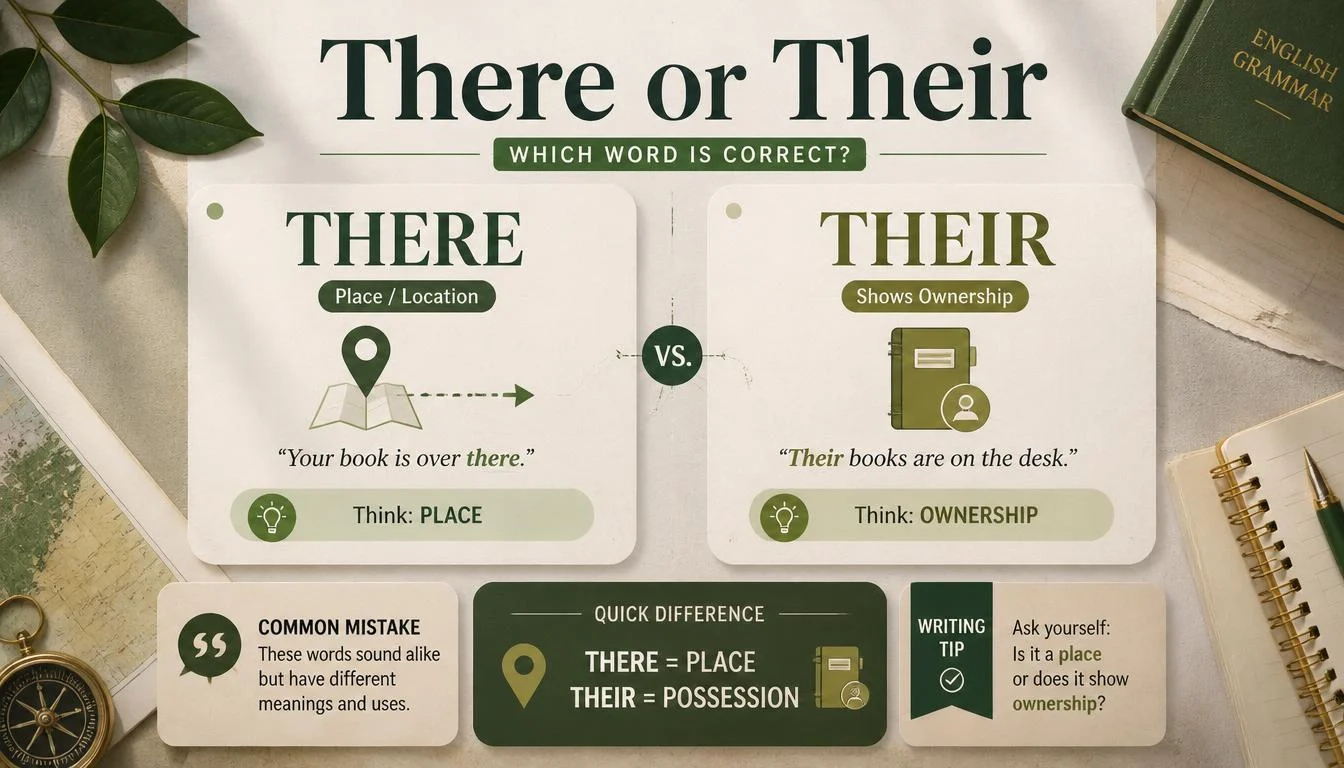
The main difference between “there” and “their” is simple: “there” refers to a place or exists as an introductory word, while “their” shows possession. “There” answers “where?” or introduces existence (“There is a problem”), whereas “their” indicates ownership by multiple people (“Their car is red”).
If you have ever paused mid-sentence while texting a colleague or writing an email and wondered whether to type “there” or “their,” you are far from alone. These two tiny words cause outsized confusion, even for native English speakers who have been writing in the language their entire lives. The frustration is real and it usually happens at the worst possible moment, right when you need to sound competent and professional.
Here is the good news: this is not a difficult concept to master. The confusion exists because the words sound identical when spoken, making it easy to mix them up in writing. In fact, many people rely on pronunciation alone and never develop the instinct to check which word fits the meaning they actually want. By the time you finish this guide, you will not only understand the difference but also never hesitate again when choosing between these two commonly confused words.
Throughout this article, we will explore exactly how to use “there” and “their” correctly, examine real-world examples from professional settings, learn practical memory tricks, and understand why getting this right matters for clear communication.
What’s the Difference Between There and Their?
At its most basic level, the difference between “there” and “their” comes down to purpose: one indicates location or existence, and the other indicates possession. While they sound exactly alike, they serve completely different grammatical functions in a sentence.
| There | Their | |
|---|---|---|
| Meaning | Refers to a place, position, or existence | Shows possession or belonging to a group |
| Part of Speech | Adverb, pronoun, noun, or adjective | Determiner (possessive adjective) |
| Refers To | A location, an introductory existence, or a point in a process | Something owned or associated with multiple people |
| Typical Usage | “The book is over there.” “There is a solution.” | “Their house is beautiful.” “Their opinions matter.” |
| Example | “We arrived there at noon.” | “The students submitted their assignments.” |
| Common Confusion | Often confused with “their” in phrases like “there house” | Often confused with “there” in phrases like “their are” |
To put it even more simply: if you can replace the word with “here,” then “there” is correct. If you can replace it with “our” or “my,” then “their” is correct. This simple test works every time.
The core challenge is that both words begin with “the,” making them look visually similar in addition to sounding identical. However, remembering that “their” contains the word “heir” can help an heir is someone who inherits something, which implies ownership. There is no owner in “there,” only a place or existence.
Is This a Grammar, Vocabulary, or Usage Issue?
Understanding whether this is a grammar problem, a vocabulary problem, or a usage problem actually helps determine the best approach to fixing it.
Grammatically, this is primarily a usage issue rather than a grammar error, though mixing them up does create a grammatical mistake. The confusion stems from homophones words that sound the same but have different meanings and spellings. While the mistake is common enough that some might call it a spelling error, the real issue is one of word selection, not knowing the difference between the two meanings.
From a vocabulary standpoint, these are completely different words with distinct definitions. “There” comes from Old English þær and connects to location and existence. “Their” comes from Old Norse þeirra and relates to possession. They are not synonyms, nor are they interchangeable in any context.
In terms of usage, the difference is entirely contextual. In formal English, business writing, academic papers, and everyday conversation, the distinction remains the same. There is no situation where these words can be swapped without changing the meaning of the sentence. A business email that says “We appreciate their hard work” means something completely different from “We appreciate there hard work” (which is simply incorrect).
The key takeaway is that this is a usage distinction with grammatical consequences. Understanding the purpose of each word in a sentence whether it indicates location or ownership is the solution.
There: Meaning, Usage, and Examples
“There” serves multiple functions in English, but they all relate to position, existence, or pointing to something. Think of “there” as a word that directs attention or announces presence.
When to Use “There”
To Indicate a Specific Place or Location
- “Please place the package over there.”
- “We have never been there before.”
To Introduce the Existence of Something
- “There is a new restaurant opening downtown.”
- “There are several options available.”
To Draw Attention to Something
- “There goes the bus!”
- “Look there, that’s the building we need.”
As a Pronoun in “There Is” and “There Are” Constructions
- “There appears to be a mistake.”
- “There seems to be confusion about the schedule.”
To Refer to a Point in a Process or Sequence
- “We will take it from there.”
- “Stop right there, that’s exactly what we discussed.”
Common Collocations with “There”
- Over there – indicating a distant location
- There is/are – introducing existence
- There it is – announcing discovery or arrival
- Here and there – scattered in various places
- There you go – acknowledging understanding or completion
Workplace Example
“During the presentation, I noticed the client’s attention drifted toward the whiteboard there in the corner. I redirected the conversation back to the main point.”
Academic Example
“In examining the data, there is clear evidence that the hypothesis requires revision. There are three primary factors contributing to this conclusion.”
Technology Example
“After reviewing the code, there were several bugs that needed fixing. There is a patch available for download on the support page.”
Email Example
“Hi Sarah, the documents you requested are stacked there on the filing cabinet. Please let me know if there are any questions about the contents.”
Daily Conversation Example
“There goes my favorite coffee shop! I can’t believe they’re closing. Is there another location nearby?”
Common Learner Mistake
Incorrect: “Their is a problem with the server.”
Correct: “There is a problem with the server.”
The mistake happens because the writer hears the word in their head and writes the first spelling that comes to mind. The key is to ask: “Is the next part of the sentence naming something that exists?” If yes, “there” is correct.
Mini Recap
Use “there” whenever you are talking about a place, pointing to a location, or introducing the existence of something. If you can substitute “here,” “there” fits. This word never indicates ownership.
Their: Meaning, Usage, and Examples
“Their” is a possessive determiner, meaning it usually comes before a noun to show that something belongs to or is associated with a group of people. Unlike “there,” it never refers to a place or introduces existence.
When to Use “Their”
To Show Possession by Multiple People
- “The students submitted their assignments.”
- “The employees submitted their complaints to HR.”
To Refer to a Group of Unknown Gender
- “Someone left their umbrella in the conference room.”
- “Each applicant should bring their identification.”
To Show Association or Relationship
- “They love their new neighborhood.”
- “The company is proud of their achievements this year.”
To Indicate Shared Ownership
- “The couple renovated their house themselves.”
- “Both departments have revised their budgets.”
To Refer to a Singular Person When Gender Is Unknown or Non Binary
- “A student can access their grades online.”
- “Anyone can submit their opinion anonymously.”
Common Collocations with “Their”
- Their own – emphasizing exclusive possession
- Their way – indicating a chosen path or preference
- Their turn – indicating sequence or opportunity
- Their best – indicating maximum effort
- Their decision – indicating choice or judgment
Workplace Example
“The marketing team presented their quarterly report to the executive board. Their findings suggested a complete revision of the advertising strategy.”
Academic Example
“Researchers must carefully document their methodology to ensure reproducibility. Their conclusions should always align with the evidence presented.”
Technology Example
“The developers finalized their code review and prepared their deployment schedule. All team members signed off on their respective modules.”
Email Example
“Dear team, thank you for submitting your feedback on the proposal. I appreciate your honesty and will incorporate your suggestions into the final draft.”
Note: “Your” is used when speaking directly to someone, while “their” is used when referring to a third party.
Daily Conversation Example
“My neighbors finally sold their house after six months on the market. Their new home is only a few blocks away.”
Common Learner Mistake
Incorrect: “The employees turned in there timesheets.”
Correct: “The employees turned in their timesheets.”
This mistake is incredibly common because the words sound identical. To choose the correct spelling, ask: “Who owns the timesheets?” Since the employees own them, “their” is correct.
Mini Recap
Use “their” whenever you need to show that something belongs to or is associated with a group of people. If you can substitute “our,” “my,” or “your,” then “their” fits. This word never refers to a place or existence.
When Not to Use Each Word
Understanding when not to use each word is just as important as knowing when to use them. Here are some of the most common mistakes writers make when choosing between there and their.
1. Do Not Use “Their” With Singular Nouns That Are Not Possessive
- Incorrect: “Their is a meeting at noon.”
- Why it happens: The writer hears the phonetic sound and chooses the wrong spelling.
- Correct: “There is a meeting at noon.”
- Memory tip: If the sentence states that something exists, use “there.”
2. Do Not Use “Their” to Indicate Location
- Incorrect: “Please put the files over their.”
- Why it happens: The writer mentally connects the sound with the wrong spelling.
- Correct: “Please put the files over there.”
- Memory tip: If you are pointing to a place or location, use “there.”
3. Do Not Use “There” to Show Ownership
- Incorrect: “The team submitted there report.”
- Why it happens: The writer types “there” without considering whether the sentence expresses possession.
- Correct: “The team submitted their report.”
- Memory tip: If something belongs to someone, “their” is the correct choice.
4. Do Not Use “There” Before a Noun Showing Relationship
- Incorrect: “They love there new house.”
- Why it happens: The phrase sounds natural when spoken, so the writer may choose the first spelling that comes to mind.
- Correct: “They love their new house.”
- Memory tip: Use “their” before a noun when something belongs to or is associated with someone.
5. Do Not Use “Their” in Introductory “There Is/Are” Constructions
- Incorrect: “Their are plenty of options.”
- Why it happens: The writer confuses the two homophones because they sound identical.
- Correct: “There are plenty of options.”
- Memory tip: Use “there” in “there is” and “there are” when introducing something that exists.
6. Do Not Use “There” When Referring to a Group’s Possession
- Incorrect: “The clients expressed there satisfaction.”
- Why it happens: The writer focuses on the subject and overlooks the possessive meaning.
- Correct: “The clients expressed their satisfaction.”
- Memory tip: If the satisfaction belongs to the clients, use “their.”
7. Do Not Use “There” to Show Group Association
- Incorrect: “The university updated there website.”
- Why it happens: The writer hears the sound and automatically chooses the wrong spelling.
- Correct: “The university updated their website.”
- Memory tip: When the website belongs to or is associated with the university, “their” is the appropriate choice.
8. Do Not Use “Their” When Referring to a Process Point
- Incorrect: “Let’s pause their and regroup.”
- Why it happens: The writer confuses a location or stopping point with possession.
- Correct: “Let’s pause there and regroup.”
- Memory tip: Use “there” when referring to a place, point, or stopping point in a process.
Common Mistakes Table
| Correct Sentence | Incorrect Sentence | Explanation |
|---|---|---|
| “There is a package on the doorstep.” | “Their is a package on the doorstep.” | “There” introduces the existence of the package. “Their” would imply the package belongs to someone, but the sentence doesn’t describe possession. |
| “The students submitted their homework.” | “The students submitted there homework.” | The homework belongs to the students, so “their” shows possession. “There” would refer to a location, which makes no sense here. |
| “We have never been there before.” | “We have never been their before.” | “There” indicates the location being discussed. Their” would mean we have never been in possession of something, which changes the meaning entirely. |
| “Their presentation was impressive.” | “There presentation was impressive.” | The presentation belongs to the presenters, so “their” shows ownership. “There” would be introducing existence, which is grammatically incorrect here. |
| “There are three options available.” | “Their are three options available.” | “There are” introduces the existence of options. “Their are” is never grammatically correct. |
| “The employees submitted their grievances.” | “The employees submitted there grievances.” | The grievances belong to the employees, so “their” is required. “There” would indicate a location, which is nonsensical. |
Decision Box
If you mean location or existence → Use “there”
- “The meeting is over there.”
- “There are several solutions.”
If you mean ownership or association → Use “their”
- “Their proposal won the contract.”
- “The managers revised their strategy.”
When in doubt, perform the replacement test:
- If “here” fits → choose “there”
- If “our” fits → choose “their”
Real-World Examples
Office Communication:
The new policy confused several employees because their managers hadn’t explained it clearly. The confusion persisted until HR scheduled a meeting there in the main conference room.”
Business Email:
“Dear colleagues, please review your schedules and let me know if there are conflicts. We need to find a time when all stakeholders can attend. Remember, the final decision rests with their department heads.”
Academic Context:
“Researchers must ensure their methodology is sound before drawing conclusions. There is no substitute for rigorous data collection, and there are no shortcuts to reliable results.”
Customer Support:
“The customer service team addressed their concerns promptly. We directed them to the FAQ section there on our website, but there were still questions remaining.”
Technology Development:
“The developers pushed their code to production after extensive testing. There were no critical bugs, and there is now a stable version available to users.”
Daily Conversation:
“Have you seen their new puppy? He’s adorable. We’re going over there tomorrow to meet him. There is always something exciting happening at their house.”
There and Their in Modern Technology
In the world of artificial intelligence and virtual assistants, the distinction between “there” and “their” takes on new importance for both developers and users.
Artificial Intelligence and Machine Learning:
Natural language processing models must distinguish between homophones to accurately interpret user intent. When someone types “there are new updates available,” the AI understands this as an existence statement. When someone writes “their features have improved,” the AI recognizes possession. Language models trained on human text learn these patterns through exposure to millions of examples, but mistakes still occur in edge cases.
Virtual Assistants:
Voice assistants like Siri and Alexa must interpret spoken language, where “there” and “their” sound identical. They rely on contextual clues to determine the intended meaning. For example, “Put the book over there” creates a location context, while “Update their contact information” creates a possessive context. This processing is remarkably sophisticated but not flawless.
Chatbots and Customer Support:
Automated systems struggle more with written language than humans might expect. A chatbot that misinterprets “there is a problem” as “their is a problem” may fail to understand the user’s concern. This is why quality assurance teams regularly review chatbot conversations and refine their training data.
Software and Business Tools:
Collaboration platforms like Slack, Teams, and project management tools are filled with written communication where these distinctions matter. A project manager writing “Their tasks are overdue” means something very different from “There tasks are overdue” (the latter being incorrect). Effective communication tools rely on users understanding these fundamental distinctions.
Word Origin
Understanding where these words came from can help solidify their meanings and reinforce the difference between them.
There originates from Old English þær, which meant “in or at that place.” This root has remained remarkably consistent for over a thousand years. The word traces back even further to Proto-Germanic þær and ultimately to Proto-Indo-European ter-, meaning “through” or “cross over.” The concept of location has always been central to “there.”
Their comes from Old Norse þeirra, the genitive plural form of the demonstrative pronoun meaning “of them.” The Vikings brought this word to England during their invasions and settlements, and it eventually replaced the Old English equivalent. The concept of possession has always been the core meaning, as demonstrated by the connection to “heir.”
This distinct etymology explains why these words have completely different functions despite sounding identical. They developed from different linguistic families “there” from Old English and “their” from Old Norse and their roles in the language have never overlapped.
Expert Insight
As someone who has taught English to thousands of students over my career, I have found that the most successful learners are those who stop trying to memorize rules and start recognizing patterns through exposure. The “there” versus “their” distinction is a perfect example of this principle in action.
Rather than drilling flashcards or memorizing grammar rules, try this approach: when you encounter either word in your reading, pause and think about its function. Is it pointing to a location? Is it introducing a statement about existence? Is it indicating ownership by a group? The more you consciously notice these patterns, the more automatic the correct usage becomes.
Another strategy that works well for my students is to read their writing aloud. While “there” and “their” sound identical, the context of the sentence usually reveals the meaning. When you read your own writing, ask yourself whether the word you typed matches the meaning you intended. This self-correction habit strengthens your language instincts over time.
Error Prevention Checklist
- Always use “there” when: indicating a location or introducing the existence of something.
- Always use “their” when: showing possession or association by a group of people.
- Never confuse them if: you perform the substitution test and check whether “here” or “our” fits.
- Quick memory tip: “Their” contains “heir” (someone who inherits, indicating ownership) and points to a group of people. “There” contains “here” (location) and points to a place.
Related Grammar Confusions
If you are working on mastering “there” and “their,” you might also find these related topics helpful to learn:
- Your vs. You’re – Understanding the difference between possession and contraction
- Its vs. It’s – Distinguishing possessive from contraction
- To vs. Too vs. Two – Three homophones with distinct meanings
- Then vs. Than – Time versus comparison
- Affect vs. Effect – Verb versus noun distinction
- Who vs. Whom – Subject versus object pronoun
- Which vs. That – Restrictive versus non-restrictive clauses
- Who’s vs. Whose – Contraction versus possessive
- Accept vs. Except – Agreement versus exclusion
- Principle vs. Principal – Rule versus leader
FAQs
What Is the Easiest Way to Remember the Difference Between “There” and “Their”?
The substitution test is one of the easiest ways to remember the difference. If you can replace the word with “here,” use “there.” If you can replace it with “our,” use “their.” This quick check can help you build accurate usage habits over time.
Can I Ever Use “Their” to Refer to One Person?
Yes. “Their” is commonly used as a singular pronoun when a person’s gender is unknown or when a gender neutral option is preferred. For example, “A student should bring their identification” is grammatically acceptable and widely used in modern English.
Why Do People Confuse “There” and “Their” So Often?
The main reason is that “there” and “their” are homophones. They sound the same when spoken but have different meanings and functions. Their similar appearance also makes them easy to mix up in writing, especially when people write quickly.
Is It Ever Acceptable to Use “There” Instead of “Their” in Formal Writing?
No. “There” and “their” are not interchangeable when writing. Using “there” when “their” is required is considered an error in formal writing, academic papers, business communication, and other professional contexts.
How Can I Stop Making Mistakes With “There” and “Their” in My Writing?
A useful strategy is to proofread specifically for this common mistake. After writing, scan your text for every use of “there” and “their.” Then check each word based on its meaning and use the substitution test when needed. With regular practice, choosing the correct word becomes easier.
Do English Grammar Checkers Catch “There” and “Their” Mistakes?
Many grammar and spell checkers can detect incorrect uses of “there” and “their” by analyzing the surrounding context. However, both words are correctly spelled, so automated tools may not catch every mistake. It is still important to review these words yourself instead of relying entirely on software.
Conclusion
The difference between “there” and “their” is straightforward but important. “There” points to a location or introduces existence, while “their” shows ownership by a group of people. These words serve distinct purposes and are never interchangeable in any professional, academic, or personal context.
Mastering this distinction is one of the simplest ways to improve your writing credibility. The investment of time required is minimal, but the payoff in clarity and professionalism is substantial. Remember the substitution test: if “here” fits, choose “there”; if “our” fits, choose “their.” With this tool in your toolkit, you will never hesitate again.
Read More Related Articles:
- Totaling or Totalling | American vs British English In 2026
- Hoodie or Hoody | Easy Way to Remember the Difference In 2026
- Truly or Truely | Simple Guide to Getting It Right In 2026

Zoe Chambers works as a content writer at synoseek.com, contributing thoughtful pieces on everyday subjects and ideas. She writes in a simple, grounded way, often drawing from real-world experiences. Her focus is on keeping content natural, clear and easy for readers to connect with.
1 thought on “There or Their | Your Quick Guide to Correct Usage In 2026”