Quick Answer
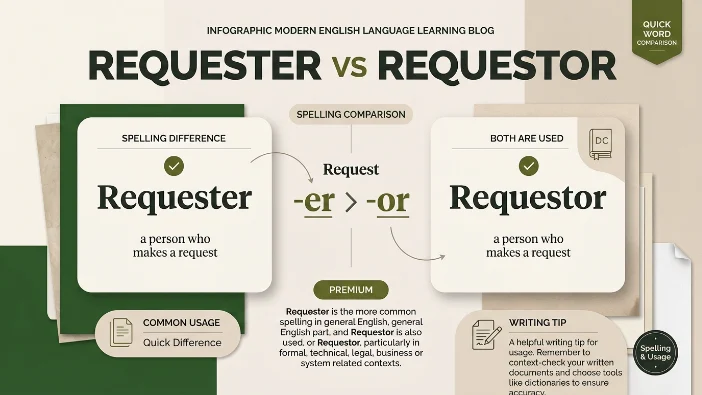
Requester is the standard, widely accepted spelling in modern American and British English. Requestor is a valid variant used mainly in legal, technical, and government documents. Both refer to a person who makes a request, but requester works in nearly every context, while requestor is more of a specialized professional term.
You’re typing an email, filling out a support ticket, or drafting a policy document, and suddenly you freeze. Is it “the requester will be notified” or “the requestor will be notified”? Spell check doesn’t complain about either one, and that’s exactly the problem. Both requester and requestor describe the same thing: someone who asks for something, whether that’s information, access, a refund, or approval. The confusion isn’t about meaning at all. It’s about which spelling belongs where, and why two versions of the same word even exist in the first place.
This mix-up shows up constantly in workplace writing, IT documentation, legal contracts, and customer service scripts. Get it wrong in a casual email and nobody notices. Get it wrong in a formal contract or a government form, and it can look careless or even confuse a reader who’s used to seeing one specific spelling in that field. By the end of this guide, you’ll know exactly which version to use, why the second spelling exists at all, and how to stop second-guessing yourself every time the word comes up.
Requester vs Requestor: What’s the Difference?
The core difference between requester and requestor is spelling and context, not meaning. Requester is the standard form used in everyday writing, business communication, and general English. Requestor is an accepted variant that shows up primarily in legal, government, and technical documentation.
Both words are nouns. Both come from the verb “request.” Both describe a person, group, or system that initiates a request. Neither word carries a different definition, a different pronunciation beyond the final syllable, or a different grammatical function. The entire distinction lives in formatting convention and audience expectation.
| Feature | Requester | Requestor |
|---|---|---|
| Meaning | Person who makes a request | Person who makes a request |
| Part of Speech | Noun | Noun |
| Refers To | Individual, group, or system asking for something | Individual, group, or system asking for something |
| Typical Usage | General writing, business emails, customer service, tech support | Legal documents, contracts, government forms, IT/security systems |
| Common Confusion | Assumed to be the “less correct” version | Assumed to be a typo or informal error |
Neither spelling is wrong, but they signal different registers. Requester feels natural in a Slack message or a help desk reply. Requestor feels natural in a subpoena, a procurement contract, or a database field name written by a systems architect. Reach for the one that matches the room you’re writing in.
Is Requester/Requestor a Grammar, Vocabulary, or Usage Issue?
This isn’t a grammar rule in the traditional sense you won’t find a textbook chapter dedicated to it. It’s a usage and vocabulary issue, closer to the “gray/grey” or “advisor/adviser” family of words, where regional habit and professional tradition shaped two acceptable spellings over time.
Grammatically, both words behave identically. They take the same articles, the same plural forms (requesters, requestors), and the same possessive structures (the requester’s account, the requestor’s authorization). Neither is more “correct” in a strict grammatical sense.
In formal English, business English, and academic writing, requester dominates by a wide margin. Style guides like the Chicago Manual of Style favor the “-er” ending for agent nouns formed from regular verbs, which is the pattern requester follows. Requestor tends to survive mostly in specialized fields where a particular document template or software system standardized it decades ago and nobody bothered to change it.
In everyday conversation, you’ll almost never hear someone worry about this distinction out loud, because spoken English doesn’t reveal spelling. The issue only becomes visible in writing, which is exactly where it trips people up.
Practical takeaway: if you’re writing for a general audience, use requester. If you’re editing a legal or technical document and the surrounding text already uses requestor, match that convention rather than “correcting” it.
Requester: Meaning, Usage, and Examples
Requester is the agent noun formed the standard way English usually handles verbs ending in a silent “-t” sound followed by an action suffix: request plus “-er,” similar to how “manage” becomes “manager” or “employ” becomes “employer.” It’s pronounced ri-KWES-ter, with stress on the second syllable, exactly like requestor.
As a noun, requester refers to the person, department, or automated system that initiates a request. It pairs naturally with words like “original,” “initial,” “primary,” and “authorized” the original requester, the authorized requester, the primary requester on file.
Workplace example: “Please loop in the requester before closing this ticket, since they may have additional context we’re missing.”
Academic example: “The requester must submit a formal application to the ethics review board before data collection begins.”
Technology example: “Once the API receives the call, it logs the requester’s IP address for security auditing purposes.”
Email example: “As the requester of this document, you’ll receive an automated update once approval is finalized.”
Daily conversation example: “I was the requester on that vacation swap, so I should probably follow up with HR myself.”
One learner mistake: Non-native speakers sometimes write “requestor” by default because it visually resembles words like “doctor” or “actor,” assuming the “-or” ending is the neutral, professional-sounding choice. In most everyday and business writing, that assumption backfires, since requester is what readers expect to see.
Mini recap: Requester is your default choice. Use it unless you have a specific reason like matching an existing legal template to switch to the alternate spelling.
Requestor: Meaning, Usage, and Examples
Requestor carries the exact same meaning as requester. The spelling difference traces back to Latin-influenced agent noun patterns, where “-or” endings were historically used for more formal or Latinate verbs (think “auditor,” “creditor,” “editor”). Even though “request” doesn’t strictly follow that Latin pattern, the “-or” spelling caught on in certain professional dialects anyway, likely influenced by neighboring legal terms like “petitioner” and “grantor.
Pronunciation matches requester exactly: ri-KWES-tor. Part of speech is identical too a noun functioning as the subject or object in a sentence.
Requestor shows up most often in:
- Legal filings and contracts
- Government and municipal forms
- IT security and access-control systems
- Procurement and vendor management documents
Workplace example: “The access request was denied because the requestor’s clearance level didn’t match the system requirement.”
Academic example (legal studies context): “Under the statute, the requestor bears the burden of proving a legitimate interest in the records.”
Technology example: “In the authentication log, the requestor field records which service account triggered the API call.”
Email example: “This automated notice confirms that requestor ID 44821 has been added to the review queue.”
Daily conversation example: This spelling almost never appears in casual speech-to-text conversation. If you hear someone say it out loud in a non-professional setting, it’s usually because they picked it up from a form they filled out recently, not because it’s their natural word choice.
One learner mistake: Writers sometimes switch spellings mid-document, using requester in one paragraph and requestor in the next. This looks inconsistent to an editor even though both spellings are technically acceptable pick one and stay with it throughout a single piece of writing.
Mini recap: Requestor isn’t wrong, but it’s a specialized choice. Use it when you’re working inside a legal, governmental, or technical framework that already relies on it.
When Not to Use Each Word
Mistake 1: Using requestor in casual customer-facing emails. Customers generally expect friendlier, more familiar language. Requestor can feel stiff or overly bureaucratic in a support reply. Stick with requester.
Mistake 2: Switching spellings within the same document. This is one of the most common errors editors catch. Once you choose requester or requestor at the top of a document, run a find-and-replace check before submitting to make sure you didn’t slip into the other spelling halfway through.
Mistake 3: Assuming requestor is the “formal” version and always safer for business writing. It’s actually the opposite in most modern style guides. Chicago Manual of Style and most corporate style sheets recommend requester as the default for general business writing.
Mistake 4: Using requestor in marketing or UX copy. Product interfaces, app notifications, and onboarding flows almost universally use requester because it reads as more approachable to end users.
Mistake 5: “Correcting” requestor to requester inside a legal template someone else wrote. If you’re editing a contract or government form where requestor is already the established term throughout, changing it introduces inconsistency rather than fixing an error.
Mistake 6: Assuming spell-check will flag the wrong one. Most spell-check tools accept both spellings as valid, so they won’t warn you about inconsistency or context mismatch. You have to catch that yourself.
Mistake 7: Using requestor because it “sounds more official” in a resume or cover letter. Recruiters and hiring managers are used to seeing requester far more often; an unexpected requestor can read as slightly off, even if it’s technically fine.
Mistake 8: Forgetting the plural form matters too. Some writers get the singular right but slip on the plural, writing “requestors” in one sentence and “requesters” a page later. Decide early and stay consistent through every form of the word.
Common Mistakes Table
| Correct Sentence | Incorrect (Inconsistent) Sentence | Explanation |
|---|---|---|
| The requester will receive a confirmation email.” | “The requestor will receive a confirmation email,” followed later by “the requester’s account was updated.” | Mixing spellings within one document confuses readers and looks unedited. |
| “Please contact the original requester for clarification.” | “Please contact the original requestor for clarification” in a casual customer support chat. | Requestor feels overly formal for a friendly, informal support tone. |
| “The requestor must sign Form 27-B before access is granted.” | “The requester must sign Form 27-B” when every other legal document uses requestor. | Breaks consistency with an established legal template. |
| “Our system logs each requester’s timestamp.” | “Our system logs each requestor’s timestamp” in consumer-facing app documentation. | Product-facing writing generally favors requester for a friendlier tone. |
Quick Decision Box
If you’re writing a general email, business document, app, or website copy, use requester.
If you’re working inside an existing legal contract, government form, or technical system that already uses the other spelling, match requestor.
If you’re not sure and there’s no existing pattern to follow, default to requester. It’s the more widely recognized and expected form.
Real World Examples
Office communication: A manager writes in a team update, “Once the requester approves the final draft, we’ll move it to the design team.” Here, requester keeps the tone light and collaborative.
Business email: A vendor coordinator sends, “Per your request, I’ve attached the invoice. Let me know if the requestor needs any additional documentation for procurement.” In this case, the writer is echoing language already used by the finance department’s internal forms.
School or university: A student services portal reads, “Transcript requesters should allow five to seven business days for processing.” Universities almost always default to requester in student-facing materials.
Customer support: A help desk ticket note says, “Escalating this to Tier 2 support; the requester mentioned the issue has occurred three times this week.” Support software overwhelmingly defaults to requester as the field label.
Technology: A developer comment in code reads, “// Validate requestor permissions before granting database access.” Many enterprise systems, especially older ones built with legal or compliance oversight, standardized on requestor at the schema level years ago.
Artificial Intelligence: A chatbot log entry notes, “Requester intent classified as billing inquiry, confidence score 0.92.” AI and machine learning documentation tends to favor requester, matching general software conventions.
Daily conversation: A colleague mentions, “I was actually the requester on that new monitor, not Sarah she just forwarded the ticket for me.” This is the kind of natural, spoken usage where requestor would sound noticeably out of place.
Requester or Requestor in Modern Technology
In artificial intelligence, cloud computing, and API design, the word requester shows up constantly, and it almost always wins over requestor. When a system processes an API call, developers refer to the “requester” as the client, application, or user account that initiated the call. Logging systems, rate-limiting rules, and authentication tokens are typically documented using requester because it aligns with broader software engineering conventions.
Virtual assistants and voice assistants rarely use either term directly with end users you won’t hear Alexa or Siri say “requester” out loud but the backend documentation that governs how these systems process commands frequently uses requester when describing the user or device that triggered an action.
Chatbots and customer service automation tools also lean toward requester in their internal logs and ticketing metadata, mainly because most major help desk platforms (the software many companies build their support workflows around) standardized on that spelling from the start.
Where requestor survives in tech is mostly in enterprise systems tied to compliance, security clearance, or access management fields where the underlying software was originally modeled after legal or government processes. If you’re building a new tool from scratch with no legacy constraints, requester is the safer, more conventional choice.
A Quick Note on Word Origin
Both words trace back to the Latin verb “requirere,” meaning to seek or ask again, which evolved through Old French into the English verb “request.” The “-er” suffix is the native English agent-noun ending, applied the same way to countless everyday verbs. The “-or” suffix arrived through direct Latin borrowing, more common in words that came into English straight from Latin without passing through French first, like “auditor” or “governor.
Requester, following the native “-er” pattern, became the dominant spelling as English usage settled over the twentieth century. Requestor persisted mainly because certain legal and technical fields adopted early templates using that spelling and never updated them, which is why you’ll still find it embedded in older government forms and enterprise software today.
Expert Insight
When students ask me which spelling is “correct,” I tell them to think about audience first, not grammar rules. Requester and requestor mean exactly the same thing, so there’s no comprehension risk either way. What changes is how polished and context-appropriate your writing feels to the person reading it. A resume, a customer email, or a product description should almost always use requester, because that’s what readers expect and what most style guides recommend. The moment you’re editing something inside an existing legal or technical framework, though, consistency matters more than the “preferred” spelling match what’s already there rather than introducing a second version partway through.
Error Prevention Checklist
- Always use requester in general business writing, emails, resumes, and customer-facing content.
- Always use requestor when editing or continuing a legal, government, or technical document that already uses that spelling consistently.
- Never confuse them if you remember this rule: requester is the everyday default; requestor is the specialized exception.
- Quick memory tip: “Requester” ends the same way as “manager” and “employer” common, everyday words. “Requestor” ends the same way as “auditor” and “creditor” formal, legal-sounding words. Match your context to the ending.
Related Grammar Confusions Worth Learning
- Advisor vs Adviser another agent-noun spelling pair where regional and professional convention decides the “correct” choice.
- Affect vs Effect a genuinely different-meaning pair, unlike requester/requestor, and one of the most common grammar mix-ups in English.
- Complement vs Compliment homophones with completely different meanings that trip up even confident writers.
- Assure vs Ensure vs Insure three verbs with overlapping meanings but distinct professional contexts.
- Principal vs Principle a classic confusion pair that shows up constantly in school and business writing.
- Personnel vs Personal a single-letter difference that changes the entire meaning of a sentence.
- Councilor vs Counselor similar sound, entirely different jobs, and a common error in formal writing.
- Its vs It’s a small but reputation-damaging mistake in professional documents.
- Farther vs Further a distance-versus-degree distinction many writers never learned clearly.
- Discreet vs Discrete spelled almost identically, but with meanings that don’t overlap at all.
FAQs
Is “requestor” a real word?
Yes. “Requestor” is a legitimate spelling variant of “requester,” not a spelling mistake. However, it is less common in everyday English and appears more often in legal, technical, administrative, and government contexts.
Which spelling do style guides recommend?
For general and business writing, “requester” is usually the safer and more familiar choice. It follows the common English pattern of forming agent nouns with “-er.” If your organization has a preferred style, follow that consistently.
Can I use “requester” and “requestor” interchangeably?
Yes. Both words refer to someone who makes a request, so they can have the same meaning. However, avoid switching between them in the same document. Choose one spelling and use it consistently.
Why do legal documents often use “requestor” instead of “requester”?
“Requestor” is common in some legal, government, and technical contexts because these fields often use established terminology and standardized templates. The “-or” ending also appears in words such as grantor and petitioner, which may reinforce this usage.
Is “requestor” British or American English?
No. The difference is not primarily regional. Both “requester” and “requestor” can appear in British and American English. The choice is more closely related to professional context, industry terminology, and organizational preference.
What is the plural of “requester” and “requestor”?
The plural forms are “requesters” and “requestors.” Simply add “-s” to the singular form. Both plurals are grammatically correct.
Conclusion
The difference between requester and requestor ultimately comes down to context, not correctness. Both words describe the same person or system asking for something, and neither one is a grammar mistake. Requester is the word most readers expect to see in everyday business writing, customer communication, and modern software documentation. Requestor survives as a specialized variant in legal, government, and enterprise technical fields, where older conventions still shape how documents get written.
If you remember nothing else from this guide, remember this: when in doubt, use requester. It’s the safer, more widely recognized choice for almost any writing situation you’ll encounter, and you can always switch to requestor later if you find yourself working inside a document that already relies on it.