Quick Answer
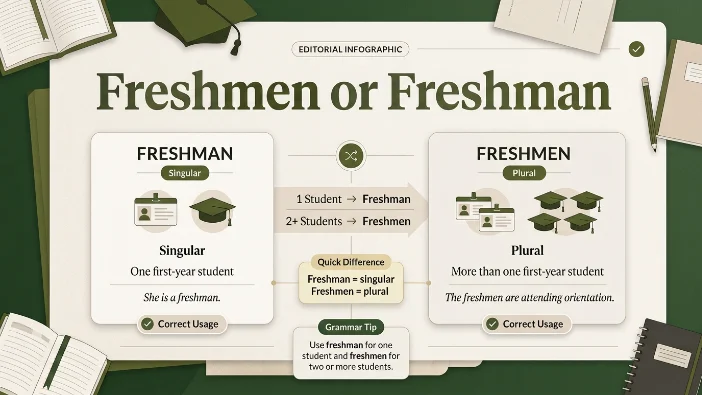
The difference between freshmen and freshman is simple: freshman is singular (one student), while freshmen is plural (two or more students). Both words refer to first-year high school, college, or university students. Use freshman when speaking about one person and freshmen when referring to a group. Remember that freshman also works as an adjective.
You’re writing an email to a university department. You need to ask about orientation for new students. Do you write freshmen or freshman? Maybe you’ve stared at both words, knowing one is right but unsure which. It is a common point of confusion, even for native English speakers. The words look nearly identical, and in casual conversation, the difference can be hard to hear. Yet using the wrong one can make your writing look less polished and create confusion about whether you mean one person or many .
This guide will clear up the confusion for good. You will learn the simple grammar rule that separates these two terms, see practical examples from everyday life, and understand how to use each word with confidence in your writing, whether you are a student, a professional, or someone learning English as a second language.
What’s the Difference Between Freshmen and Freshman?
The core difference is straightforward: number. Freshman is singular, and freshmen is plural. This means the choice depends entirely on how many first-year students you are discussing .
The word is an irregular noun. Just as the plural of man is men, the plural of freshman is freshmen. This is why the plural is not freshmans (which is never correct) . This follows a pattern seen in other compound words ending in -man, such as fireman/firemen and chairman/chairmen .
Here is a quick comparison to clarify:
| Feature | Freshman | Freshmen |
|---|---|---|
| Meaning | A first-year student | First-year students |
| Part of Speech | Singular noun or adjective | Plural noun |
| Refers To | One person | A group of two or more |
| Typical Usage | “He is a freshman.” | “The freshmen are lost.” |
| Example | “My daughter is a freshman at Yale.” | “There are 1,000 freshmen in this year’s class.” |
| Common Confusion | Incorrectly used as a plural | Incorrectly used as a singular |
Remembering this key rule will prevent most errors. If you are talking about one person, use freshman. If you are talking about a group, use freshmen.
Is Freshman vs. Freshmen a Grammar, Vocabulary, or Usage Issue?
This confusion is primarily a grammar issue related to number agreement. At its core, it is about using the correct singular and plural forms. It is not a vocabulary issue because both words have the same definition. The confusion arises in usage when people pair a singular subject with a plural noun or vice versa.
The distinction is also a usage problem. Knowing the rule is one thing, but applying it correctly in different contexts—academic writing, business communication, or casual conversation—is where people stumble.
For example, in formal English, particularly in academic and professional settings, using the correct form is a sign of attention to detail. In contrast, a business email that says “The freshmen class” would be marked as a grammatical error, as freshman is the correct adjective form. In everyday conversation, the difference can be subtle, as the words sound very similar. However, using freshmen when you mean a single person is a noticeable mistake that can undermine your credibility .
The Practical Takeaway: Always match the form of the word to the number of people you are describing. One student? Freshman. A group? Freshmen. This one simple rule resolves nearly all confusion.
Freshman: Meaning, Usage, and Examples
Freshman is a singular noun. It refers to a student in their first year of high school, college, or university. Despite the word man in its spelling, freshman is used as a gender-neutral term in modern English to refer to people of any gender .
It can also function as an adjective, modifying a noun that follows it.
Common Collocations & Sentence Patterns:
- a freshman: “She is a freshman at the local community college.”
- freshman year: “My freshman year of college was a big adjustment.”
- freshman class: “The freshman class is the largest in the school’s history.”
- freshman student: “The program is designed for freshman students.”
Examples in Different Contexts:
- Workplace: “We’re hiring a few interns, and one will be a freshman from the local university.”
- Academic: “The professor offered extra help to any freshman who was struggling with the material.”
- Technology: “The company’s mentorship program pairs a senior developer with a freshman hire who is new to the industry.”
- Email: “Dear Mr. Chen, I am writing to confirm that my daughter, a freshman, will be attending the orientation on Saturday.”
- Daily Conversation: “I remember when I was a freshman. Everything felt so new and exciting.”
One Learner Mistake: The most common error is using freshmen when a single person is involved.
- ❌ Incorrect: “I am a freshmen at the university.”
- ✅ Correct: “I am a freshman at the university.”
Mini Recap: Use freshman when talking about one first-year student or when using the word as an adjective (e.g., freshman year).
Freshmen: Meaning, Usage, and Examples
Freshmen is a plural noun. It refers to two or more students in their first year of high school, college, or university. It is the plural form of freshman and is used when referring to a group or class of students .
Common Collocations & Sentence Patterns:
- the freshmen: “The freshmen are attending a welcome assembly.”
- all freshmen: “All freshmen must submit a health form.”
- new freshmen: “The university welcomed over 2,000 new freshmen this fall.”
- freshmen orientation: “Freshmen orientation is scheduled for next week.” (In this case, it’s a noun adjunct, acting as an adjective but remaining plural because it describes an event for a group).
Examples in Different Contexts:
- Workplace: “The company’s leadership program is designed for freshmen entering the workforce.”
- Academic: “Freshmen often face challenges adjusting to the academic rigor of college.”
- Technology: “The new software is designed to help freshmen navigate their university’s online portal.”
- Email: “All freshmen are reminded that the deadline for course registration is this Friday.”
- Daily Conversation: “We met in our first year and have been friends ever since we were freshmen.”
One Learner Mistake: The most common error is using freshman when a group of people is involved.
- ❌ Incorrect: “All the freshman are going on a field trip.” (Unless it’s being used as an adjective, e.g., “All the freshman students are going…”)
- ✅ Correct: “All the freshmen are going on a field trip.”
Mini Recap: Use freshmen whenever you are talking about more than one first-year student.
Common Mistakes: When to Not Use Each Word
Here are some common situations where writers often choose the wrong word.
Using “Freshmen” as an Adjective
Why the mistake happens: Writers sometimes assume that a plural noun should stay plural when describing another plural noun. For example, they may write “freshmen students.”
Which word is correct: Freshman.
Use the singular form when it modifies another noun, as in freshman students, freshman year, or freshman class.
How to remember: When freshman describes another noun, keep it singular. English noun modifiers usually stay in their singular form.
Using “Freshmen” for One Person
Why the mistake happens: Since freshmen refers to more than one person, writers may accidentally use it after a or one, especially when typing quickly.
Which word is correct: Freshman.
For example, say “She is a freshman,” not “She is a freshmen.”
How to remember: If you can say a student or one student, you need a freshman.
Using “Freshman” for a Group of People
Why the mistake happens: Some writers forget that freshman has an irregular plural and simply use the singular form for multiple people.
Which word is correct: Freshmen.
For example, “The freshmen are attending orientation” is correct when referring to several first-year students.
How to remember: If you could replace the word with students, use freshmen.
Using “Freshmans”
Why the mistake happens: English speakers often form plurals by adding -s, so freshmans may seem logical.
Which word is correct: Freshmen.
Freshman follows the same irregular pattern as man → men and woman → women. Therefore, the correct plural is freshmen, never freshmans.
How to remember: Whenever man changes to men in the plural, freshman follows the same pattern.
Using “Freshmen” with a Singular Verb
Why the mistake happens: A group of freshmen may be thought of as one unit, which can lead writers to pair the plural noun freshmen with a singular verb.
Which word is correct: It depends on what you mean. Freshmen is plural, so it normally takes a plural verb: “The freshmen are ready.”
If you want to describe the group as a single unit, use a singular noun such as class: “The freshman class is large.”
How to remember: Match singular nouns with singular verbs and plural nouns with plural verbs.
Here’s a simple table summarizing these errors:
Decision Box: Which One Should You Use?
If you are writing about one student, use freshman.
If you are writing about two or more students, use freshmen.
If you are using the word as an adjective (e.g., before a noun like year, class, or student), use freshman.
This simple rule will help you choose the correct word in almost every scenario.
Real-World Examples of Freshmen and Freshman
Seeing these words in context is the best way to internalize the difference. These are realistic examples from various settings.
- Office Communication: “The new project manager is a freshman when it comes to our software, so we need to be patient.” (Used metaphorically to mean a beginner in a specific context) .
- Business Email: “Dear Team, please welcome the new interns. Two are freshmen from the local university.”
- School/University: “The university is known for its excellent support for freshmen, with a dedicated orientation program.”
- Customer Support: “Since you’re a freshman with our product, we’ve included a free one-on-one tutorial session with your purchase.”
- Technology: “As a freshman developer, you’ll find the documentation helpful for getting started.”
- Artificial Intelligence: “The AI system is designed to help freshmen choose their courses based on their interests and academic history.”
- Daily Conversation: “My brother is a high school freshman this year.” “Oh, cool! Are there many freshmen at his school?”
Freshmen and Freshman in Modern Technology
In the tech world, the word freshman is often used metaphorically to describe a new user or someone with beginner-level experience. This usage mirrors the academic context but applies to software, platforms, or even jobs.
- Artificial Intelligence & Virtual Assistants: An AI might be described as a “freshman AI” when it is newly deployed and still learning from user interactions. Similarly, a company might introduce a “freshman onboarding program” for new users of a complex software platform, often facilitated by a virtual assistant or chatbot .
- Software: Many software companies create specific “freshman” tutorials or help sections for first-time users. These guides walk users through the basics, assuming no prior knowledge.
- Business Tools: When a company implements a new tool like Slack or Asana, employees who haven’t used it before are often called “freshmen” users by the internal training team.
This demonstrates how the core meaning of newness and inexperience remains the same, even when the context shifts from the classroom to the boardroom.
Expert Insight on Mastering This Distinction
The confusion between freshman and freshmen is a classic example of how the English language can trap even careful writers. The difference is purely grammatical, but it trips people up because the two words are so visually and phonetically similar. When I teach this in my workshops, I tell students to stop trying to “hear” the difference and instead “feel” the difference. Think about the number you are referring to. Is it one or many? Once you establish that, the answer becomes obvious. This isn’t about a complex vocabulary rule; it’s about a simple act of checking your subject-verb agreement. This kind of precision is what distinguishes a good writer from a great one.
Error Prevention Checklist
- ✅ Always use freshman when referring to one first-year student.
- ✅ Always use freshmen when referring to a group of first-year students.
- ✅ Always use freshman as an adjective (e.g., freshman class, freshman year).
- ❌ Never use the word freshmans. It is always incorrect .
- ❌ Never use freshmen as a singular noun.
- Quick Memory Tip: If you can use the word “student(s)” in its place, the rule is simple. “A student” is a freshman. “Students” are freshmen.
Related Grammar Confusions
Understanding the singular/plural distinction for freshman is a great starting point, but English has many other word pairs that cause similar confusion. Learning them will make your writing much stronger.
- Woman vs. Women: Similar to man/men, the singular is woman and the plural is women.
- Man vs. Men: The foundational rule: singular man, plural men.
- Chairman vs. Chairmen: Like freshman, the plural changes the -man to -men.
- Alumnus vs. Alumni: A classic Latin-derived singular/plural pair.
- Criteria vs. Criterion: One criterion, many criteria.
- Phenomenon vs. Phenomena: One phenomenon, many phenomena.
- Data vs. Datum: In formal writing, datum is singular and data is plural.
- Index vs. Indices: An irregular plural form.
- Appendix vs. Appendices: Another irregular plural.
- Crisis vs. Crises: The *-is* ending changes to *-es* in the plural.
FAQs
Is it “freshman year” or “freshmen year”?
It is always freshman year. In this phrase, freshman acts as an adjective modifying the noun year. As a rule, adjectives in English do not change form to show number, so it remains singular .
Are the words “freshmen” and “freshman” pronounced differently?
The difference is subtle. The plural freshmen is pronounced with a short ‘e’ sound in the second syllable, like “men.” The singular freshman is pronounced with a schwa sound (ə) in the second syllable, like “muhn,” so it sounds like “fresh-muhn” .
Is “freshmen” acceptable for a group of students that includes non-male students?
Yes, the term is considered gender-neutral in modern usage, despite the “man” suffix. However, some universities and style guides prefer the term “first-year student” to be more explicitly inclusive and to avoid any perception of gender bias .
Can “freshman” be used to describe someone who is not a student?
Yes, it is commonly used metaphorically to describe someone who is a beginner or new to a particular field, job, or activity. For instance, “He is a freshman in the world of marketing” means he is new to marketing .
What is the British English equivalent of “freshman”?
In British English, the term “first-year student” or simply “first-year” is much more common than freshman or freshmen. The American term “fresher” is also used in some UK universities .
Conclusion
The difference between freshmen and freshman is simple but important. Freshman is the singular form used for one person, while freshmen is the plural form for groups. Remember that freshman is also the go-to choice when the word is used as an adjective.
Getting this right is a small detail that makes a big difference in the clarity and professionalism of your writing. By following the simple rule of matching the noun to the number of people you are describing, you can avoid a common grammatical pitfall and communicate with confidence.
One memorable rule: One student = freshman. Two or more = freshmen.
Read More Related Articles:
- Totaling or Totalling | American vs British English In 2026
- Hoodie or Hoody | Easy Way to Remember the Difference In 2026
- Truly or Truely | Simple Guide to Getting It Right In 2026

Lucas Mitchell is a content writer at synoseek.com. He writes simple, thoughtful pieces that focus on everyday ideas, observations and general knowledge topics. His work is shaped by a calm, realistic tone that keeps the reader engaged without overstatement.