Quick Answer
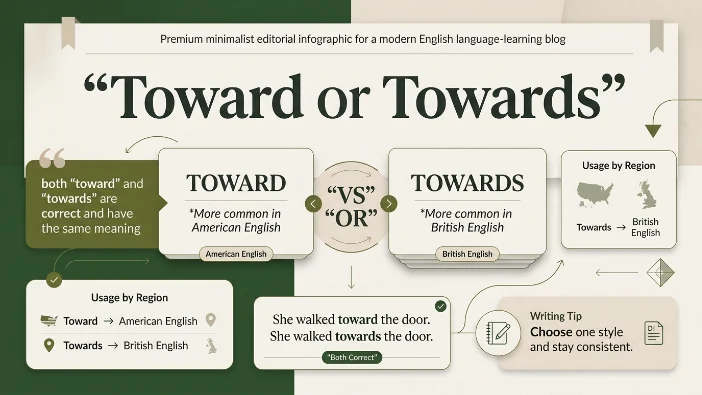
Toward and towards mean exactly the same thing and are both correct. The real difference is regional: American English favors toward, while British, Canadian, and Australian English favor towards. Neither spelling is a grammar mistakepick one based on your audience and stay consistent throughout your writing.
You’re halfway through an email, you type “I’m looking forward toward next week,” and suddenly you freeze. Should that last word have an s on it or not? This happens to writers constantly, and it’s one of those small moments where confidence just evaporates. The confusion around toward and towards is understandable because both words show up everywhere in books, in news articles, in casual texts and nobody ever clearly explained why two spellings exist for one word.
Here’s the short version: toward and towards are variant spellings of the same preposition, both describing movement or orientation in a direction. The mix-up happens because English is really two dialects wearing one trench coat American English on one side, British-influenced English on the other and each side picked its own favorite spelling decades ago. Get the wrong one in the wrong context, and it’s not exactly a grammar crime, but it can make your writing look inconsistent or out of place for your audience.
By the end of this guide, you’ll know exactly which spelling fits which audience, how to use the word correctly in real sentences, and how to avoid the small mistakes that trip up even confident writers.
Toward or Towards: What’s the Difference?
The difference between toward and towards is purely regional spelling, not meaning or grammar. Both words function identically as prepositions that show direction, movement, or a figurative shift in attitude.
Toward dropped its final s in American English sometime in the 19th century as part of a broader pattern of simplification (similar to how “colour” became “color”). Towards kept the s and remained standard in British English, along with most Commonwealth countries like Canada, Australia, New Zealand, and Ireland.
| Meaning | Part of Speech | Refers To | Typical Usage | Example | Common Confusion |
|---|---|---|---|---|---|
| In the direction of | Preposition | Movement, position, or attitude | American English | She walked toward the door. | Assumed to be incorrect outside the US |
| In the direction of | Preposition | Movement, position, or attitude | British/Commonwealth English | She walked towards the door. | Assumed to be informal or wrong in the US |
Both spellings pass through dictionaries and style guides without penalty. The Cambridge Dictionary lists towards as the primary British entry, while Merriam-Webster lists toward as standard American usage, with towards noted as a variant. Neither source treats one form as more “correct” than the other the distinction is about where your reader lives, not about grammar rules.
Quick recap: if you’re writing for a US audience, business report, or American publication, toward is the safer default. If you’re writing for a UK, Canadian, or Australian audience, towards will feel more natural. Either way, the meaning of the sentence never changes.
Is Toward a Grammar, Vocabulary, or Usage Issue?
Toward versus towards is a usage issue, not a grammar or vocabulary issue. Grammatically, both spellings behave the same way they’re prepositions that require an object (a noun or pronoun) to complete their meaning, as in “walking toward the park” or “leaning towards a decision.
There’s no vocabulary difference either, since the words share an identical dictionary definition. What separates them is regional convention, similar to how “color” and “colour” or “realize” and “realise” split along the same American-versus-British line.
The two spellings are fully interchangeable in meaning, which means you won’t confuse a reader no matter which one you choose. That said, consistency matters more than most people realize. In formal English, business English, and academic writing, style guides typically expect you to stick with one spelling throughout an entire document. Switching between toward and towards in the same piece even though both are “correct” reads as sloppy rather than intentional. In everyday conversation and casual writing, nobody notices or cares which one you use.
The practical takeaway: match your spelling to your audience’s region, then lock it in for the rest of the document.
Toward: Meaning, Usage, and Examples
Toward is a preposition meaning “in the direction of” something, whether that’s a physical location, a point in time, or a shift in feeling or opinion. It’s the standard spelling in American English and appears in nearly all US-based writing, from news articles to corporate style guides.
Part of speech: Preposition Pronunciation: tuh-WORD (two syllables, stress on the second)
Common collocations: move toward, head toward, work toward, lean toward, contribute toward, a step toward
Typical sentence pattern: [Subject] + [verb] + toward + [noun/destination]
Here’s how toward shows up across different real-life situations:
- Workplace example: “Our team is working toward the Q3 deadline, and we’re ahead of schedule.”
- Academic example: “The professor’s research contributes toward a better understanding of climate migration patterns.”
- Technology example: “The company is shifting toward a subscription-based pricing model.”
- Email example: “I wanted to check in on our progress toward finalizing the contract.”
- Daily conversation example: “Can you walk toward the parking lot? I’ll meet you there.”
One learner mistake: Non-native speakers sometimes add “to” before toward, writing something like “she walked to toward the store.” Toward already includes the sense of direction, so it never needs a second preposition in front of it.
Mini recap: Toward is the American English standard, works the same grammatically as any directional preposition, and never needs “to” paired with it.
Towards: Meaning, Usage, and Examples
Towards carries the identical meaning as toward movement or orientation in a direction but it’s the preferred spelling in British, Canadian, Australian, and most other Commonwealth varieties of English. If you’re writing for an international audience outside the US, towards will look more natural and expected.
Part of speech: Preposition Pronunciation: tuh-WORDZ (same stress pattern as toward, with an added z-sound)
Common collocations: move towards, gravitate towards, put money towards, a gesture towards, attitude towards
Typical sentence pattern: [Subject] + [verb] + towards + [noun/destination]
Real-world examples across different contexts:
- Workplace example: “The board’s attitude towards remote work has softened considerably this year.”
- Academic example: “Students are encouraged to put effort towards independent research early in the term.”
- Technology example: “Developers are moving towards open-source frameworks for faster deployment.”
- Email example: “Thank you for putting time towards reviewing my proposal this week.”
- Daily conversation example: “He’s been saving money towards a trip to Portugal.”
One learner mistake: Some writers assume towards is informal slang and avoid it in professional writing. That’s inaccurate towards is completely standard formal English in every country outside the US, including in academic journals, legal documents, and business reports.
Mini recap: Towards is the standard spelling across most English-speaking countries outside the US, and it carries no less formality or correctness than toward.
When Not to Use Toward or Towards
Even though both spellings are grammatically valid, there are situations where writers pick the wrong one or use the word incorrectly altogether.
Mixing spellings within one document. This is the single most common mistake. A writer uses toward in paragraph two and towards in paragraph five without noticing. It’s not a grammar error, but it looks careless to an editor or a careful reader. Pick one spelling before you start writing and search your document for the other one before you submit it.
Writing for the wrong regional audience. If you’re submitting a manuscript to a British publisher, using toward throughout will mark your writing as American, which may or may not matter depending on the context. Always check your target publication’s house style first.
Using it instead of “to.” Toward and towards indicate direction or progress, not a completed destination. She drove toward the airport” means she was heading there, not that she arrived. If the sentence describes arrival, “to” is usually the better word: “She drove to the airport” confirms she got there.
Overusing it in formal writing. Some writers lean on toward/towards so often that sentences start to feel repetitive. “We’re working toward growth, moving toward efficiency, and heading toward success” reads clunky. Vary your prepositions and verbs when possible.
Confusing it with “toward” as an adjective. Toward doesn’t function as an adjective in modern English (an older, archaic use existed centuries ago, meaning “promising” or “favorable,” but this has essentially disappeared from contemporary usage). If you need an adjective describing direction, you’ll want a different word entirely, like “forward-facing” or “directional.”
Dropping the object. Toward and towards always need something after them. “He walked toward” isn’t a complete thought you need “he walked toward the house” or similar. Leaving the preposition dangling without its object is a genuine grammar error, unlike the spelling variation itself.
Common Mistakes Table
| Correct Sentence | Incorrect Sentence | Explanation |
|---|---|---|
| She’s saving money toward a new car. | She’s saving money to toward a new car. | Toward already implies direction; adding “to” is redundant. |
| We made real progress toward our goal. | We made real progress toward. | Toward needs an object to complete the sentence. |
| He gestured towards the exit. | He gestured towards to the exit. | Never pair towards with another directional preposition. |
| Her attitude toward the project changed. | Her attitude of toward the project changed. | “Of” doesn’t belong before toward in this context. |
| The company is moving towards automation. | The company is moving forward towards automation. | “Forward towards” is redundant; choose one directional phrase. |
Decision Box
- If you’re writing for a US audience or American publication, use toward.
- If you’re writing for a UK, Canadian, Australian, or other Commonwealth audience, use towards.
- If you’re unsure who your audience is, either one works just stay consistent for the entire piece.
Toward and Towards in Real-World Situations
Office communication: A manager writing a performance review might say, “Maria has shown real initiative toward improving team communication this quarter.” The phrase signals ongoing effort, not a finished achievement.
Business email: “We’re excited to put resources toward expanding into the European market next year” works well in a quarterly update, showing forward momentum without overpromising results.
School or university: A student’s thesis advisor might note, “Your latest chapter moves the argument towards a much stronger conclusion,” using towards naturally in an academic British-English context.
Customer support: A support agent might write, “We’re working toward a permanent fix and will update you within 48 hours,” reassuring a frustrated customer that action is in progress.
Technology: Product teams often describe roadmaps this way: “Our next release moves toward full API compatibility,” signaling incremental technical progress rather than a finished product.
Artificial Intelligence: AI researchers frequently write things like, “The model’s training data has been adjusted towards reducing bias in output,” a phrase common in both American and international technical papers.
Daily conversation: Something as simple as “Head toward the light and you’ll find the exit” shows how naturally the word fits into everyday spoken directions.
Toward and Towards in Modern Technology
Toward and towards show up constantly in tech writing, product descriptions, and AI-related content, mostly because so much of that language describes progress, direction, and iterative improvement.
Artificial Intelligence: Companies building machine learning models often describe their work as moving “toward more accurate predictions” or “towards ethical AI development,” depending on whether the company is based in the US or elsewhere.
Virtual and Voice Assistants: Product teams designing tools like smart speakers or chatbots frequently discuss user behavior shifting “toward voice-first interactions” as adoption grows.
Chatbots: Customer service platforms describe automation trends as businesses moving “toward AI-powered support” to handle higher ticket volumes without expanding staff.
Software development: Agile teams commonly track “progress toward a sprint goal,” using the word to represent partial completion rather than a finished task.
Business tools: SaaS companies pitch their platforms as helping teams “move toward better collaboration,” a phrase so common it’s practically a genre convention in software marketing.
The word fits naturally in tech writing because so much of that industry’s language is about momentum heading somewhere, without necessarily having arrived yet.
Word Origin
Toward traces back to Old English toweard, a combination of “to” and a suffix meaning “in the direction of” (the same root that gives us “-ward” in words like “forward” and “backward”). The s in towards came later, as Old English developed an adverbial genitive ending that got attached to directional words. Over time, American English simplified spelling in many places, dropping the s, while British English preserved the older form. This is the same historical pattern responsible for other American-British spelling splits, though each word’s path is slightly different.
Expert Insight
Here’s something worth remembering as a language learner or writer: regional spelling differences like toward and towards aren’t inconsistencies in English they’re evidence that English evolved differently across different countries after they stopped sharing daily contact. Neither version is “more correct.” What matters far more than which spelling you choose is whether you apply it consistently and appropriately for your audience. A single document that mixes toward and towards signals inattention to detail more than either spelling on its own ever could.
Error Prevention Checklist
- Always use toward when you’re writing for an American audience, US publication, or US-based company.
- Always use towards when you’re writing for a British, Canadian, Australian, or other Commonwealth audience.
- Never confuse them if you remember: same meaning, same grammar, different region.
- Quick memory tip: Towards has more letters, just like “colour” has more letters than “color” both extra letters belong to the same British spelling tradition.
Related Grammar Confusions
- Backward or Backwards follows the exact same American-British spelling pattern as toward/towards.
- Forward or Forwards another directional preposition with a regional split worth knowing.
- Among or Amongst a similar case where American English drops a letter that British English keeps.
- While or Whilst whilst is common in British formal writing but rare in American English.
- Learned or Learnt a common irregular verb spelling split between the two dialects.
- Gray or Grey a classic American-British spelling difference that trips up many writers.
- Cancelled or Canceled one l versus two, depending on which side of the Atlantic you’re writing for.
- Practice or Practise American English uses “practice” for both noun and verb, while British English separates them.
- Toward vs. To understanding when direction differs from arrival avoids a subtle but real meaning mistake.
- Farther or Further not a regional split, but another preposition pair that confuses writers for different reasons.
FAQs
Is “towards” grammatically incorrect in American English?
No. Towards is grammatically correct in American English, but toward is more common and generally preferred in US writing. Using towards will not confuse readers, although toward may look more natural in formal American writing.
Can I use “toward” and “towards” interchangeably in the same document?
Both forms are correct, but it is better to choose one and use it consistently. Switching between toward and towards within the same document can make your writing appear inconsistent, especially in academic or professional contexts.
Does “toward” need a comma before it?
Not by itself. Whether a comma appears before toward depends on the overall sentence structure. For example, commas may be needed around an interrupting phrase, but toward does not automatically require punctuation before it.
Which spelling do American style guides recommend?
American style guides, including APA Style and The Chicago Manual of Style, generally prefer toward without the s. It is the standard choice for most US academic, professional, and formal writing.
Is “towards” more formal than “toward”?
No. Neither word is more formal than the other. The difference is mainly regional: toward is more common in American English, while towards is more frequently used in British English.
Why does British English often use “towards” while American English prefers “toward”?
The difference developed through historical spelling preferences. British English retained the -s ending in several directional words, while American English tends to favor shorter forms. Similar patterns can be seen with pairs such as backward/backwards and forward/forwards.
Conclusion
Toward and towards mean exactly the same thing, function the same way grammatically, and never create confusion in meaning no matter which one a reader encounters. The only real difference comes down to geography: toward for American English, towards for British and Commonwealth English.
If you remember one rule going forward, make it this one match your spelling to your audience, then stay consistent for the rest of your writing. Get that right, and you’ll never second-guess this word again.
1 thought on “Toward or Towards | Easy Rule You Need to Know In 2026”