Quick Answer
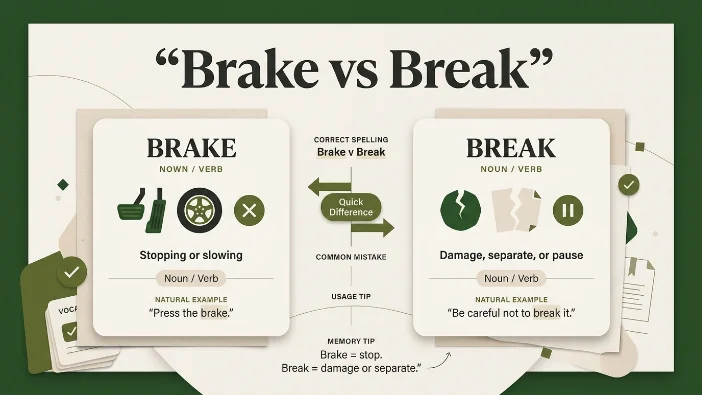
Brake is a noun or verb related to slowing or stopping a vehicle, while break means to separate, damage, or pause something. A car has a brake pedal, but you break a promise, a plate, or a habit. Mixing up brake vs break is one of the most common homophone errors in English writing, especially in emails and reports.
You’re driving down the highway, and suddenly the car in front of you slams on its brakes. Or wait did it slam on its breaks? If you paused even for a second to think about that, you’re not alone. Thousands of people search for the difference between these two words every single day, and it’s easy to see why.
Brake and break sound exactly the same when spoken out loud. They’re homophones, which means your ear can’t help you here only your understanding of meaning and context can. One word belongs to cars, bicycles, and machinery. The other belongs to almost everything else: broken hearts, broken rules, coffee breaks, and shattered glass.
Getting this wrong doesn’t just look like a small typo. In a business email, a school essay, or a technical manual, confusing brake and break can genuinely confuse your reader or make your writing look careless. By the end of this guide, you’ll know exactly which word to use, why the confusion happens in the first place, and how to remember the difference for good.
Brake vs Break: What’s the Difference?
The core difference comes down to this: brake refers specifically to stopping or slowing motion, while break refers to separating, damaging, interrupting, or pausing something.
Brake is the narrower word. It almost always shows up in conversations about vehicles, machines, or motion the brake pedal, the emergency brake, braking distance. Break, on the other hand, is one of the most flexible words in English. It can describe a cracked phone screen, a lunch break, breaking a world record, or breaking bad news.
Grammatically, brake works as both a noun (the brake failed) and a verb (she braked hard). Break also works as both a noun (take a break) and a verb (don’t break the vase), which is part of why the two words feel so similar in structure even though their meanings point in completely different directions.
| Meaning | Part of Speech | Refers To | Typical Usage | Example | Common Confusion |
|---|---|---|---|---|---|
| To stop or slow a vehicle | Noun / Verb | Vehicles, machines | “Hit the brakes” | The brakes squealed loudly. | Written as “breaks” |
| To separate, damage, or pause | Noun / Verb | Objects, time, rules, relationships | “Take a break” | He broke his phone screen. | Written as “brakes” |
Here’s the quick recap: if you’re talking about stopping a car, bike, or machine, you almost certainly want brake. If you’re talking about damage, interruption, rest, or violation of a rule, you want break. Once you anchor brake to “stopping motion,” the rest of the confusion tends to clear up fast.
Is Brake vs Break a Grammar, Vocabulary, or Usage Issue?
This isn’t really a grammar problem in the traditional sense there’s no rule about verb tense or sentence structure being violated. It’s a vocabulary and spelling issue rooted in the fact that brake and break are homophones with unrelated meanings and unrelated word origins.
Because they sound identical, spell-check software often won’t catch the mistake either. If “brake” is spelled correctly but used in the wrong context, most basic spell-checkers will let it pass since it’s a real word. That’s exactly why this mix-up shows up so often in fast-typed emails, text messages, and even published articles.
These two words are never interchangeable, regardless of tone or setting. In formal business writing, academic papers, or professional emails, the wrong choice stands out immediately to an attentive reader. In casual conversation over text, the meaning is usually still clear from context, but it can still make writing look rushed or unedited.
The practical takeaway: treat brake and break as two completely separate words that just happen to sound alike. Never let the sound guide your spelling let the meaning guide it instead.
Brake: Meaning and Usage
Brake refers to a device or action used to slow down or stop movement, most commonly associated with vehicles and machinery.
As a noun, it names the physical part the brake pedal, the brake pads, the emergency brake. As a verb, it describes the action of using that device to brake suddenly, to brake before a turn.
Common collocations include: hit the brakes, apply the brakes, brake pads, brake fluid, emergency brake, hand brake, and braking distance.
Workplace example: The mechanic replaced the worn brake pads before returning the delivery van.
Academic example: The physics assignment asked students to calculate the braking distance of a vehicle traveling at sixty miles per hour.
Technology example: The new electric car uses regenerative braking to recharge the battery while slowing down.
Email example: “Just a heads-up the fleet inspection flagged an issue with the rear brakes on van 12.”
Daily conversation example: “I had to brake hard when that dog ran into the road.”
One common learner mistake is writing “breaks” when describing a car’s stopping system, as in “the breaks on my bike are broken.” This looks correct because “broken” is nearby, but the stopping mechanism itself is always spelled brake.
Mini recap: Brake is your go-to word anytime you’re talking about slowing down or stopping motion pedals, pads, cars, bikes, and machines all fall under this word.
Break: Meaning and Usage
Break means to separate into pieces, to damage something, to interrupt an activity, or to fail to follow a rule or agreement.
It’s one of the most versatile verbs in English, which is part of the reason it appears so often. As a noun, it can mean a pause (a coffee break), a fracture (a break in the bone), or an opportunity (a lucky break). As a verb, it covers everything from breaking a window to breaking a promise to breaking a habit.
Common collocations include: take a break, break a record, break the news, break a habit, break down, break up, and coffee break.
Workplace example: The team decided to take a short break before finishing the quarterly report.
Academic example: Students are given a fifteen-minute break between the second and third exam sessions.
Technology example: A single software update can break compatibility with older devices if it’s not tested properly.
Email example: “I’ll be stepping away for a lunch break at noon and back online by one.”
Daily conversation example: “Careful with that mug it’s already got a small break in the handle.”
A frequent mistake among learners is using “brake” when they mean to pause or stop an activity, such as writing “let’s brake for lunch” instead of “let’s break for lunch.” The confusion usually happens because both ideas involve some kind of stopping, but only vehicles and machines get the word brake.
Mini recap: Break covers almost everything outside of vehicles damage, pauses, rule violations, and interruptions all belong to this word.
When Not to Use Each Word
Mistake 1: Writing “breaks” for a car’s stopping system. This happens because break feels like the more familiar, everyday word. Remember that brake always relates to stopping motion think “brake equals stop.”
Mistake 2: Writing “brake” when describing a pause from work. People sometimes associate any kind of stopping with brake, but a work pause is always a break. A useful trick: if you could replace the word with “pause” or “rest,” it’s break.
Mistake 3: Using “brake” for breaking news. News isn’t a vehicle, so it can’t be braked it’s broken and then reported.
Mistake 4: Confusing “brake down” with “break down.” A car breaks down (stops working), it doesn’t brake down. The phrasal verb always uses break, even though the topic is vehicles.
Mistake 5: Writing “brake a record” instead of “break a record.” Records are broken, not braked, since breaking here means surpassing a previous limit.
Mistake 6: Using “break” for a vehicle part. Some writers describe a squeaky “break pad,” but the correct spelling is always brake pad, since it names the stopping component.
Mistake 7: Mixing them in idioms. Phrases like “give me a break” or “break the ice” never use brake, even though they involve the idea of stopping an awkward moment.
Mistake 8: Assuming spell-check will catch it. Since both words are spelled correctly on their own, most spell-checkers won’t flag the wrong one in context. Proofreading by meaning, not just spelling, is essential here.
Common Mistakes Table
| Correct Sentence | Incorrect Sentence | Explanation |
|---|---|---|
| The brakes on my car feel loose. | The breaks on my car feel loose. | Refers to the vehicle’s stopping system, so brakes is correct. |
| Let’s break for coffee. | Let’s brake for coffee. | Refers to pausing an activity, not stopping a vehicle. |
| She broke her arm skiing. | She braked her arm skiing. | Refers to injury or damage, which is always break. |
| He hit the brake just in time. | He hit the break just in time. | Describes the physical action of stopping a vehicle. |
| The company had to break the bad news. | The company had to brake the bad news. | Refers to delivering information, unrelated to vehicles. |
| The mechanic checked the brake fluid. | The mechanic checked the break fluid. | A specific automotive term that always uses brake. |
Quick Decision Box
If you mean stopping or slowing a vehicle or machine, use Brake.
If you mean damage, interruption, a pause, or breaking a rule, use Break.
Brake vs Break in Real Life
Office communication: A facilities manager sends a memo: “Please report any issues with the brake system on company vehicles before Friday’s inspection.”
Business email: A manager writes to staff: “Let’s take a fifteen-minute break before we dive into the budget discussion.”
School or university: A driving instructor explains, “Always ease onto the brake instead of stamping down suddenly.”
Customer support: A support agent tells a customer, “It sounds like the app crashed and may have broken your saved settings.”
Technology: A product update note reads, “This patch may temporarily break integration with third-party plugins.”
Artificial Intelligence: A voice assistant might warn a driver, “Apply the brake gently, road conditions are icy,” while a chatbot separately tells a user, “Let’s break this task into three smaller steps.”
Daily conversation: A friend says, “I need a break from my phone this weekend,” while another mentions, “My bike’s brake cable snapped yesterday.
Brake and Break in Modern Technology
In the world of technology, both words show up constantly, but they still stay in their own lanes.
Brake appears mainly in the context of vehicles and automation think autonomous braking systems in self-driving cars, regenerative brakes in electric vehicles, or sensors that trigger emergency braking when a collision risk is detected. Virtual assistants and in-car AI systems often use the word brake when giving driving-related alerts or instructions.
Break, on the other hand, shows up constantly in software and business tools. A “breaking change” in software development refers to an update that disrupts existing functionality. Chatbots and virtual assistants might tell users to “take a break” as a wellness reminder, or a project management tool might let you “break down” a large task into smaller subtasks.
Both words are common in tech writing, but they never overlap in meaning brake stays tied to physical stopping mechanisms, while break covers digital disruption, task division, and pauses.
Word Origin
Brake traces back to Middle English and Middle Dutch roots referring to a device used for crushing or restraining, which later evolved into its modern meaning tied to stopping vehicles.
Break comes from Old English “brecan,” meaning to shatter or destroy, a meaning that has stayed remarkably consistent for over a thousand years while expanding into figurative uses like breaking news or breaking habits.
Knowing this history helps explain why brake stayed narrow in meaning while break became one of the most flexible verbs in the language.
Expert Insight
Here’s something worth remembering as a language instructor would put it to students: whenever you’re unsure, picture the two situations side by side. Brake is what your foot does in a car. Break is what happens to almost everything else. If your sentence has nothing to do with a vehicle slowing down, break is almost always the safer choice. This one mental image resolves the vast majority of real-world mix-ups.
Error Prevention Checklist
- Always use Brake when talking about stopping or slowing a vehicle, bicycle, or machine.
- Always use Break when talking about damage, pauses, interruptions, or violated rules.
- Never confuse them if you remember that brake only applies to physical stopping mechanisms.
- Quick memory tip: Brake has an “a” like in “car,” while Break can mean to “wreck” something different sounds in your head can anchor different spellings.
Related Grammar Confusions
Its vs It’s A classic possessive versus contraction mix-up that trips up even experienced writers.
Affect vs Effect One is usually a verb and the other a noun, but the overlap causes constant confusion.
Then vs Than Confusing time sequence with comparison changes the entire meaning of a sentence.
Your vs You’re Another possessive versus contraction pair that shows up in nearly every writing guide.
Loose vs Lose A single letter separates two words with completely different meanings.
Principal vs Principle One refers to a person or main idea, the other to a foundational rule.
Complement vs Compliment Praising someone versus completing something sound identical but mean very different things.
Stationary vs Stationery A word about standing still versus a word about paper products.
Advice vs Advise The noun and verb forms of guidance are frequently swapped in writing.
Desert vs Dessert A dry landscape versus a sweet treat, separated by one letter and a lot of confusion.
FAQs
Is it “brake” or “break” for a car?
When you’re talking about a car’s stopping mechanism, the correct word is “brake.” You might refer to the brake pedal, brake pads, or brake fluid. However, if a car stops working, you would say it “broke down”, using break.
What does “break a habit” mean?
“Break a habit” means to stop doing something you regularly do, especially an unwanted behavior such as procrastinating or biting your nails. The correct word is break because the phrase refers to stopping a behavior, not slowing a vehicle.
Why do brake and break sound the same?
Brake and break are homophones, meaning they have the same pronunciation but different spellings and meanings. Because they sound identical, you need to use the meaning and context of the sentence to choose the correct word.
Is “brake” ever used outside of vehicles?
Yes. Although brake is most commonly associated with vehicles and machinery, it can also be used figuratively for something that slows or restrains progress. For example, “High costs put a brake on business growth.”
What’s the difference between “break down” and “brake down”?
“Break down” is the correct phrase. It can describe a vehicle that stops functioning, a person becoming emotionally overwhelmed, or something being separated into smaller parts. “Brake down” is not a standard English expression.
Can “break” ever mean to stop a vehicle?
No. When referring specifically to a device used to slow or stop a vehicle, the correct spelling is “brake.” Break has many meanings, but it is not used for a vehicle’s stopping mechanism.
Conclusion
The difference between brake and break really comes down to one simple test: are you talking about a vehicle slowing down, or are you talking about damage, pauses, or interruptions? Brake belongs to cars, bikes, and machines. Break belongs to almost everything else in the language.
Next time you’re typing quickly and pause on which spelling to use, picture your foot on a pedal. If that image fits, you want brake. If it doesn’t, break is almost certainly the word you’re reaching for and that one mental check will save you from one of English’s most common homophone mistakes.