Quick Answer
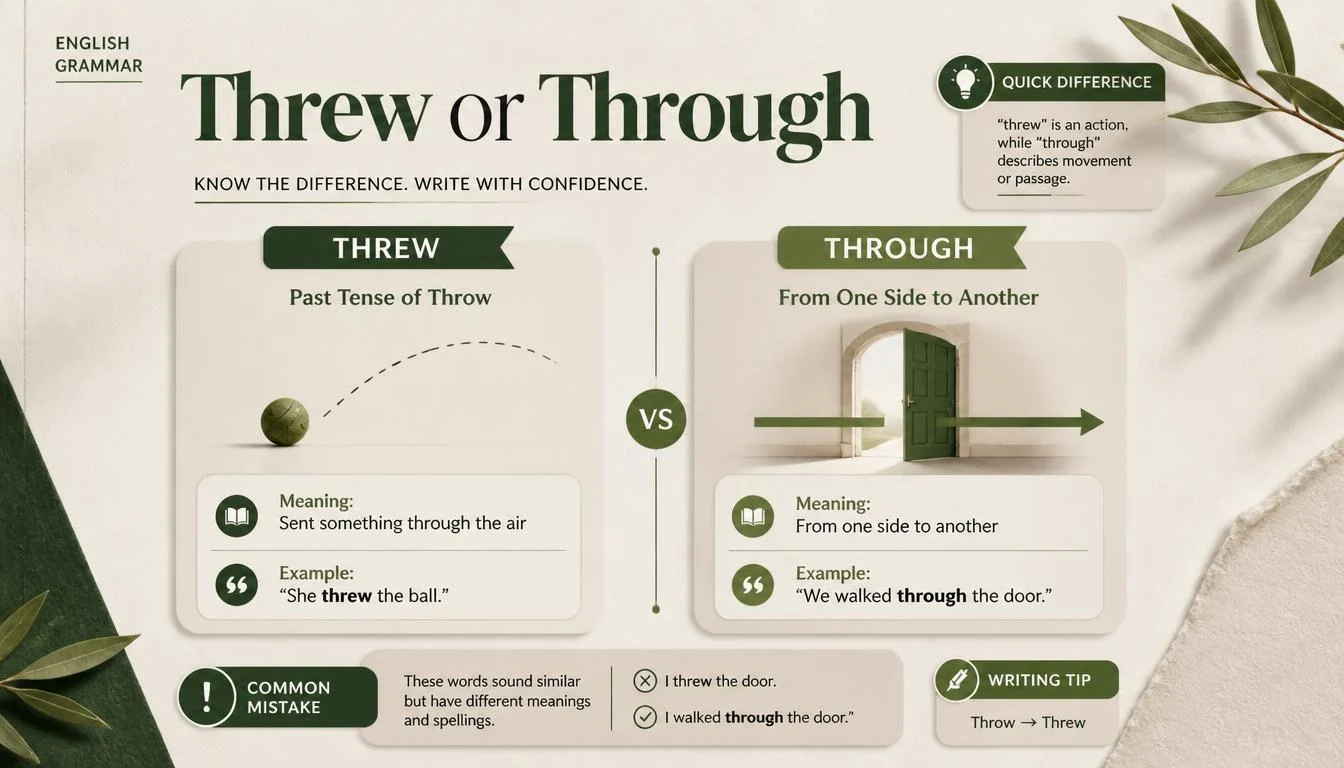
Threw or through confuses writers because the words sound related but serve completely different jobs. Threw is the past tense of throw, meaning you tossed or hurled something. Through is a preposition or adverb showing movement from one side of something to the other, or completion of a process. They aren’t interchangeable in any context.
Threw or Through can be confusing because these words look and sound somewhat similar, but they have completely different meanings and grammatical uses. Understanding the difference will help you avoid common spelling and grammar mistakes in everyday writing.
In this guide, we’ll explain when to use threw and when to use through, with simple examples to make the distinction easy to remember. Whether you’re writing an email, an assignment, or a casual message, you’ll know which word fits the sentence.
Threw or Through: What’s the Difference?
The core difference comes down to function: threw is a verb showing a completed action, while through is a preposition or adverb showing movement, direction, or completion of a process.
Threw only ever means one thing grammatically. It’s the simple past tense of the irregular verb throw. If you threw something, you already performed the physical or figurative act of throwing it. There’s no other use for this word. You can’t use threw to describe location, direction, or a state of being finished with something.
Through works much harder in a sentence. It can describe physical movement (walking through a tunnel), a method (getting a message through email), a timeframe (working through the night), or a state of completion (being through with a task). Because through covers so many uses, people sometimes reach for it instinctively, even in spots where threw is the word that actually belongs.
| Meaning | Part of Speech | Refers To | Typical Usage | Example | Common Confusion |
|---|---|---|---|---|---|
| Past tense of “throw” | Verb (past tense) | An action already completed | Describing a physical or figurative toss | “She threw the keys on the table.” | Written as “through” by mistake |
| Movement or completion | Preposition / Adverb | Direction, method, or finished state | Describing space, time, or process | “He walked through the park.” | Confused with “threw” due to similar sound |
Once you see them side by side like this, the difference stops feeling tricky. Threw answers the question “what did someone do?” Through answers “how, where, or when did something happen?” If your sentence needs an action verb, you’re almost certainly looking for threw. If your sentence needs to describe passage, direction, or completion, through is your word.
Is Threw or Through a Grammar, Vocabulary, or Usage Issue?
This confusion sits mostly in the vocabulary and spelling category, not core grammar rules. Both words are grammatically correct English words; the mistake happens when a writer selects the wrong one for the intended meaning.
From a grammar standpoint, threw always functions as a verb. It fits into sentence structures the same way any past-tense verb does: subject plus threw plus object, such as “The pitcher threw the ball.” Through, meanwhile, never acts as a main verb. It attaches to nouns as a preposition (“through the window”) or modifies a verb as an adverb (“she made it through”).
Because the confusion is rooted in sound and spelling rather than grammatical rule, this is technically a vocabulary and usage issue. Spell-checkers rarely catch it either, since both words are spelled correctly on their own; the software just can’t tell which meaning you intended.
These words are never interchangeable, in any register of English. Formal business writing, academic papers, casual texts, and everyday conversation all follow the same distinction. There’s no context where swapping one for the other is acceptable, unlike some word pairs that shift meaning slightly by formality level.
The practical takeaway: if you can replace the word with “tossed” or “hurled” and the sentence still makes sense, you need threw. If you can replace it with “via” or “finished with,” you need through.
Threw: Meaning, Usage, and Examples
Threw is the simple past tense of the verb throw, meaning to propel something through the air using force, usually with your hand or arm.
Part of speech: Verb (irregular past tense)
Common collocations: threw a ball, threw a party, threw a fit, threw away, threw out, threw together, threw off, threw up
Typical sentence pattern: Subject + threw + object (+ location/direction)
Here’s how threw shows up across different everyday situations:
- Workplace example: “The manager threw out the old proposal and asked the team to start fresh.”
- Academic example: “The researcher threw doubt on the earlier study’s methodology during her presentation.”
- Technology example: “The app threw an error message every time users tried to log in.”
- Email example: “I threw together a quick draft last night, let me know if it works as a starting point.”
- Daily conversation example: “He threw his jacket on the couch and grabbed a snack.”
One learner mistake: Non-native speakers sometimes write “I have threw” instead of “I have thrown,” confusing the simple past form with the past participle. Remember: threw stands alone as the simple past (“I threw it yesterday”), while thrown pairs with helping verbs like have or had (“I have thrown it away already”).
Mini recap: Threw is always a completed action verb. If someone performed the act of throwing, physically or figuratively, in the past, threw is the correct choice every time.
Through: Meaning, Usage, and Examples
Through describes movement from one side to another, a method of doing something, a span of time, or a finished state.
Pronunciation note: Many learners mispronounce through by adding a hard “g” sound. It’s pronounced “throo,” rhyming with “blue,” not “thruff” or “throw.”
Part of speech: Preposition, adverb
Common collocations: through the door, through email, through the night, through and through, get through, come through, follow through, through no fault of
Typical sentence pattern: Subject + verb + through + noun (location, method, or timeframe)
Real examples of through in action:
- Workplace example: “She finally got through the entire budget report before the meeting started.”
- Academic example: “Students must read through all three chapters before Friday’s discussion.”
- Technology example: “You can reset your password through the account settings menu.”
- Email example: “I’ll send the contract through our shared drive by end of day.”
- Daily conversation example: “We drove through downtown to avoid the highway traffic.”
One learner mistake: Some writers confuse through, threw, and thorough, a three-way mix-up that’s more common than people expect. Thorough means complete or detailed, as in “a thorough investigation.” If your sentence is about carefulness or completeness of an action, not direction or physical throwing, check whether thorough is actually the word you want.
Mini recap: Through never describes an action someone performed. It describes the path, method, timeframe, or completion connected to an action.
When Not to Use Each Word
Writers stumble in fairly predictable spots. Here are the situations that trip people up most often.
Describing a physical toss. If someone genuinely threw an object, only threw works. Writing “she through the frisbee” is never correct, no matter how casual the context.
Talking about finishing something. People often want to say “I’m done” and reach for through correctly here, as in “I’m through with this project.” The mistake happens when writers accidentally type threw instead, producing “I’m threw with this project,” which isn’t grammatically valid.
Describing movement through space. Walking, driving, or moving through a location always calls for through. Writers occasionally slip and use threw here when they’re typing quickly, especially since both words start with “thr.”
Past tense confusion with “throw.” Some writers second-guess themselves and write “throwed” instead of threw, treating the irregular verb like a regular one. English doesn’t follow that pattern here; throw becomes threw in the past tense, not throwed.
Idiomatic expressions. Phrases like “through thick and thin” or “read between the lines” don’t tolerate substitution. Swapping through for threw in an idiom breaks the phrase entirely and confuses readers who recognize the expression.
Autocorrect and voice-to-text errors. Because the two words sound similar when spoken casually, voice-to-text software occasionally transcribes threw when a speaker meant through, or the reverse. Always proofread dictated text for this pair specifically.
Rushed writing under deadline pressure. This is less about not knowing the rule and more about typing speed outrunning attention. Writers who know the difference perfectly well still make this error when they’re moving fast, which is why a final proofread matters even for confident writers.
Translating directly from another language. In some languages, the concepts of “passing through” and “throwing” share a root word or similar phrasing, which can lead non-native English speakers to blend the two concepts when translating in their head.
Common Mistakes Table
| Correct Sentence | Incorrect Sentence | Explanation |
|---|---|---|
| “He threw the ball across the yard.” | “He through the ball across the yard.” | Needs a past-tense verb for the action of throwing. |
| “We drove through the tunnel.” | “We drove threw the tunnel.” | Needs a preposition describing movement, not an action verb. |
| “I’m through with excuses.” | “I’m threw with excuses.” | Through” here means finished, not an act of throwing. |
| “She threw away the receipt.” | “She through away the receipt.” | The verb form is required for the disposal action. |
| “He got through the interview.” | “He got threw the interview.” | Completion of an event needs “through,” not “threw.” |
Quick Decision Box
If you mean someone performed the act of tossing something, use Threw.
If you mean movement, method, timeframe, or completion, use Through.
Say the sentence out loud. If you can replace the word with “tossed,” you need threw. If you can replace it with “via” or “finished,” you need through.
Real World Examples of Threw and Through
Office communication: “She threw the marketing report on my desk right before she went through the numbers with the client on the phone.”
Business email: “I threw together a rough timeline last night. Could you review it through the shared folder before our call?”
School or university: “The professor threw out a surprise question, and half the class barely got through the answer.”
Customer support: “The rep threw in a discount code after walking the customer through the return process.”
Technology: “The app crashed and threw a system error while updating through the latest patch.”
Artificial intelligence: “The chatbot threw an unexpected response after the user typed a command through the voice interface.”
Daily conversation: “He threw his bag by the door and finally made it through the front gate after a long commute.”
Threw or Through in Modern Technology
Technology writing produces plenty of chances to mix these words up, mostly because both show up constantly in error messages, instructions, and casual tech talk.
In artificial intelligence and machine learning contexts, systems commonly “throw” errors, meaning the software generates an error message when something fails. You’ll see this in developer documentation: “the function threw an exception” is standard technical phrasing, borrowed directly from programming terminology where “throw” describes triggering an error condition.
Virtual assistants and voice assistants get accessed through different channels: through an app, through a smart speaker, through a browser extension. Since these tools rely on spoken commands, and speech-to-text systems sometimes mishear “threw” and “through,” proofreading transcribed content matters more than usual in this space.
Chatbots and support software often walk users through a process step by step, while developers describe bugs that get thrown by the code. Business tools follow the same pattern: reports get sent through a platform, while a system might have thrown an alert when something needed attention.
Word Origin
Threw comes from the Old English verb thrawan, which originally meant to twist or turn, later shifting toward the modern sense of hurling something with force. Through traces back to the Old English thurh, meaning “from end to end,” a meaning that has stayed remarkably consistent for over a thousand years. Knowing this history helps explain why the words feel unrelated in meaning despite their similar spelling: they evolved from entirely different roots that happened to end up looking alike.
Expert Insight
After years of grading student writing, one pattern shows up again and again: students rarely misunderstand these words in speech. They understand exactly what they mean to say. The error appears almost exclusively in writing, particularly when someone types quickly or relies on autocorrect without a careful reread. The fix isn’t memorizing another rule; it’s building the habit of pausing on any word ending in “-rew” or “-rough” during a final proofread, since that split second of attention catches nearly every mistake of this kind before it reaches a reader.
Error Prevention Checklist
- Always use Threw when describing a completed action of tossing, hurling, or figuratively throwing something.
- Always use Through when describing movement, method, duration, or completion.
- Never confuse them if you remember that threw is a verb and through is not.
- Quick memory tip: Threw has an “e” like “verb,” while through has an “o” like “flow,” reminding you it describes flow or movement.
Related Grammar Confusions
- Thorough vs. Through: Worth learning because these two are commonly typed interchangeably despite having entirely different meanings.
- Throne vs. Thrown: A useful pair to master since both involve royalty-adjacent spelling traps that confuse spellcheckers.
- Passed vs. Past: Another past-tense pair that trips up writers moving quickly through a sentence.
- Affect vs. Effect: Essential for anyone writing professionally, since the wrong choice changes a sentence’s meaning entirely.
- Its vs. It’s: A foundational confusion every English learner eventually needs to resolve for clean writing.
- Lose vs. Loose: Worth reviewing because the spelling difference is small but the meanings are completely unrelated.
- Then vs. Than: Important for comparison sentences, where the wrong word quietly changes logical meaning.
- Complement vs. Compliment: Useful for business writing, where mixing these up can look unprofessional in client communication.
- Weather vs. Whether: A classic homophone pair that benefits from the same “say it out loud” test used here.
- Advice vs. Advise: Helpful for anyone writing emails or reports, since one is a noun and the other a verb, much like threw and through split by function.
FAQs
Is it “threw up” or “through up”?
It’s always “threw up” when you mean to vomit or raise something quickly. “Through up” is not a standard English phrase, so there is no real ambiguity between the two.
What’s the difference between threw and throw?
Throw is the present tense or base form, used for current or future actions, such as “I throw the ball every day.” Threw is the past tense, used for an action that already happened: “I threw the ball yesterday.”
Can “through” ever be a verb?
No. Through does not function as a verb in standard English. It is most commonly used as a preposition or adverb and can occasionally function as an adjective, as in “The deal is through.”
Why do threw and through sound so similar?
Threw and through have the same pronunciation in standard English, even though they have different spellings and meanings. Their similarity comes from the development of English pronunciation and spelling rather than from a shared modern meaning.
Is “throughout” related to threw or through?
Throughout is directly related to through, not threw. It means “during the entire time” or “in every part of,” as in “She remained focused throughout the meeting.”
How can I stop mixing up threw and through when typing fast?
Focus on the meaning before choosing the spelling. Use threw when describing the past action of throwing something. Use through when referring to movement from one side to another, a method, a process, or completion.
Conclusion
The difference between threw and through comes down to one simple test: does your sentence describe an action someone already performed, or does it describe direction, method, timing, or completion? Threw only ever fills the first role, while through only ever fills the second.
Once that distinction clicks, the confusion tends to disappear for good, even in fast typing or casual writing. Whenever you catch yourself hesitating between the two, ask a quick question: could I replace this word with “tossed”? If yes, write threw. If not, through is almost certainly the word your sentence needs.
Read More Related Articles:
- Totaling or Totalling | American vs British English In 2026
- Hoodie or Hoody | Easy Way to Remember the Difference In 2026
- Truly or Truely | Simple Guide to Getting It Right In 2026

Caleb Dawson is a content writer at synoseek.com, where he works on simple, reader-focused articles across a range of everyday topics. His writing style is practical and grounded, aiming to present information in a clear and relatable way without unnecessary complexity.
3 thoughts on “Threw or Through | Grammar Guide That Finally Clears Up the Confusion In 2026”