Quick Answer:
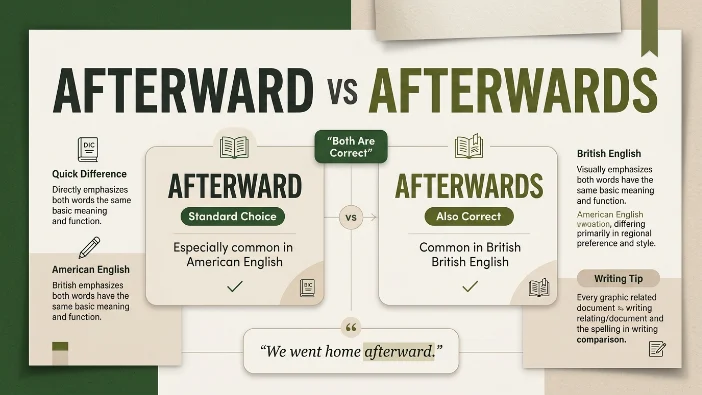
Afterward and afterwards are interchangeable adverbs meaning “at a later time” or “following an event.” The only difference is that afterward is more common in American English, while afterwards is preferred in British English. Both are correct, and choosing either won’t affect your meaning or grammar.
You’re writing an important email, and suddenly you hesitate. Should you say “I’ll send the report afterward” or “I’ll send the report afterwards? That tiny -s at the end seems insignificant, but it’s enough to make you second-guess yourself. This confusion is incredibly common, even among native English speakers who have used both forms their entire lives without thinking twice.
Here’s the truth: both spellings are correct, and they mean exactly the same thing. The difference comes down to geography and personal preference rather than grammar rules. Afterward and afterwards both function as adverbs, and you can use them interchangeably in almost every situation.
Throughout this guide, you’ll learn exactly when to use each version, why the difference exists, and how to choose confidently. We’ll explore usage patterns across American and British English, examine real-world examples, and clear up any lingering confusion. By the end, you’ll never pause over this tiny -s again.
What’s the Difference Between Afterward and Afterwards?
The core difference between afterward and afterwards is primarily regional. Afterward is the preferred spelling in American English, while afterwards dominates in British English and other Commonwealth varieties. Both words mean “at a later time” or “subsequently,” and they function identically in sentences.
| Feature | Afterward | Afterwards |
|---|---|---|
| Meaning | At a later time | At a later time |
| Part of Speech | Adverb | Adverb |
| Primary Usage | American English | British English |
| Formality | Neutral | Neutral |
| Example | We went to dinner afterward. | We went to dinner afterwards. |
| Common Confusion | Often misspelled as “afterword” | Sometimes seen as more informal |
Think of it like “toward” versus “towards” the same pattern applies. The -s version is more common in British English, while the version without -s is standard in American English. However, neither is considered incorrect in either dialect.
What’s important to remember is that both words serve the same purpose: they connect events in time and indicate that something happened later. They’re your go-to words when you want to show sequence without using specific time references like “then,” “later,” or “subsequently.”
Is Afterward vs Afterwards a Grammar, Vocabulary, or Usage Issue?
This question sits at the intersection of vocabulary choice and usage preference rather than strict grammar rules. From a grammar perspective, both afterward and afterwards are completely correct adverbs. You won’t violate any grammatical rules by choosing either version.
However, understanding the distinction is primarily a usage issue. It’s about knowing which spelling to use based on your audience and context. Think of it similarly to choosing between “color” and “colour” both are grammatically correct, but your choice signals something about your writing style and intended readership.
In formal writing, either version is acceptable, but consistency matters. If you’re writing for an American publication, afterward is the conventional choice. British publications lean toward afterwards. The same principle applies to business writing, academic papers, and everyday communication.
One practical takeaway: if you’re writing for an international audience, pick one version and stick with it throughout your document. Mixing afterward and afterwards in the same piece can look careless, even though both forms are correct.
Guide to Using Afterward
Meaning and Usage
Afterward is an adverb meaning “at a later time” or “following an event.” It’s the standard American English spelling and appears frequently in both formal and informal contexts. When you use afterward, you’re indicating that something happens after a particular point in time or after another action.
Common collocations:
- Shortly afterward
- Soon afterward
- Immediately afterward
- Days afterward
- Years afterward
- Not long afterward
Typical sentence patterns:
- [Action] happened, and [event] occurred afterward.
- [Person] did [something], and afterward, [result].
- Afterward, [subject] [verb].
Workplace example:
The team meeting ran long, so we decided to grab lunch afterward. The discussion about the quarterly projections dominated most of our time, and afterward, everyone seemed exhausted but satisfied with the direction we’d chosen.
Academic example:
The professor delivered her lecture on cognitive behavioral therapy, and afterward, students engaged in a forty-five minute discussion about practical applications. Several research papers published afterward have cited her theories extensively.
Technology example:
The software update installed automatically, and afterward, users noticed significantly faster load times. The development team released a hotfix shortly afterward to address minor compatibility issues.
Email example:
“Thanks for confirming our meeting time. I’ll send the presentation materials afterward so you have everything before the client call.”
Daily conversation example:
“We could see the movie first and grab dinner afterward. I’ve been craving that new Italian place that opened downtown.”
Learner mistake:
Incorrect: “I went to the store afterword to buy milk.”
The word “afterword” refers to a concluding section of a book. Always use afterward (or afterwards) to indicate time.
Recap:
Afterward is your go-to choice for American English contexts. It’s professional, clear, and works perfectly in business writing, academic papers, and everyday conversation.
Guide to Using Afterwards
Meaning and Usage
Afterwards is the British English spelling of the same adverb. It means exactly the same thing as afterward “at a later time” but it’s the preferred form in the United Kingdom, Australia, New Zealand, and other English-speaking regions outside North America.
Common collocations:
- Shortly afterwards
- Soon afterwards
- Immediately afterwards
- Days afterwards
- Years afterwards
- Not long afterwards
Typical sentence patterns:
- [Action] happened, and [event] occurred afterwards.
- [Person] did [something], and afterwards, [result].
- Afterwards, [subject] [verb].
Workplace example:
The director approved the budget proposal, and afterwards, the finance team began allocating resources. Several departmental meetings scheduled afterwards focused on implementation strategies.
Academic example:
Researchers conducted the initial study in 2019, and afterwards, they published three follow-up papers examining long-term effects. The data collected afterwards provided crucial insights into treatment outcomes.
Technology example:
The system crashed during the update, and afterwards, we had to restore from backup. The IT team implemented new protocols shortly afterwards to prevent similar issues.
Email example:
“Please review the attached contract. We can discuss any concerns afterwards during our afternoon call.”
Daily conversation example:
“The concert was incredible. We went for drinks afterwards and ended up talking until midnight.”
Learner mistake:
Incorrect: “We’ll discuss the details afterwords.”
Remember that “afterwords” (plural) isn’t the same as afterwards. Stick with the adverbial form when indicating time.
Recap:
If you’re writing for British or international audiences, or if you prefer the sound of afterwards, use it confidently. Just remember to be consistent throughout your writing.
When Not to Use Each Word
Many writers choose the wrong form because they’re unaware of the regional preference or they confuse these words with similar-sounding terms. Here are common situations where mistakes happen:
1. When you mean “later” in American English contexts
Some American writers use “afterwards” because they’ve heard it in British media. While not incorrect, this can seem out of place in American publications. Stick with “afterward” for US audiences.
2. When you’re writing formal British English
Using “afterward” in British academic writing might mark you as American. If you’re submitting to a British journal or applying to a UK university, “afterwards” is the safer choice.
3. When you actually mean “afterword”
“Afterword” refers to a concluding section of a book. It’s not related to time at all. If you’re writing about the final chapter of a manuscript, you need “afterword,” not “afterward” or “afterwards.”
4. When you need an adjective
Remember that afterward and afterwards are adverbs, not adjectives. You wouldn’t say “the afterward meeting” you’d say “the subsequent meeting” or “the meeting afterward.”
5. When you’re using US government or military style guides
American government publications typically mandate “afterward.” Military writing often follows the same convention. Check your style guide if you’re writing in these contexts.
6. When clarity requires different phrasing
Sometimes, words like “later,” “then,” or “subsequently” work better. If your sentence already has several adverbs, consider whether “afterward” adds value or unnecessary complexity.
Common Mistakes Table
| Correct Sentence | Incorrect Sentence | Explanation |
|---|---|---|
| We went to dinner afterward. | We went to dinner afterword. | Afterword” means a book’s concluding section, not a time reference. |
| The team celebrated afterwards. | The team celebrated afterwardsly. | Adding “-ly” to an adverb that already functions as such is redundant and incorrect. |
| She called me shortly afterward. | She called me short afterward. | “Shortly” means “soon after,” while “short” means brief. Use the correct adverb. |
| Afterwards, we discussed the results. | Afterwards we discussed the results. | Both are actually correct, but some style guides prefer the comma after introductory adverbs. |
| I’ll handle it afterward. | I’ll handle it after. | “After” alone works, but it’s less precise than “afterward” when indicating a specific point in time. |
| The meeting ended, and afterward we left. | The meeting ended, and after we left. | “After” requires a noun or clause to follow it, while “afterward” works alone. |
Quick Decision Guide
Choose “afterward” when:
- You’re writing for an American audience
- You’re following US style guides (AP, Chicago Manual)
- You’re writing for a US publication
- You’re speaking American English
- You prefer the simpler version
Choose “afterwards” when:
- You’re writing for a British or Commonwealth audience
- You’re following UK style guides (Oxford, Cambridge)
- You’re writing for a British publication
- You’re speaking British English
- You naturally prefer the longer version
Remember this quick memory tip: America = without the -s. Britain = with the -s. It’s that simple.
Real-World Examples
Office communication:
The all-hands meeting concluded at 4 PM, and afterward, several team members approached the CEO with questions. The HR representative scheduled individual follow-ups for afterward to address specific concerns.
Business email:
“Thanks for your prompt response. I’ll compile the feedback from the focus groups, and afterward, we can schedule a strategy session to review the findings. Please let me know your availability for afterward.”
School or university:
The final exam ended at noon, and afterwards, students gathered in the common room to decompress. The professor posted the grades online shortly afterwards, ending weeks of anxious waiting.
Customer support:
“Your ticket has been escalated to our technical team. You’ll receive an update shortly afterward. In the meantime, please refrain from restarting your system until we’ve completed our diagnostic checks.”
Technology:
The AI-powered chat feature processed the user’s request, and afterward, it generated three potential solutions. The system logged the interaction for future training purposes afterward.
Artificial Intelligence:
When training large language models, developers feed massive datasets into the neural network, and afterward, the model learns patterns through iterative refinement. The evaluation phase occurs afterward to measure accuracy.
Daily conversation:
“We could grab coffee first, then catch the 3 PM show afterward. Or we could do the movie first and get dinner afterward whatever works better for your schedule.”
Social media:
“Attended the most amazing workshop today. The speaker shared incredible insights about AI in education, and afterward, we got hands-on experience with the new tools. Highly recommend checking out their content afterward!”
Afterward and Afterwards in Modern Technology
In today’s tech-driven world, the distinction between afterward and afterwards appears everywhere from AI chatbots to virtual assistants. When you ask Siri or Alexa about your schedule, they might respond with phrases like “I’ll add that to your calendar, and afterward, you’ll receive a notification.”
Artificial intelligence systems process these words similarly, recognizing them as temporal markers. However, voice assistants often adjust their responses based on regional settings. Users with US English settings hear “afterward,” while those with UK settings hear “afterwards.”
In software documentation, consistent usage matters. Tech companies typically choose one spelling and stick with it throughout their user interfaces, help documentation, and marketing materials. Google uses “afterward” in its American English materials, while many European tech companies default to “afterwards.”
The rise of AI writing assistants has also highlighted this distinction. These tools often flag inconsistent usage, encouraging writers to pick one version and apply it throughout their documents. This automation helps maintain consistency, even when writers are unaware of the regional differences.
Word Origins and History
Both afterward and afterwards evolved from Old English roots. The base word “after” comes from the Old English “æfter,” meaning “behind in place or time.” The suffix “-ward” (or “-wards”) indicates direction, similar to “toward” and “towards” or “forward” and “forwards.
The form “afterward” appeared in English around the 13th century, while “afterwards” emerged shortly after. Both versions coexisted for centuries, with regional preferences developing gradually. British English retained the “-s” suffix in many directional words, while American English gradually dropped it in certain cases.
This pattern appears in several other word pairs:
- Toward vs towards
- Forward vs forwards
- Upward vs upwards
- Downward vs downwards
- Homeward vs homewards
The American preference for dropping the “-s” followed Noah Webster’s efforts to simplify American English spelling in the early 19th century. Webster advocated for removing unnecessary letters, which contributed to the American adoption of “afterward” over “afterwards.”
Expert Insight
As an experienced language instructor, I’ve noticed that students often overthink this choice. They worry that choosing the “wrong” version will make their writing look uneducated or careless. Here’s the truth: native speakers rarely notice the difference, and even professional editors won’t flag either version as incorrect.
What matters more is consistency. If you start a document with “afterward,” stick with it. If you prefer “afterwards,” use it throughout. The occasional slip between versions isn’t a major error, but consistent usage demonstrates attention to detail.
Here’s a practical teaching approach I’ve developed: when students ask which to use, I remind them that their audience matters more than arbitrary rules. An American business email should use “afterward.” A British job application should use “afterwards.” An academic paper for an international journal could use either, as long as it’s consistent.
For learners who want a simple rule, I suggest this: if you’re writing for American readers, drop the -s. If you’re writing for British readers, keep it. For everyone else, choose whichever you prefer and stick with it.
Error Prevention Checklist
✓ Always use “afterward” when:
- Writing for American audiences
- Following US style guides
- Using American English
- Writing for US publications
✓ Always use “afterwards” when:
- Writing for British/Commonwealth audiences
- Following UK style guides
- Using British English
- Writing for UK publications
✓ Never confuse them with:
- “Afterword” (book section)
- “Aftermath” (consequences)
- “Afterglow” (lingering effects)
✓ Quick memory tip:
American English drops the -s for direction words. British English keeps it. If you’re not sure, consistency matters more than the choice itself.
Related Grammar Confusions
- Toward vs Towards Same regional pattern as afterword vs afterwards; American writers drop the -s, British writers keep it.
- Among vs Amongst “Among” is standard in American English, while “amongst” appears more frequently in British English.
- While vs Whilst “While” is common in American English, while “whilst” is primarily British (and sometimes considered slightly formal).
- Further vs Farther “Further” indicates abstract distance or extent, while “farther” indicates physical distance.
- Farther vs Further Similar to above, but worth learning separately because many writers confuse these.
- Between vs Among “Between” is for two items, “among” is for more than two.
- Because vs Since “Because” indicates cause, while “since” indicates time (though both can express causation).
- Less vs Fewer “Less” is for uncountable nouns, “fewer” is for countable nouns.
- Who vs Whom “Who” is subjective, “whom” is objective.
- That vs Which “That” introduces essential clauses, while “which” introduces non-essential clauses.
FAQs
Is “afterwards” more formal than “afterward”?
No. Both afterward and afterwards have the same level of formality. The difference is mainly regional preference, not tone. Both forms can appear in academic, professional, and everyday writing.
Can I use “afterward” and “afterwards” in the same document?
You can, but it’s better to choose one form and use it consistently. Switching between the two isn’t grammatically wrong, yet it may make your writing look less polished. Following one spelling throughout also creates a smoother reading experience.
Is “afterwards” incorrect in American English?
No. Afterwards is accepted in American English, although afterward is more common in the United States. American readers will understand both forms without difficulty, but afterwards may sound slightly more British to some speakers.
Why do some words have both “-ward” and “-wards” forms?
Both endings developed from older English patterns used to express direction or movement. Over time, different varieties of English developed preferences for forms with or without the final s. This is why pairs such as toward/towards, forward/forwards, and backward/backwards both exist.
What’s the difference between “after” and “afterward”?
After has several grammatical roles and can function as a preposition, conjunction, or adverb. Afterward is an adverb that refers to something happening later. For example, you can say, “We went home after dinner,” but “We went home afterward” uses afterward to refer back to the earlier event.
Conclusion
By now, you should feel completely confident choosing between afterward and afterwards. Remember that both forms are grammatically correct and interchangeable. The real choice comes down to your audience and your personal preference.
If you’re writing for American readers, use afterward. If you’re writing for British or Commonwealth readers, use afterwards. If you’re writing for an international audience, pick one version and use it consistently throughout your document.
The most important lesson here goes beyond this single word pair. Understanding how English varies across regions will serve you well in all your writing. Whether you’re crafting business emails, academic papers, or casual messages, being aware of these nuances shows professionalism and attention to detail.
So the next time you pause over that tiny -s, you’ll know exactly what to do. Choose with confidence, write with consistency, and remember that even native English speakers don’t overthink this as much as learners often do.