Quick Answer
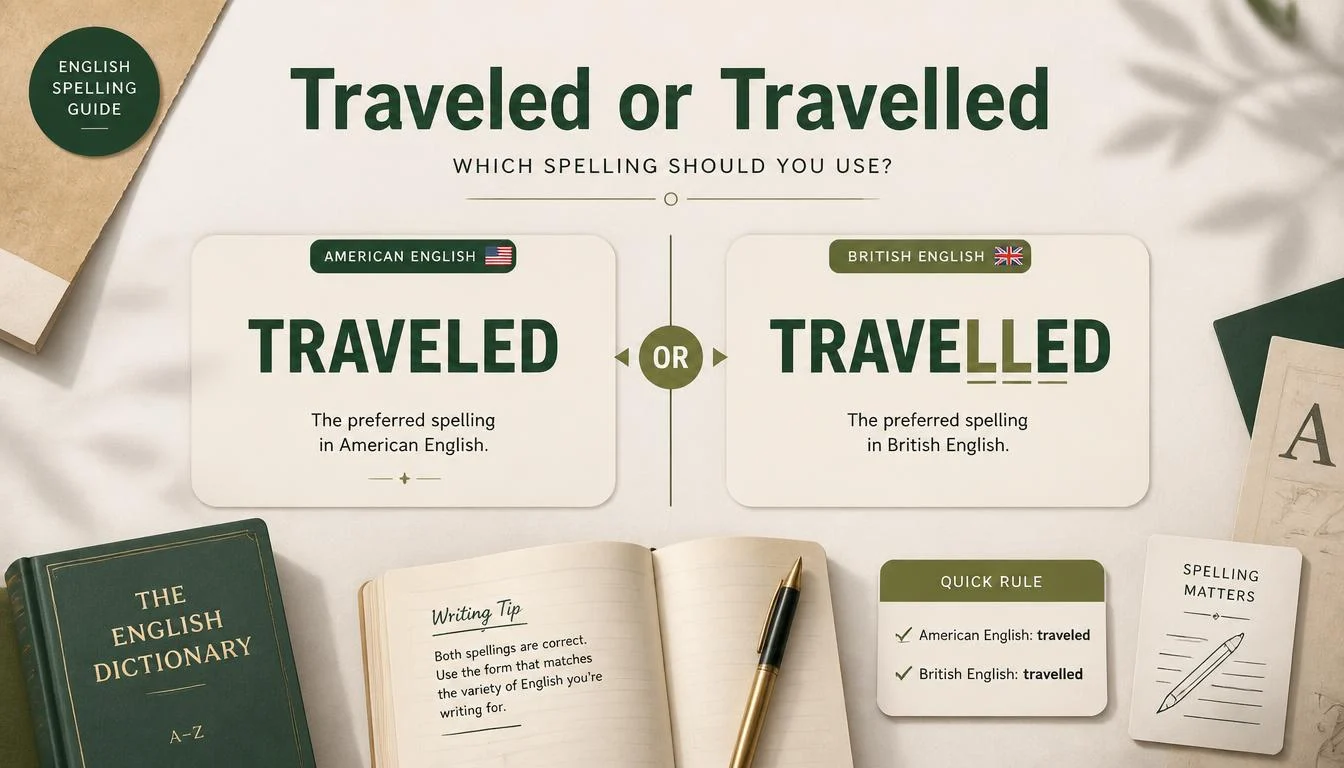
The difference between “traveled” and “travelled” is purely regional spelling variation, not meaning. Use “traveled” (one “l”) for American English audiences and “travelled” (two “l’s”) for British, Canadian, Australian, and other Commonwealth English audiences. Both are correct in their respective contexts and mean exactly the same thing.
Wondering whether to write Traveled or Travelled? Both spellings are correct, but the choice depends on the variety of English you are using. American English generally uses “traveled” while British English uses “travelled.”
Understanding this spelling difference can help you write more accurately and consistently. In this guide, we explain when to use each form with simple examples and a clear rule to remember.
What’s the Difference Between Traveled and Travelled?
The straightforward answer is that there is no difference in meaning between these two words. Both “traveled” and “travelled” are the past tense and past participle forms of the verb “travel.” They also function as adjectives in certain contexts. The only difference is the number of letter “l’s” and the geographical audience each spelling serves.
| Aspect | Traveled | Travelled |
|---|---|---|
| Meaning | Made a journey; experienced travel; moved from place to place | Made a journey; experienced travel; moved from place to place |
| Part of Speech | Verb (past tense), Adjective | Verb (past tense), Adjective |
| Primary Region | United States | United Kingdom, Canada, Australia, New Zealand, and other Commonwealth nations |
| Example Sentence | She traveled to Paris last summer. | She travelled to Paris last summer. |
| Common Confusion | People often wonder if one is incorrect; neither is it depends on your audience | Same confusion applies; both forms are standard in their respective regions |
The table shows that the core definition remains identical. The spelling difference is not a matter of one being “more correct” than the other it’s simply a regional preference that has become standardized over time. When you write for an American audience, choose “traveled.” When you write for a British, Canadian, or Australian audience, choose “travelled”.
Is This a Grammar, Vocabulary, or Usage Issue?
This question is actually a usage and spelling issue rather than a strict grammar rule or vocabulary distinction. Let’s break this down.
Grammatically, “traveled” and “travelled” function identically. They are both the past tense and past participle forms of the regular verb “travel.” The grammatical rules governing how they function in sentences remain unchanged regardless of which spelling you use.
In terms of vocabulary, there is no difference at all. These are not two distinct words with separate meanings, like “affect” and “effect” or “principal” and “principle.” They represent the same word written according to different spelling conventions.
From a usage perspective, this is where the real distinction matters. The choice between “traveled” and “travelled” depends entirely on your audience and the variety of English you are writing in. In American English, the single-“l” spelling is standard and expected. In British English and its variants, the double-“l” spelling predominates.
Are these words interchangeable? Yes, in the sense that they mean the same thing. However, you should not mix them within a single document or piece of writing. Consistency is key. Choose one spelling based on your target audience and stick with it throughout your work.
In formal English, academic writing, and business contexts, this consistency becomes even more important. A document that switches between “traveled” and “travelled” can appear careless or unprofessional, especially in contexts where attention to detail matters.
Traveled (American English)
Meaning
“Traveled” means having made a journey, moved from one place to another, or experienced travel. It can also describe a road or path that receives frequent use.
Pronunciation
/ˈtrævəld/ (TRAV-əld)
Part of Speech
“Traveled” is a verb used as the past tense and past participle of “travel.” It can also function as an adjective.
Common Collocations
Common collocations with “traveled” in American English include:
- well-traveled (having extensive travel experience)
- heavily traveled (describing a road with lots of traffic)
- less-traveled (describing a road or path less frequently used)
- widely traveled (having visited many places)
Typical Sentence Patterns
“Traveled” follows standard past tense sentence structures. For example, you might say, “He traveled across the country” or “The package traveled 500 miles.”
As an adjective, “traveled” appears before nouns, as in “a well-traveled man” or “the less-traveled path.”
Natural Workplace Example
“Our CEO traveled to three international offices last quarter to meet with regional directors.”
Academic Example
“The researchers traveled to remote field sites to collect water samples for their study on pollution levels.”
Technology Example
“The data traveled across the network in milliseconds, reaching the server before the user noticed any delay.”
Email Example
“I traveled for work last week, so I’m catching up on emails this morning. Please send me the updated timeline.”
Daily Conversation Example
“We traveled all the way to the coast just for that restaurant, and honestly, it was worth every mile.”
One Learner Mistake
A common error is adding an extra “l” and writing “travelled” when American English requires “traveled.” This often happens because British spelling appears frequently in global media, which can cause confusion about regional spelling conventions.
Mini Recap
Use “traveled” when your audience primarily uses American English. This includes most US-based publications, schools, and workplaces. The single-“l” spelling is the standard form in the United States and should be your default choice when writing for American readers.
Travelled (British and Commonwealth English)
Meaning
“Travelled” has the same meaning as “traveled.” It describes having made a journey, moved from place to place, or experienced travel. It can also describe a frequently used road or path.
Pronunciation
/ˈtrævəld/ (TRAV-əld)
Part of Speech
“Travelled” is a verb used as the past tense and past participle of “travel.” It can also function as an adjective.
Common Collocations
Common collocations with “travelled” in British and Commonwealth English include:
- well-travelled (having extensive travel experience)
- heavily travelled (describing a high-traffic road or path)
- less-travelled (describing a less frequently used route)
- widely travelled (having visited many places)
Typical Sentence Patterns
“Travelled” follows the same sentence patterns as “traveled.” For example, “She travelled to London for work” or “The goods travelled across the border.”
As an adjective, you might write, “We chose the less-travelled route to avoid traffic.”
Natural Workplace Example
“Our team leader has travelled extensively in Asia and understands the regional markets well.”
Academic Example
“Travelled samples were transported in temperature-controlled containers to preserve their integrity.”
Technology Example
“The signal travelled through multiple satellites before reaching the ground station.”
Email Example
“I’ve travelled to the Manchester office twice this month already. Could we schedule a virtual meeting instead?”
Daily Conversation Example
“We travelled for six hours to get here, and I’d do it all over again for that view.”
One Learner Mistake
Some learners use the single-“l” form when writing for a British or Commonwealth audience, assuming English spelling conventions are the same everywhere. This can be noticeable in academic or professional settings where regional conventions matter.
Mini Recap
Use “travelled” when writing for British or Commonwealth English audiences. It is the standard spelling in the UK and is also used in countries such as Canada, Australia, and New Zealand.
When Not to Use Each Spelling
American Audiences Expect “Traveled”
If you are writing for a US-based publication, submitting work to an American university, or communicating with US colleagues, use “traveled.” Writing “travelled” may stand out as an unfamiliar regional spelling to American readers.
British and Commonwealth Audiences Expect “Travelled”
For UK businesses, Australian universities, or other audiences that follow British English conventions, “travelled” is generally the expected spelling. While readers will understand “traveled,” the American form may appear inconsistent with the surrounding language.
Avoid Mixing Both Spellings
Avoid switching between “traveled” and “travelled” within the same email, report, or article. Mixing regional spellings can make your writing appear inconsistent. Choose one spelling and use it throughout the document.
Follow Your Organization’s Style Guide
Many companies and institutions specify which English variant employees should use. For example, organizations following American English conventions may prefer “traveled,” while organizations using British English conventions may prefer “travelled.”
Keep Academic Writing Consistent
Whether you are submitting work to a US or UK journal, follow the publication’s spelling requirements. Consistent regional spelling helps maintain a professional and polished academic style.
Consider Your Digital Audience
If you are publishing online, consider whether your primary readers are American or international. Both spellings are valid regional forms, so the important point is to match the spelling to your target audience and remain consistent.
Use Extra Care in Legal and Formal Documents
Contracts, legal filings, and official correspondence require careful attention to language conventions. Using a spelling that does not match the document’s established regional style can create unnecessary inconsistency.
Check Your Software and AI Language Settings
Many spell-checkers and writing tools default to American English and may automatically suggest “traveled.” If you are writing for a British audience, check your language settings so the tool recognizes “travelled” as the preferred spelling.
Common Mistakes Table
| Correct Sentence | Incorrect Sentence | Explanation |
|---|---|---|
| She traveled to Chicago for the conference. | She travelled to Chicago for the conference. | American audience expects “traveled.” |
| He travelled to London from Edinburgh. | He traveled to London from Edinburgh. | British audience expects “travelled.” |
| The well-traveled businessman visited 40 countries. | The well-travelled businessman visited 40 countries. | In American English, the adjective takes one “l.” |
| This road is less travelled than the main highway. | This road is less traveled than the main highway. | In British English, the adjective takes two “l’s.” |
Quick Decision Box
- If your audience is primarily American → use “traveled”
- If your audience is British, Canadian, Australian, or from a Commonwealth country → use “travelled”
- If you are unsure or writing for an international audience → choose one and stay consistent throughout your document
Real-World Examples
Office communication: “Last week, I traveled to the New York office to meet with the marketing team. The trip was productive, and we finalized the Q4 strategy.” (American context)
Business email: “Having travelled extensively throughout Europe, I can confirm that our logistics plan will work well in all target markets.” (British context)
University setting: “The study included participants who had traveled to regions affected by the disease within the past three months.” (Academic, American journal)
Customer support: “Your package has traveled through our international shipping network and is currently at the customs facility.” (Customer-facing, American company)
Technology: “The request traveled across the load balancer to the nearest available server.” (Technical documentation, American company)
Artificial Intelligence: “The training data traveled through multiple neural network layers before generating the output.” (Technical, style varies by company)
Daily conversation: “We travelled through five countries on our backpacking trip, and every single one was incredible.” (British speakers in conversation)
Traveled and Travelled in Modern Technology
In the technology sector, both spellings appear frequently, reflecting the global nature of the industry. American tech companies like Google, Apple, and Microsoft typically use “traveled” in their documentation and communications. However, international tech teams may use “travelled” if they follow British conventions.
In artificial intelligence and machine learning, you might encounter sentences like: “The data traveled through 12 processing layers” or “The signal travelled across the network.” The technical meaning remains identical regardless of spelling.
The important consideration for tech writers is consistency and audience awareness. If you are writing documentation for a global audience, consider whether your company has an established style guide. Many international tech companies standardize on American English simply because it is more widely recognized, but this is not universal.
Word Origin
The word “travel” came into English from Middle English, where it was a variant of “travail.” Interestingly, the original meaning related to labor or toil, reflecting how difficult long journeys were in earlier centuries. Over time, the word shifted to focus on the journey itself rather than the hardship.
The spelling variation between “traveled” and “travelled” can be traced to Noah Webster, the American lexicographer who published his dictionary in the 1820s. Webster advocated for simplified spellings in American English, including dropping the second “l” from words like “travelled” and “cancelled.” His dictionary played a major role in standardizing “traveled” in the United States, while British English retained the traditional double-“l” spelling.
Expert Insight
Here is a simple way to think about “traveled” versus “travelled”: imagine you are choosing the language variety your reader expects. If your reader speaks American English, they expect one “l.” If they speak British English or another Commonwealth variety, they expect two. Neither choice reflects your knowledge of grammar it reflects your attention to your reader’s expectations.
The key to mastering this distinction is not memorizing rules but understanding your audience. When you are unsure, consider who will read your writing. For an American professor, choose “traveled.” For a British manager, choose “travelled.” The consistency of your choice across your writing matters more than the choice itself.
Error Prevention Checklist
Always use “traveled” when…
- Writing for American audiences
- Submitting to US-based publications or schools
- Following American style guides like AP Style
Always use “travelled” when…
- Writing for British, Canadian, Australian, or Commonwealth audiences
- Submitting to UK-based publications or schools
- Following British style guides like The Guardian style
Never confuse them if…
- Your audience expectations are clearly defined
- Your organization has a documented style guide
- Your writing requires professional consistency
Quick memory tip: Think of the “l” in “traveled” as standing for “America” (one “l”), while the two “l’s” in “travelled” remind you of the “two” sides of the Atlantic British English keeps the extra one.
Related Grammar Confusions
Here are other spelling and grammar comparisons worth learning:
- Focused vs. Focussed American and British spelling difference with a similar “one l versus two l’s” pattern.
- Canceled vs. Cancelled Another American vs. British spelling distinction following the same rule as traveled/travelled.
- Color vs. Colour The classic American versus British spelling difference for many “-or” and “-our” words.
- Defense vs. Defence American and British spelling variations for this common word.
- License vs. Licence American versus British spelling, with the added layer of noun/verb distinctions in British English.
- Practice vs. Practise A British English distinction where the noun and verb forms differ (practice is the noun, practise is the verb).
- Toward vs. Towards American English typically drops the final “s,” while British English keeps it.
- Judgment vs. Judgement American English drops the “e,” while British English typically keeps it.
- Organize vs. Organise American and British spelling differences for words ending in “-ize” versus “-ise.”
- Program vs. Programme American versus British spelling and usage differences.
FAQs
Which Spelling Is Correct: Traveled or Travelled?
Both spellings are correct. “Traveled” is the standard spelling in American English, while “travelled” is commonly used in British, Canadian, Australian and other Commonwealth varieties of English. The choice depends on your audience and preferred variety of English.
Do Americans Use Traveled or Travelled?
Americans use “traveled” with one “l.” The double “l” spelling “travelled” is not the standard form in American English. If you are writing for a US audience, “traveled” is the preferred spelling.
Do Canadians Use Traveled or Travelled?
Canadians generally use “travelled” with two “l’s,” following many British spelling conventions. Canadian English has its own spelling preferences and often differs from both American and British English in certain words.
Is It Traveled or Travelled in Australia?
Australians use “travelled” with two “l’s.” This spelling follows British English conventions that are common in Australian writing. The single “l” form “traveled” is generally associated with American English.
Why Do Americans Spell It Traveled Instead of Travelled?
The single “l” spelling “traveled” became associated with American English through spelling reforms promoted by Noah Webster. His dictionaries favored simplified spellings in several words. Over time, these preferences became established in American English.
How Do You Use Traveled in a Sentence?
“Traveled” is commonly used as the past tense of “travel.” For example, “We traveled to Spain for our vacation.” It can also appear as an adjective, as in “She is a well-traveled person.” The same grammatical uses apply to “travelled” with the spelling changed according to the variety of English being used.
Conclusion
The difference between “traveled” and “travelled” is refreshingly straightforward compared to many English language challenges. Both spellings are correct and mean exactly the same thing. The distinction is purely regional: American English prefers “traveled” with one “l,” while British English and Commonwealth varieties prefer “travelled” with two “l’s.”
The best approach is to know your audience. If you are writing for Americans, use “traveled.” If you are writing for a British, Canadian, Australian, or other Commonwealth audience, use “travelled.” Consistency matters more than the choice itself. Pick the spelling that matches your readers’ expectations and use it throughout your document.
Remember the simple memory trick: America uses one “l,” while the British keep the extra one. With this understanding, you can write with confidence, knowing that whichever spelling you choose, you are using English correctly.
Read More Related Articles:
- Totaling or Totalling | American vs British English In 2026
- Hoodie or Hoody | Easy Way to Remember the Difference In 2026
- Truly or Truely | Simple Guide to Getting It Right In 2026

Lucas Mitchell is a content writer at synoseek.com. He writes simple, thoughtful pieces that focus on everyday ideas, observations and general knowledge topics. His work is shaped by a calm, realistic tone that keeps the reader engaged without overstatement.
5 thoughts on “Traveled or Travelled | Simple Spelling Rule You Need to Know In 2026”