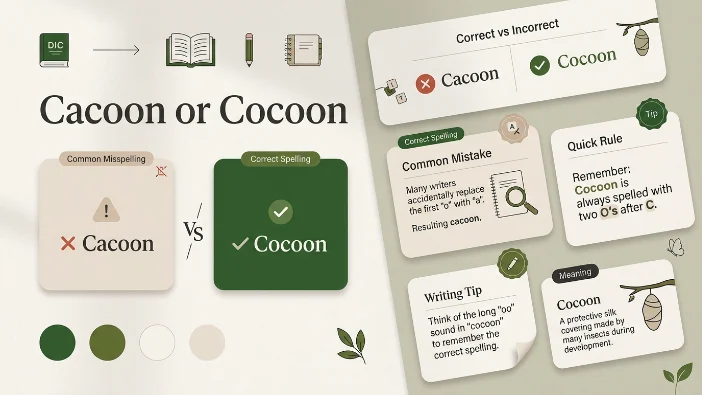
Quick Answer
Cocoon is the correct English word. It names the silky protective casing an insect spins before it becomes an adult, and it’s also used to describe a safe, sheltered state of mind. Cacoon is almost always a misspelling of cocoon, though it has one narrow, separate meaning as the name of a tropical vine grown in the Caribbean and West Africa.
Many people wonder whether Cacoon or Cocoon is the correct spelling, especially when writing about butterflies, insects, sleeping bags, or protective coverings. Because the two words look and sound similar, it’s easy to make a spelling mistake.
In this guide, we’ll compare Cacoon or Cocoon, explain which spelling is correct, provide example sentences, and share simple tips to help you remember the right word every time.
Why This Mix-Up Happens So Often
You’re typing a sentence about a caterpillar, or maybe about feeling wrapped up and protected from the outside world, and your fingers land on “cacoon” instead of “cocoon.” Then autocorrect either fixes it silently or, worse, leaves it alone because it doesn’t recognize either spelling as an obvious error. That small gap between what you meant to write and what actually appeared on the screen is where most of the confusion between these two words begins.
The two spellings sound almost identical when spoken at normal conversational speed, which is exactly why people search for this comparison in the first place. Cocoon has a clear, well-documented meaning in biology and in everyday figurative speech. Cacoon, on the other hand, isn’t a recognized alternative spelling at all in mainstream dictionaries it’s treated as an error, with one small exception tied to a specific plant that most English speakers will never need to write about.
Getting this right matters more than it might seem. Use the wrong spelling in a school essay, a science report, or a professional email, and a sharp-eyed reader or teacher will notice immediately. By the end of this guide, you’ll know exactly when to use cocoon, why cacoon almost never belongs in your writing, and how to remember the difference permanently.
Cocoon vs Cacoon: What’s the Difference?
The core difference is that cocoon is a standard English word with two well-established meanings, while cacoon is not a recognized English word except in one specialized botanical context that rarely comes up outside plant science.
Cocoon functions as both a noun and a verb. As a noun, it refers to the silk casing that moths, silkworms, and some other insects spin around themselves during the pupal stage of their life cycle. As a verb, “to cocoon” means to wrap something (or someone) up so completely that it’s shielded from everything around it think of a parent who cocoons a newborn in blankets, or someone who cocoons at home on a rainy Sunday and avoids the outside world entirely.
Cacoon, by contrast, has no accepted meaning tied to insects or protective wrapping. In the rare cases where it does appear correctly, it refers to a large, hard-shelled seed pod produced by a tropical climbing vine found in parts of the Caribbean and West Africa, sometimes called the “sea heart” or “monkey ladder” plant. Outside of botany texts, gardening forums, or Caribbean folk-remedy discussions, you will almost never have a legitimate reason to type “cacoon.”
| Feature | Cocoon | Cacoon |
|---|---|---|
| Meaning | Silk casing spun by insects; also a metaphor for shelter or protection | A hard seed pod from a specific tropical vine |
| Part of Speech | Noun and verb | Noun only, and rarely used |
| Refers To | Insects, comfort, isolation, transformation | A plant species in limited regional contexts |
| Typical Usage | Science writing, everyday speech, metaphor, literature | Botanical or regional folk-medicine discussions |
| Common Confusion | Often misspelled as “cacoon” | Frequently typed by accident when the writer means “cocoon |
If you take one thing away from this table, let it be this: unless you are specifically writing about that tropical vine, cocoon is almost certainly the word you want. Ninety-nine times out of a hundred, “cacoon” on a page is simply cocoon with a typo.
Is This a Grammar Issue, a Vocabulary Issue, or a Spelling Issue?
This isn’t really a grammar problem in the traditional sense you won’t find rules about verb tense or sentence structure here. It’s a spelling and vocabulary issue. Both words are pronounced almost the same way, so the confusion happens at the level of how the word looks on paper, not how it functions in a sentence.
Vocabulary-wise, the two words aren’t interchangeable at all. Cocoon belongs to everyday English vocabulary that shows up in casual conversation, journalism, poetry, and scientific writing alike. Cacoon belongs to a much smaller, specialized vocabulary set tied to a specific plant, and most native English speakers go their entire lives without needing it.
In formal writing academic papers, business reports, professional emails cocoon is the only acceptable spelling unless your subject matter genuinely involves that particular vine. In casual conversation, the distinction matters less because nobody sees the spelling, but the moment you write it down, precision counts. If you remember nothing else from this section, remember this: when in doubt, write cocoon.
Cocoon: Meaning, Usage, and Examples
Cocoon is pronounced kuh-KOON, with the stress on the second syllable. It works as a noun most of the time, but it’s a fully functional verb too, and both uses are common in modern English.
As a noun, a cocoon is the protective silk case an insect larva builds around itself before transforming into its adult form. Silkworms are probably the most famous example their cocoons are literally the source of silk fabric. As a verb, to cocoon means to wrap, shelter, or isolate someone or something, often for comfort or protection.
Common word pairings include “spin a cocoon,” “wrapped in a cocoon,” “cocoon yourself,” and “emerge from your cocoon.” That last phrase is especially popular in figurative writing about personal growth or change.
Here’s how the word looks in real contexts:
Workplace example: After the layoffs were announced, the remaining team members seemed to cocoon themselves, avoiding meetings and keeping their heads down.
Academic example: The biology lab assignment asked students to observe how a silkworm larva builds its cocoon over a seventy-two-hour period.
Technology example: The startup’s new noise-cancelling headphones were marketed with the tagline “cocoon yourself in silence,” appealing to remote workers who needed focus.
Email example: “I’m going to cocoon this weekend and finally catch up on sleep please don’t expect a reply until Monday.”
Daily conversation example: “Ever since the breakup, she’s kind of cocooned herself. I haven’t seen her out with friends in weeks.”
One mistake learners commonly make is treating “cocoon” as if it only applies to insects, and avoiding the figurative use because it feels unfamiliar. In reality, the metaphorical meaning describing emotional withdrawal or comfort-seeking is just as common in everyday English as the literal, biological one.
Quick recap: Cocoon means a protective silk casing (noun) or the act of wrapping something for shelter and comfort (verb). It’s the word almost everyone actually needs.
Cacoon: Meaning, Usage, and Examples
Cacoon is pronounced almost identically to cocoon, which is precisely the problem. It functions only as a noun, and its legitimate meaning is narrow: the large seed pod of a tropical climbing vine native to parts of the Caribbean and West Africa. In Jamaica and some neighboring islands, the dried seeds from this plant have traditionally been used to prepare a folk remedy sometimes called cacoon tea, and the vine itself is occasionally referred to by gardeners and collectors as the “monkey ladder” or “sea heart” plant because of its long, woody stems and heart-shaped seeds.
Because this usage is so specialized, you’ll rarely encounter genuine sentences using “cacoon” correctly outside of botanical writing, regional folklore, or gardening communities that deal in tropical seeds.
Botanical example: Researchers collecting samples along the coastline noted several cacoon vines climbing the surrounding trees, their pods still unripe.
Regional/cultural example: Her grandmother used to brew cacoon tea from seeds she kept in an old tin, a remedy passed down through the family for generations.
Gardening forum example: A member asked whether anyone had successfully germinated cacoon seeds outside of a tropical climate.
The mistake almost everyone makes with this word isn’t a grammar mistake it’s simply typing “cacoon” when they meant the insect-related word “cocoon.” If your sentence has anything to do with caterpillars, moths, silk, comfort, protection, or emotional withdrawal, you need cocoon, not cacoon.
Quick recap: Cacoon is a real but rare word limited to one plant species. If your topic isn’t botany or regional folk remedies, you almost certainly meant cocoon.
When Not to Use Each Word
Don’t use “cacoon” when writing about insects. This is the single most common error. Caterpillars, moths, and silkworms build cocoons, never cacoons.
Don’t use “cacoon” in emotional or figurative writing. If you’re describing someone withdrawing from the world, feeling safe, or shutting themselves away, the correct word is always cocoon.
Don’t use “cocoon” when specifically discussing the tropical vine. If your writing genuinely concerns the Caribbean seed pod plant, cacoon is the term botanists and regional writers use swapping in “cocoon” here would be inaccurate.
Don’t rely on how the word sounds when spoken. Because “ca” and “co” blend together in fast speech, your ear won’t reliably tell you which spelling is correct. Always double-check on the page.
Don’t assume spellcheck will catch it. Some writing tools don’t flag “cacoon” as incorrect because it technically exists as a proper noun for the plant, so your software may let a genuine typo slide through unnoticed.
Don’t use either word carelessly in academic or professional writing. A misspelled cocoon in a biology report signals a lack of attention to detail, even if your reader understands what you meant.
Don’t confuse this pair with similar-looking words like “raccoon” or “balloon.” The double-O pattern is common in English, but each word still needs to be checked individually.
Don’t second-guess yourself into using the rare word by accident. Some writers, after learning that cacoon technically exists, start using it just because it feels more “correct” or unusual. Unless you’re specifically writing about the vine, this backfires.
Common Mistakes Table
| Correct Sentence | Incorrect Sentence | Explanation |
|---|---|---|
| The caterpillar spun a cocoon on the underside of the leaf. | The caterpillar spun a cacoon on the underside of the leaf. | Insects build cocoons, not cacoons. |
| She wanted to cocoon herself in blankets and watch movies all day. | She wanted to cacoon herself in blankets and watch movies all day. | The figurative “wrap and shelter” meaning always uses cocoon. |
| Researchers are studying how cacoon vines climb nearby trees. | Researchers are studying how cocoon vines climb nearby trees. | This sentence is specifically about the plant, so cacoon is correct here. |
| After the trip, he retreated into his own emotional cocoon. | After the trip, he retreated into his own emotional cacoon. | Emotional withdrawal is always described with cocoon. |
| The moth cocoon hung silently from the branch. | The moth cacoon hung silently from the branch. | Cocoon is the standard biological term. |
Quick Decision Box
- If you’re writing about insects, comfort, emotional protection, or wrapping something up use cocoon.
- If you’re specifically writing about the tropical Caribbean or West African seed-pod vine use cacoon.
- If you’re not sure which one applies, it’s cocoon. Almost always.
Cocoon and Cacoon in Real-World Situations
Office communication: A manager might tell a stressed employee, “Take the afternoon off go cocoon and reset,” using the word to suggest rest and recovery rather than literal insect behavior.
Business email: “Our Q3 planning has us cocooning the new product line from external feedback until the internal review is complete” here, cocoon describes shielding something from outside influence.
School or university: A biology teacher might ask students to compare how a butterfly’s chrysalis differs structurally from a moth’s cocoon, a distinction that trips up many learners.
Customer support: A support agent explaining a product’s insulated packaging might say, “The item ships cocooned in protective foam,” describing careful, complete wrapping.
Technology: App developers sometimes describe “focus mode” features as helping users “cocoon” from notifications and distractions during deep work sessions.
Artificial intelligence: Writers discussing AI-assisted productivity tools occasionally describe them as helping people “cocoon their attention,” filtering out digital noise so they can concentrate.
Daily conversation: “I just want to cocoon this weekend” has become a common, casual way of saying someone wants to stay home, relax, and avoid social obligations.
Notice that in every single one of these situations, cocoon is the correct choice. Cacoon simply doesn’t appear naturally in modern conversation, business writing, or technology contexts, because its meaning is tied to one specific plant that most industries never discuss.
Cocoon in Modern Technology
The word cocoon has found a comfortable home in modern tech and wellness marketing, even though it originally described an insect’s silk casing. Product designers and copywriters use it because it instantly communicates comfort, protection, and separation from distraction three things people actively want from their devices and apps.
You’ll see it in headphone marketing that promises to “cocoon you in sound,” in meditation and focus apps that offer a “digital cocoon” away from notifications, and in smart-home descriptions of insulated, quiet spaces. Virtual assistants and chatbots don’t typically use the word themselves, but the companies building them frequently lean on cocoon-style language to describe the sense of calm, distraction-free environments their tools are meant to create.
Cacoon has essentially no presence in technology writing. Because its meaning is locked to a specific plant, there’s no natural bridge between it and software, hardware, or digital products which is one more reason to default to cocoon whenever the subject involves comfort, focus, or protection.
Where the Word Cocoon Comes From
Understanding the origin of cocoon helps explain why the spelling looks the way it does. The word traveled into English from French “cocon,” which itself developed from an older Provençal word, “coucoun,” ultimately tracing back to a Latin root associated with “shell” or “husk.” That Latin connection makes sense once you think about what a cocoon actually is a hard or silky outer shell protecting something soft and vulnerable inside.
This etymology is part of why cocoon has kept its double-O spelling so consistently across centuries of English usage. There’s no historical branch of the word that ever used an “a” in that middle position, which is one more piece of evidence that “cacoon” isn’t a legitimate variant spelling it’s simply an error that happens to look plausible.
A Teacher’s Perspective on This Mix-Up
In years of correcting student writing, this particular error tends to show up most often in essays about nature, personal growth, or emotional topics exactly the kind of writing where the figurative meaning of cocoon gets used heavily. Students reaching for a metaphor about change or protection will often type quickly, trust their ear rather than their memory of the spelling, and end up with “cacoon” on the page without noticing.
The fix isn’t complicated. It comes down to slowing down for just one extra second before submitting any piece of writing that uses this word, and running a quick mental check: am I talking about an insect, comfort, or protection? If yes, it’s cocoon, every time.
Error Prevention Checklist
- Always use cocoon when writing about insects, silk casings, or metamorphosis.
- Always use cocoon when describing comfort, emotional withdrawal, or being wrapped up and protected.
- Always use cacoon only when specifically referring to the Caribbean or West African seed-pod vine.
- Never confuse the two if your sentence has nothing to do with tropical plants default to cocoon.
- Quick memory tip: think of the double “O” in cocoon as two eyes peeking out from inside a shelter it’s the same double “O” you see in “moon” and “cozy.”
Related Grammar and Vocabulary Confusions Worth Learning
- Chrysalis vs cocoon worth learning because these two are often used interchangeably even though they describe different insect groups.
- Larva vs pupa useful for anyone writing about insect life cycles alongside cocoon terminology.
- Complement vs compliment a classic sound-alike pair that trips up even experienced writers.
- Affect vs effect one of the most searched grammar confusions in English, and a good companion topic for vocabulary-focused learners.
- Discreet vs discrete another spelling pair where meaning changes completely based on one letter.
- Stationary vs stationery helpful for business writers who frequently mix these up in professional emails.
- Envelop vs envelope a verb-noun pair with the same kind of “sounds the same, looks different” trap.
- Metamorphosis vs transformation not a spelling issue, but a useful vocabulary distinction for nature and self-help writing alike.
- Insulate vs isolate both relate to protection and separation, making them easy to blur in figurative writing.
- Nestle vs settle a pair worth knowing for anyone who enjoys the cozy, comfort-focused vocabulary that cocoon belongs to.
FAQs
Is cacoon ever correct?
Yes, but only in a very specific context. Cacoon is the name of a tropical seed-pod vine found in parts of the Caribbean and West Africa. In nearly every other context, whether you’re referring to insects, protection, comfort, or emotional withdrawal, cocoon is the correct spelling.
Why do so many people spell cocoon as cacoon?
The two words have very similar pronunciation, making this a common sound-based spelling mistake. Many writers rely on how the word sounds rather than its correct letter pattern, which leads to the error.
Does a butterfly make a cocoon?
Not exactly. Butterflies form a chrysalis, which is a hardened outer covering created from their own body. Cocoons are typically spun from silk by moths and certain other insects before they enter the pupal stage.
Can cocoon be used as a verb?
Yes. Cocoon is both a noun and a verb. As a verb, it means to wrap, shelter, or isolate someone or something for protection or comfort. For example, people often say they are cocooning at home to describe staying in a cozy, sheltered environment.
What’s an easy way to remember the correct spelling?
Remember the double “oo” in cocoon. It follows the same vowel pattern found in words like moon, spoon, and balloon, making it easier to recall the correct spelling.
Is cacoon used in business or technology writing?
Almost never. Since cacoon refers only to a specific tropical plant, it rarely appears outside botanical discussions. In business, technology, education, and everyday writing, cocoon is the correct and appropriate word in nearly all situations.
Conclusion
The difference between cocoon and cacoon comes down to one simple rule: cocoon is the word almost everyone needs, whether they’re writing about insects, comfort, protection, or emotional withdrawal, while cacoon is reserved for a specific tropical vine that rarely comes up outside botanical writing. Mixing them up is an easy, understandable mistake, but it’s also one of the simplest to fix once you know what to look for.
Next time you’re unsure which spelling to use, picture the double “O” the same shape you’d find peeking out of a caterpillar’s silky shelter and you’ll land on the right word every time.
6 thoughts on “Cacoon or Cocoon | Simple Rule You’ll Never Forget In 2026”