Quick Answer
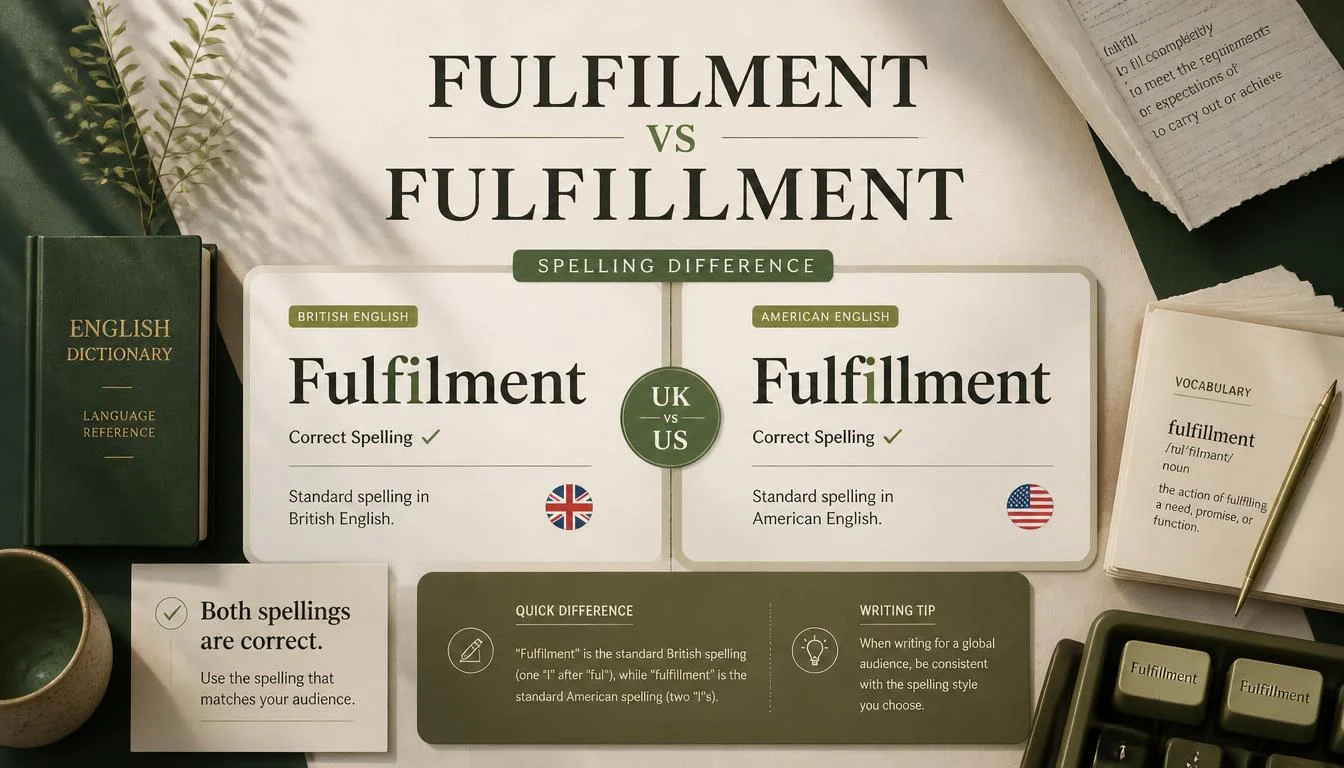
The difference between fulfilment and fulfillment is purely a matter of regional spelling variation. Fulfilment (one ‘l’) is British English, while fulfillment (two ‘l’s) is American English. Both spellings mean exactly the same thing: the act of achieving or completing something. Neither spelling is grammatically incorrect, but using the wrong variant for your audience can affect professional credibility.
You’re in the middle of drafting an important business proposal, and suddenly your spellchecker flags a word you’ve used countless times. Is it fulfilment with one ‘l’ or fulfillment with two? If you’re like most professionals, you’ve probably stopped mid-sentence, stared at the screen, and wondered which version your client, boss, or professor expects to see. This small spelling difference has tripped up everyone from university students to C-suite executives, often at the most inconvenient moments.
The confusion stems from the broader differences between British and American English spelling conventions. These variations appear throughout the language, from colour versus color to organise versus organize. However, the case of fulfilment or fulfillment tends to be particularly tricky because both spellings appear frequently in business, academic, and professional contexts. Using the wrong spelling doesn’t change your meaning, but it can signal inattention to detail or unfamiliarity with your audience’s expectations.
This guide will walk you through everything you need to know about these two spellings. You’ll learn when to use each version, understand why the difference exists, and discover practical strategies for choosing the correct spelling in any context. Whether you’re writing for an international audience, preparing academic work, or simply want to improve your professional writing, this comprehensive guide will help you navigate this common spelling dilemma with confidence.
What’s the Difference Between Fulfilment and Fulfillment?
At its core, the difference between fulfilment and fulfillment is purely regional. Both words function identically in sentences, carry the same meaning, and are recognized by standard dictionaries worldwide. The variation occurs entirely in the spelling of the final syllable, where British English prefers a single ‘l’ and American English uses a double ‘l.
The word itself refers to the process or state of achieving something you’ve worked toward. It captures that satisfying moment when a goal becomes reality, an order is completed, or a promise is kept. In business contexts, it often refers to the completion of customer orders, known as “order fulfilment.” In personal development, it describes the feeling of satisfaction that comes from achieving meaningful goals.
Core Difference Overview
| Aspect | Fulfilment | Fulfillment |
|---|---|---|
| Meaning | The act of achieving or completing something | The act of achieving or completing something |
| Part of Speech | Noun | Noun |
| Refers To | Achievement, completion, satisfaction | Achievement, completion, satisfaction |
| Typical Usage | British English, Commonwealth nations | American English |
| Example | The fulfilment of his ambition was complete. | The fulfillment of his ambition was complete. |
| Common Confusion | Users often don’t know which version to choose for international audiences. | Users often second-guess the spelling when writing for UK or Australian readers. |
Breaking Down the Spelling Difference
The spelling variation follows a common pattern in English where American English doubles consonants when adding suffixes to words ending in a vowel plus a consonant. This pattern appears in words like:
- Travel: travelled (British) vs. traveled (American)
- Cancel: cancelled (British) vs. canceled (American)
- Model: modelled (British) vs. modeled (American)
- Fulfil: fulfilled, fulfilment (British) vs. fulfill, fulfillment (American)
Understanding this pattern helps explain why the difference exists and makes it easier to remember which spelling to use in different contexts. The British prefer to keep the single consonant from the base word “fulfil,” while Americans double the ‘l’ in “fulfill” and maintain that doubling when adding suffixes.
Real-World Implications
Choosing between fulfilment and fulfillment isn’t just about spelling accuracy—it’s about professional communication. For instance, if you’re writing for an American company, using “fulfilment” might appear as a careless error. Conversely, using “fulfillment” for a London-based client could seem like you haven’t bothered to tailor your writing to their expectations.
In digital content, this choice becomes even more significant. Companies that use “fulfillment” in their branding, like Amazon Fulfillment Centers, establish audience expectations. In e-commerce, “order fulfillment” has become an industry standard term, and the preferred spelling often aligns with the company’s target market.
Is This a Grammar, Vocabulary, or Usage Issue?
Understanding whether the fulfilment or fulfillment question falls under grammar, vocabulary, or usage helps clarify why both spellings are considered correct. This distinction is one of usage rather than grammar or vocabulary. Both words exist in standard English dictionaries, both function identically as nouns, and both carry precisely the same definition.
Grammar Classification
From a grammatical standpoint, both spellings represent the same noun. The word can function as:
- A subject: “Fulfillment of customer orders requires careful planning.”
- An object: “She found great fulfillment in her teaching career.”
- An object of a preposition: “The company specialized in order fulfilment.”
Neither variant breaks any grammatical rules. The choice between them has no impact on sentence structure, verb agreement, or any other grammatical consideration.
Vocabulary Classification
In terms of vocabulary, fulfilment and fulfillment are identical lexical items. They share the same root verb (fulfil/fulfill), the same noun-forming suffix (-ment), and the same semantic range. British and American dictionaries recognize both spellings, though each assigns its preferred spelling based on regional conventions.
Usage Classification
The primary distinction falls under usage because the choice depends entirely on regional or stylistic preferences rather than correctness. Usage encompasses the conventions of how language is used in different contexts, regions, and situations.
Formal English:
Both spellings appear in formal writing, but the choice depends on the publication’s style guide. The Oxford English Dictionary lists “fulfilment” as the standard British spelling, while Merriam-Webster lists “fulfillment” as the standard American spelling.
Business English:
Business writing typically follows the spelling conventions of the target audience. If your company uses American English, you’ll write “fulfillment.” If it follows British English, you’ll write “fulfilment.”
Academic Writing:
Universities generally specify a preferred style guide. UK institutions typically follow Oxford or Cambridge style, using “fulfilment.” US institutions follow Chicago or APA style, using “fulfillment.”
Everyday Conversation:
In spoken language, there’s no difference whatsoever. The spelling variation is purely written and never affects pronunciation or comprehension.
One Practical Takeaway
You’re never making a grammatical error when choosing either spelling. The only potential mistake involves selecting the wrong variant for your specific audience. Always consider who will read your document and which English convention they expect.
Understanding Fulfilment (British English)
Fulfilment with one ‘l’ represents the standard spelling in British English and most Commonwealth English-speaking countries. This variant maintains the spelling pattern of the base verb “fulfil,” which has remained relatively unchanged since the word entered English from Old French.
Pronunciation
The word is pronounced /fʊlˈfɪlmənt/ with three syllables. The stress falls on the second syllable, “fil.” Both spellings share this identical pronunciation, so you’ll never hear the difference in spoken conversation.
Part of Speech
Fulfilment functions as a noun. It’s an abstract noun that describes either the act of fulfilling something or the state of being fulfilled.
Common Collocations
Certain words frequently appear alongside fulfilment:
- Order fulfilment
- Self-fulfilment
- Job fulfilment
- Sense of fulfilment
- Career fulfilment
- Relationship fulfilment
- Creative fulfilment
- Personal fulfilment
- Spiritual fulfilment
Typical Sentence Patterns
Fulfilment commonly appears in these structural patterns:
1: Someone finds fulfilment in something.
- “She found deep fulfilment in mentoring young professionals.”
2: Something brings someone fulfilment.
- “Volunteering brought him the fulfilment he had been seeking.”
3: The fulfilment of something.
- “The fulfilment of his lifelong ambition was bittersweet.”
4: Fulfilment comes from something.
- “True fulfilment comes from meaningful relationships, not material possessions.”
Natural Workplace Example
“When the project was finally delivered ahead of schedule, the entire team experienced a profound sense of fulfilment. We had worked through countless obstacles, but seeing the client’s satisfaction made every late night worthwhile.”
Academic Example
“Research consistently demonstrates that individuals pursuing intrinsically motivated goals experience greater psychological fulfilment than those focused primarily on external rewards.”
Technology Example
“The company has developed an automated order fulfilment system that processes over 10,000 shipments daily without human intervention.”
Email Example
Dear Mr. Thompson,
I want to express my sincere gratitude for the opportunity to lead this initiative. The fulfilment I have derived from guiding this team through such challenging work is genuinely beyond measure.
Warm regards,
Sarah
Daily Conversation Example
“Ever since I started that pottery class, I’ve felt this real sense of fulfilment. It’s like I’ve found something that’s just for me.”
One Learner Mistake
Common mistake: Adding a double ‘l’ in British English after adding a suffix.
- Incorrect (British context): “The project brought him great fulfillment.”
- Correct (British context): “The project brought him great fulfilment.”
Mini Recap
Fulfilment with one ‘l’ represents the British and Commonwealth spelling. It follows the pattern of other British English words that maintain single consonants when adding suffixes. Use this spelling when writing for UK, Australian, New Zealand, South African, or other Commonwealth audiences.
Understanding Fulfillment (American English)
Fulfillment with two ‘l’s represents the standard American English spelling. This variant reflects a common American English pattern of doubling consonants when adding suffixes to words ending in a vowel plus a consonant, particularly when the stress falls on the final syllable.
Pronunciation
Fulfillment shares the exact same pronunciation as its British counterpart: /fʊlˈfɪlmənt/. The spelling difference has no effect on how the word is spoken, making it one of those spelling variations that creates confusion primarily in writing.
Part of Speech
Fulfillment functions as a noun, sharing the same grammatical behavior as the British variant. It describes the act of fulfilling or the state of being fulfilled.
Common Collocations
American English uses these common pairings:
- Order fulfillment
- Self-fulfillment
- Job fulfillment
- Sense of fulfillment
- Career fulfillment
- Customer fulfillment
- Personal fulfillment
- Emotional fulfillment
- Creative fulfillment
- Spiritual fulfillment
Typical Sentence Patterns
The same sentence patterns apply in American English:
1: Someone finds fulfillment in something.
- “She found deep fulfillment in her work at the nonprofit.”
2: Something brings someone fulfillment.
- “Running his own business brought him the fulfillment he craved.”
3: The fulfillment of something.
- “The fulfillment of her grandmother’s wishes became her life’s mission.”
4: Fulfillment comes from something.
- “For many people, genuine fulfillment comes from helping others.”
Natural Workplace Example
“After the successful product launch, the marketing team experienced an overwhelming sense of fulfillment. Their months of strategic planning had finally paid off, and the numbers reflected their success.”
Academic Example
“Studies indicate that fulfillment in the workplace correlates strongly with employee retention rates and overall organizational productivity.”
Technology Example
“The company invested significantly in fulfillment technology, implementing AI-powered systems that reduced order processing errors by 85%.”
Email Example
Dear Mr. Davis,
Completing this project on time has been personally rewarding, but the true fulfillment comes from knowing our work will positively impact thousands of users. Thank you for your trust and support.
Best regards,
Michael
Daily Conversation Example
“Honestly, I never expected to find this much fulfillment in teaching. Every time a student has that ‘aha’ moment, I remember exactly why I chose this profession.”
One Learner Mistake
Common mistake: Dropping one ‘l’ in American English.
- Incorrect (American context): “The sense of fulfilment was overwhelming.”
- Correct (American context): “The sense of fulfillment was overwhelming.”
Mini Recap
Fulfillment with two ‘l’s represents the American English spelling. It follows the American pattern of doubling consonants when adding suffixes. Use this spelling when writing for American audiences or when following US style guides.
When Not to Use Each Spelling
Understanding when to avoid each spelling helps prevent embarrassing errors in professional communication. Here are the most common situations where writers choose the wrong variant.
When Not to Use Fulfilment (British Spelling)
1. Writing for American Corporations
If you’re submitting work to a US company like Amazon, Netflix, or any American business, avoid fulfilment. American readers will likely view it as an error.
2. Submitting to US Academic Journals
Most US universities and academic publications require American spelling. Using British spelling in an American academic context can suggest carelessness.
3. Publishing on American-Focused Platforms
If your content targets an American audience through US-based media platforms, fulfillment is always the safer choice.
When Not to Use Fulfillment (American Spelling)
1. Writing for UK Government or Legal Documents
British government bodies and legal institutions typically require British spelling conventions. Using American spelling in these contexts could appear unprofessional.
2. Submitting to British Academic Institutions
UK universities and academic journals expect British English spelling. Your work might be returned for revision if it uses American spelling.
3. Targeting Australian, Canadian, or UK Audiences
These readers expect British English spelling conventions. Although Canadians often accept both, they generally prefer British spelling in formal contexts.
Why the Mistake Happens
Several factors contribute to the confusion:
Exposure to Both Variants: With the globalization of media, most writers encounter both spellings regularly, making it difficult to remember which is appropriate.
Spellchecker Confusion: Your device’s spellchecker might default to one variant, automatically “correcting” the other spelling without alerting you.
Bilingual Uncertainty: Non-native speakers often learn both variants simultaneously without understanding the regional distinction.
Memory Tip
Ask yourself: “Who is my primary reader?” If the answer includes Americans, use two ‘l’s. If it’s anyone from the UK, Australia, New Zealand, or South Africa, use one ‘l’. For international audiences, choose whichever convention you’ve established consistently throughout your document.
Common Mistakes Table
| Correct Sentence | Incorrect Sentence | Explanation |
|---|---|---|
| The company specializes in order fulfillment for e-commerce businesses. | The company specializes in order fulfillement for e-commerce businesses. | Misspelling the word entirely by adding an extra ‘e’. |
| She found great fulfilment in her volunteer work. (UK) | She found great fulfillment in her volunteer work. (UK) | Using American spelling in a British context. |
| His sense of fulfillment came from meaningful relationships. (US) | His sense of fulfilment came from meaningful relationships. (US) | Using British spelling in an American context. |
| Fulfillment of customer orders requires careful inventory management. | Fulfilment of customer orders requires careful inventory management. | Inconsistent spelling within the same document when writing for a US audience. |
| The fulfillment center operates 24 hours daily. | The fulfilment center operates 24 hours daily. | Using British spelling to describe a facility typically associated with American business terminology. |
| This project brings me personal fulfillment beyond expectations. | This project brings me personal fullfilment beyond expectations. | Inserting an extra ‘l’ in the wrong position. |
| Order fulfilment is crucial for customer satisfaction. (UK) | Order fulfilllment is crucial for customer satisfaction. | Adding an unnecessary third ‘l’. |
Quick Decision Guide
Always choose fulfilment (one ‘l’) when:
- You’re writing for a UK-based organization
- Your audience is in Australia, New Zealand, or South Africa
- You’re following Oxford or Cambridge style guides
- You’re publishing in a British or Commonwealth publication
Always choose fulfillment (two ‘l’s) when:
- You’re writing for American audiences
- Your company or clients are US-based
- You’re following Chicago or APA style guides
- You’re publishing in American media
Pro Tip: If you’re writing for an international audience and want to maintain consistency, choose one spelling and use it throughout your document. Inconsistent usage looks far more unprofessional than choosing either variant.
Real-World Examples Across Different Contexts
Office Communication
In a London office, the project manager noted, “The fulfilment of our quarterly targets depends on everyone meeting their deadlines.” Meanwhile, her New York counterpart wrote, “Our team’s fulfillment of the quarterly targets has exceeded expectations.”
Business Email
British example: “Thank you for your assistance with the order fulfilment process. We appreciate your attention to detail.”
American example: “Thank you for your assistance with the order fulfillment process. We appreciate your attention to detail.”
School or University
British university assignment: “This essay examines the concept of self-fulfilment in Victorian literature.”
American university assignment: “This paper explores the concept of self-fulfillment in Victorian literature.”
Customer Support
A British customer support agent writes: “We will confirm when your order has been dispatched. The fulfilment timeline is typically 3-5 working days.”
An American agent writes: “We will confirm when your order has been shipped. The fulfillment timeline is typically 3-5 business days.”
Technology Documentation
British tech company: “The software automates order fulfilment for retail clients worldwide.”
American tech company: “The software automates order fulfillment for retail clients worldwide.”
Artificial Intelligence
Both British and American AI systems recognize both spellings, but they generate responses based on their training data. A British-trained AI might produce “fulfilment,” while an American-trained AI produces “fulfillment.”
Daily Conversation
“I’ve been searching for a career that gives me fulfilment,” said Sarah, who had just moved to London from Manchester.
“I’ve been searching for a career that gives me fulfillment,” said Sarah, who had just moved to Chicago from Boston.
Modern Technology and Digital Considerations
In today’s digital landscape, the fulfilment or fulfillment question takes on new dimensions. From e-commerce platforms to AI writing tools, technology influences how we approach this spelling variation.
Artificial Intelligence and Spellcheckers
Most modern AI writing tools and spellcheckers recognize both spellings as correct. However, they’ll typically suggest the variant matching your device’s language settings. If your computer’s language is set to “English (United States),” your spellchecker will flag “fulfilment” as incorrect and suggest “fulfillment.” The reverse happens with “English (United Kingdom)” settings.
Virtual Assistants
Voice assistants like Siri, Alexa, and Google Assistant all recognize both spellings when you speak the word aloud. However, when displaying text responses, they’ll use the spelling based on their regional settings.
Chatbots
Business chatbots often use language specific to their intended audience. An e-commerce company serving both US and UK customers might need to customize their chatbot responses based on the user’s location.
Software Localization
Professional software and business tools increasingly offer localization options. This means you can set your language preferences to ensure all interface text matches your expected spelling conventions.
E-Commerce and Order Fulfillment
In e-commerce, “order fulfillment” has become standard terminology. Interestingly, many international companies now use the American spelling “fulfillment” even in British contexts because of the dominance of US-based platforms and marketplaces.
Word Origin and Language History
Understanding the history of these spellings provides useful context for remembering when to use each variant.
The word comes from the Old English “fullfyllan” meaning “to make full,” which combined “full” with “fyllan” meaning “to fill.” This evolved into the Middle English “fillen” and eventually into the modern forms “fulfil” and “fulfill.
The spelling divergence between British and American English began in the late eighteenth and early nineteenth centuries. Noah Webster, the American lexicographer, promoted simplified spellings to distinguish American English from British English. His reforms included dropping silent letters, simplifying double consonants in certain cases, and standardizing spellings that seemed inconsistent.
For words ending in a vowel plus a consonant, Webster generally recommended maintaining the spelling pattern when adding suffixes. However, “fulfill” proved to be one of those cases where his recommendations produced a consistent pattern: if the base word ends with a double consonant, keep it throughout its derivatives.
Meanwhile, British English maintained more traditional spellings, including preserving the single ‘l’ in “fulfil” and its derivatives. This pattern appears in other words where the British prefer single consonants in derived forms.
Expert Insight: Understanding Regional Spelling with Confidence
As an English language educator with years of experience helping international professionals improve their business writing, I’ve noticed that regional spelling variations like fulfilment versus fulfillment create disproportionate anxiety among learners. Many students worry that choosing the “wrong” spelling will make them appear foolish or unprofessional.
Here’s the truth: neither spelling is wrong. The only mistake you can make is being inconsistent or failing to consider your audience’s expectations. Think of it like choosing between wearing a suit to a formal meeting versus business casual attire—both are acceptable in different contexts. The key is reading the room.
When I work with professionals transitioning between UK and US markets, I encourage them to focus on audience awareness rather than perfection. Set your spellchecker to the variant you need most often. If you’re writing for multiple audiences, create separate documents or use language settings specific to each project. This small adjustment eliminates the guesswork and ensures consistent spelling.
Remember: native speakers frequently encounter the “other” spelling in daily life. We see American spellings in British media and vice versa. So while maintaining consistency is important, a single instance of the “wrong” spelling won’t undermine your credibility nearly as much as inconsistent use throughout a document.
Error Prevention Checklist
Always use fulfilment when:
- Your audience is in the United Kingdom
- Your audience is in Australia, New Zealand, or South Africa
- You’re following British English style guides
- You’re writing for a Commonwealth publication
- You’re using Oxford or Cambridge spelling conventions
Always use fulfillment when:
- Your audience is in the United States
- You’re following American English style guides
- You’re writing for US-based publications
- You’re using Chicago, MLA, or APA style guides
- You’re targeting an American market
Never confuse them if:
- You’ve established which variant your document uses
- You’ve set your spellchecker to the correct language variant
- You’ve reviewed your document for consistency
- You know your audience’s location and expectations
Quick memory tip: Consider the ‘U’ in fulfilment as standing for “United Kingdom” and the ‘LL’ in fulfillment as standing for “Language Lovers” in the United States. These silly memory tricks often help learners distinguish between the two spellings.
Related Grammar and Vocabulary Confusions
Here are eight related spelling and vocabulary comparisons worth learning alongside fulfilment vs. fulfillment:
1. Colour vs. Color – The British ‘u’ appears in many words where American English drops it. Master this pattern to avoid common spelling errors.
2. Centre vs. Center – Another British-American spelling variation that follows a consistent pattern worth memorizing.
3. Organise vs. Organize – British and American spelling conventions differ on -ise versus -ize endings, affecting hundreds of words.
4. Travelled vs. Traveled – This follows the same double ‘l’ pattern as fulfilment and is equally common in professional writing.
5. Cancelled vs. Canceled – Another double consonant variation that often confuses writers and follows the same rules.
6. Practice vs. Practise – Unlike fulfilment, this pair differs in meaning, making it a more complex usage issue.
7. Program vs. Programme – This variation changes based on both region and context, appearing in technology and entertainment.
8. License vs. Licence – Another noun-verb distinction that differs between British and American usage patterns.
Learning these comparisons alongside fulfilment vs. fulfillment helps build a comprehensive understanding of British-American spelling conventions.
FAQs
Is fulfilment or fulfillment correct?
Both spellings are correct. The choice depends on the English variety you are using. Fulfilment is preferred in British English and many Commonwealth countries, while fulfillment is the standard spelling in American English. Neither spelling is grammatically incorrect.
What is the difference between fulfilment and fulfillment?
There is no difference in meaning or pronunciation. The only difference is the spelling. Fulfilment follows British English conventions, while fulfillment follows American English conventions, similar to differences such as colour and color or centre and center.
Which spelling is used in the UK?
In the United Kingdom, fulfilment is the preferred spelling. It is commonly used in British business writing, media, government communication, legal documents, and academic publications.
Which spelling is used in the US?
In the United States, fulfillment is the standard spelling. You will commonly see it in American business writing, educational materials, government documents, and professional publications.
What is the correct spelling for business writing?
Choose the spelling that matches your target audience. Use fulfilment for UK, Australian, New Zealand, and many other Commonwealth audiences. Use fulfillment for US audiences. If you are writing for an international audience, choose one spelling system and use it consistently.
Is the spelling changing over time?
The American spelling fulfillment is increasingly visible in international digital and business communication, partly because of the influence of American companies and online content. However, fulfilment remains the established preference in British English and continues to be widely used in professional writing.
Conclusion
The difference between fulfilment and fulfillment comes down to a single letter, yet this small variation causes outsized confusion for writers around the world. Understanding that both spellings are correct, and that your choice depends on your audience’s expectations, transforms this spelling dilemma from a source of anxiety into a simple decision-making process.
Remember that consistency matters more than which variant you choose. If you’re writing for a British audience, use fulfilment throughout your document. For an American audience, use fulfillment. And if you’re writing for an international audience, select the variant that aligns with your organization’s standard practices or the expectations of your primary readers.
The next time you hesitate while typing fulfilment or fulfillment, think about your reader. Consider whether they expect British or American spelling conventions. Then write with confidence, knowing that whichever spelling you choose, your meaning remains clear and your grammar remains correct. This small but important distinction is one more tool in your professional writing toolkit, helping you communicate effectively with any audience.
Read More Related Articles:
- Cacoon or Cocoon | Simple Rule You’ll Never Forget In 2026
- Shiny or Shiney | Avoid This Simple Spelling Error in English In 2026
- Occasion or Ocassion | Common Mistake Explained with Real-Life Examples In 2026

Caleb Dawson is a content writer at synoseek.com, where he works on simple, reader-focused articles across a range of everyday topics. His writing style is practical and grounded, aiming to present information in a clear and relatable way without unnecessary complexity.
1 thought on “Fulfilment or Fulfillment | Ultimate Spelling Guide for Professionals In 2026”